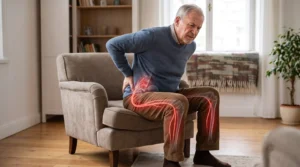
Expert Review: This article includes clinical insights from Dr. Vivek Arora, a physical therapist (physiotherapist) with 20+ years of experience.
If you are also considering a glide, read about sciatic nerve glides and when to stop a stretch.
Ask the internet is walking good for sciatica and you will get an unusually confident yes, usually accompanied by an instruction to walk thirty minutes a day. Ask someone three days into a genuine flare, halfway down the street with their leg on fire, and the answer feels considerably less obvious. Both experiences are real, and the gap between them is the interesting part.
Walking can be a manageable activity for some people with sciatica, but it is not mandatory or proven to speed nerve recovery. The right activity depends on symptoms, balance, other health conditions and your goals.
Key takeaways
- Walking is one activity option when appropriate. It is not universally safe or superior, and warning signs take priority.
- The evidence for staying active is stronger for ordinary low back pain than for sciatica specifically — an honest distinction most articles skip.
- Shorter bouts may be easier during a flare, but five-to-ten-minute walks have not been shown to outperform one longer walk for everyone.
- Your response helps adjust the activity. It is not a diagnostic test, a healing measure or an automatic green light.
- Walking-related leg pain relieved by rest or leaning forward can have spinal, vascular or other causes and deserves assessment rather than self-diagnosis.
Is walking good for sciatica?
Walking may help you maintain daily activity and fitness if you can do it safely and comfortably. It is not automatically the safest starting exercise, and the evidence does not establish that it accelerates sciatica recovery.
Walking may help maintain or build general activity and fitness when appropriate. It is not a treatment that can be promised to remove nerve compression or cure sciatica, and another activity may suit a person better.

What does the evidence actually say?
The evidence supports staying active over resting in bed, but it is noticeably stronger for general low back pain than for sciatica. A Cochrane systematic review comparing advice to rest in bed with advice to stay active found that people with acute low back pain may get small benefits in pain and function from staying active — while for people with sciatica, there was little or no difference between the two approaches.
That finding surprises people, so it is worth being precise about what it does and does not mean. It does not mean bed rest is a good idea — nothing in that comparison showed rest to be superior, and the wider consequences of prolonged rest, from muscle loss to low mood to reduced fitness, sit outside what these trials measured. What it means is that the specific claim “staying active makes sciatica resolve faster” is not well supported by trials directly comparing the two, even though it is repeated constantly.
Clinical guidance encourages tailored self-management and continuation of normal activities where possible. That supports choosing a manageable activity, but it does not prescribe walking as a nerve treatment or prove that every period of rest worsens sciatica.
Choose walking if it suits your needs and response, or another suitable activity if it does not. There is no requirement to walk through a flare or to meet a four-to-six-week recovery target.
Why does walking help some people and flare others?
Different conditions and activity tolerances can produce different walking responses. Spinal posture may matter for some people, but walking does not uniformly extend the spine or reliably unload a disc-related nerve root.
Walking involves repeated movement and muscle activity. Claims that it shifts a disc away from a nerve, frees a “sticky” nerve or flushes inflammatory chemicals have not been established as explanations for an individual’s symptom response.
Symptoms eased by sitting or leaning forward can occur with spinal stenosis, while leg pain relieved by rest can also reflect circulation problems. Do not diagnose the cause or assume it is harmless from a shopping-cart response.
Use a comfortable pace and support if you need it. A guarded gait may reflect pain or balance concerns rather than a harmful habit. The guide to back pain while walking offers related context.
What is your walking response telling you?
Observe symptoms during and after an activity to help adjust it and describe the pattern to a clinician. A ten-minute walk is not a validated diagnostic test and is not required if walking is difficult or unsafe.
| Observation | What it can tell you | Reasonable response |
|---|---|---|
| Symptoms ease or remain manageable | The activity may be tolerable | Continue or adjust gradually; this does not confirm a diagnosis |
| Back or leg symptoms change location | A response worth describing | Consider pain, function and neurological findings together |
| Symptoms build with distance and ease with rest | Several spinal or vascular causes are possible | Arrange assessment rather than self-diagnosing stenosis |
| Symptoms remain worse afterward | The current activity may need adjustment | Reduce or change it; seek review if persistent |
| Foot drags or leg gives way | Possible weakness or balance problem | Urgent assessment for new or worsening weakness |
| Cold, pale, numb limb with sudden severe pain | Possible circulation emergency | Seek emergency care now |
How much should you walk, and how fast?
Start with a duration and pace you can manage safely, which may be much shorter than five minutes. Short bouts are an option, but there is no validated universal number of daily walks or ten-to-twenty-percent weekly progression rule for sciatica.
Adjust one aspect at a time according to symptoms, function and the assessment rather than following compulsory steps.
- Start with a manageable amount: Choose a safe setting and support. Your pre-flare distance is not an obligation.
- Respond to worsening symptoms: Shorten or stop a walk if symptoms progressively worsen or balance changes. A symptom appearing does not prove that walking is teaching the nervous system fear.
- Try shorter bouts if useful: These may be easier to tolerate, but are not proven superior to a longer walk for every person.
- Increase gradually: Consider the immediate and later response without a mandatory weekly increment.
- Adjust pace and terrain: Pick what suits comfort, balance and the environment; there is no required order for everyone.
- Review a setback: Reduce or change the activity if needed. New weakness or significant sensory change requires assessment rather than simply waiting four or five days.
Quick check: is walking working for you?
Use a walk only if appropriate and manageable, then reflect on these observations. This is not a validated score and three “yes” answers do not certify that walking is safe or therapeutic.
- During the walk, did your leg symptoms stay the same or improve?
- Did the furthest point of your pain stay put or move up the leg rather than down?
- Two hours later, were symptoms no worse than before you set off?
- The next morning, was stiffness the same or better than the previous day?
- Did you feel steadier on your feet at the end than at the start?
If walking repeatedly aggravates symptoms, feels unsafe or function is deteriorating, change the activity and seek assessment. You do not have to keep walking because a checklist says so.
Which walking mistakes make sciatica worse?
A flare after walking can have several explanations. It should not automatically be blamed on a wrong dose or technique.
- Exceeding your current tolerance: A long walk may be difficult during a flare. Try less if helpful, without assuming a fixed duration injured or inflamed a nerve.
- Pushing through sustained worsening: Adjust activity if symptoms steadily increase or function worsens. New weakness deserves urgent assessment, not a walking-dose experiment.
- Avoiding support you need: Treadmill handrails or an appropriate walking aid can improve safety. Do not abandon them or walk outdoors unsupported to preserve arm swing. Choose an environment and support appropriate to your balance.
- Ignoring a difficult transition: After sitting, stand and start at a manageable pace if comfortable. Sitting does not prove the disc or nerve is at its least tolerant. See back pain while driving for general adjustments.
- Using one activity for every goal: Walking can improve fitness, while other activities may better address strength or specific tasks. Additional exercises should match your needs rather than an assumption that every walking-only plan stalls.
When is walking not the right first move?
A small set of situations call for assessment rather than a walking program, because they suggest the problem is not simply an irritable nerve root that needs time and movement.
- Any change in bladder or bowel control, or numbness in the saddle area — the groin, genitals or inner thighs. This suggests compression of the nerve bundle at the base of the spine and requires emergency assessment now; no exercise plan applies until that is excluded.
- New or worsening weakness, a dragging foot or a leg giving way needs urgent medical assessment. Several spinal or peripheral causes are possible; do not exercise around it.
- New sciatic pain down both legs, or severe or worsening weakness or numbness in both legs, needs emergency care now.
- Leg pain predictably triggered by walking and relieved by rest needs assessment for spinal, vascular and other causes. It is not automatically harmless. Sudden severe leg or foot pain with a cold, pale or numb limb needs emergency assessment.
- Fever, unexplained weight loss, night pain unrelieved by any position, or a history of cancer alongside the leg pain, all of which shift the priority toward excluding other causes first.
Three claims about walking worth retiring
- “Ten thousand steps will clear sciatica.” A general step target is not a validated rehabilitation dose. Choose manageable activity with suitable support and adjust to symptoms, function and clinical advice.
- “Any walking pain proves worsening damage.” Pain does not directly measure damage, but intensity, function, neurological changes and the overall pattern all matter; the direction of pain alone is not a safety rule.
- “Walking can meet every rehabilitation goal.” It can build fitness and activity tolerance, but some people need additional strength or task-specific work. No single exercise mix guarantees prevention.
From the Clinic: Dr. Arora’s Expert Insight
Walking may suit one person and aggravate another. Review the setting, pace, duration, support and possible diagnosis rather than declaring the idea right and the dose wrong in every case.
Check symptoms and function both during and after activity. A later flare does not automatically show a delayed inflammatory reaction or prove that halving a dose will solve it.
Walking can build fitness rather than merely preserve it. Additional exercises may help meet lifting, work or sport goals, but they should be selected individually rather than required for every person with sciatica.
What should walking be combined with?
Combine activities according to the assessment and your goals. Walking, comfortable position changes and strengthening are possible options, not three obligatory components that everyone must complete.
Directional exercises may be considered after assessment if they help, but backward arching is not a default first-week prescription. A supported reclined position is an optional comfort measure rather than a proven way to offload the pain source.
Strengthening can start at an appropriate level without requiring pain to retreat above the knee. Consider neurological status, function and response; the guides to piriformis versus spinal sciatica and possible sciatica symptoms explain assessment limitations.

Do’s and don’ts for walking with sciatica
- Choose a surface and route that suit your balance and symptoms. Flat even ground may be easier for some people, without a compulsory first-week terrain rule.
- Let the arms move comfortably when practical, but use handrails or a walking aid when needed for safety.
- Consider both the immediate response and how you feel later or the next day, alongside function and neurological symptoms.
- Reduce or share a load if it aggravates you; asymmetric carrying is not automatically harmful.
- Do not force a stretch that increases leg symptoms. There is no established ranking of hamstring stretching as the most common cause of setbacks.
- Return to running depends on the assessment, symptoms, strength, balance and activity demands. Thirty symptom-free walking minutes and a loaded hinge are not universal clearance tests.
What if walking is not helping at all?
Seek review if symptoms are worsening, limiting normal activity or not improving after a few weeks. The assessment should consider nerve, hip, vascular and other causes rather than automatically prescribing a preferred direction or stronger glutes.
Specialist options depend on the cause and severity. Selected severe acute sciatica may justify an epidural discussion; persistent disabling symptoms with matching imaging may justify decompression. New or worsening weakness needs urgent assessment and emergency signs should never wait for walking to fail.
Seek care if…
- Walking now brings on leg symptoms that were not there last week, or your walking distance is shrinking rather than growing.
- A new or worsening foot drag, loss of push-off or leg weakness needs urgent medical assessment.
- New sciatic pain down both legs needs emergency care now.
- Two to three weeks of consistent walking and self-care have changed nothing.
- Any bladder, bowel or saddle-numbness change — stop and seek emergency care now.
Conclusion
Is walking good for sciatica? It can be a useful activity option when it is safe and manageable. Trials do not establish that walking itself accelerates nerve recovery, identify a universal dose or guarantee that a flare will resolve within four to six weeks.
Choose an activity and support that fit your circumstances, adjust to symptoms and function and seek assessment when needed. New weakness, new bilateral sciatic pain, saddle numbness or bladder/bowel changes override the walking plan.
Related reading: when new sciatica in both legs needs emergency care.
Related reading: how sciatica symptoms may change over time.
Frequently asked questions
How far should I walk with sciatica?
There is no universal distance or step target. Start with a manageable amount, which may be shorter than five minutes, and adjust to the response and your balance. A ten-percent weekly increase is not a validated rule for sciatica.
Is walking better than stretching for sciatica?
Neither is universally better. Walking and selected exercises can be options when appropriate; avoid forcing a stretch or walk that causes sustained worsening, and seek assessment for new neurological changes.
Why does my sciatica hurt more after walking, not during?
Symptoms can fluctuate during or after activity for several reasons. A delayed flare does not establish inflammation or prove the dose was wrong. Adjust the plan and seek review if symptoms persist or worsen.
Should I walk on a treadmill or outside?
Either may suit you. Choose a safe setting, use handrails or an appropriate aid if needed, and adjust pace or incline to your response. There is no proven best one-to-two-percent incline or reason to reject necessary support.
Can I walk if I have numbness in my foot?
It depends on the cause, severity, strength and balance. Discuss persistent numbness and take care with footing; new or spreading sensory changes or weakness need earlier assessment. Do not treat stable numbness as automatic walking clearance.
When can I go back to running?
Use an individualized return based on symptoms, strength, balance, function and clinical findings. A walk-jog progression may suit some people, but six to twelve weeks or a 30-minute walk is not a universal gate.
Is walking safe with sciatica during pregnancy?
Walking may be appropriate in an uncomplicated pregnancy, but pelvic or leg pain is not automatically sciatica. Discuss new pain, numbness, weakness or activity restrictions with your maternity team; follow the urgent guidance for neurological warning signs.
Medical disclaimer
This article provides general activity information rather than an individual prescription. Walking tolerance depends on diagnosis, neurological function, balance and other health conditions. Get emergency care now for new difficulty passing or controlling urine, loss of bowel control or sensation, numbness around the genitals or anus, or new sciatic pain down both legs. Severe or worsening weakness or numbness in both legs also needs emergency care. Get urgent medical assessment for new or worsening weakness in one leg.
References
- Dahm KT, Brurberg KG, Jamtvedt G, Hagen KB. Advice to rest in bed versus advice to stay active for acute low-back pain and sciatica. Cochrane Database of Systematic Reviews. 2010;(6):CD007612. https://doi.org/10.1002/14651858.CD007612.pub2
- National Institute for Health and Care Excellence. Low back pain and sciatica in over 16s: assessment and management (NG59). Recommendations on assessment, imaging and management.
- NHS. Sciatica. Symptoms, activity advice and emergency warning signs.
- NHS. Peripheral arterial disease. Walking-related leg symptoms and assessment.
- NSW Agency for Clinical Innovation, Emergency Care Institute. Acute limb ischaemia. Emergency warning signs.