Expert Review: This article includes clinical insights from Dr. Vivek Arora, a physical therapist (physiotherapist) with 20+ years of experience.
Leg pain has a way of hijacking your attention. One moment you are reaching for a dropped set of keys, the next a hot line of pain is running from your buttock down the back of your thigh, and your first thought is rarely calm. So let’s answer the question directly. What does sciatica feel like? At its core it is nerve pain that travels — a shooting, burning, or electric sensation that follows a defined path down one leg, often mixed with tingling, numbness, or a leg that feels oddly weak. It is not the same as an ordinary sore lower back, and knowing the difference changes what you do next.
This guide walks through the seven sensations that most reliably point to sciatica, why the pain behaves the way it does, how to separate it from look-alikes such as hip and buttock pain, and — importantly — the small number of symptoms that mean you should stop reading and get assessed the same day.
Key takeaways
- Sciatica is a symptom, not a diagnosis — it describes irritation of a lumbar nerve root or the sciatic nerve, most often from a bulging or herniated disc.
- The hallmark is pain that radiates down one leg, frequently below the knee, rather than staying parked in the lower back.
- Tingling, numbness, and a burning or electric quality are common; genuine leg weakness deserves closer attention.
- Most cases settle substantially within four to six weeks with sensible movement and load management.
- A few symptoms — loss of bladder or bowel control, numbness around the groin — are emergencies and override everything else here.
What does sciatica actually feel like?
Sciatica typically feels like a sharp, shooting, or burning pain that starts in the lower back or buttock and travels down the back or side of one leg, often past the knee toward the calf or foot. Many people also notice tingling, patches of numbness, or a sense that the leg is heavy or unreliable. The pain tends to be one-sided and is frequently worse when sitting, bending forward, or straining.
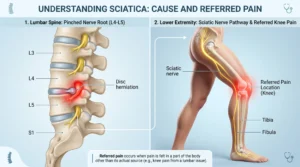
The word itself simply means pain in the distribution of the sciatic nerve — the largest nerve in the body, formed from lower lumbar and upper sacral nerve roots. When one of those roots is irritated where it exits the spine, the brain interprets the signal as coming from wherever that nerve travels. That is why a problem in your back announces itself in your shin or your foot. The leg is the messenger, not the culprit.
What are the 7 sensations that confirm it is sciatica?
No single sensation proves sciatica on its own, but the pattern is recognizable. If several of the following show up together on the same side, sciatica moves to the top of the list.
- Radiating pain that travels down the leg. The signature feature. Pain that clearly moves from the buttock into the thigh and past the knee is far more telling than pain that stays local.
- An electric, shooting, or burning quality. Nerve pain rarely feels like a dull muscular ache. People describe lightning, a hot wire, or a zap.
- Pins and needles. A tingling, buzzing, or “fizzing” strip along the leg or into specific toes, tracking the nerve rather than spreading evenly.
- Numbness or reduced feeling. A patch of skin on the calf, the outer shin, the sole, or the toes that feels muffled, like a partial dental freezing.
- Leg heaviness or weakness. The thigh tires quickly, the foot catches on steps, or pushing off feels underpowered. This one earns more respect than pain alone.
- A jolt when you cough, sneeze, or strain. These briefly raise pressure around the nerve root, and a sudden spike down the leg is a classic tell — the same reason a sharp jolt in the back when you sneeze is worth paying attention to.
- A stubbornly one-sided pattern. Sciatica almost always picks one leg. Pain in both legs at once is a different, less common situation that deserves a proper look.
Why does sciatica feel the way it does?
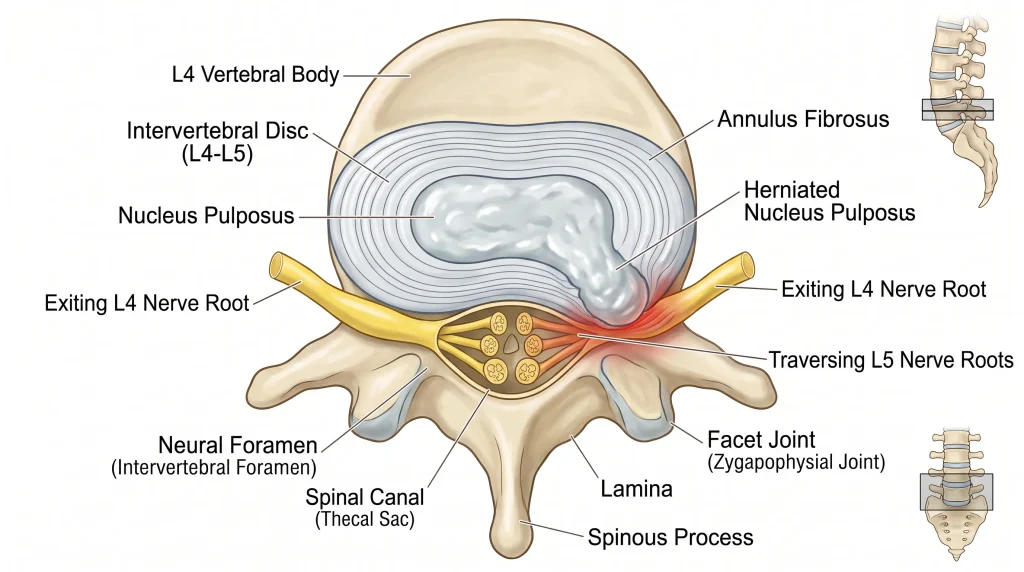
Sciatica feels sharp and travelling because the problem sits at a nerve root, not in the muscle where you feel it. A disc that bulges or herniates can press on and chemically inflame the nearby root as it leaves the spine. The nerve, now irritated, fires abnormal signals that your brain maps onto the leg — producing pain, tingling, or numbness along that nerve’s territory rather than at the actual site of trouble.
Anatomy makes this vivid. Each lumbar nerve root threads through a narrow bony gap and sits close to the back of a disc. Bend, lift, and slump repeatedly and the disc’s outer wall can weaken; its softer center can push backward toward that gap. Sitting and forward bending load the front of the disc and nudge its contents further back — which is exactly why sciatica often bites hardest in a low car seat or a slumped desk chair. Stand up, walk, and gently arch, and many people feel the pressure ease. Pain that changes with position is a strong clue that mechanics, not menace, are driving it.
How is sciatica different from ordinary back or hip pain?
The quickest way to tell them apart is to ask where the pain lives and how it travels. Mechanical back pain and hip pain tend to stay put and feel achy or stiff. True sciatica moves down the leg and carries nerve symptoms — tingling, numbness, or an electric edge. The table below lays out the patterns clinicians actually use.
| Feature | Sciatica (nerve root) | Muscular / mechanical back pain | Hip or buttock pain |
|---|---|---|---|
| Where you feel it | Buttock into the leg, often below the knee | Across the lower back, may spread to the top of the buttock | Groin, outer hip, or deep in the buttock |
| Quality | Sharp, burning, electric, shooting | Dull, achy, tight, stiff | Aching, catching, sometimes clicking |
| Nerve symptoms | Tingling, numbness, weakness common | Usually none | Usually none |
| Worse with | Sitting, bending, coughing, sneezing | Prolonged postures, first thing in the morning | Weight-bearing, stairs, crossing the legs |
| Travels below the knee? | Often yes | Rarely | Rarely |
Two overlaps trip people up. Tight, irritable glute muscles can mimic a deep buttock ache and even refer pain into the thigh, which is why tight glutes and lower back pain are so often tangled together. And hip joint problems can send pain toward the thigh, so working out whether leg pain is coming from the hip or the back is a routine but important step. The distinguishing thread is simple: genuine sciatica usually brings nerve symptoms and travels past the knee; hip and muscle problems usually do neither.
When is sciatica a red flag?
Most sciatica is uncomfortable but not dangerous. A small set of symptoms, however, can signal pressure on the bundle of nerves at the base of the spine — a condition called cauda equina syndrome — or another serious cause. These are not “wait and see” situations. If any of the following appear, treat it as an emergency and seek immediate medical care.
- New difficulty controlling your bladder or bowel, including leaking, or being unable to pass urine. This is the single most important warning sign because delayed treatment can cause permanent damage.
- Numbness around the groin, genitals, or inner thighs — the “saddle” area you would sit on. Reduced sensation when wiping after the toilet counts.
- Weakness spreading in both legs, or a foot that suddenly cannot lift properly (a foot that slaps or drags).
- Fever, night sweats, or unexplained weight loss alongside the back and leg pain, or a history of cancer, which can point to infection or other pathology.
- Severe pain after a significant fall or accident, where a fracture needs to be ruled out.
Each of these matters because it suggests the problem may be more than an irritated single nerve root. When the nerves that control the bladder, bowel, and both legs are involved, the clock starts ticking — which is why this list overrides the reassurance in the rest of this article.
When do you actually need an MRI?
Most people with sciatica do not need a scan, at least not at first. Imaging rarely changes early management, and MRIs of pain-free adults routinely show disc bulges that cause no symptoms — so a scan can easily reveal a “finding” that has nothing to do with your pain and simply frightens you. Guidance from bodies such as the UK’s National Institute for Health and Care Excellence discourages routine imaging for low back pain and sciatica unless the result would change treatment.
An MRI becomes genuinely useful in three situations: when red-flag symptoms suggest something serious, when severe or worsening weakness raises the question of significant nerve compression, or when pain has not improved after a fair trial of conservative care and you are actively considering an injection or surgery. In other words, imaging is ordered to answer a decision, not to satisfy curiosity. If your symptoms are settling week to week, a scan usually adds cost and anxiety without adding value. It can be worth understanding what common MRI findings such as stenosis actually mean before assuming the picture explains everything.
Myths worth putting down
A few beliefs make sciatica harder than it needs to be. Clearing them out early tends to speed recovery.

- “The pain means my disc is crumbling.” Discs are living tissue that heal. The herniated material that irritates a nerve often shrinks and is reabsorbed over weeks to months, which is part of why symptoms fade.
- “I should lie flat until it stops.” Extended bed rest tends to make sciatica worse, not better. Gentle, frequent movement keeps the nerve mobile and the muscles from stiffening.
- “Bad pain equals bad damage.” Nerve pain is loud by design. Intensity reflects how irritated the nerve is, not how badly you are injured.
- “A scan will finally explain everything.” As above, images often show changes that are common in comfortable backs too. The story your symptoms tell usually matters more than the picture.
From the Clinic: Dr. Arora’s Expert Insight
If I had to name the thing people get wrong most often about leg pain, it wouldn’t be the anatomy — it’s the assumption that the leg is the problem. Someone arrives convinced the trouble is in their calf or their foot because that is where it screams, and they have spent weeks massaging, stretching, and rolling the exact spot that is only relaying the message. A pattern that comes up repeatedly is a person who has been chasing the symptom down the leg while the irritated nerve root in the back goes unaddressed.
The other place generic advice quietly fails is the “just rest it” instinct. With most strains, backing off works. With sciatica, prolonged stillness tends to let the nerve become stickier and more sensitive, so the first few careful movements each morning hurt more, which convinces the person to move even less — a loop I see often. What tends to work better is the opposite of dramatic: small, frequent, tolerable movement, positions that calm the leg symptoms rather than provoke them, and patience with a nerve that recovers on its own timeline. When people stop fighting the leg and start respecting the back, the whole thing usually starts to turn.
What can you do in the first 72 hours?
In the first few days, the goal is not to “fix” sciatica but to calm the nerve and keep moving within comfort. Stay gently active, change position often, use short walks to break up sitting, and find one or two positions that ease the leg symptoms. Most people do not need to escalate care in this window; they need to avoid the two extremes of total rest and aggressive stretching.
What to do today
- Keep moving in small doses. A few minutes of easy walking every hour beats one long walk or none at all.
- Break up sitting. If a chair lights up your leg, stand and gently arch backward a few times, or work standing for short spells.
- Find your easing position. Lying on your back with knees supported, or lying face-down propped on your forearms, relieves the leg for many people. Use what calms the symptom.
- Use short-term pain relief sensibly if appropriate for you, so you can keep moving — movement is the actual treatment.
- Protect your sleep. A pillow between or under the knees often takes the edge off overnight.
What does a sensible rehab progression look like?
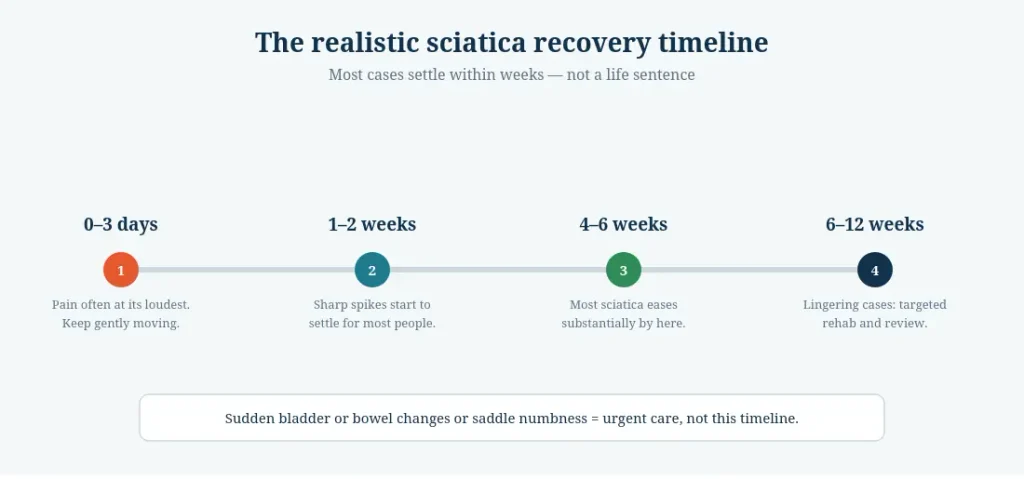
Recovery works best in phases, and the trigger to advance is your symptoms, not the calendar. The rule of thumb clinicians use is centralization: movements that pull the pain out of the leg and back toward the spine are moving you in the right direction, even if the back itself feels a little more worked. Movements that push pain further down the leg are a signal to ease off.
| Phase | Rough timing | Main goal | What it looks like | Ready to progress when… |
|---|---|---|---|---|
| 1. Calm it down | Days 0–7 | Settle nerve irritation | Frequent easy walking, position changes, gentle movements that draw symptoms out of the leg | Leg pain is easing and staying closer to the back |
| 2. Restore movement | Weeks 1–3 | Regain pain-free range | Gentle directional exercises, nerve-gliding movements, hip and trunk mobility within comfort | You can sit and bend with far less leg symptom |
| 3. Rebuild capacity | Weeks 3–6 | Strength and load tolerance | Progressive hip hinge, glute and trunk strengthening, graded return to lifting and daily tasks | Strength feels even side to side and daily loads are comfortable |
| 4. Return to full activity | Weeks 6+ | Confident loading and sport | Sport- or job-specific movements, heavier lifting, impact reintroduced gradually | You trust the leg under speed and load |
A structured set of home exercises for the lower back can carry you through much of this, provided you let the leg symptoms — not ambition — set the pace.
Do’s and don’ts specific to sciatica
- Do favor gentle back-arching (extension) positions if they draw pain out of the leg; many disc-related cases respond well to this direction.
- Do keep walking, even short loops, to keep the nerve mobile.
- Don’t chase deep forward-bending hamstring stretches early — pulling on an already-irritated nerve often flares it.
- Don’t sit through rising leg pain to “push past it.” With nerve pain, that usually backfires.
- Don’t spend days in bed. Stillness is the one thing sciatica reliably dislikes.
When does conservative care fail, and is surgery ever needed?
For most people, conservative care wins, and it does so within weeks. Surgery is considered only in a minority: when severe or progressing weakness signals meaningful nerve compression, when any red-flag emergency is present, or when genuinely disabling leg pain has not responded to a fair trial — usually six to twelve weeks — of well-directed rehab, and imaging confirms a compressive cause that matches the symptoms. Even then, a procedure such as a microdiscectomy is aimed squarely at the leg pain from nerve compression, not at back pain in general. The decision belongs with a spine specialist who can weigh your specific pattern, and it is a decision, not a default.
Seek care promptly if…
- Leg weakness is getting worse rather than better, or your foot is starting to drag.
- Pain is severe and unrelenting despite a couple of weeks of sensible self-care.
- Symptoms are creeping into both legs.
- You develop any bladder, bowel, or saddle-numbness changes — this one means the same day, not next week.
What is the realistic outlook?
The outlook for sciatica is genuinely reassuring. Most episodes improve markedly within four to six weeks, and the majority resolve without injections or surgery even when the early pain is fierce. Recurrences can happen, and building hip and trunk strength plus sensible lifting habits lowers the odds. So to close the loop on the question we started with — what does sciatica feel like — it feels alarming precisely because it is nerve pain, but that same nerve is usually on a path to settle. Understanding the pattern, respecting the red flags, and keeping gently active is most of the battle.
Frequently asked questions
What does sciatica feel like when it first starts?
It often starts as a deep ache in the buttock or lower back that begins sending sharp, shooting, or tingling sensations down one leg, especially when you sit, bend, or get up from a chair. Early on the leg symptoms may come and go before becoming more constant, which is why the travelling quality is a better early clue than pain severity.
How do I know if it is sciatica or just a pulled muscle?
A pulled muscle usually stays local, feels like a dull ache or tightness, and lacks nerve symptoms. Sciatica travels down the leg, frequently below the knee, and brings tingling, numbness, or a burning, electric quality. If coughing or sneezing sends a jolt down your leg, that points strongly to nerve involvement rather than a muscle.
Can sciatica cause numbness and tingling without much pain?
Yes. Some people mainly notice tingling, a strip of numbness, or a heavy, unreliable leg rather than severe pain. This still reflects nerve irritation and is worth monitoring, especially if the numbness or weakness is spreading rather than fading.
Is it safe to walk and exercise with sciatica?
For most people, yes — gentle walking and movement help more than rest. The guide is your leg symptoms: activity that keeps pain closer to the back or leaves it unchanged is fine, while movements that steadily drive pain further down the leg should be eased off. Deep forward-bending stretches are best avoided early.
How long does sciatica usually last?
Most cases improve substantially within four to six weeks, and many resolve completely without surgery. A minority linger longer and benefit from structured rehab. Persisting or worsening weakness, rather than pain that is slowly settling, is the reason to seek a closer look.
Will I need surgery for sciatica?
Almost certainly not. The large majority recover with conservative care. Surgery is reserved for severe or worsening nerve weakness, emergency red-flag symptoms, or disabling leg pain that has not responded to weeks of well-directed treatment with imaging that matches the symptoms.
Why is my sciatica worse when I sit?
Sitting, especially slumped, increases pressure on the front of the lumbar discs and can nudge disc material toward the nerve root, intensifying leg symptoms. Standing, walking, and gentle backward arching often relieve it, which is why frequent position changes help.
Conclusion
So, what does sciatica feel like in the end? It feels like pain and strange sensations that travel — down one leg, often past the knee, carrying tingling, numbness, or an electric edge that ordinary back strain simply does not have. That travelling nerve pattern is your clearest signal, and it usually points to an irritated nerve root in the lower back rather than a problem in the leg itself. The reassuring part is that most sciatica calms down within weeks when you keep gently moving, respect the positions that ease the leg, and give the nerve time. Keep the short list of red flags close, act on them immediately if they appear, and let the rest of your recovery be patient and unhurried.
Medical disclaimer
This article is for general education and is not a substitute for individual medical assessment, diagnosis, or treatment. Nerve-related pain can have several causes, and the right plan depends on your specific history and examination. If you have severe, worsening, or red-flag symptoms — particularly any change in bladder or bowel control or numbness around the groin — seek urgent medical care. Always consult a qualified health professional before starting or changing treatment.
References
- Davis D, Taqi M, Vasudevan A. Sciatica. StatPearls [Internet]. Treasure Island (FL): StatPearls Publishing; updated 2024. Available at: https://www.ncbi.nlm.nih.gov/books/NBK507908/
- National Institute for Health and Care Excellence (NICE). Low back pain and sciatica in over 16s: assessment and management (NG59). Available at: https://www.nice.org.uk/guidance/ng59