
Expert Review: This article includes clinical insights from Dr. Vivek Arora, a physical therapist (physiotherapist) with 20+ years of experience.
A burning sensation in the lower back most often points to an irritated nerve, either a nerve root leaving the spine or a small nerve branch supplying the skin. Tired or strained muscles more often ache; they burn only during a long, unbroken effort, and that burn fades within a minute or two of moving.
Sometimes the spine is not involved: shingles can burn before its rash appears, kidney infections cause deep flank pain with fever, and heating pads or creams can irritate skin. The usual fear, nerve damage, is rarely the answer.
Key takeaways
- Burning is mostly a nerve word. Muscles tend to ache, tighten or feel sore.
- Watch your skin for a week. A one-sided band of burning followed by a rash suggests shingles, and early treatment matters.
- Fever changes the plan. Burning with fever or painful urination needs a doctor today.
- Nerve-type burning usually settles with gentle nerve movement and graded walking, not heat or hard stretching.
Is a burning back nerve pain or muscle pain?
Burning that runs in a line, comes with tingling or numbness, or makes the skin sensitive to touch is most likely nerve pain. Burning that builds while you hold one position and fades within a couple of minutes of moving is more likely muscle fatigue. A strained muscle itself usually feels aching, tight or sharp on movement.
The fixes differ. A clinical review describes spontaneous nerve pain as commonly burning, shooting or shock-like, sometimes with allodynia, pain from a touch that should not hurt, such as clothing against the skin (Gilron and colleagues). Muscle pain rarely does either.
| The word you would use | What it often suggests | Quick check |
|---|---|---|
| Burning in a strip, maybe into the buttock or leg | Irritated nerve root | Slump test; tingling in the same strip |
| Raw or sunburned; clothing hurts | Oversensitive skin nerves | Brush a tissue over it, then the other side |
| Stinging in one patch, one side | Skin nerve branch, or shingles before the rash | Mirror check each morning for a week |
| Hot and deep after standing still | Back muscles working without a break | Fades within two minutes of moving? |
| Hot, and the skin really is warm or red | Skin or deeper inflammation or infection | Back of hand on both sides; take your temperature |
Why an irritated nerve burns
Each lumbar nerve root leaves the spine through a small opening between two vertebrae and serves a strip of skin called a dermatome. Irritated by a disc bulge, a narrowed opening or inflammation, the root can fire on its own, and the brain reads that as burning along its strip.
Surface nerves can do the same. The superior cluneal nerves, small skin nerves crossing the top rim of the pelvis about 7 cm (3 in) from the spine, can be squeezed in a fibrous tunnel there, causing burning or aching over the upper buttock that can mimic a disc problem.
Muscle burn works differently. When the muscles beside the spine hold you without a break, over a sink or at a counter, blood flow through them can drop as chemical byproducts build up. The warm ache across the belt line lets go once you move.
What causes a burning sensation in the lower back?
The common causes are nerve root irritation from a disc or narrowed spinal canal, trapped skin nerves over the pelvic rim, and muscles working too long without rest. Less common but important are shingles, kidney infection or stones, and skin irritation from heat, creams or patches. Location and triggers usually separate them.
| Cause | Where it burns | Worse with | Easier with | Other clues |
|---|---|---|---|---|
| Nerve root irritation, often a disc | Back into buttock, often down one leg | Sitting, bending, coughing | Walking, lying down | Tingling; leg often worse than back |
| Spinal stenosis | Buttocks and legs, maybe both | Standing, walking | Sitting, leaning on a cart | Usually over 50 |
| Cluneal nerve entrapment | Upper buttock below the pelvic rim | Bending, twisting, tight belts | Changing position | Tender spot on the rim |
| Muscle fatigue or strain | Band on both sides of the spine | Holding one posture | Moving, warmth | Skin normal to touch |
| Shingles | One-sided band, may wrap toward the belly | Light touch, clothing | Little helps | Rash within days |
| Kidney infection or stone | Flank, under the lowest ribs | Not changed by movement | Little helps | Fever, painful or bloody urine |
Nerve root irritation is the most feared cause, yet very treatable. Leg symptoms outweighing back symptoms suggest it; knowing what sciatica typically feels like helps you describe it.
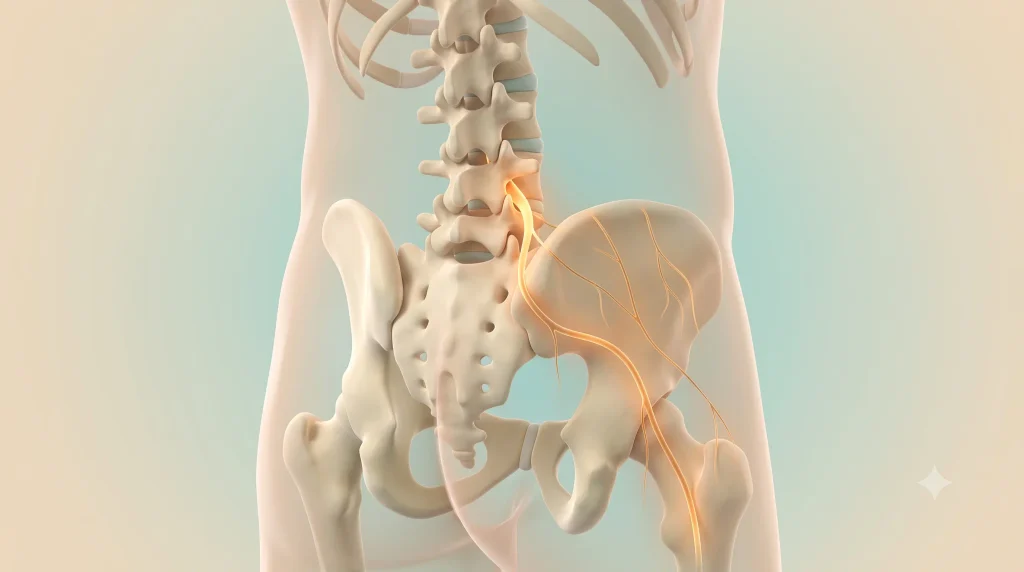
For informational purposes only and may contain errors.
Spinal stenosis, a narrowing of the nerves’ passages, mainly affects older adults: burning builds in the buttocks and legs with walking and fades on sitting or leaning forward. If a scan named it, see what spinal stenosis on an MRI report means.
Nerve-root burning is commonest in working-age adults who sit for long periods or lift often. Burning that starts in both feet and creeps upward is more often a peripheral neuropathy, such as from diabetes, than a back problem.
Could it be shingles, your kidneys or your skin?
Yes, and these are often missed. Shingles can burn in a one-sided band for days before any rash. Kidney problems cause deep flank pain, usually with fever or urinary changes. Skin causes, from heating pads to patches, burn exactly where something touched you and do not change when you bend.
Shingles
Shingles is the chickenpox virus reactivating inside a sensory nerve. Pain, itching or tingling can start where the rash will develop, and the rash usually stays within one or two adjacent dermatomes without crossing the midline: a one-sided band. Antiviral treatment is most effective when started within 72 hours (CDC), so new blisters need a prompt appointment. Risk rises with age and weakened immunity.
Kidneys
The kidneys sit higher than people expect, under the lowest ribs. Their pain is deep, often one-sided and unchanged by bending. Infection adds fever or burning urination; a stone brings waves of severe pain toward the groin. This comparison of kidney pain and back muscle pain covers the finer points.
Your skin, and what you put on it
Capsaicin creams work by producing a burn, which a hot shower can intensify; menthol and heat patches can irritate skin. Repeated long heating-pad sessions can cause toasted skin syndrome (erythema ab igne), a net-like brown mottling that may itch or burn, so never sleep on a pad. Belts pressing on the pelvic rim may irritate the cluneal nerves.
How can you tell which kind of burn you have?
Five checks, about five minutes in all, usually sort a burning back into nerve, muscle, skin or see-a-doctor-today. None diagnoses you, but together they show which pattern you most resemble. Stop any check that sharply raises your pain.
Quick check
- Touch test: brush a tissue lightly over the burning area, then the other side. Raw or strange-feeling touch suggests oversensitive skin nerves.
- Mirror check: redness or blisters in a one-sided band? Get seen within a day.
- Press test: press firmly into the muscle beside the spine. A deep, familiar ache rather than a surface burn fits muscle.
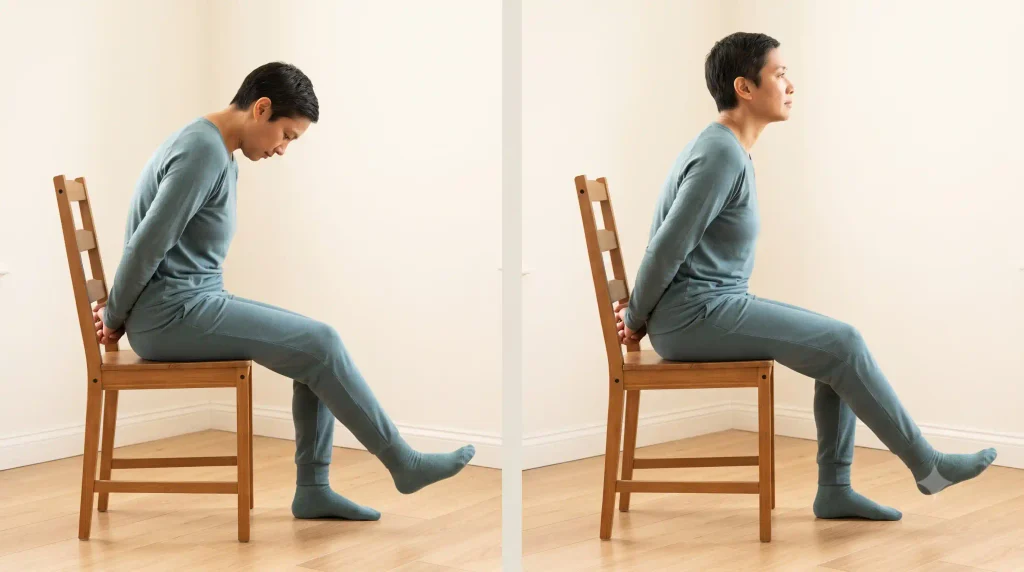
- Slump test: a burn into the buttock or leg that eases when you lift your head fits a sensitive nerve root.
- Move test: gently bend, arch and twist. Nothing changes it, and you have fever or painful urination? See a doctor today.
Numbness between the legs, new bladder or bowel trouble, or weakness in both legs means emergency care now.
For the slump test, sit on the front edge of a firm chair, hands behind your back. Slump, chin to chest, then slowly straighten one knee and pull your toes up, stopping when your familiar burn appears. Now lift your head: if the burn eases while the leg stays still, the nerve, not the hamstring, is the sensitive structure. Compare sides.
When is burning back pain a red flag?
Burning back pain is a red flag when it comes with loss of nerve function, fever, a rash, sudden severe pain with faintness, or signs of wider illness. These patterns do not respond to rest or stretching, and several get harder to treat with each day of delay.
- Numbness between the legs, new urinary difficulty, incontinence or weakness in both legs. Possible cauda equina syndrome, compression of the nerve bundle at the base of the spine; hours matter, so go to emergency care.
- Fever or chills with the burn, especially after a spinal procedure or with weakened immunity. Infection can spread; get same-day care.
- A foot that drags or slaps, or a leg that gives way. Weakness means a nerve is losing function, not just misfiring; get urgent assessment.
- Sudden severe back or belly pain with faintness or a pulsing abdomen, particularly in older smokers. This can signal an aortic aneurysm; call emergency services.
- Cancer history, unexplained weight loss, or burning constant in every position and worse at night. Mechanical pain shifts with position; this needs investigation.
Do you need an MRI or other tests?
Usually not at first. An MRI shows discs, nerve roots and the spinal canal, and earns its place with red flags, weakness, or nerve-type burning unimproved after about six weeks when injection or surgery is on the table. X-rays show bone, not nerves. Non-spinal causes need other tests: urine tests or CT for kidneys, a skin exam for shingles, nerve conduction studies when the nerve problem may lie outside the spine.
Two myths worth dropping
Myth: burning means nerve damage. It signals an oversensitive nerve; spreading numbness and weakness are the real warnings. Myth: you can stretch it loose. Nerves do not lengthen like muscles, and a hard hamstring stretch pulls on an irritated root.
From the Clinic: Dr. Arora’s Expert Insight
I write a patient’s own word for their pain in my notes, inside quotation marks, because “burning”, “hot”, “raw” and “stinging” usually send my examination in four different directions. Burning that travels, especially with tingling, sends me to the nerve roots. Hot, when the skin is not actually warm, more often belongs to overworked muscle. Raw, the sunburned-under-my-shirt feeling, sends me to the skin and its small nerves before the spine, and stinging in one patch makes me ask about rashes, creams and belts.
The standard advice for a sore back, heat and stretch, ignores these words. Someone with a raw patch puts a heating pad on skin whose nerves are already oversensitive; someone with a traveling burn holds a hamstring stretch that pulls on the irritated root. Both return worse, convinced their back is fragile. A pattern that comes up repeatedly: people with the raw kind have already swapped belts for elastic waists, and mention it only when I ask what they have stopped wearing.
What works better is matching the word to the first move: nerve words get gentle gliding and position changes, skin words get cool compresses, loose clothing and a daily mirror check, muscle words get more frequent breaks. I keep the original word on the chart as a progress measure. When “burning” becomes “aching” or “tight” at a follow-up, the nerve is usually settling even if the pain score has barely moved, and that change in vocabulary is often the first sign of recovery I trust.
What should you do in the first 72 hours?
For the first 72 hours, keep moving in short bouts, find the position that quiets the burn, and match heat or cold to its type: gentle warmth for a deep muscle burn, cool for raw or stinging skin. See a doctor today if fever or a rash appears.
What to do today
- Walk on flat ground about 10 minutes at a time, several times daily, stopping before the burn spreads.
- Sitting spreads it? Lie face down or stand. Standing spreads it? Sit, or lie on your back with knees bent.
- Raw or stinging skin: a cool damp cloth for 10 minutes. Deep muscle burn: warmth for 15 to 20 minutes through cloth.
- Check or photograph the skin each morning for a week.
- Use over-the-counter pain relief only as labeled; ask a pharmacist first if you have kidney, stomach or heart problems.
Clearly easing by day three, with no rash or fever? Start the plan below.
This comparison of ice versus heat for lower back pain explains when each helps.
How do you calm a burning nerve and rebuild?
Settle the nerve with positions and movement that do not spread the burn, restore its ability to slide with gentle gliding exercises, then rebuild the hip and trunk strength and the sitting and walking tolerance that keep it calm. Advance by symptom response, not the calendar.
| Phase | Typical timing | Main work | Move on when |
|---|---|---|---|
| 1. Calm | Days 1–14 | Relief positions, short walks, sliders in a comfortable range | Burn no longer spreading; 20-minute walk comfortable |
| 2. Glide and load | Weeks 2–6 | Bigger slider range, bridges, side planks, hip hinge, 30-minute walks | Slump test calmer; 30 to 45 minutes of sitting without spread |
| 3. Build | Weeks 6–12 | Split squats, carries, lifting from about 5–10 kg (11–22 lb) | A normal week with flares settling within 24 hours |
| 4. Return | Week 8 onward | Sport, heavy lifting, long drives | Goal activity done twice with no next-day spread |
Why these exercises
- Nerve sliders move the nerve through surrounding tissue without stretching it, which may ease its sensitivity.
- Press-ups lying face down help some disc-related burning, but only if the burn retreats toward the spine; stop if it spreads down.
- Bridges and side planks build hip and trunk endurance without repeated bending.
- Cycling suits stenosis-type burning: the spine stays slightly bent forward, the position that eases it.
For a lying slider, lie on your back holding behind one thigh, hip bent to about 90 degrees. Straighten the knee while pointing your toes away, then bend it while pulling them back. Do 10 slow repetitions two or three times daily; any flicker of burn should settle within 30 minutes, or halve the range.

Once the nerve settles, a broader physical therapy home program for low back pain can take over.
Do’s and don’ts for a burning back
- Do repeat the touch test every few days; a shrinking raw patch is real progress.
- Do loosen waistbands and move tool belts or pack hip belts off a tender spot on the pelvic rim.
- Don’t put heat, capsaicin or menthol on skin that already feels raw or stings.
- Don’t hold hard hamstring stretches into the burn.
How long does a burning lower back take to settle?
Muscle-fatigue burn settles within minutes to days once the habit behind it changes. Nerve-root burning often improves substantially over six to twelve weeks, with ups and downs. A shingles rash usually clears in two to four weeks, though nerve pain can outlast it, and trapped skin nerves often ease once pressure is removed.
Desk work usually continues, with breaks. Drive once you can sit 30 minutes without the burn spreading and brake hard without hesitation. Lifting returns in phase 3, running once a brisk 45-minute walk and gentle hops leave no next-day spread.
If progress stalls or surgery comes up
If four to six weeks of work brings no clear change, see a physical therapist (physiotherapist) or physician to test strength, reflexes and sensation and look for a missed non-spinal cause. An epidural steroid injection may calm persisting nerve-root burning enough for rehab to work; a nerve block at the pelvic rim can confirm and treat cluneal entrapment. Surgery is considered for leg-dominant symptoms with matching scan findings after six to twelve weeks of good care, and urgently for cauda equina syndrome or worsening weakness; most people recover from a herniated disc without surgery.
The bottom line on a burning sensation in your lower back
Name the burn before you treat it. Tonight, do the touch test, slump test and mirror check, then pick your first move: cool compresses and loose clothing for raw skin, short walks and sliders for a burn running down a leg, a posture change every 30 minutes for muscle burn, and a doctor today if fever or a rash appears.
Frequently asked questions
1. Can shingles cause burning in the lower back without a rash?
Rarely, yes. Most people develop the rash within several days of the burning starting, but a few never get a visible rash. A one-sided band of burning with no movement triggers, especially after 50 or with weakened immunity, is worth raising with a doctor early.
2. Is burning back pain a sign of permanent nerve damage?
Usually not. Burning signals an irritated nerve, and most nerve-root irritation settles over weeks to months. Spreading numbness, a weakening foot or leg, and bladder or bowel changes are the signs of lost function that need prompt assessment.
3. Why does my lower back burn when I stand for a long time?
Usually because the muscles beside your spine are holding you up without a break. If the burn spreads into the buttocks or legs and eases only when you sit or lean forward, spinal stenosis is more likely. Resting one foot on a low step and shifting position every 20 to 30 minutes helps both.
4. Why does my lower back burn at night?
Often because lying still leaves a sensitive nerve or a tired back unmoved for hours. If turning over or a pillow between the knees eases it, the cause is probably mechanical. Burning that stays constant in every position, or comes with fever or weight loss, needs a doctor.
5. Does a burning sensation in the lower back mean a kidney problem?
Seldom on its own. Kidney pain sits higher, under the lowest ribs, ignores movement, and infections usually bring fever or burning urination. A clinician may tap over the back of the lowest ribs, which jolts an inflamed kidney, and a urine test settles most doubts.
6. Will I need surgery for nerve-type burning in my back?
Most people do not. Surgery is generally reserved for severe, persisting leg-dominant symptoms with matching scan findings, progressive weakness or cauda equina syndrome. Burning confined to the back is rarely a surgical problem.
Medical disclaimer
This article describes common patterns behind a burning low back; it cannot examine your skin, test your nerves or check your urine. Shingles and kidney infection need a clinician and often prescription treatment, so use the self-checks to choose a first step, never to rule a cause out. Seek emergency care for numbness between the legs, new bladder or bowel problems, weakness in both legs, fever with severe flank pain, or sudden severe back pain with faintness.
References
- Gilron I, Watson CPN, Cahill CM, et al. Neuropathic pain: a practical guide for the clinician. CMAJ. 2006;175(3):265-275.
- Centers for Disease Control and Prevention. Clinical Overview of Shingles (Herpes Zoster). CDC; 2024.