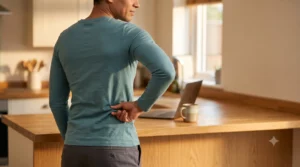
An ache sitting high in the flank — just under the ribs, a little off to one side — raises a very specific worry. Is this my back, or is this my kidney? It is a fair question, because the lowest ribs, the deep spinal muscles and the kidneys all occupy roughly the same patch of anatomy, and the nerves supplying them overlap in the spinal cord.
Low back pain near kidneys is usually muscular when it moves with you, and usually renal when it does not. Muscle pain sits close to the surface, can be reproduced by pressing on it, and changes with bending or twisting. Kidney pain sits deeper and higher, at the angle where the last rib meets the spine, stays steady whatever position you take, and often travels toward the groin.
Anything that adds fever, chills, burning or bloody urination, or repeated vomiting to that flank ache shifts the balance decisively toward the kidney and deserves same-day assessment rather than a heat pack.
Key Takeaways
- Position is the cheapest test. Pain that spikes when you bend, twist, cough or rise from a chair is behaving like muscle and joint tissue. Pain that ignores your posture entirely is behaving like an organ.
- Height and depth matter. Renal pain concentrates at the costovertebral angle — the corner where the 12th rib meets the spine — and feels internal. Muscular pain is lower, broader, and can be located with a fingertip.
- Radiation toward the groin is a renal signature. Stone pain characteristically sweeps from the flank forward and downward toward the groin or testicle, in waves.
- Systemic symptoms outrank pain description. Fever, chills, nausea and vomiting, visible blood in the urine, or burning and urgency on passing urine are the findings that change the plan.
- Most flank-area back pain is mechanical. The commonest driver in this region is the quadratus lumborum and the deep spinal muscles, which can feel convincingly “organ-deep” while being entirely musculoskeletal.
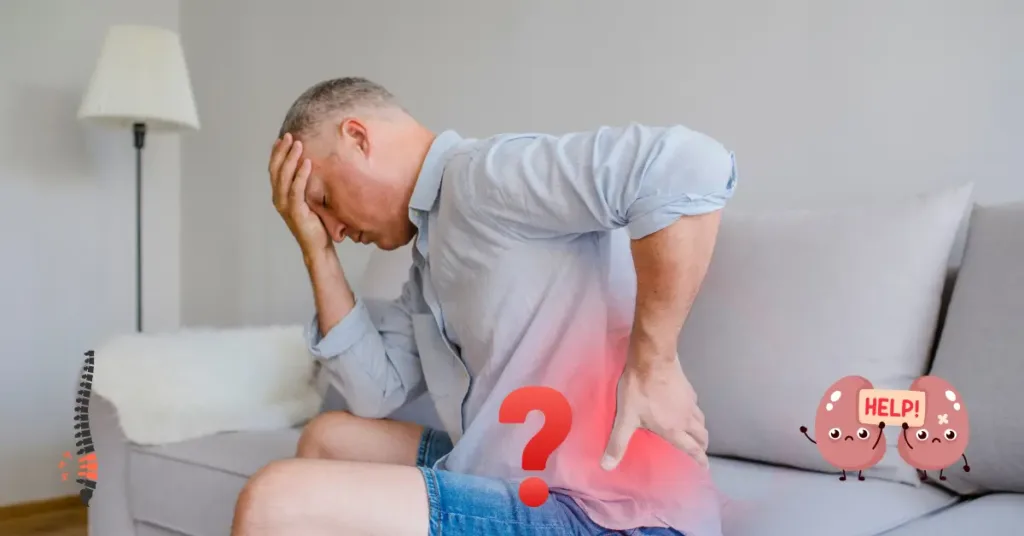
Where Are Your Kidneys Compared With Your Back Muscles?
Your kidneys sit higher than most people assume — tucked under the lower ribs at roughly the level of the bottom of the ribcage, one either side of the spine, closer to your back than your belly. The muscles people strain sit below and around them. That vertical overlap of a few centimeters is the entire reason this confusion exists.
The kidneys: high, deep and rib-protected
Each kidney is a bean-shaped organ sitting behind the abdominal contents, cushioned in fat and partly shielded by the 11th and 12th ribs. Because they lie behind rather than inside the abdominal cavity proper, an irritated or swollen kidney announces itself at the back, at the costovertebral angle — the corner formed where the lowest rib meets the spine. Tapping there is the classic clinical test, and a kidney that is inflamed or obstructed usually objects.
The muscles that impersonate them
Three muscle groups do most of the impersonating. The quadratus lumborum runs from the 12th rib down to the pelvic rim and is loaded every time you side-bend, carry a bag on one side, or sit twisted toward a monitor — it sits directly over the kidney zone and refers pain that feels deep and internal. The erector spinae columns run vertically alongside the spine and tighten protectively after any lifting mishap. The multifidus, the small segmental stabilizers, tend to switch off after an episode of back pain and leave the larger muscles overworking. None of these are life-threatening, but they can produce an ache that feels every bit as ominous as an organ problem.
What Actually Causes Pain in the Kidney Area of Your Back?
Two very different families of problem produce pain in this region. Renal causes — infection, stones and, less commonly, inherited cystic disease — irritate or stretch the kidney itself. Musculoskeletal causes — strained muscle, an irritated facet joint, a disc problem — load the structures around it. The two feel different, but only if you know what you are comparing.
Kidney-Related Causes
Kidney Infection (Pyelonephritis)
An upper urinary tract infection happens when bacteria travel up from the bladder into the kidney. Clinical references describe the classic presentation of acute pyelonephritis as a triad of fever, flank pain and nausea or vomiting, with tenderness over the costovertebral angle on examination — though not every symptom has to be present. Burning, urgency and increased frequency of urination often come with it. This is one of the few back-pain presentations that genuinely needs prompt medical treatment rather than watchful waiting, because untreated kidney infection can progress to kidney damage or bloodstream infection.
Kidney Stones
A stone lodged in the drainage system produces one of the most distinctive pain patterns in medicine. Clinical descriptions of acute renal colic place its origin at the costovertebral angle, extending forward and downward toward the groin or testicle, with a dull background ache punctuated by colicky surges of intense pain. Most people show blood in the urine, visible or microscopic, and more than half report nausea or vomiting. The telling behavioral clue: someone with renal colic typically cannot get comfortable and will pace or writhe, whereas someone with a muscular back injury usually finds one position that helps and stays in it.
Polycystic Kidney Disease
An inherited condition in which fluid-filled cysts gradually enlarge the kidneys. The pain here is not colicky but a persistent, dragging fullness in both flanks that builds over years rather than hours, and it commonly travels with raised blood pressure and a family history of kidney disease. It is uncommon, but worth knowing about if flank discomfort has been a background feature of your life rather than a new event.
Musculoskeletal Causes
Muscle Strain or Sprain
Far and away the most common explanation. A single awkward lift, a long drive, a weekend of gardening, or carrying a toddler on one hip for a fortnight can overload the quadratus lumborum and the erector spinae. The tissue protests, the surrounding muscles splint to protect it, and the resulting ache sits exactly where you imagine your kidney to be. The giveaway is reproducibility — you can find the sore band with your thumb, and the pain has a clear on-switch in movement.
Herniated Disc
When disc material bulges and irritates a nearby nerve root, pain typically has an electrical, travelling quality and frequently runs below the knee, sometimes with pins and needles or weakness. Disc pain tends to be worse with sitting, bending forward and coughing or sneezing — a pressure response that renal pain simply does not show.
Sciatica
Sciatica describes nerve-root pain running from the back through the buttock and down the leg. It is sometimes mistaken for organ pain because it is deep and hard to localize, but the direction of travel settles it: sciatica goes down the leg, whereas stone pain goes forward toward the groin.
How Do You Tell Kidney Pain From Muscle Pain?
Four features separate them reliably: height, depth, behavior with movement, and company. Renal pain sits high at the costovertebral angle, feels internal, refuses to change with position, and often brings fever or urinary symptoms along. Muscular pain sits lower and broader, can be pressed and reproduced, eases in some positions and worsens in others, and arrives alone.
| Feature | More typical of kidney origin | More typical of muscle or spine origin |
|---|---|---|
| Where it sits | High in the flank, at the costovertebral angle where the lowest rib meets the spine; often one side only | Lower and broader across the low back, sometimes into the buttock |
| How deep it feels | Internal and deep; hard to point to with one finger | Superficial enough to locate precisely; you can put a thumb on it |
| Pressing on it | Usually does not reproduce the pain; tapping the flank may jar it | Reliably reproduces a tender band or knot |
| Effect of movement and posture | Largely unchanged by bending, twisting, sitting or lying | Clearly worse with bending, twisting, lifting, coughing or rising from a chair; eased by certain positions |
| Direction of travel | Forward and downward toward the groin or testicle | Down the back of the leg if a nerve root is involved; otherwise stays local |
| Pattern over hours | Steady ache with colicky surges, or steadily building with infection; person cannot get comfortable | Settles with rest and a favored position; stiffest first thing in the morning |
| What comes with it | Fever, chills, nausea and vomiting, burning or frequent urination, blood in urine | Muscle tightness and spasm; no fever, no urinary change |
| Response to heat | Little or no change | Often noticeably eased |
Pain location and sensation
Renal pain concentrates in a small, high patch just under the ribs, on one side of the spine, and feels as though it is coming from somewhere behind the muscles rather than in them. Muscular pain is broader, closer to the surface, and usually has a tender band you can find by pressing along the edge of the spine between the 12th rib and the top of the pelvis.
Associated symptoms to watch for
The company the pain keeps is often more informative than the pain itself. Renal causes commonly travel with:
- Fever
- Nausea and vomiting
- Painful or frequent urination
- Blood in urine
Muscular and joint problems almost never produce that list. A strained back does not give you a fever, and it does not change the color of your urine. If those features are present, the musculoskeletal explanation should be set aside until a clinician has ruled the kidney out.
Response to movement or rest
This is the single most useful thing you can test yourself. Mechanical pain has a mechanical trigger: it flares when you bend forward to load the dishwasher, twist to reach the back seat, cough, or stand up after twenty minutes of sitting — and it settles when you find a position that unloads the tissue. Renal pain has no such switch. Someone with a stone will change position repeatedly and get no relief from any of them, which is why they pace rather than lie still.
👨⚕️ Dr. Arora’s Clinical Note:
Patients ask me if “kidney pain” should hurt when they press the spot. Here’s a useful clinical clue: true kidney-origin flank pain is often deep and not sharply reproducible by poking the surface muscles, whereas quadratus lumborum (QL) and deep erector-spinae trigger points can feel “organ-deep” and convincingly mimic kidney discomfort.A simple pattern test I use: brace + move vs. stay still. If your pain clearly spikes with bending, side-bending, getting out of a chair, coughing, or lifting, and you can “catch it” by pressing a tender band of muscle beside the spine (often between the 12th rib and the top of the pelvis), it strongly supports a musculoskeletal driver. If instead the pain feels internally deep, is paired with fever/chills or urinary symptoms, and doesn’t change much with movement, treat it as kidney-related until proven otherwise.
One counter-intuitive rehab tip: don’t start with aggressive stretching. For QL-driven “kidney-area” back pain, the fastest win is often unloading + breathing control (side-lying with knees bent, slow nasal breaths, gentle abdominal brace) for 2–3 minutes—then progress to stability work, rather than pulling harder on tight tissues.
Which Warning Signs Mean You Should Be Seen Today?
Flank pain accompanied by fever or chills, visible blood in the urine, burning or urgent urination, repeated vomiting, or pain so severe that no position gives relief should be assessed the same day. These features point toward infection or obstruction rather than strained tissue, and both are time-sensitive. A back that simply hurts when you move is not in this category.
Fever, chills or feeling systemically unwell
Why it matters: muscles and joints do not generate fever. A raised temperature with rigors alongside one-sided flank pain is the pattern of an upper urinary tract infection reaching the kidney, and it can progress to kidney scarring or bloodstream infection if it is left to run. The same combination in someone who is pregnant, diabetic, immunosuppressed, or has a single functioning kidney should be treated as more urgent still.
Blood, burning, cloudiness or urgency on passing urine
Why it matters: these findings locate the problem in the urinary tract, not the spine. Burning and urgency suggest infection; visible or microscopic blood is common with stones and may also occur with infection. Blood in the urine without pain has its own set of causes and should always be investigated rather than assumed to be a stone.
Nausea, vomiting, or pain you cannot get comfortable with
Why it matters: the kidney and the gut share autonomic nerve supply, so a distended, obstructed drainage system triggers nausea in a way that a strained muscle does not. Combined with restless, wave-like pain that no position eases, this suggests a stone obstructing urine flow — which needs assessment for pain control and to check the kidney is still draining.
Signs that point to the spine rather than the kidney — but still need urgent review
Why it matters: a small number of back presentations are urgent for entirely different reasons. New numbness around the groin or inner thighs, difficulty starting or controlling urination, loss of bowel control, or progressive weakness in a leg can indicate significant nerve compression and warrant emergency assessment. Likewise, back pain that is unrelenting at night, accompanied by unexplained weight loss, or that follows a fall in someone with osteoporosis, should be examined rather than rehabilitated.
What Points Toward a Muscle or Spine Problem Instead?
A musculoskeletal cause is likely when the pain has a clear movement trigger, a findable tender spot, a position that helps, and no accompanying fever or urinary change. Most people in this group can also name the moment it started — a lift, a long drive, an unusual load — even if the pain only announced itself the following morning.
- It has an on-switch. Bending to load the washing machine, twisting to reach behind you, standing up after sitting, or coughing reliably makes it worse.
- You can find it with your thumb. A tender, ropey band beside the spine or along the rim of the pelvis reproduces the familiar ache when pressed.
- It has an off-switch too. Lying with knees bent, walking gently, or a heat pack takes the edge off — even briefly.
- It is worst first thing. Morning stiffness that loosens over ten or fifteen minutes of movement is a joint and muscle pattern, not an organ pattern.
- Nothing else is wrong. No fever, no chills, no nausea, no change in how or how often you pass urine.
What Will a Clinician Actually Do to Sort This Out?
The workup is usually quick and inexpensive. A hands-on examination plus a urine dipstick answers the question in most cases: if the urine is clean and the pain is reproducible on movement and palpation, the kidney is effectively excluded. Imaging is added only when the history, examination or urine result raises a specific question that would change treatment.
The physical examination
Expect a clinician to tap over the costovertebral angle, palpate along the spinal muscles and the rim of the pelvis, check how your pain responds to bending, side-bending and extension, and test reflexes, sensation and strength in the legs if any symptoms travel below the knee. The aim is simple: can the pain be provoked from the outside? If it can be turned on and off mechanically, that is powerful evidence for a musculoskeletal source.
Urine tests, blood tests and imaging for the kidney
A urine dipstick looking for blood, nitrites and white cells is the single most useful test in this situation, often with a urine culture if infection is suspected. Blood tests may check kidney function and markers of infection. Ultrasound can show a swollen, obstructed kidney and is preferred in pregnancy; non-contrast CT is the more sensitive test for stones and is used when the diagnosis is uncertain or the pain is severe. These tests change management directly — they determine whether you need antibiotics, whether a stone is blocking drainage, and whether admission is required.
When spinal imaging is — and is not — worth having
For ordinary mechanical back pain in the first six weeks, an MRI rarely changes what is done. Disc bulges and degenerative changes appear commonly on scans of people with no pain at all, so an incidental finding can be actively unhelpful — it names something that may have nothing to do with your symptoms. Spinal imaging earns its place when there is progressive leg weakness, numbness in the saddle area or bladder and bowel change, a history of cancer, suspected fracture, suspected infection, or pain that has failed a genuine course of conservative treatment and surgery is being considered.
Can You Check This Yourself Before Seeing Anyone?
You can gather useful information in about two minutes, provided none of the urgent features are present. Three simple checks — whether movement changes the pain, whether pressing on the area reproduces it, and whether heat helps — will point you toward muscle or organ with reasonable accuracy. None of them replaces a urine test, and none of them is safe to rely on if you have a fever.
The movement check
Standing, bend slowly forward, then lean back, then side-bend away from the painful side and toward it. Then sit down and stand up again. If one or two of those clearly spike the pain and others do nothing, you have a mechanical pattern. If all five feel identical to standing still, the pain is not coming from tissue that moves.
The pressing check
Reach around and press firmly with your thumb along the muscle beside the spine, in the gap between the bottom rib and the top of the pelvis. A muscular problem usually gives you a distinctly tender band that reproduces your familiar ache. Kidney pain generally will not be recreated this way, though a genuinely inflamed kidney may object to a firm tap over the same area — which is a reason to stop, not to keep testing.
Fluids, and what they can and cannot tell you

Being persistently under-hydrated raises the risk of forming stones, and drinking more is sensible general advice. But treat this as prevention, not a diagnostic test — drinking a large glass of water will not tell you within an hour whether your kidney is the problem, and it should never be used to talk yourself out of getting checked when fever or blood in the urine is present. If pain is severe and you cannot keep fluids down, that is a reason to be seen, not a reason to keep drinking.
The heat check
Fifteen to twenty minutes with a warm pack over the sore area is a reasonable, low-risk experiment. Muscular pain typically softens noticeably as the tissue relaxes and the protective guarding eases. Renal pain tends to be indifferent to it. A partial response is common and does not prove anything on its own, which is why this check is most useful alongside the movement and pressing checks rather than by itself.
How Is Kidney-Related Pain Treated?
Treatment depends entirely on which renal problem is present. Infection is treated with antibiotics guided by a urine culture. Stones are managed with fluids, pain relief and time if small, or with a procedure if they are large or blocking drainage. Neither responds to rest, stretching or a heat pack, which is why the diagnosis has to come first.
Antibiotics for infection
A kidney infection is treated with antibiotics, usually guided by a urine culture, and the course is longer than for a simple bladder infection. Feeling better after two days is not a reason to stop early. Deferring treatment risks kidney scarring and, in a minority of people, bloodstream infection — which is why this is the one scenario in this article where waiting to see how it goes is the wrong call.
Managing stone pain
Small stones often pass on their own with adequate fluids and pain relief, sometimes assisted by medication that relaxes the ureter. Anti-inflammatory painkillers are commonly used first for the pain of renal colic. What matters clinically is not only comfort but drainage: a stone obstructing the kidney in the presence of infection is an emergency, and severe pain with fever should not be managed at home.
Procedures, when a stone will not pass
Larger stones, or those causing persistent obstruction, may be treated with shock wave lithotripsy, ureteroscopy, or in some cases a percutaneous approach. The choice depends on the stone’s size, position and composition rather than on how much it hurts.
What Helps if It Turns Out to Be Muscular?
Relative rest for a day or two, then graded movement — not prolonged bed rest. Most flank-area muscular pain settles substantially within two to six weeks if the tissue is unloaded early and then progressively reloaded. The mistake that stretches a three-week problem into a three-month one is staying still, or its opposite: stretching hard into pain in the first few days.
Early days: unload, then move
In the first 48 to 72 hours, favor positions that reduce the pull on the quadratus lumborum: lie on your side with knees bent and a pillow between them, avoid carrying weight on one side, and rise from a chair by hinging at the hips rather than levering off the low back. Short, frequent walks — five to ten minutes, several times a day — usually feel better than either sitting all day or attempting your normal routine.
Then: rebuild the side that failed
Because this region is loaded mostly in side-bending and rotation, generic abdominal work rarely resolves it. What tends to help is lateral and anti-rotation loading — side planks progressed from knees to feet, suitcase carries with a weight in one hand while keeping the ribs stacked over the pelvis, and hip hinge practice so that bending happens at the hips instead of at the 12th rib. Progress when the current level stops producing next-morning soreness, not on a fixed calendar.
Medication, in proportion
Over-the-counter anti-inflammatories or topical preparations can lower pain enough to let you move, which is their real value — they buy movement rather than heal tissue. Muscle relaxants are sometimes used short-term for spasm. If pain relief is the only thing happening after three or four weeks, the plan needs revisiting.
Preventing Future Lower Back Pain
Drink enough to keep urine pale
For anyone who has formed a stone, a higher fluid intake is one of the few measures with real preventive value, because dilute urine is less likely to crystallize. A practical target for most adults is enough fluid to keep urine pale straw-colored throughout the day — often in the region of 2 to 3 liters (roughly 70 to 100 fl oz), and more in hot weather or with heavy physical work. People with heart or kidney disease should have that target set individually rather than copied from a general article.
Train the movements this area actually performs
The flank musculature earns its keep in side-bending, rotation and one-sided carrying. Training that reflects that — carries, side planks, single-leg work, loaded hinging — protects it better than endless crunches. Two or three sessions a week is usually enough to hold the gains.
Change position more often than you fix it
The problem with desk work is rarely a single bad posture; it is holding any posture for two hours. Stand or walk briefly every 30 to 45 minutes, keep your monitor square in front of you rather than off to one side, switch the shoulder you carry a bag on, and get out of a car by turning to face outward before standing rather than twisting up out of the seat.
Conclusion
Most low back pain near kidneys turns out to be exactly what it feels like from the outside — muscle and joint tissue that has been asked to do more than it was ready for. The way to be confident about that is not to guess from the depth of the ache, but to test it: does it change with movement, can you press on it and find it, does heat help, and is anything else going on. If all four answers point to the muscles and nothing else is wrong, treat it as a mechanical problem and load it back up gradually.
If any answer points the other way — a fever, a change in your urine, vomiting, or pain that follows you into every position you try — stop testing and get a urine dipstick and an examination the same day. That is a short conversation and an inexpensive test, and it is the one thing this article cannot do for you.
References
- Belyayeva M, Leslie SW, Rout P, Jeong JM. Acute Pyelonephritis. StatPearls [Internet]. Treasure Island (FL): StatPearls Publishing; updated 28 February 2024. NCBI Bookshelf NBK519537
- Patti L, Leslie SW. Acute Renal Colic. StatPearls [Internet]. Treasure Island (FL): StatPearls Publishing; updated 23 December 2024. NCBI Bookshelf NBK431091
FAQs
1. Can kidney pain come and go like muscle pain?
Stone pain comes in waves, but it never switches off completely when you change position. Muscular pain does switch off — it eases in an unloaded position and returns the moment you bend, twist or stand up. That on-off quality, rather than the intensity, is the useful distinction.
2. How long does kidney-related back pain last?
It depends on the condition. Kidney infections can resolve in a few days with antibiotics, while kidney stone pain persists until the stone is passed or removed.
3. Can dehydration cause low back pain near kidneys?
Indirectly, yes. Being persistently under-hydrated concentrates the urine and raises the risk of forming stones, which can then cause flank pain. Dehydration on its own does not damage healthy muscle or produce back pain.
4. Is it possible to have both kidney and muscle pain together?
Yes, and it is a frequent source of confusion. A kidney problem can make the overlying muscles guard and tighten, adding a genuine musculoskeletal layer on top of the original organ pain — so finding a tender muscle does not by itself rule the kidney out.
5. What type of doctor should I consult for low back pain near kidneys?
Start with a general physician. They may refer you to a nephrologist (kidney specialist) or an orthopedic/spine specialist based on initial assessments.
6. Does pain near the kidneys always mean something serious?
No. The large majority turns out to be muscle and joint tissue, particularly if the pain has a movement trigger and a tender spot you can press. It becomes serious when fever, urinary changes or vomiting join it, or when no position gives any relief.
7. Can kidney stones cause pain only in the lower back?
Rarely only in the back. Stone pain characteristically starts high in the flank and then sweeps forward and downward toward the groin or testicle. Pain that stays fixed in one spot and never travels forward is more likely mechanical.
8. Are there specific exercises to avoid if I have low back pain near kidneys?
Until the cause is clear, avoid heavy or one-sided lifting, deep backbends and high-impact work. Gentle walking and side-lying rest are safe in almost every case. If the cause turns out to be muscular, hard stretching in the first few days often aggravates it more than it helps.
9. Can diet affect kidney-area back pain?
Diet influences stone formation rather than back pain directly. Low fluid intake and high salt intake are the factors most often addressed in people who form stones. Diet has little bearing on muscular flank pain, which responds to load management rather than nutrition.
10. When should I seek immediate medical attention for low back pain near kidneys?
Seek same-day care for flank pain with fever or chills, visible blood in the urine, repeated vomiting, or pain so severe that no position brings any relief. Seek emergency care for new numbness around the groin, loss of bladder or bowel control, or progressive weakness in a leg.