Expert Review: This article includes clinical insights from Dr. Vivek Arora, a physical therapist (physiotherapist) with 20+ years of experience.
A knot in your lower back is usually a small patch of muscle that has become tender and tight, most often beside the spine or deep in the waist. It is rarely dangerous, and brief pressure plus the right movement usually settles it within days to a few weeks.
The real worry is often whether the lump is muscle at all. Below: a two-minute self-test for that, a timed tennis-ball routine, and exercises that stop it returning.
Key takeaways
- A knot is a tender spot, not a tied-up muscle. Examiners often disagree on where “trigger points” are, so treat the tender spot, not the theory.
- Muscle knots change when the muscle works. A lump that slides under the skin, or ignores tensing, is probably not muscle.
- Pressure opens a window; movement uses it. Follow 60 to 90 seconds on a tennis ball with an exercise for that muscle.
- Some lumps need a scan, not a massage. Growing, deep or painful lumps, or those over about 5 cm (2 in), should be examined.
What is a knot in your lower back, really?
It is a firm, tender spot within a back muscle that hurts when pressed and often reproduces your familiar ache. Clinicians call the most sensitive of these spots myofascial trigger points, myofascial meaning muscle and its connective tissue. What you feel is real, but whether a distinct physical knot exists inside the muscle is still debated.
Trigger point theory proposes that a cluster of fibers gets stuck in contraction, forming a taut band that sends pain nearby. The evidence is thin: a 2017 meta-analysis of six studies found that examiners locating trigger points by hand agreed only moderately (a score of 0.45, where 1 is perfect agreement) and judged the method unreliable; local tenderness was the most consistent finding (Rathbone and colleagues, 2017).
A more honest description: a knot is a spot where muscle is guarding and nerve endings have grown more sensitive to pressure. That explains why it feels hard yet softens when you fully relax. It is not trapped lactic acid, which clears within hours of exercise, and it does not mean a vertebra is out of place.
Which muscle is the knot usually in?
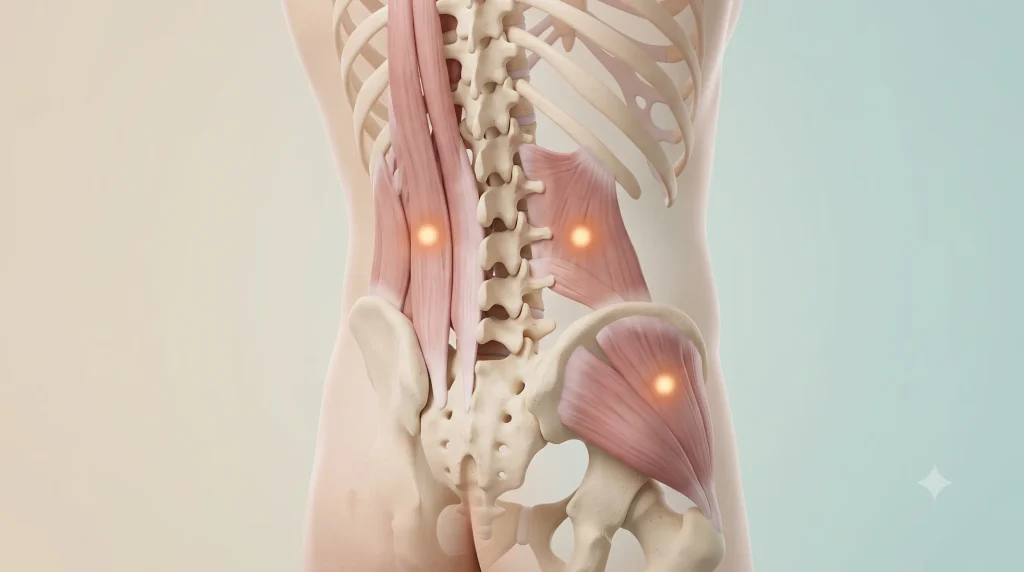
Most lower back knots sit in one of three muscles: the erector spinae beside the spine, the quadratus lumborum deep in the waist, or the gluteus medius just below the pelvic rim. Each is loaded by different everyday movements, so location hints at the cause.
- Erector spinae, beside the spine. These long columns hold you up whenever you lean over a sink or counter. Their knots ache after long standing or sitting.
- Quadratus lumborum, deep in the waist between rib and pelvis. It hitches one hip and steadies the pelvis when you stand on one leg. Knots here catch when you roll over in bed or rise from a sofa.
- Gluteus medius, upper outer buttock. Many people pressing their “lower back” are really pressing this hip muscle, which keeps the pelvis level on stairs and walks.
This guide to the muscles behind low back pain maps how each one can produce pain.
Why do knots form in the lower back?
Knots usually form when a muscle holds a load for longer, or more one-sidedly, than it is conditioned for, or tightens to protect an irritated joint or disc nearby. Poor sleep and stress lower the threshold, so a quiet spot can flare in a busy week.
- Holding, not lifting. A laptop on the sofa or a long drive keeps the erector spinae working nonstop.
- One-sided habits. A toddler on the same hip or a bag on one shoulder keeps one quadratus lumborum working while its partner rests.
- Guarding. An irritated facet joint, disc or sacroiliac joint makes nearby muscles tighten to limit movement; the knot is the messenger and returns until the source settles.
Knots are most common in people with long, static or lopsided days and in anyone returning to activity after a break, and less common in those who change position often and load both sides evenly.
A knot is not a spasm, the sudden contraction that locks you in one position; this guide to why back spasms happen covers that.
Is it a muscle knot or a lump under the skin?
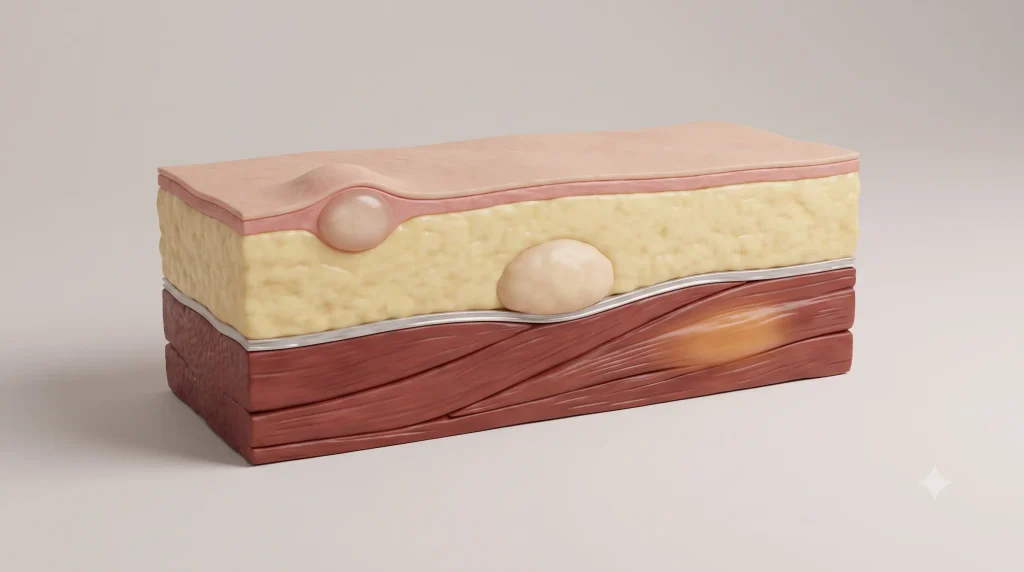
A muscle knot sits inside the muscle, so it firms up when the muscle contracts and turns vaguer when it relaxes. A lump that slides under the skin, lifts with the skin, or feels the same whether you tense or relax is probably not muscle and deserves a closer look.
Quick check
- Relax, then tense: lie face down, keep a fingertip on the spot and lift that side’s leg 3 to 5 cm (1 to 2 in). Does the spot blend into firming muscle? That fits a knot.
- Pinch: does the lump rise when you gently lift the skin? It probably sits in the skin, like a cyst.
- Slide: does a small rubbery nodule roll away under a fingertip? It probably sits in the fat above the muscle.
- Date it: photograph it beside a coin. Bigger in four weeks? Get it examined.
A hot, red lump, or a lump with fever, needs same-day care.
The classic look-alike is the “back mouse,” a small, rubbery, often tender nodule over the back of the pelvic rim, commonly near the dimples at the base of the spine. Doctors call it an episacral lipoma, fat thought to push through gaps in the fascia, and because pressing it can reproduce a familiar ache it is easily mistaken for a knot. See this guide to why lower back dimples can hurt.
| What you find | How it behaves | Often suggests | Next step |
|---|---|---|---|
| Tender, ropey firmness in muscle | Blends in when tensed; pressing reproduces the ache | Muscle knot | Self-care plan below |
| Small, rubbery, tender nodule over the pelvic rim | Rolls away under a fingertip | Back mouse (episacral lipoma) | Exam if painful or persistent |
| Soft, doughy, usually painless lump | Moves under the skin; grows slowly, if at all | Lipoma (benign fatty lump) | Exam if growing or over 5 cm (2 in) |
| Dome-shaped lump, sometimes with a central pore | Lifts with the skin; can turn red | Epidermoid (skin) cyst | Exam if inflamed |
| Hard, fixed or deep lump, or one that keeps growing | Does not move; unchanged by tensing | Needs imaging to rule out a tumor | Prompt exam, usually ultrasound first |
UK sarcoma guidelines flag three features in any soft tissue lump: increasing size, a size over 5 cm (2 in), and pain. Deeper lumps are also more likely to be serious, and growth is the best single warning sign (Dangoor and colleagues, 2016).
When should a knot in your lower back be checked?
Get it checked when the lump has warning features, when the pain behaves unlike muscle, or when other symptoms arrive with it. Muscle knots ease with rest, heat and a change of position; constant or night pain, fever, leg weakness or bladder changes need medical assessment, sometimes urgently.
- Numbness between the legs or new bladder or bowel problems. Possible cauda equina syndrome, compression of the nerve bundle at the base of the spine. Delay risks permanent damage: go to emergency care now.
- Fever, chills or a hot, red swelling. Infection, usually in the skin but rarely in the spine, needs same-day treatment.
- Leg weakness, a dragging foot or numbness below the knee. These point to a nerve root, not muscle; get assessed within days, the same day if weakness is worsening.
- A history of cancer, unexplained weight loss, or pain worst lying still at night. Muscle pain eases with rest; this pattern needs prompt review for a bone problem.
- Pain after a fall, or with osteoporosis or long-term steroid use. A vertebral fracture can feel like a deep, sore spot.
Pain under the ribs with fever or burning urine suggests the kidney; see this comparison of kidney pain versus a back muscle problem.
Do you need a scan for a back knot?
Not for an ordinary knot. Neither X-ray nor MRI reliably shows a tender muscle spot, so a normal scan does not mean the pain is imagined. Imaging earns its place for the red flags above and for a lump with warning features, where ultrasound usually comes first because it shows which tissue layer the lump sits in and whether it is solid, fatty or fluid-filled; MRI follows if anything looks suspicious.
From the Clinic: Dr. Arora’s Expert Insight
The tool I recommend most often for a lower back knot is a tennis ball against a wall, and it usually costs less than the shipping on the massage gun already sitting in a drawer at home. I am not against gadgets, but they deliver pressure you cannot easily steer, on a spot you cannot see, and the stronger models reward pushing too hard. A ball trapped against a wall lets you set the pressure by how far you lean and step away the moment it turns sharp.
The failure I see most with the generic advice to “roll it out” is chasing the lump. People press the spot late in the evening, when it is angriest, find it still there, and press harder the next night. Within a week the area is more sensitive, sometimes bruised, and the knot seems worse. So I ask them to press the same spot first thing in the morning too. If it is barely tender at breakfast and sore by evening, the day’s positions are rebuilding it, and no amount of pressure at night will outpace that.
What works better is treating the ball as the warm-up and the exercise as the treatment: ninety seconds of moderate pressure, then straight into a movement that makes that muscle work, such as a hip hitch. Then we change the one habit that loads that side all day. I judge progress by whether rolling over in bed or getting out of the car has stopped catching, not by whether a thumb can still find the spot. Plenty of people keep a tender spot for years and stop noticing it once the muscle can cope.
What should you do in the first 72 hours?
For the first 72 hours, keep moving in short, frequent bouts, use heat for 15 to 20 minutes, give the tender spot brief moderate pressure, and interrupt the position or one-sided habit that set it off. Full rest usually lets a guarding muscle stiffen rather than settle.
What to do today
- Walk for 5 to 10 minutes every hour or two.
- Apply heat for 15 to 20 minutes, two or three times a day; never fall asleep on a heat pad.
- Do the tennis-ball routine below once or twice.
- Switch sides: bag on the other shoulder, child on the other hip, weight on the other leg.
- Sleep on your side with a pillow between the knees, or on your back with one under them.
No clear easing by day three, or pain spreading down a leg? Get assessed rather than pressing harder.
How do you release a knot in your lower back with a tennis ball?
Use a tennis ball against a wall, not the floor, so your lean controls the pressure. Hold moderate pressure on the tender spot for 30 to 90 seconds, add small movements, then use the muscle straight away. The steps take about five minutes.
- Place it over the tender muscle beside the spine, never on the bony ridge in the middle.
- Lean in until you feel a strong but tolerable ache, about 4 to 6 out of 10. Sharp, burning or tingling pain means ease off.
- Hold and breathe for 30 to 60 seconds, until the ache fades by about half.
- Add small movements, bending your knees to roll the ball.
- Stop at 90 seconds per spot, two or three spots, once or twice a day.
- Use the muscle straight away with one exercise below.
These timings are clinical starting points, not research-proven doses. For a knot deep in the waist, turn so the ball sits between the lowest rib and pelvic rim. If the spot is more tender next morning, halve the pressure and time.
Do’s and don’ts
- Do swap the side you carry on and stand on for two weeks, as a test as much as a treatment.
- Don’t press on the bony spine, bruised or numb skin, or an unidentified lump.
- Don’t lie across a foam roller at the lower back; it arches the spine without reaching the deep waist muscle.
Which exercises stop a lower back knot coming back?
The exercises that prevent recurrence build endurance in whichever muscle keeps knotting, because a muscle that tires quickly under daily loads keeps guarding. Start with gentle contract-and-relax movements, progress to holds and carries, and advance only when the spot is no more tender the next morning.
| Phase | Timing | Main work | Move on when |
|---|---|---|---|
| 1. Settle | Days 1–3 | Ball routine, walks, knee rocks and pelvic tilts on your back | Getting out of bed or a chair no longer catches |
| 2. Wake it up | Days 3–14 | Side-lying hip hitch, bird dog, side-lying leg lift: 2 sets of 8–12 | Two sets feel easy and the spot is no more tender next morning |
| 3. Build | Weeks 2–6 | Side plank 20–45 s; back extension holds 20–60 s; suitcase carry of 8–12 kg (18–26 lb) for 30 m (33 yd) | An hour of yard work passes without the knot returning |
| 4. Keep it | Week 6 onward | Two sessions a week: heavier carries, hip hinge, step-ups | Maintenance; drop back a phase if the spot returns |
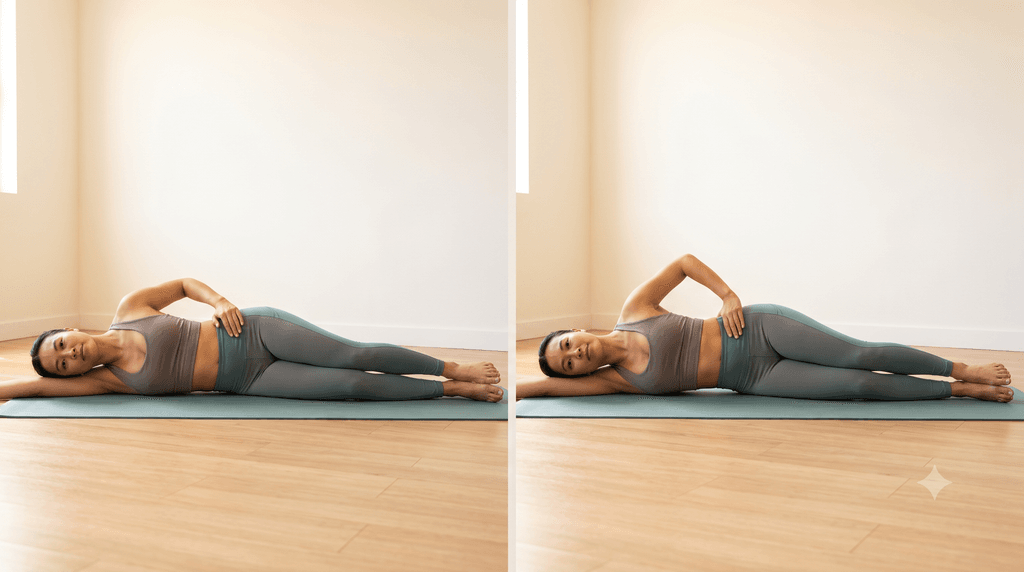
Hip hitches and side planks make the quadratus lumborum hold the pelvis level, its real job; bird dog and extension holds build the erector spinae endurance a long drive drains; leg lifts and carries train the gluteus medius so the back stops covering for it.
For the hip hitch, lie on your side with both legs straight. Without rolling forward, draw the top hip toward your ribs by 2 to 3 cm (about 1 in), hold three seconds and lower slowly. You should feel it deep in the waist.
A muscle that guards because it tires needs capacity more than stretching. If the spot is really in the upper buttock, see this guide to tight glutes and lower back pain.
How long does a lower back knot last?
A knot with a clear trigger, such as a long drive or a weekend of gardening, often settles within a few days to two weeks once that load changes. Knots that return to the same spot for months usually point to an ongoing habit, low endurance or an irritated joint underneath, and respond more slowly.
Desk work and walking usually continue throughout. Most people are back at the gym within a week at lighter loads, and at heavy lifting or contact sport once phase 3 feels easy, commonly within two to six weeks.
If it keeps coming back
If six weeks of consistent exercise and habit changes bring no clear progress, a physical therapist (physiotherapist) can check whether the knot is guarding a joint, disc or hip problem. This comparison of chiropractic care versus massage for lower back pain covers hands-on options.
Injections, dry needling or surgery?
Surgery is not a treatment for muscle knots. Dry needling (a thin needle inserted into the tender spot) or local anesthetic injections are sometimes offered for stubborn cases; relief is often short-lived, so they work best as a bridge into exercise. A painful back mouse that fails other care, or a large or growing lipoma, can be removed surgically, usually as a minor procedure.
The bottom line on a knot in your lower back
Treat the knot as a tired or guarding muscle, but confirm it is muscle first. Tonight, run the relax-then-tense and slide checks. If it behaves like muscle, give it 90 seconds on a tennis ball against a wall, follow with a set of hip hitches, and swap the one-sided habit that set it off.
Frequently asked questions
1. Can a lower back knot cause pain down the leg?
It can send a vague ache into the buttock or back of the thigh, but rarely below the knee. Tingling, numbness or weakness in the calf or foot point to an irritated nerve root instead and deserve assessment within a few days.
2. Why do I always get a knot on the same side?
Usually a one-sided habit is loading that side, such as the hip you carry a child on. A stiff hip or irritated joint on that side can also make its muscles guard. If two weeks of switching sides changes little, the joint is the likelier driver.
3. Is it safe to use a massage gun on a back knot?
Generally yes, on the muscles beside the spine at a low setting, about a minute per area. Avoid the bony midline, numb or bruised skin and any unidentified lump. If you are sorer the next day, lower the setting or switch to a tennis ball.
4. Do you need to break up a knot with deep pressure?
No. Knots are not debris or crystals waiting to be crushed, and a crunch under a ball is tissue sliding, not something breaking. Pressure is thought to work by calming the nervous system’s response, so moderate pressure usually helps as much as brutal pressure, with less bruising.
5. Could a lump on my lower back be cancer?
It is uncommon; most back lumps are lipomas, cysts, back mice or tender muscle. Examination often tells which, and ultrasound settles most of the rest. Growth over weeks matters most, so do not wait for pain before checking a growing lump.
6. Will a knot in my lower back ever go away completely?
Usually yes: pain from a knot with a clear trigger fades within days to weeks. A knot that keeps returning for months is rarely a sign of permanent damage; it usually means something is still overloading that muscle, and it responds once that driver is found.
Medical disclaimer
This article explains how lower back muscle knots usually behave and differ from other lumps; it cannot examine a lump or rule out infection, a nerve problem or a tumor. Ask a clinician before using pressure if you have osteoporosis or take blood thinners. Seek same-day care for a hot, red or fast-swelling lump, fever with back pain or new leg weakness, and emergency care for numbness between the legs or new bladder or bowel problems.
References
- Rathbone ATL, Grosman-Rimon L, Kumbhare DA. Interrater agreement of manual palpation for identification of myofascial trigger points: a systematic review and meta-analysis. The Clinical Journal of Pain. 2017;33(8):715-729.
- Dangoor A, Seddon B, Gerrand C, et al. UK guidelines for the management of soft tissue sarcomas. Clinical Sarcoma Research. 2016;6:20.