Expert Review: This article includes clinical insights from Dr. Vivek Arora, a physical therapist (physiotherapist) with 20+ years of experience.
A back muscle spasm is one of the few events in musculoskeletal medicine that can take a perfectly functional adult from reaching for a dropped phone to frozen on all fours in about three seconds. The movement is trivial. The response is enormous. That mismatch is precisely why most people assume something has torn, slipped, or broken.
Usually, nothing has. The gripping, locked-up sensation is a protective reflex, and the single most effective way to shut it down is not a hard stretch, not two days flat in bed, and not a foam roller. It is positional unloading followed by small, rhythmic movement in whatever direction the spasm still allows. That combination interrupts the loop keeping the muscle switched on. The reasoning behind it matters more than the instruction, because once you understand the loop, you know what to do when the first attempt does not work.
Key takeaways
- Spasm is a response, not the injury. The muscle contracts because the nervous system is trying to splint an irritated area, so treating the muscle in isolation misses the point.
- The loop outlives the trigger. Sustained contraction squeezes its own blood supply, metabolites build up, pain signals increase, and the muscle contracts harder. This is why a spasm can rage on days after a minor bend.
- It usually peaks 12 to 24 hours after the trigger, which is why waking up on day two feels like a deterioration when it is actually the expected curve.
- Unload first, then move. A position that drops the pain within 60 to 90 seconds, followed by gentle rhythmic motion in a small range, does more in an hour than aggressive stretching does in a week.
- A few spasms are warnings. Fever, progressive leg weakness, saddle numbness, bladder or bowel change, or pain that no position eases all change the plan from self-management to prompt assessment.
What is actually happening when your back goes into spasm?
A back muscle spasm is an involuntary, sustained contraction of the muscles surrounding the spine, driven by a protective reflex rather than by damage to the muscle itself. Something in the region sends irritation signals into the spinal cord, and the cord replies by switching on the nearby muscle to restrict movement. The clenching you feel is the nervous system applying a brake, not the tissue that got hurt.
The muscles doing the clenching are rarely the ones people blame. The erector spinae group runs like long cables either side of the spine and mainly controls how fast you lower into a bend. The multifidus sits deeper, spanning only a few segments at a time, and its job is segmental fine-tuning rather than power. Quadratus lumborum bridges the pelvis to the lowest rib and works hardest when you carry a bag on one side or stand asymmetrically. All of these sit inside the thoracolumbar fascia, a broad sheet of connective tissue that transmits tension across the whole lower back. When one segment gets irritated, the reflex does not politely tighten one muscle belly — it recruits across that entire network, which is why the pain often feels like a wide band rather than a point. The relationship between these muscles and everyday low back pain is more about coordination and load-sharing than about raw strength.
The important part is the loop. It runs like this:
- A structure in the area — a facet joint, a disc, a ligament, or the muscle tissue itself — becomes irritated and starts firing nociceptive signals, meaning signals that the nervous system interprets as potential threat.
- The spinal cord responds with a protective motor output, increasing tone in the surrounding muscle to limit movement at that segment.
- That contraction is sustained rather than rhythmic, so it compresses its own small blood vessels. Muscle under continuous tension restricts its own circulation.
- Reduced blood flow means reduced oxygen delivery and slower clearance of metabolic by-products, which accumulate locally.
- Those accumulated by-products are themselves irritating to nociceptors, so the pain signal increases — and the cord answers the increased signal with more contraction.
That is the pain-spasm-pain cycle, and it explains something that otherwise makes no sense: the spasm frequently outlives the thing that caused it. The original irritation may have settled within a day or two, but the loop has become self-sustaining. You are no longer treating the injury. You are treating a reflex that forgot to switch off.
Why does a back spasm get worse the next morning?
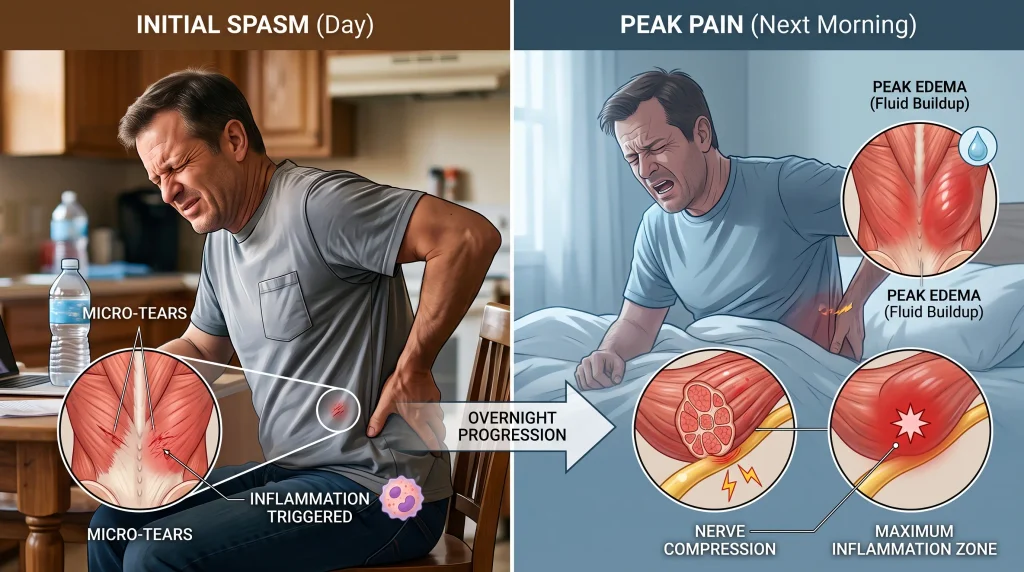
Most back spasms peak somewhere between 12 and 24 hours after the triggering event, not at the moment it happens. The initial mechanical irritation is followed by an inflammatory response that takes hours to build, and inflammatory chemicals lower the firing threshold of local pain receptors. Add a night of near-total stillness, and you wake into a muscle that has been contracting without circulation for eight hours.
This delayed peak causes a lot of unnecessary alarm. People go to bed thinking they have got away with it and wake unable to roll over, and they reasonably conclude they made it worse overnight by sleeping badly. In most cases they simply met the natural curve of the process. Sleep also removes the small, constant positional adjustments you make all day, which are effectively free circulation for a tight muscle.
Onset pattern matters too. A spasm that arrives instantly during a specific movement, such as a sudden flare when bending over, usually has an identifiable mechanical trigger. A spasm that creeps in over an afternoon, with no single moment attached, is more often a cumulative load story — a long drive, an unusually heavy training week, several nights of poor sleep, or a job that kept you in one posture for hours.
Is it a spasm, a cramp, a strain, or something that needs urgent attention?
These four feel similar in the moment but behave very differently over minutes and hours. A protective spasm is a sustained guarding response with a clear positional escape. A true cramp is a short, intensely painful involuntary contraction that releases. A strain is actual tissue overload with tenderness on direct testing. And a small subset of spasms is a signal from something that is not primarily muscular at all.
| Pattern | What it feels like | Timing and duration | What eases it | What it commonly suggests |
|---|---|---|---|---|
| Protective spasm (guarding) | Broad band of gripping tightness, often to one side; movement feels blocked rather than weak | Builds over minutes to hours, peaks at 12 to 24 hours, eases over days | A specific unloaded position; gentle rhythmic movement; heat | A reflex response to an irritated joint, disc, or soft tissue in the region |
| True muscle cramp | Sharp, visible or palpable knot, extremely intense, often mid-activity or at night | Seconds to a few minutes, then releases fully | Slow lengthening of the cramping muscle; the pain stops once it releases | Fatigue, unaccustomed load, or occasionally fluid and electrolyte factors |
| Muscle strain or tear | Localized, point-tender; hurts when you contract that muscle against resistance | Immediate onset during effort, soreness increases over 24 to 48 hours | Relative rest from the aggravating contraction; graded load after a few days | Tissue overload beyond current capacity, usually a clear mechanism |
| Spasm with warning features | Spasm plus fever, progressive leg weakness, numbness in the saddle region, or unrelenting night pain | May not follow any predictable curve; often worse at rest or overnight | Nothing reliably; no position gives meaningful relief | A non-mechanical or neurological source that should be assessed promptly |
One presentation deserves a separate mention because it frightens people badly: a spasm severe enough to visibly bend you sideways. That posture is the reflex choosing the position of least irritation and holding you there. It looks dramatic and it is uncomfortable, but a body that leans to one side with low back pain is generally a mechanical pattern that resolves as the underlying irritation settles, not evidence that the spine has shifted out of place.
When is a back spasm a red flag?
The vast majority of back spasms are benign and self-limiting. A small number are the muscular expression of something else, and those are identified by the company the spasm keeps rather than by its intensity. Severity alone is a poor guide — some of the most agonizing spasms are entirely mechanical. What matters is whether other systems are involved, whether neurological function is changing, and whether the pain behaves in a way mechanical pain does not.
- Spasm with fever, chills, or night sweats. Muscle guarding can be the body splinting an infected structure. Spinal infections such as discitis or vertebral osteomyelitis are uncommon, but they present with back pain and marked muscle protection, and they require prompt investigation.
- Spasm with leg weakness that is getting worse. Difficulty pushing off the toes, a foot that catches on stairs, or a leg that gives way suggests the nerve root is being compromised rather than simply irritated. Progression over days is the concerning part, not a single episode of heaviness.
- Numbness in the saddle region, or any change in bladder or bowel control. Numbness across the inner thighs, buttocks, or genital area, difficulty starting or feeling urination, or new incontinence may indicate cauda equina compression. This is treated as a medical emergency and needs same-day emergency assessment, not a physical therapy appointment.
- Spasm that no position relieves, or that is worse lying flat and wakes you in the small hours. Mechanical pain almost always has an escape position. Pain that ignores position and peaks at night is behaving in a way that warrants a broader look.
- Spasm after significant trauma, or in someone with osteoporosis or long-term corticosteroid use. Vertebral compression fractures can occur with very little force in bone that has lost density, and the surrounding muscle spasm may be the loudest symptom.
- Spasm with unexplained weight loss, or a personal history of cancer. New back pain in someone with a previous malignancy should be assessed rather than assumed to be muscular, particularly when it is not clearly linked to a movement.
- Spasm with flank pain, blood in the urine, or pain that comes in waves. Renal problems can produce genuine muscle guarding in the lower back, and the wave-like quality is a useful clue that the source may not be the spine.
Seek care if
- You have new numbness around the groin, inner thighs, or buttocks, or you cannot tell when your bladder is full — go to an emergency department the same day.
- Leg weakness is measurably worse today than it was yesterday.
- You have a temperature alongside the spasm, or you feel systemically unwell.
- After 72 hours you still cannot find a single position that reduces the pain even slightly.
- The spasm is still limiting basic daily function at the two-week mark despite sensible self-management.
Do you need an X-ray or MRI for a back muscle spasm?
In most cases, no. Muscle spasm does not appear on an X-ray or MRI, so imaging cannot confirm the thing you are actually experiencing. Scans look for structural problems such as fractures, significant disc herniation compressing a nerve root, or signs of infection or tumor. When none of those is clinically suspected, imaging tends to add cost and anxiety without changing what anyone does next.
UK national guidance takes a clear position on this: routine imaging is not recommended for low back pain in non-specialist settings, and it should be considered only when the result is likely to change management. That last phrase is the whole test. If a scan finding would alter the treatment plan — for example, confirming nerve root compression that matches the symptoms in someone considering an injection or surgery — it earns its place. If the plan is going to be the same either way, it does not.
There is a second, less obvious cost. Disc bulges, degenerative changes, and facet arthrosis are extremely common findings in people with no pain at all, and seeing them on a report can convert a temporary muscular episode into a long-term belief about a fragile spine. Understanding what the phrases in a low back X-ray report actually mean is genuinely protective if you have already had one, because most of those terms describe age-related change rather than injury.
What makes a back spasm last longer than it should?
Three beliefs reliably extend a spasm that would otherwise settle. Each one feels intuitively correct, which is exactly why it persists. The common thread is that all three treat the muscle as the problem to be defeated, when the muscle is following instructions from a nervous system that has decided the area needs protecting. Argue with the muscle and you lose. Change the input and the muscle stands down.
Myth one: you need to stretch it out. A muscle in protective spasm is not short — it is switched on. Pulling into it lengthens a contracting muscle against its own reflex, which increases spindle activity and typically feeds the loop rather than releasing it. People often report the stretch feels good for about 20 seconds and then the grip returns harder. Small-range rhythmic movement achieves what the stretch was aiming for without provoking the reflex.
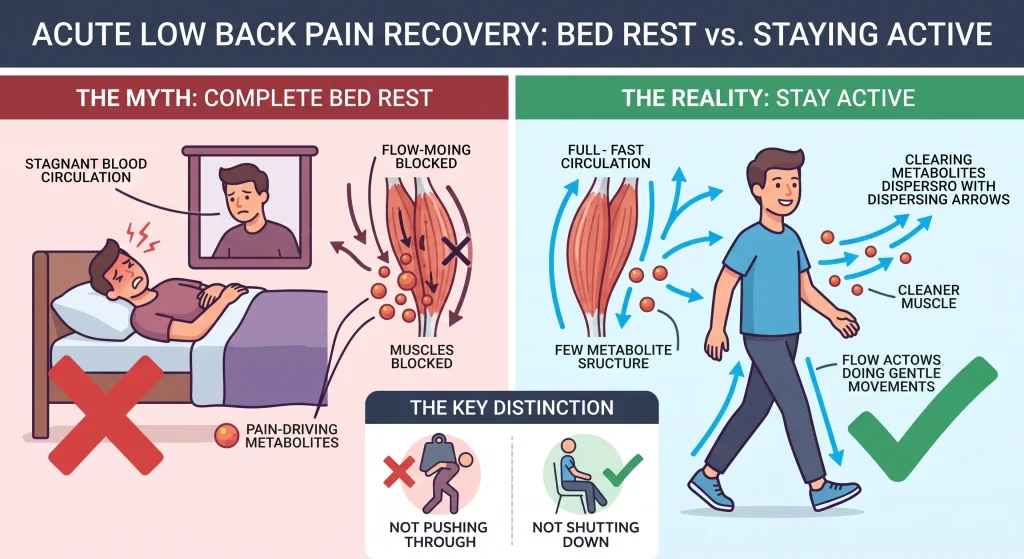
Myth two: rest completely until it settles. Prolonged bed rest removes the circulation that clears the metabolites driving the pain half of the loop. A Cochrane review of trials comparing advice to rest in bed with advice to stay active found small benefits in pain and function favoring staying active in acute low back pain. The distinction matters: staying active does not mean pushing through, it means not shutting down.
Myth three: something has gone out of place and needs to be put back. Vertebrae do not slip out and get reseated. What changes during a spasm is muscle tone, segmental irritation, and how you are distributing load — all of which are reversible without anything being repositioned. This belief matters clinically because it pushes people toward repeated passive treatment and away from the movement that actually resolves the loop.
From the Clinic: Dr. Arora’s Expert Insight
Almost everyone who arrives after a back spasm brings me a culprit already selected — the sock, the suitcase, the sneeze, the toddler. And almost every time, when we walk backwards through the preceding two or three weeks, the actual work was done long before that moment. A holiday that broke a training rhythm and then a rushed return to it. Four nights of five-hour sleep. A new car with a seat that sits you in a slight rotation. A project deadline that turned a mobile job into a sedentary one. The event people blame is usually just the last small demand placed on a system that had already been quietly running out of tolerance. That reframe changes the conversation from “what did I do wrong” to “what accumulated”, which is a far more useful question because accumulation is something you can manage.
The place generic advice fails hardest here is the instruction to release the tight muscle — the roller, the ball against the wall, the aggressive stretch held until it burns. Applied to a protective spasm, this is a category error. You are treating a switched-on muscle as if it were a short one, and pressing hard into a region the nervous system has already flagged as needing defending. A pattern that comes up repeatedly is someone who has spent five days escalating self-massage intensity, who is genuinely bewildered that the muscle keeps tightening back within the hour. It tightens back because nothing has changed the reason it was recruited in the first place.
The detail I find most useful in the acute phase, and one that rarely gets mentioned, is breathing. People in spasm breath-hold. They take shallow upper-chest breaths and keep the abdominal wall braced continuously, because bracing feels safer. The problem is that continuous abdominal bracing maintains tension through the thoracolumbar fascia, which is the same system the spasm is running through — so the protective strategy quietly keeps the loop supplied. When I get someone into an unloaded position and coach a long, slow exhale with a genuinely relaxed abdominal wall for six or eight breaths, the tone often drops noticeably before any exercise has been performed. It is not a relaxation technique in the wellness sense. It is removing a tension input that the person did not know they were providing.
What actually stops a back muscle spasm fast?
The fastest reliable approach is positional unloading followed by gentle rhythmic movement in the direction the spasm still permits. Unloading removes the mechanical input that is driving the reflex, and rhythmic movement restores the circulation that a sustained contraction has cut off, clearing the metabolites feeding the pain side of the loop. Together they break the cycle. Neither works nearly as well on its own.
Here is how that plays out in practice, in order:
- Find your unloaded position. Test three or four candidates and judge each by whether the pain drops meaningfully within 60 to 90 seconds. Common winners are lying on your back with the lower legs supported on a chair or sofa so hips and knees are both at roughly 90 degrees; side-lying with a pillow between the knees and a small towel roll under the waist; or a semi-reclined position with the hips higher than the knees. If a position has not helped in 90 seconds, it is not your position — move on rather than persisting.
- Breathe out slowly, six to eight times, with a soft belly. Long exhales with a genuinely unbraced abdominal wall reduce the background tension running through the lower back before you attempt any movement.
- Add small rhythmic movement inside the comfortable range. From the unloaded position, rock the knees a few centimeters side to side, or tilt the pelvis gently back and forth, 10 to 15 slow repetitions. Stay well within the range that does not provoke a grab. Repeat every 20 to 30 minutes while awake. Rhythmic beats static every time here, because it is the pumping action that restores flow.
- Use heat rather than cold for the muscular component. Heat encourages local blood flow, which is precisely what a chronically contracting muscle lacks. Cold has a role when there is a fresh, clearly inflammatory injury, and the choice between ice and heat for lower back pain depends mostly on which of those two pictures you are in.
- Get upright and walk in short bouts. Three to five minutes of flat walking every hour or so, even at a shuffle, does more for circulation than any single position. Short and frequent beats one long attempt.
What to do today
- Spend 10 minutes identifying your one unloaded position, and note it down. You will need it repeatedly over the next three days.
- Set an hourly reminder: 10 to 15 gentle rhythmic repetitions, then 3 to 5 minutes of walking.
- Apply heat for 15 to 20 minutes, two or three times, ideally just before the movement bouts rather than instead of them.
- Do not test the painful movement to see if it still hurts. Repeatedly poking the reflex keeps it awake.
- Sleep with support that maintains your unloaded position — a pillow under the knees if you sleep on your back, between the knees if you sleep on your side.
How do you get back to normal without triggering another episode?
Recovery from a back spasm runs in phases, and the mistake most people make is judging progress by pain level alone. Pain is a poor progression signal in the first week because it fluctuates with the reflex rather than with tissue healing. Better markers are what you can do, how long a position is tolerated, and whether symptoms settle quickly after activity rather than escalating through the following day.
| Phase | Typical timing | Goal | What it looks like | Ready to progress when |
|---|---|---|---|---|
| 1. Calm the reflex | 0 to 72 hours | Break the pain-spasm-pain loop | Unloaded positions, hourly rhythmic movement, short walks, heat, long exhales | You can change position without a guarding grab, and you can walk 5 minutes continuously |
| 2. Restore range | Day 3 to day 10 | Recover pain-free movement in all directions | Knee rolls, pelvic tilts, cat-camel, hip flexor and hamstring mobility, walking 10 to 20 minutes | You can bend forward to knee height and rotate both ways without the spasm re-engaging |
| 3. Reload the system | Week 2 to week 4 | Rebuild tolerance under real load | Bridges, dead bugs, side planks, sit-to-stand from a low chair, hip hinge practice with no weight | You can hinge to shin height and hold a 30-second side plank each side without next-day flare |
| 4. Return to capacity | Week 4 to week 12 | Remove the vulnerability that allowed it | Progressive loaded hinging and carrying, gradual return to sport or gym, work-specific tasks | Symptoms settle within an hour of activity and do not rebound the following morning |
The exercises in phases 2 and 3 are chosen for specific reasons rather than as a generic list. Knee rolls and pelvic tilts deliver the rhythmic segmental motion that restores flow without demanding force. Bridges and dead bugs rebuild the hip extensors and anterior trunk so the lumbar segments stop being the default answer to every load. Side planks target quadratus lumborum and the lateral system, which matters because one-sided carrying is a frequent contributor to the accumulation that preceded the episode. Hinge practice teaches the hips to do the bending, which is the single mechanical change that most reduces recurrence. A structured progression of home exercises for lower back pain is usually enough for a first episode, provided it moves forward on criteria rather than on the calendar.
Do’s and don’ts specific to spasm
- Do change position before the spasm reminds you to. Set a limit — 20 to 30 minutes in any one posture for the first week — and move before symptoms build rather than after.
- Do keep the abdominal wall soft during daily tasks. Continuous bracing is the most common thing people add without realizing, and it maintains exactly the tension you are trying to reduce.
- Don’t stretch into the gripping sensation. If a movement produces a sharp defensive catch, back off to the range just before it and work there.
- Don’t spend the day on the floor. Lying down has a role as a positional reset in bouts of 10 to 20 minutes, not as a day-long strategy.
- Don’t carry on one side. Bags, toddlers, shopping and laptop cases all load the lateral system asymmetrically, and that is often the accumulated factor that set the episode up.
- Don’t hold your breath during any movement. If you cannot talk through a repetition, the load or range is currently too high.
Return-to-activity milestones
Use function, not a date on the calendar. Before returning to desk-based work at full hours, you should be able to sit for 30 minutes without needing to shift constantly and stand up without using your hands to push off. Before driving any distance, you should be able to check both blind spots and get in and out of the seat without a defensive catch. Before returning to the gym, you should manage a bodyweight hip hinge to shin height, hold a 30-second side plank on each side, and carry roughly 10 kg (22 lb) in one hand for 20 meters (about 65 feet) each side without symptom escalation. Before returning to running or a sport with cutting and rotation, you should be pain-free through a full session of the preceding tier, and symptoms should not rebound the following morning.
When conservative care stalls, and where surgery fits
If a back spasm is still meaningfully limiting you at six weeks despite sensible self-management, the useful question is not “should I do more of the same” but “what is still driving it”. Recurring spasm at the same segment often points to something the reflex is protecting — a persistently irritable joint, a segment with poor movement control, or hip and thoracic stiffness pushing the workload downward. This is the point at which an in-person assessment earns its keep, because these are things that need to be tested rather than guessed. A supervised exercise program, and manual therapy delivered as part of a package that includes exercise rather than as a treatment on its own, are the reasonable next steps in guideline terms.
Surgery has essentially no role in treating muscle spasm itself. There is nothing to operate on: the spasm is a motor response, not a structural lesion. Surgery becomes part of the conversation only when there is nerve root compression producing genuine neurological compromise, when the imaging findings clearly match the symptoms, and when non-surgical treatment has failed to improve pain or function. In that specific situation, spinal decompression may be considered. A spasm alone, however severe and however many times it recurs, does not meet that bar.
The realistic outlook
Most acute back spasms settle substantially within one to two weeks, with the sharpest improvement usually occurring between days three and seven once the loop is interrupted. Residual stiffness for another two to four weeks is common and is not a sign that something was missed. Recurrence is the more meaningful issue: an episode indicates that the system reached its tolerance limit, and unless that tolerance changes, the next demanding period will find the same edge.
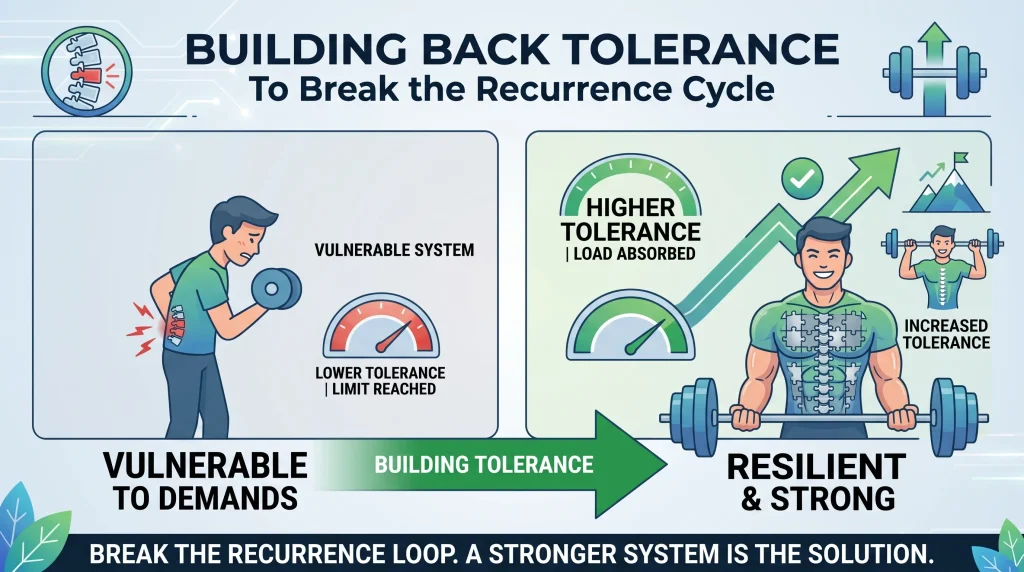
The most reliable protection is not a stronger back in the abstract but better distribution of load — hips that hinge, a thoracic spine that rotates, and enough capacity in the lateral and posterior chain that the lumbar segments are not repeatedly the last line of defense. That is built in phases 3 and 4, which is exactly the part people skip once the pain has gone.
The bottom line on back muscle spasm
A back muscle spasm is your nervous system slamming on a brake, and it will keep the brake on for as long as it believes the area is under threat. That is why the intensity of the pain tells you very little about the seriousness of the problem, and why the fastest route out is to change the input rather than fight the muscle. Unload, breathe out, move rhythmically in the range you have, and keep the intervals short and frequent.
So do this next: find the one position that drops your pain within 90 seconds, and pair it with 10 gentle repetitions and a 3-minute walk every hour you are awake today. If you are still without a single relieving position after 72 hours, or if any of the warning features appear, that is the moment to get assessed rather than to keep waiting it out.
Frequently asked questions
How long does a back muscle spasm usually last?
The acute gripping phase typically lasts two to five days, with most people substantially better within one to two weeks. Individual spasm episodes within that period may last minutes to hours rather than being continuous. Lingering stiffness for a few weeks afterwards is common and does not mean the spasm has returned.
Should I stretch a back spasm or leave it alone?
Neither — move it gently rather than stretching or resting it. Sustained stretching into a protective spasm tends to provoke more contraction, while complete rest slows the circulation that clears the irritants driving the pain. Small, repeated movements inside your comfortable range are the middle path that works.
Can a back spasm cause pain down my leg?
Yes, spasm can refer a dull, diffuse ache into the buttock and upper thigh, but it does not usually produce true nerve symptoms. Sharp, electric, or burning pain travelling past the knee with pins and needles or numbness points toward nerve root involvement instead, and the sensations that actually identify sciatica are quite distinct from muscular referral.
Why does my back spasm when I am not doing anything?
Because the reflex is triggered by the state of the tissue, not by the size of the movement. Once a segment is sensitized, a yawn, a cough, or simply rolling in bed can supply enough input to set the protective contraction off. This is a sign of a low threshold, not of a serious injury.
Do muscle relaxants actually help back spasms?
They can reduce the intensity of the contraction short term for some people, but they act centrally rather than switching off the local reflex, and drowsiness is a common trade-off. If they are prescribed, treat them as a window that makes gentle movement possible rather than as the treatment itself. Any medication decision belongs with the prescriber who knows your history.
Can dehydration or low magnesium cause back spasms?
Fluid and electrolyte factors are more relevant to true cramps than to protective back spasm. A back that seizes after a bend or a heavy week is following a mechanical reflex, and no amount of hydration will switch that off. Staying reasonably hydrated is sensible, but treating it as the fix usually delays the things that work.
Am I going to keep getting these for the rest of my life?
Not necessarily, but a first episode does mean your current tolerance was exceeded, and recurrence is common in people who stop rehabilitation the moment the pain settles. The people who avoid repeat episodes are generally those who complete the loading phases and change the accumulating factors — one-sided carrying, long static postures, sudden jumps in training. It is a capacity problem, and capacity is modifiable.
Medical disclaimer
This article explains how back muscle spasm typically behaves and how it is generally managed, but it cannot examine your back, test your reflexes, or check your strength — and those are the things that separate an ordinary protective spasm from the small number of presentations that need urgent attention. Nothing here replaces an individual assessment by a qualified clinician who can take your history and examine you in person. If you have any of the warning features described in this article, particularly changes in bladder or bowel function, numbness around the saddle region, worsening leg weakness, or spasm accompanied by fever, seek medical assessment immediately rather than continuing with self-management. Medication decisions, including muscle relaxants and anti-inflammatories, should be made with a prescriber who knows your medical history.
References
- National Institute for Health and Care Excellence. Low back pain and sciatica in over 16s: assessment and management (NG59). 2016, last updated 2020. https://www.nice.org.uk/guidance/ng59
- Dahm KT, Brurberg KG, Jamtvedt G, Hagen KB. Advice to rest in bed versus advice to stay active for acute low-back pain and sciatica. Cochrane Database of Systematic Reviews. 2010;(6):CD007612. https://doi.org/10.1002/14651858.CD007612.pub2