
Expert Review: This article includes clinical insights from Dr. Vivek Arora, a physical therapist (physiotherapist) with 20+ years of experience.
If you have searched for body leaning to one side lower back pain, you are describing a very specific flare-up: your trunk has drifted left or right, and standing straight feels blocked or sharply painful. People phrase it differently — leaning to one side with back pain, walking bent to one side — but the worry is identical. Why am I crooked, and how do I safely get back to center?
A sideways lean with acute low back pain is usually a protective posture called a lateral shift, not a permanent deformity or a bone out of place. The nervous system adopts it to unload an irritated structure, most often disc or nerve root tissue. It typically settles, but the order of treatment matters: correcting the sideways shift comes before any extension work, because reversing that order commonly makes leg symptoms worse.
Key takeaways
- The crookedness is a symptom, not the problem. It is a protective response to an irritable structure, which is why forcing yourself straight rarely works and often hurts.
- Standing still is the test that matters. A lean that persists when you are stationary points toward a true lateral shift. A lean that only appears when you walk points toward hip or sacroiliac pain.
- Sequence beats effort. Side-glide correction first, extension work second. Press-ups performed while the shift is still present frequently send symptoms further down the leg.
- Watch which way symptoms travel. Pain retreating up toward the back is a good sign. Pain spreading further down the leg means stop.
- Some presentations need a clinician, not a home routine. Progressive weakness, changes in bladder or bowel control, or a shift that will not budge at all are assessment territory.
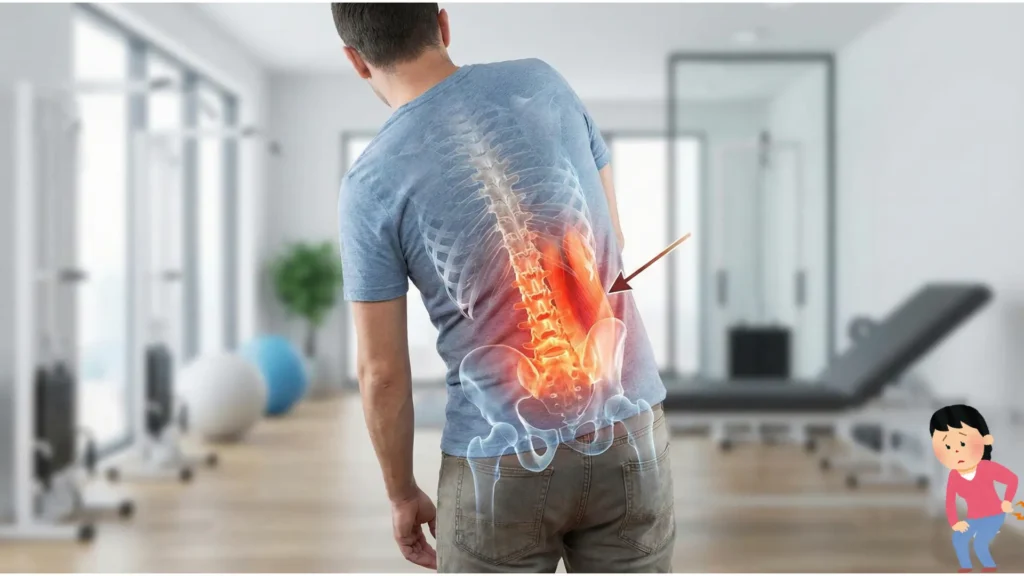
What is actually happening when the trunk shifts sideways?
A fixed crooked posture, where the shoulders sit laterally offset from the pelvis even when you are standing still, is called a lateral shift or trunk list. It is a whole-trunk translation rather than a bend or a twist. Clinically it is associated with irritable disc and nerve root presentations, and the shift often changes as those symptoms change — which is precisely why it is worth paying attention to.
The pattern in plain anatomical terms
Your lumbar spine is a stack of vertebrae with discs between them. Nerve roots exit close to those discs and travel toward the buttock and leg. When disc and nerve tissue becomes highly sensitized, the body will often settle into whichever position reduces the mechanical irritation — and sometimes that position involves translating the whole trunk to one side.
That is why the lean feels involuntary. You are not choosing to stand crooked. You are defaulting into the shape your nervous system currently reads as safest, and attempts to override it directly meet resistance.
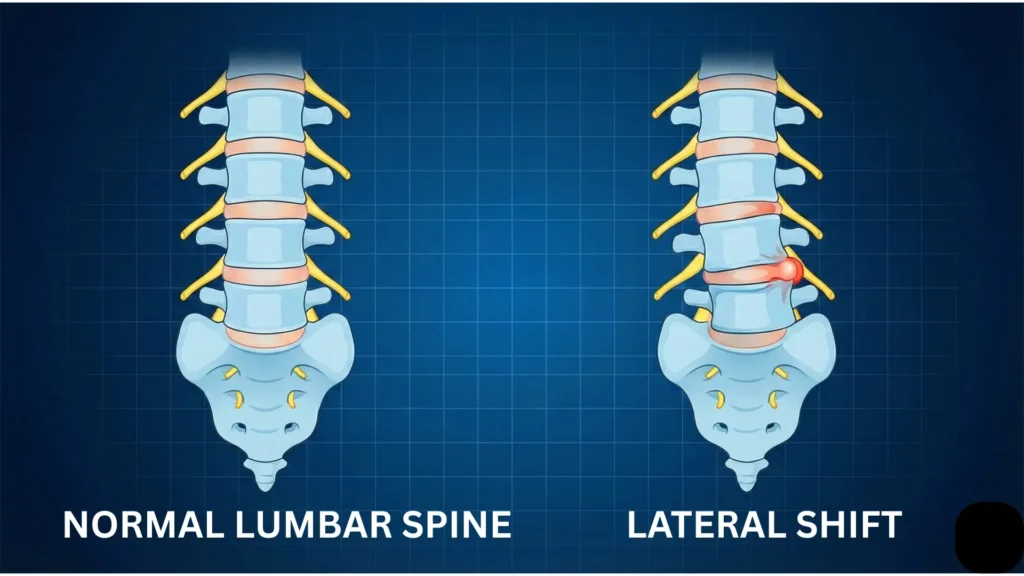
Typical signs of a true lateral shift
- You look crooked in a mirror, with the shoulders shifted left or right relative to the hips
- The crookedness remains when you are standing still, not only while walking
- Trying to straighten feels blocked or sharp, or provokes leg symptoms
- Walking feels guarded and awkward rather than simply sore
- Gliding the pelvis one way feels jammed, not just tight
Is it a lateral shift or just an antalgic lean?
This is the distinction that prevents most wrong self-diagnosis. A lateral shift is a fixed trunk offset that is present while you stand still and feels mechanically locked. An antalgic lean is a weight-bearing avoidance strategy — you tip away from the painful side as you step onto it, and look considerably straighter when standing with even weight. The first behaves like a disc and nerve problem. The second behaves like a hip or sacroiliac problem.
| Pattern | Standing still | What aggravates it | Leg symptoms | What it usually suggests |
|---|---|---|---|---|
| True lateral shift (trunk list) | Visibly offset and feels locked | Trying to return to midline; bending; coughing or sneezing | Common — buttock, thigh, sometimes below the knee | Irritable disc or nerve root tissue |
| Antalgic lean | Looks close to centered with even weight | Weight-bearing on the painful leg; stairs; fatigue | Usually local to hip or groin, not below the knee | Hip joint, gluteal tendon or sacroiliac pain |
| One-sided muscle guarding | Mildly offset, feels like a clamp rather than a block | Sudden movement, cold, prolonged sitting | Rare | Protective spasm around an irritated segment |
| Facet joint irritation | Guarded but not fixed | Arching backward and twisting | Referred to buttock at most | Extension and rotation sensitive joint irritation |
Sacroiliac and hip problems genuinely do change your gait and can make you lean. But a crooked posture that persists while you are standing still, with both feet evenly loaded, is far more consistent with a lateral shift than with isolated sacroiliac dysfunction. A Trendelenburg pattern — the pelvis dropping on one side because the hip abductors are painful or weak — also belongs in the antalgic column, not the shift column.
What causes it?
1) Disc and nerve irritation with a shift pattern
The classic story is a bend, lift or twist, followed by pain, followed by the realization that you cannot straighten up. Clinically, the shift is treated as the first target, with extension-based loading introduced only once alignment has improved.
Clues: pain may spread into the buttock, thigh or calf; coughing, sneezing or straining spikes it; one direction of movement clearly worsens the leg symptoms.
2) One-sided muscle guarding
Protective spasm can pull you sideways too, but it tends to feel like a clamp rather than a mechanical block, and it rarely comes with a consistent leg component.
Clues: pain is more local, near the spine or the iliac crest; heat and gentle walking help; no reliable symptoms below the knee.
3) Facet joint irritation
The small paired joints at the back of each segment can produce sharp one-sided pain and a guarded posture, though usually without a true fixed list.
Clues: worse with arching and twisting; many people feel better in slight flexion.
4) Hip drivers
Gluteal tendon pain, hip abductor weakness or hip joint irritation produce an antalgic lean while walking far more often than a fixed trunk list.
Clues: lateral hip or groin pain; the limp worsens as you fatigue; standing on one leg is painful or unstable.
5) Uncommon but important causes
Fracture, infection, inflammatory spinal disease and tumor are all rare in this presentation but serious when present. The distinguishing feature is usually that the pain does not respond to a change in position, and that systemic features accompany it.
When does this need assessment rather than self-treatment?
Self-management is reasonable when the shift is recent, the leg symptoms are stable or improving, and gentle correction is tolerated. It stops being reasonable the moment neurological function changes, the shift refuses to move at all, or symptoms travel further down the leg with every attempt. The features below are the ones that should redirect you from a home routine to a clinical assessment.
Emergency — same-day assessment
- New difficulty passing or controlling urine, or loss of bowel control. Combined with acute back pain this may indicate cauda equina compression, where the time to decompression strongly affects the outcome.
- Numbness in the saddle area — groin, genitals, inner thighs. This is the sensory counterpart of the same emergency and should never be watched at home overnight.
- Weakness that is getting worse rather than staying stable. A foot that catches on steps, or a calf that can no longer push off, indicates motor involvement that is progressing.
- Fever, chills or feeling systemically unwell with severe back pain. These raise the possibility of spinal infection rather than a mechanical episode.
- Significant trauma, or a history of cancer or immune suppression with new severe pain. Both lower the threshold for imaging considerably.
- Severe constant pain that does not change with any position. Mechanical pain almost always eases in some posture. Pain that ignores position needs a different explanation.
Arrange assessment within days
- Gentle correction attempts consistently push symptoms further down the leg. This is peripheralization, and it usually means the direction or the dose is wrong — something that is much easier to work out with someone watching you move.
- The shift has not budged at all in seven to ten days. A rigid, unresponsive list suggests the irritability is high enough to need guided treatment rather than repetition at home.
- You cannot walk normally or sleep through the night. Function and sleep are the two variables that most reliably track the severity of a nerve-related episode.
- The episode keeps returning with trivial triggers. Repeated shifts on minor provocation point to an underlying tolerance problem that a flare protocol alone will not solve.
It is worth knowing what an assessment should and should not produce. Scans are not the default step here: NICE guidance on low back pain and sciatica advises against routine imaging in non-specialist settings, and recommends it only where the result is likely to change management. What you want instead is a neurological screen, testing for a directional preference, a shift correction strategy and a staged loading plan.
Safe home checks
None of these are diagnostic. They help you work out whether you are dealing with a true shift and how your symptoms are behaving.
- Mirror check. Stand still, weight even. Are your shoulders offset from your hips? Can you return to center without a sharp block?
- Small side-glide check. Without twisting, glide the pelvis a short distance left, then right. If one direction is sharply blocked or increases leg symptoms, that is useful information.
- Two-minute walking check. Do you loosen slightly after 60–90 seconds, or do symptoms spread further down the leg?
- Supported strength check. Holding a kitchen counter, lift your toes up on one foot, then the other; then rise onto the ball of one foot, then the other. A clear difference between sides warrants assessment. Do this holding on — unsupported heel and toe walking is an unnecessary fall risk when you are already unsteady.
- Centralization check. Centralization means symptoms retreating from the leg or buttock back toward the spine as you repeat a movement. Try 8–10 gentle repetitions of your least uncomfortable direction. Symptoms moving upward is generally a favorable response; symptoms moving downward is a signal to stop.
From the Clinic: Dr. Arora’s Expert Insight
The most common reason this drags on is that people skip the clinical sequence. They find press-ups online and start them immediately, while the shift is still fully present. In patients with a visible trunk list, extension before correction frequently produces a sharp block or drives symptoms further down the leg — and then the person concludes that exercise made things worse and stops moving altogether.
When the order is right — correct the shift, then use extension to hold the change — people generally regain midline faster and flare less. The posture is protective. You do not win by forcing it straight. You win by restoring alignment in the direction the spine will actually accept that day, then reinforcing it with a loading progression that respects how irritable the tissue still is.
How do I fix body leaning to one side lower back pain?
In two stages, in this order. Plan A corrects the sideways shift by repositioning the pelvis under the ribcage, using side-glides against a wall. Plan B introduces gentle extension — prone on elbows, then small press-ups — only once you are visibly closer to midline. If Plan A produces no change in alignment at all, or symptoms rapidly travel further down the leg, stop and get assessed rather than pushing harder.
Plan A, step 1: identify your shift direction
- Shoulders sitting to the right of your pelvis is a right shift
- Shoulders sitting to the left of your pelvis is a left shift
Plan A, step 2: the wall side-glide
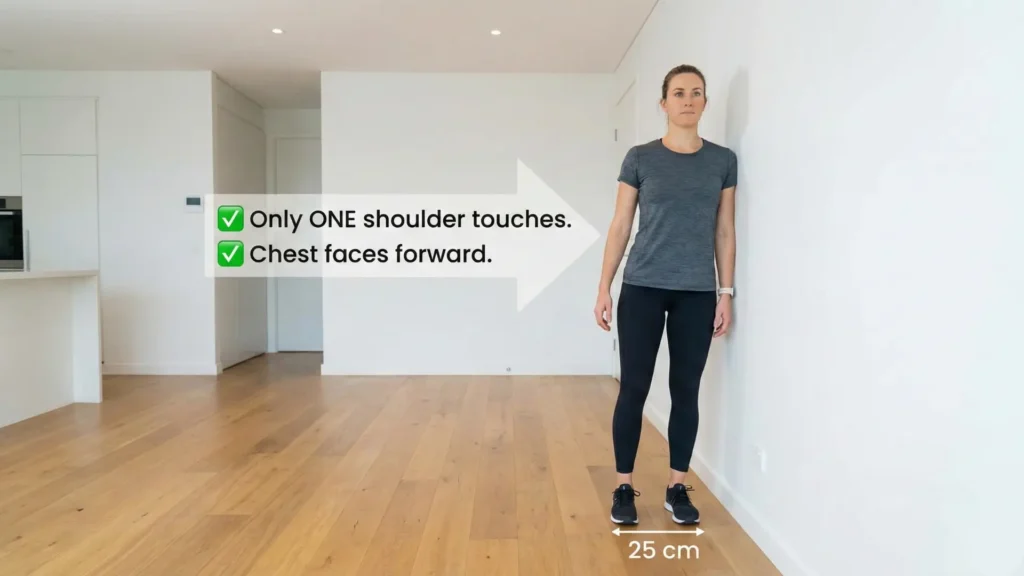
The rule: stand with the side you are leaning toward against the wall. So for a right shift, your right side goes to the wall.
- Stand beside the wall with your right side closest to it, body parallel to the wall.
- Rest only your right shoulder and upper arm against it. The left shoulder stays off the wall.
- Keep both feet 20–30 cm (8–12 in) away from the wall, parallel and facing forward.
- Keeping that shoulder in contact and your chest facing forward, slide your pelvis toward the wall so the hips travel back under the ribcage.
- Return only part way — do not bounce — and repeat.
For a left shift, mirror everything: left shoulder to the wall, pelvis gliding left.
Dose: 10 repetitions, rest 30–60 seconds, 2–3 rounds a day as tolerated.
The three cues that stop most mistakes: only one shoulder touches the wall; your chest stays facing forward; the pelvis is the part that moves, not the shoulders.
What it should feel like — and when to stop
A firm stretch or pressure is expected. New electric leg pain is not. The best sign after a set is that you look slightly more centered, or that symptoms have moved upward toward the back.
Stop and reassess if: leg pain travels further down, new numbness or tingling begins, each repetition produces sharp electric pain, or you feel unsteady or faint.
Plan B: extension, once the shift has reduced
Once you are meaningfully closer to midline — even a 30–50% improvement counts — gentle extension can be trialed to reinforce the correction.

Prone on elbows: lie on your stomach, prop onto your elbows, hold 30–60 seconds with slow breathing.

Small press-ups: hands under the shoulders, press up gently while the hips stay down, and stop before any sharp block or spread of leg symptoms. 8–10 repetitions, 1–3 sets a day if tolerated.
The rule that overrides everything: if press-ups worsen your leg symptoms, stop and go back to Plan A or to a relief position.
The first 72 hours
Do
- Short frequent walks — 5–10 minutes, three to six times a day
- Use relief positions: side-lying with a pillow between the knees, or on your back with the calves supported
- Heat or ice for 10–15 minutes, whichever genuinely reduces your symptoms
Don’t
- Force yourself upright and hold it for long stretches — the shift will simply reassert itself, usually with interest
- Stretch aggressively into the pain
- Twist or crack the back to put it back — there is nothing out of place to return
- Carry loads on one side while the tissue is still irritable
Rehab timeline after the shift settles
A visible lateral shift implies a highly sensitive system, so the early weeks emphasize symptom control, endurance and symmetrical stability rather than anything that loads the spine sideways.
| Phase | Focus | What to do | Ready to progress when |
|---|---|---|---|
| Week 1 | Calm and control | 90/90 breathing with a gentle brace, 5 breaths × 3 rounds daily; glute bridge 8–12 × 2; modified side plank 10–20 sec × 3 per side; short frequent walks | Posture is visibly closer to midline and leg symptoms are no longer spreading |
| Week 2 | Stability endurance, no lateral shear | Slow dead bug 6–8 per side × 2; slow bird dog 6–8 per side × 2; unloaded hip hinge pattern 8–10 × 2 | You can hold each position without the low back taking over, and walking tolerance is rising |
| Weeks 3–4 | Symmetrical loading | Increase walking duration; add light bilateral resistance; continue the bridge, dead bug and bird dog progressions | Daily activities are comfortable and symptoms stay settled the next morning |
| Weeks 4–6 | Asymmetrical load tolerance | Suitcase carry, 20–30 steps per side × 2–3 rounds, starting light | Only start this once the basics are symptom-free; stop if the posture shifts again |
If you want a carry earlier than week four, keep it symmetrical — two lighter weights rather than one — and only after week three if symptoms have been stable.
Myths vs facts
Myth: “Any lean means an SI joint problem.”
Fact: Sacroiliac and hip pain more often produce a walking limp than a fixed trunk list. The standing-still test separates them.
Myth: “Press-ups are always step one.”
Fact: With a visible shift, correction comes first. Extension applied before correction commonly worsens leg symptoms.
Myth: “If I am crooked, my spine is permanently out of place.”
Fact: Most cases are temporary protective patterns that resolve with the right sequence and a sensible loading progression.
The bottom line
Body leaning to one side lower back pain is usually a protective lateral shift rather than damage, and it responds to sequence far better than to effort. Work out whether the lean persists when you stand still, correct the shift with wall side-glides before you attempt any extension, and use the direction your leg symptoms travel as your feedback. Expect meaningful change within seven to ten days. If weakness is progressing, bladder or bowel function changes, or the shift will not move at all, that is the point to hand it over to a clinician rather than repeating the same routine harder.
FAQ
Why does the lean come on so suddenly?
Because it is a reflex response, not a gradual change. Acute disc or nerve root sensitivity prompts the trunk to translate sideways within minutes, which is why people describe standing up from a bend and finding themselves crooked. Muscle guarding adds to it, but a fixed trunk list is the giveaway.
Does leaning to one side always mean a disc problem?
No, but a fixed shift that persists while standing still is far more suggestive of disc and nerve irritation than of sacroiliac or hip pain alone. A lean that appears only when you walk, and disappears when you stand evenly, usually points elsewhere.
Should I start press-ups straight away?
Not while a visible shift is present. Correct the shift first with side-glides, then introduce extension once you are closer to midline. Extension applied to an uncorrected shift is one of the most reliable ways to make leg symptoms worse.
How do I know the exercise is working?
Two signs. Symptoms centralize — they retreat from the leg toward the back — and your posture looks visibly more centered in a mirror. Neither needs to happen dramatically; a small change in the right direction after a set is enough to continue.
What if side-glides make my leg pain worse?
Stop immediately. Symptoms travelling further down the leg is peripheralization, and it means the direction or the dose is wrong. Return to a relief position and arrange an assessment rather than repeating the movement to see if it settles.
Is walking helpful while I am still crooked?
Usually yes, in short frequent doses of five to ten minutes rather than one long walk. Stop if symptoms spread further down the leg during or after walking, which suggests the nerve is still too irritable for that distance.
Can massage correct a lateral shift?
It can reduce the guarding around it temporarily, which sometimes makes correction easier, but it does not reposition the trunk. Genuine correction needs direction-specific repositioning followed by a loading progression.
When can I start strengthening again?
Once the shift is clearly improving and symptoms have calmed. The first two weeks should be stability endurance work — bridges, dead bugs, bird dogs. Heavier and single-sided loading belongs several weeks later.
Medical disclaimer
This article is general education and is not a substitute for individual assessment. Shift correction is direction-specific, and the right direction cannot be determined from an article — if your symptoms are severe, neurological or not responding, arrange an in-person examination with a qualified clinician.
References
- National Institute for Health and Care Excellence. Low back pain and sciatica in over 16s: assessment and management (NG59). NICE guideline, published 2016, last updated 2020.