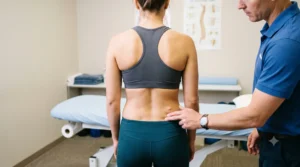
Where your pain is felt can help a clinician plan the assessment. Tests that put pressure through the sacroiliac joint are clinician-administered. No single home check can establish the joint as the cause.
Expert Review: This article includes clinical insights from Dr. Vivek Arora, a physical therapist (physiotherapist) with 20+ years of experience.
The sacroiliac (SI) joint connects the base of the spine to the pelvis. Pain near it can come from the SI joint, the lumbar spine, the hip or another cause. The location can guide an examination.
Key takeaways
- The SI joint normally moves very little. Routine pain in this area does not mean the joint needs to be put back in place.
- Pain near one of the lower back dimples is worth pointing out to a clinician. Several conditions can cause pain there.
- Mention whether stairs, getting in or out of a car, or turning in bed provoke familiar symptoms.
- Clinicians may use a group of pain provocation tests. A positive group may raise suspicion, and the findings need to be interpreted with the rest of the examination.
- Pain that began before age 45, has lasted months or comes with night waking, stiffness or improvement with movement may warrant assessment for inflammatory back pain.
What is sacroiliac joint dysfunction, and does the joint really go out of place?
The SI joint lies between the sacrum, at the base of the spine, and the ilium, part of the pelvis. SI joint pain refers to pain believed to arise from the joint or nearby supporting tissues. Inflammation and injury are also possible causes.
The joint helps transfer forces between the trunk and legs and is supported by strong ligaments. A movement assessment can guide treatment, but it cannot show that a specific muscle has failed to stabilize the joint.
A clinician checks what affects pain and function. Small differences in pelvic position and tenderness to touch can occur without establishing the source of pain.
What does sacroiliac joint pain actually feel like?
SI joint pain can be felt low on one side near the buttock and may spread into the thigh or leg. It can overlap with symptoms from the hip or lumbar spine.
The bony landmark near the back dimple is the posterior superior iliac spine. Pain around the lower back dimples helps describe the location. No exact distance from the landmark confirms a diagnosis.
Observations to share at an assessment
- Can you cover the worst of the pain with one hand, below the belt line, on one side?
- Is stepping up onto a stair or curb clearly worse on that side?
- Does rolling over in bed make you brace or wake you?
- Which everyday movements aggravate or ease your pain?
Note what you experience in ordinary activities and share it with a clinician. The answers cannot identify which structure is causing the pain.
Who tends to get sacroiliac joint dysfunction?
Pregnancy or childbirth, an injury and previous lumbar fusion are among the histories a clinician may ask about. These details shape what to examine and whether other conditions need to be considered.
Pain after childbirth has several possible contributors. Tell your clinician when the pain started, whether you had an injury and whether you have other back, hip or pelvic symptoms.
How do clinicians test for it?
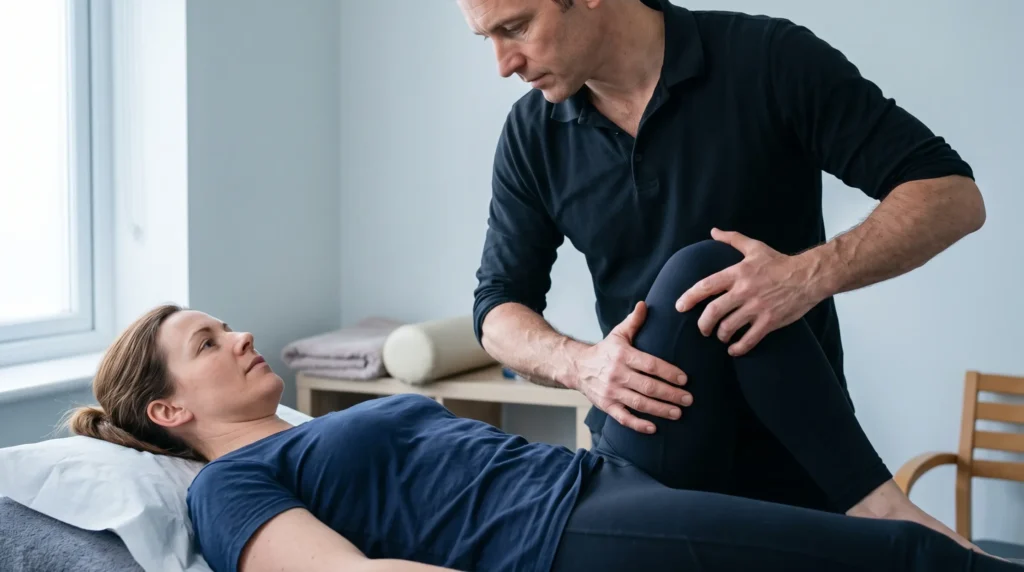
Clinicians may use several maneuvers to see whether they reproduce familiar pain. Three positive tests are sometimes used as one finding in an assessment. The clinician also looks for signs of problems in the lumbar spine or hip.
- Distraction — outward, backward pressure on both front pelvic bones, gapping the front of the joint.
- Thigh thrust — hip bent to about 90 degrees, force directed down the femur to shear the joint surface.
- Compression — side-lying, downward pressure through the upper pelvic rim.
- Sacral thrust — face down, pressure through the center of the sacrum.
- Gaenslen’s test — one hip pulled into deep flexion while the other extends off the table edge, twisting the halves of the pelvis oppositely.
A systematic review of five studies found very low-certainty evidence. Assuming a 20% starting probability, a positive cluster raised the estimated probability to 35% and a negative cluster lowered it to 8%. These estimates depend on the starting probability. A positive cluster alone is insufficient to establish the joint as the source.
Could it be something other than the SI joint?
SI joint pain, nerve-related pain, other lumbar symptoms, hip conditions and inflammatory disease can overlap. Symptoms can help a clinician decide what to examine.

| Possible source | Possible symptom area | Activities that may aggravate symptoms | Changes that may help | What a clinician may check |
|---|---|---|---|---|
| SI joint region | Buttock or near a lower back dimple, sometimes farther into the leg | Stairs, single-leg tasks or turning in bed | A comfortable position or activity change | Familiar pain on a group of tests interpreted with other findings |
| Other lumbar joint-related pain | Lower back or buttock | Standing, twisting or leaning back may be uncomfortable | Position changes | Back movement and other possible causes |
| Lumbar nerve root | Leg symptoms with or without back pain | Sitting, movement or coughing may affect symptoms | Individual response to position or movement | Strength, reflexes and sensation |
| Hip joint | Groin, thigh or buttock, sometimes farther down the leg | Walking, pivoting or putting on shoes may be uncomfortable | Modifying a task | Hip movement and strength alongside other findings |
| Inflammatory sacroiliitis | Buttock or lower back | Rest or the second half of the night can be difficult | Movement can ease symptoms | Age at onset, duration, associated conditions and whether referral is indicated |
See how back and hip symptoms can overlap. New weakness or a change in sensation may suggest a nerve problem and warrants assessment.
When is this more than a mechanical problem?
Inflammation in the SI joints can occur with axial spondyloarthritis. Symptoms can include long-lasting back pain that started before age 45, night waking, buttock pain, stiffness and improvement with movement. Individual symptoms do not establish an inflammatory diagnosis.
NICE guidance describes when a clinician should refer a person whose back pain began before age 45 and has lasted more than three months. It uses a combination of additional features. When exactly three apply, the guideline advises HLA-B27 testing and referral if positive. Tell your clinician about psoriasis, inflammatory bowel disease, a painful red eye or a family history of spondyloarthritis.
Seek care promptly if
- Emergency care now: new numbness around the genitals or anus, new difficulty passing or controlling urine, new loss of bowel control or sensation, severe or worsening weakness or numbness in both legs, or new sciatica on both sides.
- Seek urgent medical assessment for back or pelvic pain with fever or if you feel acutely unwell.
- Contact a clinician promptly for new persistent pain with unexplained weight loss or a history of cancer.
- Seek urgent assessment if you cannot bear weight after a fall, especially if you have osteoporosis or take long-term steroids.
- Seek medical assessment for persistent or worsening pain that is unexplained or interferes with sleep and daily activities.
When is imaging actually needed?
Imaging is usually unnecessary at the start for suspected mechanical pain. It can be helpful when a clinician suspects inflammation, fracture, infection or another condition that would change management.
That mirrors NICE guidance on low back pain and sciatica, which advises against routine imaging outside specialist settings and recommends it only where the result would change management. In practice: suspected axial spondyloarthritis, where MRI can show bone marrow edema before X-ray changes appear; suspected sacral or pelvic fracture; red flags suggesting infection or malignancy. Report phrases like “degenerative change” or “mild sclerosis” are common with age and are not, alone, an explanation for pain.
From the Clinic: Dr. Arora’s Expert Insight
Show your clinician the activity that is most difficult. Watching you step up or stand on one leg can guide rehabilitation when those activities are safe to assess.
A movement may be limited by pain, confidence, strength or balance. The assessment can help choose exercises you can practise comfortably.
After childbirth, share what matters most in your daily routine, such as getting off the floor or carrying a child. A pelvic health assessment can be helpful if pelvic symptoms also persist.
What does a physical therapist actually do for sacroiliac joint dysfunction?

A physical therapist can assess symptoms and movement and help you choose activity and exercises to work toward your goals. Hands-on care may be an option within a broader exercise plan.
What to do today
- Stay active within what you can manage. Try a short level walk if it feels comfortable.
- Temporarily adapt tasks that repeatedly worsen the pain, such as sitting down to dress or taking stairs with a rail.
- If it feels more comfortable, try a pillow between your knees in side-lying or beneath them when you rest on your back.
- Change position when standing becomes uncomfortable. Try a short movement break or alternate tasks.
- A warm pack can help some people feel more comfortable. Protect the skin, and seek care if you suspect an injury or have warning signs.
The examples below show how exercises can build toward everyday activities. A clinician can help choose a starting point.
| Phase | Goal | Representative work | Ready to progress when |
|---|---|---|---|
| Comfortable movement | Keep up tolerable everyday activity | Short walks or a comfortable bridge if appropriate | Daily activities are becoming easier |
| Gradual strength and balance | Build tolerance for tasks such as climbing stairs | Side-lying hip exercise, supported step-ups or a split squat | Current exercises are manageable and symptoms recover between sessions |
| Return to usual activity | Practise work or sport demands | Gradual strengthening or a return to running when appropriate | You and your clinician agree that you can resume the activity safely |
Hip, leg and trunk exercises are options. Choose work that matches an activity you want to regain and that you can practise safely.
Do’s and don’ts for this joint
- Change standing and carrying positions if that feels more comfortable.
- Discuss a pelvic support belt with your clinician if you are pregnant or recovering from childbirth and have pelvic girdle pain. Suitability is individual.
- Avoid forcing a movement just to produce a pop. Ask a clinician for help if the urge comes from repeated pain or stiffness.
- Ease off stretches that repeatedly aggravate familiar symptoms.
- Take position breaks or try a different seat if sitting becomes uncomfortable.
Returning to running, lifting and sport
For running or lifting, start with an amount and intensity you can manage. Gradually reintroduce distance, speed or load as appropriate. Seek reassessment for worsening symptoms or a change in strength or feeling.
When conservative care stalls, and where surgery fits
If pain persists or limits daily life, ask for reassessment. A specialist may consider an image-guided injection in selected cases. The result is interpreted along with the history and examination.
A specialist may discuss procedures, including fusion, for carefully selected people with persistent disabling pain. This decision depends on the diagnosis, previous treatment and potential benefits and risks.
The realistic outlook
Improvement varies with the cause and the activities you want to resume. Contact a clinician if pain is worsening, waking you frequently or accompanied by unexplained stiffness or other symptoms.
Frequently asked questions
Can a chiropractor put my SI joint back in place?
The SI joint normally moves only a small amount. Typical pain in this area does not show that a joint is displaced. Hands-on treatment may provide short-term relief for some people as part of an exercise plan.
Does SI joint pain cause numbness or tingling down the leg?
SI joint pain can spread into the leg. Numbness, tingling or weakness may have a nerve-related cause and should be discussed with a clinician. Follow the emergency advice above for new bilateral symptoms or saddle, bladder or bowel changes.
Is it safe to keep running with SI joint pain?
If you have been assessed and running is appropriate, try an amount you can manage and adjust according to your symptoms. Ask for reassessment if symptoms are getting worse.
Will this become permanent damage if I leave it too long?
The prognosis depends on the cause. Persistent or worsening symptoms deserve assessment, especially if they began after injury or occur with signs of inflammation.
Why does my pain get worse during my period or in pregnancy?
Symptoms may change with a menstrual cycle or pregnancy, for several possible reasons. Discuss persistent or recurrent pelvic or back pain with a clinician rather than assuming the SI joint is responsible.
How long before physical therapy makes a difference?
Timing varies. A clinician can help you track practical changes such as walking, turning in bed or climbing stairs and review the plan if those activities do not get easier.
Medical disclaimer
This article provides general information. The SI joint, lumbar spine and hip can produce overlapping symptoms. Use the emergency and urgent care guidance above for new warning signs.
References
- National Institute for Health and Care Excellence. Spondyloarthritis in over 16s: diagnosis and management (NG65). Published 2017, last updated 2017. https://www.nice.org.uk/guidance/ng65
- National Institute for Health and Care Excellence. Low back pain and sciatica in over 16s: assessment and management (NG59). Published 2016, last updated 2020. https://www.nice.org.uk/guidance/ng59