
Expert Review: This article includes clinical insights from Dr. Vivek Arora, a physical therapist (physiotherapist) with 20+ years of experience.
Few questions come up more often in conservative spine care than this one: is a recliner good for lower back pain, or is it secretly making things worse? The answer is genuinely interesting, because for once the popular intuition and the biomechanics actually agree — but only inside a fairly narrow window. Outside that window, the same recliner that calmed your back at 7 p.m. can leave you stiff, weak, and more sensitive to load by 7 a.m. the next morning.
For most mechanical lower back pain, a recliner does help — a trunk-thigh angle of roughly 120° to 135° with proper lumbar support loads the lumbar discs less than sitting bolt upright at 90°. But the benefit is positional, not therapeutic. Used in short blocks of 20 to 40 minutes with movement in between, it is genuinely useful. Used for hours at a time, it stalls recovery.
This article walks through what positional MRI and intradiscal pressure research actually show about reclined sitting, why a recliner helps some lower back pain presentations and aggravates others, how to use one in a way that supports recovery instead of stalling it, and the red flags that mean a chair is the wrong tool entirely. The goal is not to sell or dismiss recliners — it is to make you confident about how and when one fits into a real rehab plan.

Key Takeaways
- A reclined sitting position around 120°–135° between trunk and thighs places less mechanical load on the lumbar discs than upright 90° sitting or slumping forward, which is why many people with disc-related lower back pain genuinely feel better in a recliner.
- The benefit is positional, not therapeutic — the recliner reduces load while you are in it, but does not strengthen anything, and prolonged use without movement breaks tends to backfire.
- For acute or flare-up phases, short reclined rest blocks (20–40 minutes) interspersed with walking and gentle mobility is a reasonable home-management strategy.
- A recliner is not the right choice when pain is worse with extension, after prolonged sitting, or when symptoms suggest spinal stenosis, hip pathology, or a non-mechanical cause.
- The decisive question is rarely “should I buy a recliner?” — it is “how long am I sitting in any one position before I move?”
What does the research actually say about reclining and disc pressure?
Reclined sitting at a trunk-thigh angle around 120°–135° appears to place less compressive load on the lumbar intervertebral discs than upright 90° sitting, and substantially less than slumped forward sitting. This is the consistent finding across positional MRI studies and intradiscal pressure research. It is the mechanical reason a well-supported recliner often feels like relief during an acute lower back episode — the discs, ligaments, and posterior muscles all share load more evenly than they do in a rigid upright chair.
The most-cited evidence here is a positional MRI study presented at the Radiological Society of North America by Bashir and colleagues, which scanned healthy volunteers in three sitting positions and found the least spinal disc displacement and the most favorable lumbar curvature at a 135° trunk-thigh angle. A more recent systematic review and meta-analysis published in Life in 2022 confirmed that sitting posture induces a significantly higher intradiscal pressure on the lumbar spine than the standing posture in healthy discs, which is part of why reducing the bend at the hip — by reclining the trunk back — eases lumbar load.
A few caveats matter, though. The same meta-analysis noted that in degenerated discs, the difference between sitting and standing intradiscal pressure disappeared. Translation: if your disc is already symptomatic, position helps less than people assume, and movement helps more. The Bashir findings were also based on a small healthy sample under controlled conditions, not on patients in pain at home. So the takeaway is directional, not prescriptive — reclining unloads the lumbar spine in healthy mechanics, and most people with mechanical lower back pain feel it. That is enough to make a recliner useful, but not enough to make it a treatment.
Why does a recliner ease lower back pain for some people?
When you recline, three things shift at once: hip angle opens, lumbar lordosis is supported instead of flattened, and the spine stops working against gravity in a vertical column. Upright sitting at 90° forces the lumbar spine into a position the spine does not naturally want — flexion of the lower back combined with sustained compressive load. Slumping forward is worse, because it adds shear and stretches the posterior ligaments. Reclining back to roughly 120°–135° lets the hips open, the pelvis settle into a neutral tilt, and the lumbar curve come back.
For mechanical lower back pain — the kind that flares with bending, lifting, and prolonged sitting — this position usually feels good for the same reasons the foetal side-lying position does. Pressure on the disc drops. The deep stabilizers are not forced to work continuously. The lumbar erectors get a chance to stop guarding. If you have ever felt a wave of relief the moment you ease back into a recliner at the end of a bad-back day, that is what you were feeling — not magic, just biomechanics.
A reasonable foundation for understanding why sitting position matters at all is laid out in a separate guide on why pain often spikes at the tailbone after long sitting, which covers the same mechanism from the opposite angle.
When is a recliner not a good idea for lower back pain?
A recliner is the wrong tool when pain worsens with extension, when prolonged sitting is the primary trigger, when symptoms point to neural or stenotic causes, or when the back has lost so much movement variety that the chair becomes a hiding place rather than a recovery aid. In these cases the recliner does not just fail to help — it actively delays recovery by training the spine to tolerate only one position.
Some specific patterns where a recliner is the wrong choice:
- Lumbar spinal stenosis. People with stenosis usually feel better in flexion (leaning forward, sitting hunched) and worse in extension. A recliner promotes a more extended lumbar position, which can reproduce or worsen leg symptoms.
- Facet-joint-driven pain. Pain that gets worse with backward bending, twisting, or prolonged standing tends to be facet-irritation pattern. Reclining can load the facets in the wrong direction.
- Hip pathology masquerading as back pain. Hip osteoarthritis, labral issues, or femoroacetabular impingement may feel worse in a deep recliner because the hip joint is held in a position it cannot tolerate.
- Pain that is already worse after long sitting of any kind. If sitting itself is the trigger, switching to a more comfortable chair is not the answer — reducing total sitting time is.
- Pregnancy-related lower back and pelvic pain. Deep recliners can make it harder to maintain neutral pelvic positioning and harder to get out of, particularly later in pregnancy.
The pattern is consistent: a recliner helps when the spine is happier in a slightly extended, well-supported, lightly loaded position. It hurts when the spine is happier in flexion, in motion, or in unloading the hip rather than loading it.
How do I know which type of lower back pain I have?
Most lower back pain falls into one of four broad mechanical patterns, and the response to reclining is one of the clearer differentiators. The table below shows how each pattern typically behaves and whether a recliner is likely to help.
| Pain pattern | Common signals | Better in flexion or extension? | Likely response to a recliner |
|---|---|---|---|
| Disc-related (younger, bending/lifting trigger) | Pain worse with sitting, bending forward, coughing or sneezing; often eases with walking or lying flat | Usually better in extension | Often helps in short blocks; relief while reclined |
| Facet-driven (older, extension-sensitive) | Pain worse with standing long, walking downhill, backward bending; eases with sitting forward | Better in flexion | Often unhelpful; can reproduce pain |
| Spinal stenosis (older, leg-symptom pattern) | Leg heaviness or numbness with walking or standing; relief with sitting or leaning on a cart | Better in flexion | Usually unhelpful; reproduces leg symptoms |
| Non-specific mechanical (mixed) | Diffuse aching, stiff in morning, variable triggers | Variable | Often helps in short blocks if used with movement breaks |
This is a rough orientation, not a diagnosis. A clinical assessment is what actually classifies the pattern, but the table is a reasonable starting point for asking better questions about your own pain.
From the Clinic: Dr. Arora’s Expert Insight
Almost every patient who asks me whether a recliner is “good” or “bad” for their lower back pain is asking the wrong question, and I think it is worth saying so directly. The recliner is a piece of furniture. It is not good or bad in the way an exercise is good or bad. What it does is hold you in one position for a long time — and that is the variable that usually decides whether it helps or hurts.
A pattern that comes up repeatedly is the patient who reports that the recliner is the only place their back feels okay, so they end up spending four, five, sometimes six hours a day in it. They report this as a success. By the time I see them, their hip flexors are short, their glutes are quiet, their thoracic spine has stiffened, and their pain has become more sticky and harder to predict — exactly because they found one position that worked and stopped exploring the rest. The recliner did not cause this. The dose did.
The other failure mode I see is the opposite: patients who have been told by a well-meaning trainer or article that “reclining is bad for the back” and so they sit ramrod-upright at 90° for hours, gritting through pain. Upright sitting at 90° is one of the higher-pressure positions for a lumbar disc, not one of the lower. If a patient is going to sit for two hours straight, a slight recline with proper lumbar support is mechanically friendlier than rigid uprightness — provided they get up and move every 30 to 45 minutes.
What works better clinically, in my experience, is to stop treating the recliner as a verdict and start treating it as a tool. In the first few days of an acute flare, short reclined rest blocks combined with gentle walking and breathing work usually settle things faster than either extreme. Once pain is under control, the recliner moves into the background and the actual treatment — strength, mobility, load tolerance — moves into the foreground. Patients who hold onto the recliner as a long-term solution tend to plateau. Patients who use it for two or three weeks and then taper tend to recover cleanly.
The deeper point is that no chair fixes a back. Positions change load. Movement changes capacity. Capacity is what makes pain go away and stay away.
How should I actually use a recliner if I have lower back pain?
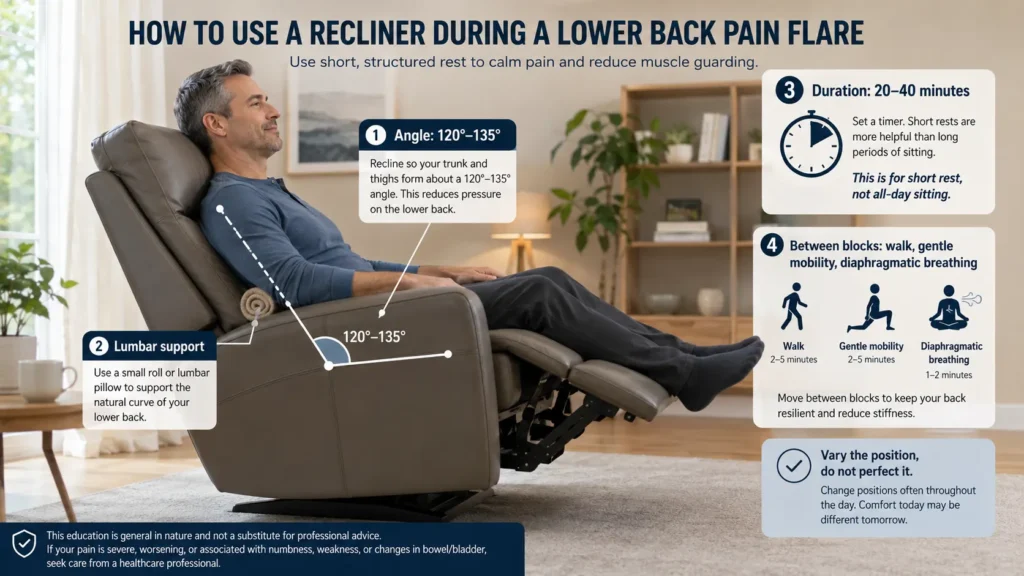
The practical use of a recliner during a lower back episode comes down to four variables: the angle, the lumbar support, the duration of each sitting block, and what you do between blocks. Get those four right and the recliner becomes a genuinely useful piece of acute-phase home equipment. Get them wrong and it becomes a couch trap.
Angle. Aim for a trunk-thigh angle somewhere between 120° and 135°. Most modern recliners cover this range comfortably. Avoid going all the way back to near-horizontal for long sitting — at that point you are not sitting anymore, you are partially lying, and the dynamics change.
Lumbar support. A small rolled towel, lumbar pillow, or built-in lumbar support behind the lower back is more important than the chair’s brand or price. The goal is to maintain a gentle lumbar curve, not to flatten it. If the chair’s backrest collapses the lower back, the recline angle alone will not save you.
Duration. Treat any single sitting block as a 20–40 minute window, not a four-hour shift. Set a timer. Stand up, walk a few minutes, do a brief mobility movement, then return. This is the single most evidence-aligned principle in conservative back care — vary the position, do not perfect it.
What you do between blocks. Short walks, gentle hip mobility, diaphragmatic breathing, and standing for everyday tasks. These are the inputs that actually shift load tolerance. The recliner is the rest period; the between-block movement is the work.
For specific guidance on the heat versus ice question that almost always comes up in the same conversation, a structured walkthrough of when each one is genuinely useful in an acute lower back episode is worth reading separately.
What should you do today?
If your lower back is flared up right now:
- Sit in the recliner at roughly 120°–135°, with a small lumbar roll behind your lower back, for 20–40 minutes maximum at a time.
- Get up and walk for 3–5 minutes every time the timer goes off — even a slow indoor lap counts.
- Do 5–10 reps of slow knee-to-chest (one leg at a time, gentle) or standing hip hinges between recliner blocks if tolerated without sharp pain.
- Limit total recliner time across the day to roughly 3–4 hours, not all day.
- Sleep on a regular mattress, not in the recliner — overnight reclined sleeping commonly leaves the hips stiff and the neck unhappy by morning.
If pain stays the same or worsens over 5–7 days of this approach, the next step is a clinical assessment, not a different chair.
How does a recliner fit into a longer rehab plan?
A recliner is a phase-one tool. It is most useful in the first one to three weeks of an acute lower back flare, where the primary goal is to reduce pain enough that movement becomes possible. Once movement is tolerable, the centre of gravity shifts: the recliner becomes background furniture, and active rehab becomes the engine of recovery.
The four phases of conservative lower back care usually look something like this:
| Phase | Typical timeline | Primary goal | Where the recliner fits |
|---|---|---|---|
| Acute calm-down | Week 1–2 | Reduce pain spike, restore basic movement | Short reclined rest blocks; gentle mobility between |
| Capacity rebuild | Week 2–6 | Restore hip mobility, glute strength, core endurance | Recliner used minimally; daily walks, posterior chain work |
| Load tolerance | Week 6–12 | Build tolerance to lifting, bending, and prolonged sitting | Recliner is just normal evening furniture |
| Return to full demand | After Week 12 | Gym, sport, heavy work, long drives | Recliner irrelevant; spine handles varied loads |
Skipping from Phase 1 straight to “feeling fine” without doing the Phase 2 and Phase 3 work is the single most common reason lower back pain comes back within six to twelve months. The recliner gives you symptom relief; the rehab gives you durability. For readers ready to start the rehab side, a structured set of physical therapy-style lower back exercises covers Phase 2 work in detail, and the role of glute strength specifically is laid out in a separate piece on how tight glutes contribute to lower back pain.
When should I worry — and when is a chair not the answer?
Some symptoms make the recliner question irrelevant. If any of the following apply, a clinical assessment is the next step, not a different chair or position:
- New or progressive weakness in one or both legs
- Numbness in the groin, inner thighs, or genital area (saddle-pattern)
- Loss of bladder or bowel control, or new difficulty starting urination
- Severe pain that wakes you from sleep and does not ease with position changes
- Pain following significant trauma (fall, road accident)
- Unexplained weight loss, fever, or a history of cancer with new lower back pain
- Pain that is steadily worsening over several weeks despite reasonable self-management
These are not “see how it goes” symptoms. They warrant prompt medical evaluation because they may point to nerve compression, cauda equina syndrome, fracture, infection, or — rarely — malignancy. None of these are problems a recliner can fix, and time-to-diagnosis matters.
For lower back pain related specifically to long periods in a vehicle — a separate but related situation — the principles are similar but the setup differs, and a dedicated guide to reducing back pain while driving covers seat angle, lumbar support, and breaks in more detail.
Quick check — is your recliner helping or hurting?
Answer yes or no to each:
- Does your lower back pain ease while you are in the recliner but feel stiff or worse when you get up?
- Are you spending more than 4 hours a day in the recliner?
- Have you been using the recliner heavily for more than 3 weeks without progressing to active rehab?
- Are you sleeping in the recliner overnight because the bed feels worse?
- Is your pain pattern worse in the recliner than in other positions?
Two or more “yes” answers is a sign the recliner has moved from a tool to a crutch. The fix is rarely a different chair — it is reintroducing movement, starting basic rehab, and limiting any one position to short blocks.
Conclusion
So, is a recliner good for lower back pain? In the short answer most patients want: yes, for most mechanical lower back pain, used briefly, used well, and used as part of a plan that also includes movement. A recline angle of roughly 120°–135° with proper lumbar support genuinely reduces lumbar load, and that is enough to make a recliner a useful piece of acute-phase home equipment. In the longer answer most patients need: a recliner is a position, and no position fixes a back. Capacity does. The recliner buys you a few weeks of comfort while you do the actual rehab work — and once that work is done, where you sit in the evening matters far less than how varied, strong, and well-loaded your spine has become.
The right question, in other words, is not whether to buy the recliner. It is whether you are using any chair as a substitute for the rest of the plan.
Frequently Asked Questions
1. Is sleeping in a recliner okay for lower back pain?
Sleeping in a recliner occasionally during a bad flare is usually fine for a few nights. Sleeping in one every night is not — it tends to stiffen the hips, irritate the neck, and reinforce a single posture the spine cannot escape. If a regular mattress genuinely feels worse, that is a clue worth bringing to a clinical assessment, not a reason to make the recliner permanent.
2. How long should I sit in a recliner with lower back pain?
Aim for 20–40 minutes per sitting block, with a movement break between blocks. Total daily time in any one position — recliner, office chair, car seat — is more important than the specific chair. The body responds badly to four hours of stillness, regardless of how supportive the furniture is.
3. Will a recliner replace physical therapy for my back pain?
No. A recliner reduces pain in the position you are in; physical therapy rebuilds the capacity your back needs in every other position. The two work together — the recliner makes the acute phase tolerable while the rehab work changes what the spine can handle. Skipping the rehab is the most common reason flares come back.
4. Can a recliner make sciatica worse?
Sometimes, yes. If the sciatica is driven by a disc problem that responds well to extension, a recliner often helps. If it is driven by spinal stenosis or a piriformis pattern, the same recliner can worsen the leg symptoms. Tracking what specifically aggravates the leg pain — sitting, standing, walking, reclining — is more useful than guessing.
5. What’s the best recliner angle for lower back pain?
A trunk-thigh angle between 120° and 135° is what the imaging and pressure research consistently points to. Most modern recliners reach this range easily. Going fully horizontal is not the same thing — at near-180° you are lying, not sitting, and the body uses the position differently.
6. Should I get a recliner or a zero-gravity chair?
Both achieve a similar trunk-thigh angle, so the biomechanical effect is comparable. Zero-gravity chairs elevate the legs higher, which some people find more relieving for venous return and lower-back-with-leg-symptom presentations. The decision is mostly comfort-driven; neither is a clinical treatment.
7. My pain feels great in the recliner but terrible when I get up. What does that mean?
That pattern usually points to deconditioning of the deep stabilizers, hip stiffness, and prolonged static posture — not a worsening problem. The fix is to shorten each sitting block, add brief mobility transitions before standing up, and start a graduated walking and hip-mobility routine. If the morning-after stiffness keeps worsening despite this, an assessment is the next step.
Medical Disclaimer
This article is for general educational purposes and does not replace individual medical advice, diagnosis, or treatment. Lower back pain has many possible causes, and what is appropriate for one person may be unsuitable for another. If your pain is severe, progressive, accompanied by neurological symptoms, or unresponsive to reasonable self-management, seek assessment from a licensed physical therapist, physician, or other qualified clinician.
References
- Li JQ, Kwong WH, Chan YL, Kawabata M. Comparison of In Vivo Intradiscal Pressure between Sitting and Standing in Human Lumbar Spine: A Systematic Review and Meta-Analysis. Life (Basel). 2022;12(3):457. doi:10.3390/life12030457.
- Bashir WA, Torio T, Smith FW, Takahashi K, Pope M. Alterations of Lumbosacral Curvature and Intervertebral Disc Morphology in Normal Subjects in Variable Sitting Positions Using Whole-body Positional MRI. Scientific abstract presented at the Radiological Society of North America annual meeting, 2006.