New neurological symptoms need assessment even if an epidural was years ago. Get emergency care now for new difficulty passing or controlling urine, new loss of bowel control or sensation, numbness around the genitals or anus, or new sciatic pain down both legs. Severe or worsening weakness or numbness in both legs also needs emergency care. Get urgent assessment for new or worsening weakness in one leg. See the American Society of Anesthesiologists’ statement on obstetric neuraxial complications.
If the procedure was recent, use the guide to warning signs in the first weeks after a childbirth epidural.
Expert Review: This article includes clinical insights from Dr. Vivek Arora, a physical therapist (physiotherapist) with 20+ years of experience.
The toddler is almost two. The newborn-fog haze has lifted. You’ve stopped breastfeeding (or you haven’t), you’ve gone back to work (or you haven’t), and life has more or less reorganized itself around a small human who now runs. But one thing has not resolved: your lower back. It nags when you stand at the sink, catches when you bend to scoop up your child, dulls every long drive, and flares whenever you sit too long. Somewhere along the way someone — your mother-in-law, a coworker, a forum thread at 2 a.m. — said the words: it must be the epidural.
That theory is everywhere. And once it lodges, it’s hard to dislodge.
Lower back pain 2 years after a childbirth epidural deserves assessment. Trials have not shown a higher rate of long-term backache after labor epidural analgesia compared with non-epidural pain relief, but they cannot establish the cause of an individual’s pain or exclude a rare complication. This article concerns epidurals for childbirth; it does not address epidural steroid injections for spinal conditions.
Key Takeaways
- Comparative labor-analgesia research has not shown an increased rate of long-term backache, but rare complications need individual assessment.
- Persistent pain at two years warrants assessment rather than being automatically attributed to the injection or to postpartum mechanics.
- Possible contributors include prior back or pelvic girdle pain, daily activity demands, abdominal or pelvic symptoms and unrelated back or medical conditions.
- Exercise and activity changes may help an assessed musculoskeletal condition. Imaging depends on clinical findings rather than a mandatory rehabilitation waiting period.
- Get emergency care now for new difficulty passing or controlling urine, loss of bowel control or sensation, or numbness around the genitals or anus. New sciatic pain down both legs or severe or worsening weakness or numbness in both legs also needs emergency care. Get urgent medical assessment for new or worsening weakness in one leg. Arrange assessment for unexplained weight loss or pain that persists at night.
What does “lower back pain 2 years after epidural” usually turn out to be?
Pain with sitting, standing or childcare tasks can occur with several conditions. Describe its onset, whether it began during the procedure or later, and any leg, scar, pelvic, bowel or bladder symptoms. These details guide assessment; location alone cannot distinguish an anesthetic complication from another cause.
A temporal link is worth discussing, but it does not prove causation. Bring the procedure history and symptom timeline to your clinician rather than assuming either a needle injury or faulty parenting habits.
Lower Back Pain 2 Years After Epidural: What the Evidence Actually Says
The strongest evidence on this question comes from prospective randomized trials and a major systematic review — and the finding is unusually consistent.
Howell and colleagues followed women from a randomized labor-analgesia comparison at about two years after delivery. They found no evidence of a difference in long-term back pain, disability or movement restriction between groups. This addresses average group outcomes, not every possible individual complication.
The 2018 Cochrane review included data from 40 trials involving more than 11,000 women overall. Its long-term-backache result came from only two studies involving 814 women, with no clear difference between groups (risk ratio 1.00, 95% confidence interval 0.89–1.12). The full review population should not be presented as the backache sample.
Local soreness can occur after a procedure. Serious neurological complications are rare and usually become apparent early, but timing alone cannot exclude one. Symptoms present since the procedure, or new neurological changes at any later point, require an appropriate review.
These findings support considering other causes without dismissing your symptoms or promising that physical therapy will resolve them.
What’s actually causing the pain? Anatomy and biomechanics two years on
Pregnancy, birth and daily demands can change comfort and function. They do not leave every person with permanent muscle dysfunction or a requirement for a standard rehabilitation sequence.
Abdominal wall, pelvic and activity changes vary between people. Neither abdominal separation nor back pain proves that deep muscles have switched off. Pelvic floor symptoms and neurological findings should be assessed when present.

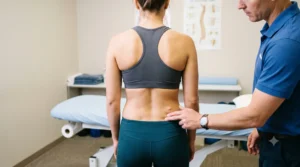
This image is for representational and educational purposes only. It is not intended to serve as or replace professional medical advice, diagnosis, or treatment.
Childcare, work, sleep and returning to activity can affect symptoms. These are useful contextual factors, rather than proof of harmful movement habits.
Persistent symptoms can follow different delivery routes and occur without an epidural. The guide to back pain a year after a C-section discusses a related setting without assuming a common cause.
What else commonly drives this pattern? (Differential thinking)
The table lists possibilities to discuss. None can be diagnosed from a two-year interval or a particular pain location alone.
| Observation | What assessment may consider | What it cannot prove |
|---|---|---|
| Back pain with sitting or standing | Back, hip and general activity tolerance | A weak or unretrained core |
| One-sided pain with rolling or stairs | Hip or pelvic girdle examination | Persistent relaxin-related instability |
| Abdominal doming or scar symptoms | Abdominal wall and scar assessment | That abdominal separation caused back pain |
| Pain with childcare tasks | Task modification and manageable loads | Harmful asymmetry or a specific weak muscle |
| Pain since pregnancy | Prior symptoms and other causes | That the epidural was or was not responsible |
| Pelvic heaviness, leakage or pain | Pelvic health or medical assessment | A weak rather than overactive pelvic floor |
Use these observations to prepare for an examination rather than to diagnose a weak core or unstable pelvis. The broader guide to low back pain in women describes other possible causes.
When could it actually be related to the epidural? And what should genuinely worry me?

New isolated back pain years after a symptom-free interval is not the usual presentation of an acute neuraxial complication. However, persistent symptoms that began around the procedure should be discussed with the anesthesia team, and new neurological symptoms require assessment regardless of timing.
Far more important than the epidural question are the general red flags that warrant urgent assessment regardless of cause or timing:
⚠️ Seek care urgently if you experience:
- New or worsening weakness in one or both legs
- Numbness in the area that would touch a saddle (inner thighs, buttocks, genitals)
- New loss of bladder control, or new difficulty emptying the bladder
- New loss of bowel control or sensation requires emergency care. Constipation alone has many causes and is not equivalent to cauda equina syndrome; seek medical advice for persistent constipation or severe abdominal symptoms.
- Unexplained weight loss, fever, or night sweats with back pain
- Pain that wakes you from sleep and is unrelieved by changing position
- Back pain following recent significant trauma
These features are not specific to postpartum or post-epidural pain. They are reasons to be seen urgently no matter who you are.
Do I need an MRI?
Not automatically. An examination can determine whether a scan is likely to change care. Two years of pain should not be dismissed, but MRI findings alone may not establish its source. Warning signs or significant neurological findings may require prompt investigation.
Imaging becomes genuinely useful when:
- Red flags are present
- Symptoms are clearly neurological (significant leg weakness, true radicular pain in a specific nerve distribution)
- Symptoms remain limiting or change despite appropriate care, and imaging would answer a specific management question.
- A specific surgical question is being asked
Assessment may include back and hip movement, strength, neurological function and pelvic symptoms. Movement-sensitive pain does not rule out a medical condition.
From the Clinic: Dr. Arora’s Expert Insight
If there is one conversation that comes up almost weekly in postpartum back pain assessments, it is this one: a woman walks in convinced her pain is from the epidural, and she has been carrying that belief for two years like a verdict. Many have already had imaging that came back essentially normal, which made things worse rather than better — because if nothing structural is wrong but the pain is real, the explanation must be something nobody else has spotted, and the epidural becomes the lingering suspect.
Possible findings include reduced strength, uncomfortable movement or pelvic symptoms, but no pattern is universal. A normal MRI neither disproves pain nor establishes a deep-core deficit.
Crunches, planks and other exercises are not categorically harmful after childbirth. Choose a tolerable starting level and modify the task for pain, pressure, leakage or other relevant findings; there is no single required order for all patients.
A useful assessment connects the timeline and examination to achievable goals. It should not assume an epidural injury or a body that failed to recover before the findings are known.
What should I actually do today?
✅ What to do this week
- Treat the pain as worth assessing without assuming permanent damage or declaring the spine normal from this article.
- Try a short comfortable walk if appropriate. Start with a duration you can manage rather than a fixed distance.
- Audit carrying habits. For one day, notice which hip you put the child on, which arm carries the car seat, and which side you sleep on. Begin alternating consciously.
- Address sitting. If you feed, work, or scroll for long stretches, change position every 25–30 minutes, even briefly.
- Try a few comfortable unloaded bends if appropriate, stopping before symptoms increase. Eighty hinges a day is not a necessary starting prescription.
- Book a postpartum-trained physical therapist (physiotherapist) assessment if pain has been ongoing for more than a month or is limiting daily activity.
For a familiar flare without warning signs, wrapped warmth or cold may offer comfort. The response does not diagnose muscle guarding or exclude inflammation; see the heat and cold guidance.
Phase-by-phase rehab: how the rebuild actually works
Rehabilitation can combine comfortable movement, strength and task practice in an order suited to the person. The examples below are not a mandatory sequence or a recovery timetable.
| Goal | Examples if appropriate | Progression guide |
|---|---|---|
| Comfortable movement | Short walks or easy mobility | Manageable symptoms and safe movement |
| Build capacity | Hip and trunk exercise selected from assessment | Small increases without a sustained flare |
| Practice daily tasks | Light lifting or carrying adapted to need | Comfort and function; no universal kilogram target |
| Return to recreation | Graded gym, running or other activity | Individual goals and clinical advice |
| Maintain progress | A workable activity routine | Review recurrence or new symptoms |
Track goals such as easier lifting, less disrupted sleep or longer comfortable activity. The home exercise guide provides options to discuss and adapt rather than a guaranteed sequence.
What makes it worse and what to avoid
Some of the most well-intentioned advice quietly makes postpartum back pain worse.

Avoid in the early phase:
- Exercises that repeatedly worsen back pain, pressure, leakage or other symptoms without adjusting their dose.
- Classes that exceed your current capacity or any medical restrictions.
- Prolonged sitting in deep slouched postures while feeding or scrolling
- Always carrying the child on the same side
- “Pushing through” exercise that consistently flares the back for hours afterwards
Do more of:
- Walk daily, every day, even if briefly
- Comfortable breathing during exercise without treating a deep-core activation drill as a prerequisite.
- Hip and glute strengthening, both sides equally
- Manageable lifting strategies and loads matched to your current tolerance.
- Strength work twice a week — the postpartum body responds to loading, not just stretching
Breastfeeding posture and the load of carrying influence the spine in ways that are easy to overlook. Women with larger breasts often carry an additional load pattern that interacts with postpartum back changes; this article on lower back pain and breast load explores that overlap in more detail.
When does conservative care fail, and what comes next?
An individualized plan should be reviewed against agreed functional goals. Lack of improvement is a reason to revisit the diagnosis, dose and barriers to care, rather than blame the person for not following a sequence.
If, after a genuine 6–8 week effort with a skilled clinician, the picture is unchanged, the next steps are:
- Detailed re-assessment. Often the original working diagnosis was incomplete. Pelvic floor involvement, hip joint pathology, or sacroiliac joint dysfunction may have been under-treated.
- Targeted investigations: Consider tests only when the history, examination and management question justify them.
- Specialist referral. A spine physician, women’s health physician, or pelvic medicine specialist may be appropriate depending on what the reassessment reveals.
Surgery has essentially no role in uncomplicated postpartum mechanical back pain. It is reserved for specific surgical pathology — significant nerve compression with neurological deficit, or structural instability — and that is rarely what this presentation is.
Realistic outlook
The cause and outlook of lower back pain 2 years after a childbirth epidural vary. Improvement remains possible, but this article cannot predict full recovery or identify a missed rehabilitation program as the cause. Arrange assessment if pain continues to limit daily life.
The next useful step is a clear assessment and a practical plan, rather than assigning blame to the procedure or to your recovery.
Frequently Asked Questions
1. Can an epidural cause back pain years later?
Labor-epidural trials have not shown an increased average rate of long-term backache. This does not exclude an individual complication. Discuss symptoms that began during or soon after the procedure with the anesthesia team and assess new neurological changes promptly.
2. Why does my back hurt only on one side two years after an epidural?
One-sided pain has several possible causes, including back, hip, pelvic girdle or other medical conditions. Carrying habits may affect comfort but cannot diagnose the cause.
3. Is it normal to still have postpartum back pain after two years?
Persistent pain can occur after childbirth, but two years of symptoms deserves assessment. It does not prove that you missed rehabilitation or that an epidural caused the pain.
4. Could I have permanent nerve damage from my epidural?
Serious anesthesia-related nerve injury is rare and usually presents early. Persistent weakness, sensory changes or bladder/bowel symptoms need individual assessment; an article cannot rule out nerve injury from the timing or type of ache.
5. Will an MRI tell me what’s wrong?
MRI can help when it answers a clinical question that changes management, but findings can also occur without pain. A clinician can decide whether imaging is relevant after examining you.
6. Can I get back into the gym or running with this kind of pain?
A graded return may be possible, depending on the cause and your current function. No single deep-core sequence is required; seek advice for pelvic symptoms, neurological changes or repeated flares.
7. How long will it take to fix this?
There is no reliable recovery deadline for this symptom description. Agree on functional goals and a review date, and reassess sooner if symptoms worsen.
8. Should I be worried that no one has been able to fix it so far?
Continued symptoms justify a fresh review of the diagnosis and treatment response. They do not by themselves establish permanent damage, a missed muscle deficit or a procedure complication.
Medical Disclaimer
This article is intended for general educational purposes and does not replace personalized medical assessment. If symptoms are worsening, accompanied by neurological changes, or limiting daily life, please seek in-person evaluation from a qualified clinician. Questions about anesthetic procedures should be discussed directly with an anesthesiologist or the obstetric team that managed the delivery.
References
- Howell CJ, Dean T, Lucking L, Dziedzic K, Jones PW, Johanson RB. Randomised study of long term outcome after epidural versus non-epidural analgesia during labour. BMJ. 2002;325(7360):357. doi:10.1136/bmj.325.7360.357. Available at: https://pmc.ncbi.nlm.nih.gov/articles/PMC117883/
- Anim-Somuah M, Smyth RMD, Cyna AM, Cuthbert A. Epidural versus non-epidural or no analgesia for pain management in labour. Cochrane Database of Systematic Reviews. 2018;5:CD000331. doi:10.1002/14651858.CD000331.pub4. Available at: https://www.cochranelibrary.com/cdsr/doi/10.1002/14651858.CD000331.pub4/full