Expert Review: This article includes clinical insights from Dr. Vivek Arora, a physical therapist (physiotherapist) with 20+ years of experience.
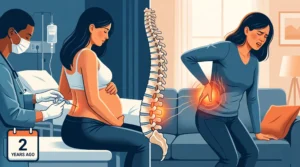
Two weeks after giving birth, almost nobody is thinking about their spine. The attention is on feeding, sleep and weight gain. So when the low back starts complaining, it tends to arrive with a suspect already attached: lower back pain 2 weeks after epidural feels like it must be the epidural’s doing, because the epidural is the one discrete thing that happened to your back.
That instinct is reasonable, and in a small number of cases the injection site genuinely is the issue. Far more often it is not. The fourteen-day mark is a useful checkpoint precisely because it separates the two. By two weeks, an ordinary needle-site reaction should be settling down, while the ordinary aches of early postpartum recovery are usually just getting going. What follows covers what is expected at this stage, what has outstayed its welcome, and which symptoms mean picking up the phone today rather than waiting for a six-week appointment.
Key takeaways
- Direction matters more than intensity. Pain that is gradually easing, even slowly, reads very differently from pain that is climbing week on week.
- Most two-week postpartum back pain is not from the anaesthetic. It is diffuse, load-related and driven by pregnancy-related ligament laxity, a deconditioned abdominal wall and the physical demands of caring for a newborn.
- A normal injection site is small, fading and quiet. Focal tenderness or a fading bruise is expected. Spreading redness, swelling, heat or any discharge is not.
- Four symptom clusters need same-day contact: fever with worsening back pain, escalating unrelenting pain, new leg weakness or numbness or bladder or bowel change, and a headache that is clearly worse sitting up and better lying flat.
- Routine imaging changes nothing here. Scans matter when infection, bleeding or nerve compression is suspected — not to explain everyday postpartum aching.
Is lower back pain 2 weeks after epidural normal?
In most cases, yes. At the two-week mark, mild tenderness or a fading bruise at the injection site is common, provided it is shrinking rather than spreading. Generalized aching across the lower back and pelvis is even more common, and usually reflects pregnancy and postpartum recovery rather than the anaesthetic itself. The pattern that carries the most information is direction of travel: improving is reassuring, escalating is not.
A settled injection site behaves in a fairly predictable way. The sore area is small — usually no bigger than a coin — and sits low in the midline of the back. It hurts when you press it directly, or when you lean back hard against a wooden chair or a car seat headrest at the wrong height. It does not hurt when you are simply standing still. There may be a bruise moving through the usual colour sequence toward yellow-green. There is no heat, no fluid, and no expanding area of redness.
Here is the part that surprises people: the pain most women describe at two weeks is not at the injection site at all. It is broad rather than pinpoint, spread across the lower back and often into the buttocks or the back of the pelvis, worse after a long feed or at the end of a day of carrying. Ask someone to point to it with one finger and they usually cannot — they rub a whole area with the flat of their hand. That distinction alone is one of the more useful pieces of self-assessment available to you.
Why does my back hurt if the epidural isn’t the cause?
Postpartum back pain is extremely common regardless of delivery method or whether any anaesthetic was used. Pregnancy loosens ligaments, stretches the abdominal wall and loads the pelvis for months, and birth does not reverse that overnight. Layer on long feeds in flexed postures, one-sided carrying, broken sleep and repeated car seat lifts, and the tissue is being asked to do real work with almost no recovery time.
It is worth breaking that down, because each element points to a different fix.
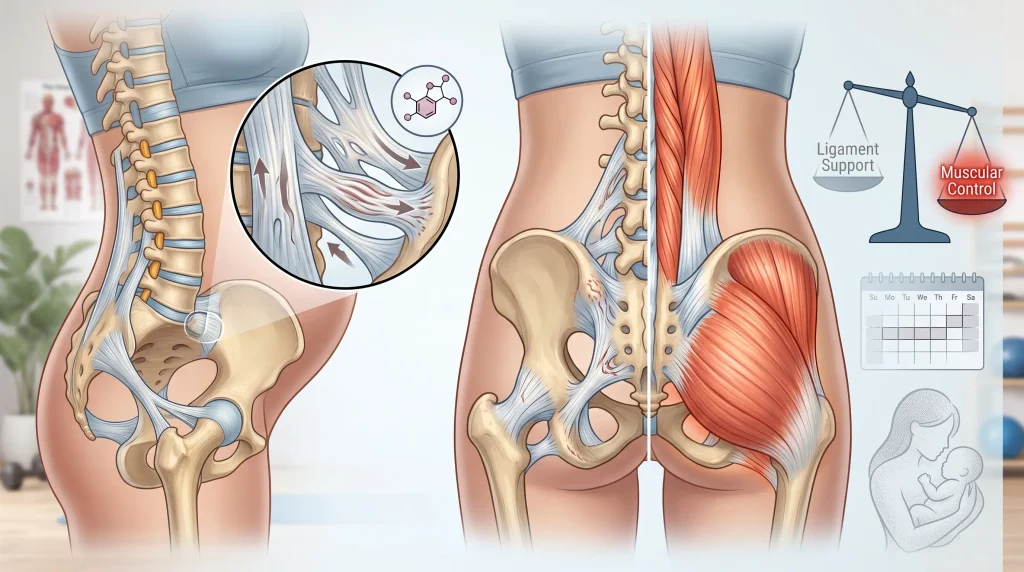
- Ligament laxity that outlasts the pregnancy. Laxity simply means the ligaments are more compliant — they allow a little more give at each joint. The hormonal changes of pregnancy increase that give across the pelvic ring and lower spine, and it does not switch off the day the baby arrives. It commonly persists for months. The practical consequence is that muscular control has to carry more of the stability job than it used to, at exactly the moment those muscles are least prepared. The same mechanism explains a lot of back pain that starts early in pregnancy, long before there is any real bump to blame.
- An abdominal wall that has been on stretch for months. The abdominal muscles are not decorative — they are a load-sharing sleeve that helps manage pressure through the trunk. After a full-term pregnancy the rectus abdominis has been lengthened and the connective tissue down the midline has widened. A stretched muscle generates tension less efficiently, so the lumbar structures take a larger share of every lift and every twist.
- Pelvic floor timing, not just pelvic floor strength. The pelvic floor normally co-contracts with the deep abdominal muscles a fraction of a second before you lift something. After delivery — vaginal or surgical — that timing is often disrupted. The muscle may be capable but late, which is functionally similar to not being there.
- Feeding posture, multiplied by volume. A single feed in a rounded-forward position is harmless. Several hours a day of it, on a soft sofa that lets the pelvis roll back, is a sustained flexion load on tissue that is already lax. This is the single most modifiable factor at two weeks.
- One-sided carrying. Most people settle on a preferred hip for carrying, which means a hitched pelvis and a laterally loaded spine for a large part of every day.
- Disturbed sleep. Fragmented sleep lowers pain tolerance. It does not create tissue damage, but it reliably makes an ordinary ache feel considerably worse — which is why so much postpartum back pain peaks in the small hours.
- The infant car seat. Mechanically, this is the worst thing most new parents do all day. The seat plus baby often comes to somewhere around 9–13 kg (20–29 lb), held at arm’s length in front of the body, usually with a twist, frequently lifted out of a footwell. And it gets heavier every single week.
None of this is specific to epidurals. Women who deliver without any anaesthetic get it. Women who deliver surgically get it, which is why back pain long after a caesarean is such a common search. The epidural simply happens to be the one identifiable event people can point at, and human beings much prefer a discrete cause to a diffuse one.
How do I tell normal recovery from a warning sign?
Compare five things: what the pain feels like, which way it is trending, how the skin at the injection site looks, what else is happening in your body, and whether anything neurological has changed. Ordinary recovery is diffuse, load-related, easing over days, with a quiet-looking site and no other symptoms. Anything focal, escalating, feverish or neurological belongs in a different category and needs assessing.
| What to check | Usually normal at two weeks | Needs assessment |
|---|---|---|
| Pain quality | Diffuse ache across the low back, buttocks or pelvis; worse after feeds, carrying or a long day; eased by changing position | Deep, focal, boring pain at one spot in the spine; unrelenting; not eased by any position; wakes you independently of the baby |
| Timing and trend | Fluctuates day to day but the overall line is downward; better mornings after a longer sleep stretch | Steadily worse each day; a pain that had settled and has now returned harder; new pain appearing after a symptom-free week |
| Injection site appearance | Small tender area, fading bruise, skin intact, no heat, shrinking | Spreading redness, swelling, warmth, a firm painful lump, or any fluid or pus leaking from the site |
| Accompanying symptoms | Tiredness, general soreness, sore neck and shoulders from feeding | Fever or chills; feeling systemically unwell; a headache clearly worse sitting or standing and relieved by lying flat |
| Neurological signs | Nothing new; sensation and power in the legs as they were before pregnancy | New or progressing leg weakness, numbness in the inner thighs or saddle area, difficulty passing urine, loss of bladder or bowel control |
| Action | Self-management, load modification, review if not improving by six weeks | Contact your maternity unit, GP or anaesthetic team the same day. Neurological change means emergency assessment now |
Which symptoms mean you need to be seen today?
Four clusters warrant same-day medical contact after an epidural: fever alongside worsening back pain, pain that is escalating rather than settling, any new or progressing leg weakness, numbness or bladder or bowel change, and a headache that is clearly worse when you sit or stand and relieved when you lie flat. Each points to something different, and each is treated far more easily early than late.
Fever with worsening back pain
Infection close to the spine — an epidural abscess, meaning a collection of pus in the space around the spinal cord and nerves — is rare, but it is the reason this combination is never watched at home. The Royal College of Anaesthetists notes that infection developing close to the spinal cord and major nerves is a very rare complication of these procedures. Fever on its own in the early postpartum period has several other explanations, including uterine infection, wound infection, mastitis and urinary infection. All of those need assessing anyway, so the fever is worth acting on regardless of what is happening in your back.
Redness, swelling, heat or discharge at the site
A bruise fades and shrinks. An infection spreads and firms up. The distinction that matters is whether the area is getting smaller or larger over two or three days, whether the skin feels warm compared with the skin next to it, and whether anything at all is leaking. Any fluid coming from the injection site — clear or otherwise — should be reported the same day rather than covered with a dressing and reviewed later.
Pain that is escalating rather than easing
Severity is a poor guide on its own — postpartum musculoskeletal pain can be genuinely severe and still completely benign. Trajectory is the better signal. Pain that climbs steadily over consecutive days, pain that had settled and has now returned worse, or pain that is unrelenting and unaffected by position all deserve review. Benign mechanical pain almost always responds to something: lying down, standing up, changing the way you are sitting. Pain that ignores position is behaving differently.
New leg weakness, numbness, or bladder or bowel change
This is the emergency category. Bleeding into the space around the spinal nerves — a haematoma — or any other cause of compression can produce weakness or numbness in the legs, numbness across the inner thighs and saddle area, difficulty starting or feeling the passage of urine, or loss of bowel control. Bladder function is often temporarily altered in the first days after birth for reasons that have nothing to do with the spine; what matters is a new change appearing after function had returned to normal. Serious nerve injury after a spinal or epidural anaesthetic is uncommon — the Royal College of Anaesthetists places permanent nerve damage in the region of one in 20,000 procedures — but the treatment window is measured in hours, which is why this cluster goes straight to emergency assessment rather than a routine appointment.
A headache that is worse sitting up and better lying flat
A postural headache of this kind — markedly worse within minutes of sitting or standing, substantially relieved by lying down — may suggest a post-dural puncture headache, which occurs when spinal fluid leaks from a small hole made during the procedure. It can be accompanied by neck stiffness, sensitivity to light, or changes in hearing. It is not something to wait out with paracetamol and hope, and it is not primarily a back problem: it needs the anaesthetic team, who have specific treatments for it. Two weeks is later than these headaches typically appear, which makes it more important, not less, to have it looked at.
Seek care today if
- You have a temperature or chills together with back pain that is getting worse.
- The injection site is red, swollen, hot, or leaking any fluid — or the sore area is growing rather than shrinking.
- Your back pain is climbing day on day, or is unrelenting and unchanged by any position.
- You have a headache that is clearly worse when upright and better when flat.
Go to emergency care immediately — do not wait for a call back — if you develop new or worsening weakness or numbness in a leg, numbness across the inner thighs or saddle area, difficulty passing urine, or any loss of bladder or bowel control.
When is imaging needed, and when is it not?
Imaging is needed when the clinical picture raises the possibility of infection, bleeding or nerve compression — in which case urgent MRI is the test that changes what happens next. It is not needed for ordinary postpartum back pain. National guidance on low back pain advises against routine imaging in non-specialist settings, and recommends it only where the result would change management. A scan ordered purely to explain an ache rarely does.
The reasoning is worth understanding rather than just accepting. Disc bulges, degenerative changes and facet joint wear are extremely common findings in people with no pain at all, so a scan of an aching postpartum back will frequently turn up something — and that something will frequently be irrelevant. What it will not do is tell you how lax your pelvic ligaments currently are, how your abdominal wall is behaving under load, or how you are lifting the car seat, which are the three things actually driving the symptoms. If you have already had a scan and are trying to make sense of the wording, a plain-English guide to what back imaging reports actually mean is more useful than the report itself.
Where imaging earns its place, it earns it decisively. Suspected epidural abscess or haematoma is investigated with urgent MRI, ordered on clinical suspicion rather than after a period of watchful waiting, because the value of the scan collapses if it is delayed. X-ray, by contrast, has almost no role in this situation: it involves radiation and cannot see the soft tissue structures in question. If you are breastfeeding and a scan is being discussed, raise it with the team rather than assuming it rules anything out — they manage this combination routinely.
Three assumptions worth setting aside
Three beliefs come up repeatedly at the two-week point, and each one quietly steers people toward the wrong action. Two of them cause unnecessary worry about a procedure that has already happened; the third delays care that should not be delayed.
- “The epidural has damaged my back long term.” When researchers have compared women who had epidural analgesia in labour with those who did not, they have not found a difference in long-term backache between the groups. The needle passes between the vertebrae and does not remove or weaken structural tissue. Persistent pain months or years later has almost always accumulated for other reasons — a point explored in more depth in this look at back pain that is still present two years after an epidural.
- “If it were the epidural, it would hurt right where the needle went.” The logic actually runs the other way. Site-related pain is focal and local. Pain that is broad, shifting, and worse with certain activities is behaving like mechanical load pain, not like a needle-site problem. When someone tells me they can cover the painful area with a whole hand, that is information about the diagnosis.
- “I’ll mention it at my six-week check.” For diffuse aching, that is perfectly sensible. For fever, spreading redness, escalating pain or any neurological change, six weeks is four weeks too late. The postpartum check is a screening appointment, not a safety net.
From the Clinic: Dr. Arora’s Expert Insight
The sentence I hear myself saying most often in these consultations — “the epidural almost certainly isn’t causing this” — is accurate, and on its own close to useless. I watch it land and I can see it doing nothing. The reason, I think, is that it answers a question about causation when the person in front of me is asking a question about legitimacy. She has an explanation that makes her pain make sense, and I have just taken it away without offering anything in its place. What she hears is not “good news, your spine is fine.” What she hears is closer to “there is no reason for this, so stop worrying about it.” Reassurance that removes a cause without supplying a better one usually reads as dismissal.
So I stopped opening with it. What I do instead is ask her to show me, physically, the three or four things she does most in a day — get up from the sofa mid-feed, lift the seat out of the car, lean over the side of a cot with a sleeping baby — and we find the one that reproduces the pain. It almost always is one of them, and it is almost never the one she expected. Here is the detail that changes the conversation more than any explanation I can give: I ask her to put one finger on where the needle went in, then one finger on where it hurts. When those two fingers are eight or ten centimetres apart and on different tissue entirely, she works it out herself. That is a far more durable form of reassurance than anything I say.
The generic advice that fails hardest here is “rest it and it should settle.” At two weeks postpartum, rest is not a thing anyone can prescribe — the feeds happen whether the back agrees or not, and telling someone to rest simply adds guilt to an already difficult fortnight. The second failure is the reflex prescription of pelvic floor exercises and general core work, which is not wrong but is aimed at the wrong variable. The limiting factor at two weeks is rarely how strong the muscle is; it is how much load arrives in a single event, and how badly organized that event is. Fixing the sofa, the feeding setup and the car seat lift buys more relief in the first fortnight than any exercise I could hand over — and it makes the exercise work far better when we start it a few weeks later.
What should you do in the next 72 hours?
Assuming none of the warning signs apply, the first three days are about reducing the size of each individual load event rather than doing more exercise. Rebuild the feeding position so your back is supported instead of hanging, change how you lift the car seat and how you transfer the baby into the cot, add gentle breathing-based work, and start short frequent walks. That combination usually shifts symptoms noticeably within a week.
What to do today
- Rebuild one feeding station properly. Sit far enough back that your hips and shoulders are supported, put a firm cushion behind your lower back rather than sinking into a soft sofa, and bring the baby up to you with pillows under your arms instead of curling down to the baby. If your feet dangle, put a book or a footstool under them.
- Change the car seat lift. Open the door fully, turn and face the seat squarely so you never lift and twist together, get one foot into the footwell, bring the seat in against your body before you straighten, and lift with your legs. Two smaller movements beat one heroic one.
- Drop the cot side or lower the mattress base if that option exists, so the transfer does not require leaning over a fixed rail with outstretched arms. Exhale gently as you lower the baby down.
- Alternate your carrying side deliberately. It will feel wrong on the non-preferred side. Do it anyway, in short stints.
- Five minutes of diaphragmatic breathing, twice a day. Lie on your back with knees bent, one hand on the lower ribs. Breathe so the ribs widen sideways rather than the chest lifting. This restores the pressure relationship between the diaphragm, the deep abdominals and the pelvic floor, which is the foundation everything else is built on.
For symptomatic relief, heat over the muscular low back is usually more comfortable than cold at this stage, since the problem is tension and load rather than an acute injury with swelling — the practical distinction between using ice and using heat is worth knowing so you are not guessing. Do not apply heat directly over the injection site while it is still tender, and never fall asleep on a heat pack. Pain relief medication choices while breastfeeding are worth a short conversation with your midwife, GP or pharmacist, since options do exist and there is no benefit to enduring pain that could be reasonably managed.
How does recovery progress from here?

Progression is driven by what your symptoms do in the 24 hours after an activity, not by the calendar. The general sequence runs from breathing and gentle positional control, to low-load abdominal and glute work, to loaded functional patterns like squatting and carrying, and finally to impact and sport. You move on when the current level stops producing next-day soreness — not when a given number of weeks has elapsed.
| Stage | Typical window | Focus | Ready to progress when |
|---|---|---|---|
| 1. Restore the pressure system | From now, roughly weeks 2–4 | Diaphragmatic breathing, gentle transversus abdominis activation on an exhale, pelvic tilts, position changes without breath-holding, walking in short frequent bouts | You can do 10 slow breaths with a light abdominal draw-in without pain, and walk 15–20 minutes with no next-day increase in symptoms |
| 2. Low-load control | Roughly weeks 4–8 | Bridges, side-lying hip abduction, dead bug variations, sit-to-stand practice without pushing through the arms, carrying with an upright trunk | Daily tasks — car seat, cot, stairs, pram — no longer flare the back, and you can hold a bridge for 30 seconds comfortably |
| 3. Loaded function | Roughly weeks 8–16, guided by assessment | Squats and hip hinges with light external load, single-leg work, split squats, graded resistance training for glutes and posterior chain | You can squat to a chair 15 times and carry a load equivalent to the car seat over 20 metres (about 65 feet) without symptoms the following day |
| 4. Impact and sport | Usually from around 12–16 weeks at the earliest | Return to running, jumping, classes or your previous sport, built up gradually | Cleared on pelvic floor assessment, no leaking or heaviness with load, and stage 3 completed without flare-ups |
One item deserves separate mention: arranging an assessment of the pelvic floor and abdominal wall is worth doing rather than assuming it will sort itself out. A pelvic health Physical Therapist (physiotherapist) can check the width and tension of the abdominal midline, assess how the pelvic floor is contracting and relaxing, and identify whether heaviness, urgency or leaking is present. Those findings change the exercise prescription substantially. If you are between the two-week point and a formal assessment and want somewhere sensible to begin, a structured home program built around physical therapy principles is a reasonable bridge, adapted to the stage you are at.
Do’s and don’ts specific to this stage
- Do exhale as you lift, rather than holding your breath and bracing hard. Breath-holding spikes downward pressure onto a pelvic floor that has not yet recovered its timing.
- Do break long feeds up with a position change — swap chair, swap side, stand for a minute between sides.
- Do keep walking, in several short bouts rather than one long outing. Staying active is better supported by evidence than resting for early low back pain.
- Don’t restart abdominal crunches, planks or sit-ups yet. With a widened abdominal midline and an untested pelvic floor, these load the exact tissue that is still reorganizing.
- Don’t lift the pram or the car seat out of a car boot with straight arms and a rotated trunk. That single movement is responsible for a great many two-week flare-ups.
- Don’t spend the day in bed to protect your back. Prolonged bed rest does not speed recovery of ordinary low back pain and comes with its own costs after birth.
- Don’t ignore a sense of pelvic heaviness or dragging alongside the back pain. That combination deserves a proper pelvic health assessment, and it is worth understanding how back pain and pelvic pressure relate to each other before dismissing it as normal.
What if it isn’t getting better?
If back pain that started around delivery has not meaningfully improved by around six to eight weeks despite sensible load management, that is the point to seek a formal musculoskeletal and pelvic health assessment rather than continuing to wait it out. Persisting pain at that stage is usually a sign that one specific driver has been missed — often pelvic girdle mechanics, an unaddressed abdominal wall, or a daily task nobody has watched you perform.
An assessment at this point should be specific. It should identify whether the pain is coming from the lumbar spine, the sacroiliac joints, the pubic symphysis or the surrounding musculature; it should test how you load a single leg, since so much of parenting is done on one leg while the other manoeuvres a door or a stair; and it should include the abdominal wall and pelvic floor rather than treating the back in isolation. Passive treatment alone — massage, manipulation, heat — tends to give short-lived relief in this population, and national guidance on low back pain supports manual therapy only as part of a package that includes exercise, not as a standalone treatment.
Surgery deserves a plain answer, because the word tends to loom large when pain persists. For ordinary postpartum back pain, spinal surgery is not relevant — there is nothing to operate on. The only situations in which an operation enters the picture are the emergencies described earlier: a spinal abscess or haematoma causing compression, where surgical decompression is done urgently, on the day, and is not a decision anyone deliberates over. Elective spinal decompression is considered only where non-surgical treatment has failed to improve pain or function and imaging findings match the symptoms — a combination that is uncommon in this group and would involve genuine nerve root symptoms rather than diffuse aching. If you have leg pain in a clear band down one limb rather than back pain alone, that is worth flagging, and it is worth learning to recognise what genuine nerve pain actually feels like.
The realistic outlook
Most women with lower back pain 2 weeks after epidural improve substantially over the following two to three months as ligament laxity reduces, the abdominal wall reorganizes and daily handling becomes more efficient. The recovery is rarely linear — a bad night, a heavy day of carrying, or a growth spurt in the baby will produce setbacks that mean nothing about the overall trend.
The single most useful action available to you today is not an exercise. It is picking the two things you do most often — the feeding position and the car seat lift — and changing how they are done, then reassessing your symptoms in a week. If they have improved, you have your answer about what was driving the pain. If they have not, or if any of the warning signs listed here appear, that is your signal to be assessed rather than to keep waiting.
Frequently asked questions
Can an epidural cause permanent back pain?
The available evidence does not support it. A Cochrane review comparing epidural with non-epidural pain relief in labour found no difference in long-term backache between the groups. Serious complications that could cause lasting problems are rare and typically declare themselves within days through fever, escalating pain or neurological symptoms — not as a slow ache appearing months later.
How long should the injection site stay sore?
Local tenderness at the site commonly settles within a few days to a couple of weeks. What matters more than the exact duration is whether the sore area is shrinking. A patch that is smaller and less tender than it was a week ago is behaving normally, even at day fourteen; one that is expanding or becoming more painful is not.
Why is my back so much worse during night feeds?
Because three things stack at night: you have been loading the tissue all day, the position is usually worse in the dark on a soft bed or sofa, and fragmented sleep lowers your pain threshold. Setting up a night feeding position with proper back support before you go to bed is more effective than trying to fix it half-asleep at 3am.
I had a c-section with the epidural. Does that change anything?
It adds a second recovering structure but does not change the back pain picture much. The abdominal wall has both the pregnancy stretch and a surgical incision to recover from, which means it contributes even less to trunk support in the early weeks. The load management advice is identical; the timeline for loaded abdominal work is usually a little more conservative and should be guided by your surgical review.
Is it safe to have a massage or see a manual therapist at two weeks?
Generally yes for gentle soft tissue work, provided the injection site is healthy and none of the warning signs are present. Avoid direct pressure over the site itself, and be cautious about vigorous spinal manipulation this early, when ligaments are still lax. Ask the practitioner to work around the area rather than on it.
Will this stop me returning to running or the gym?
In the large majority of cases, no. Most women return to full training, though the sensible route is graded rather than immediate, and impact activity is usually deferred until around the three to four month mark with pelvic floor function checked first. Rushing back to running before the pelvic floor and abdominal wall are ready is the most common reason the timeline ends up longer, not shorter.
My pain is in my tailbone rather than my lower back. Is that related to the epidural?
It is unlikely to be related to the injection, which is placed well above the tailbone. Coccyx pain after a vaginal birth is more commonly related to the mechanical stress of delivery itself, and it typically hurts most on sitting and on standing up from sitting. It is worth mentioning at your postnatal review, since the management differs from lumbar back pain.
Medical disclaimer
This article is general education about back pain in the early weeks after childbirth and cannot assess your individual situation. The early postpartum period carries a small number of genuinely time-critical complications, and no article can distinguish between them and ordinary recovery on your behalf. If you have fever, an injection site that is red, swollen or discharging, pain that is escalating, a headache that is worse when you sit up, or any change in leg strength, sensation, bladder or bowel function, contact your maternity unit, GP or emergency services rather than acting on anything written here. Nothing in this article should delay an assessment you are already considering, and none of it replaces the advice of the clinicians who know your delivery, your medical history and your current examination findings.
References
- Anim-Somuah M, Smyth RMD, Cyna AM, Cuthbert A. Epidural versus non-epidural or no analgesia for pain management in labour. Cochrane Database of Systematic Reviews. 2018;(5):CD000331. https://doi.org/10.1002/14651858.CD000331.pub4
- Royal College of Anaesthetists. Risks and side effects — nerve damage after a spinal or epidural anaesthetic. Sixth edition, 2024. https://www.rcoa.ac.uk/patients/patient-information-resources/anaesthesia-risk/nerve-damage-after-spinal-or-epidural-anaesthetic