
Expert Review: This article includes clinical insights from Dr. Vivek Arora, a physical therapist (physiotherapist) with 20+ years of experience.
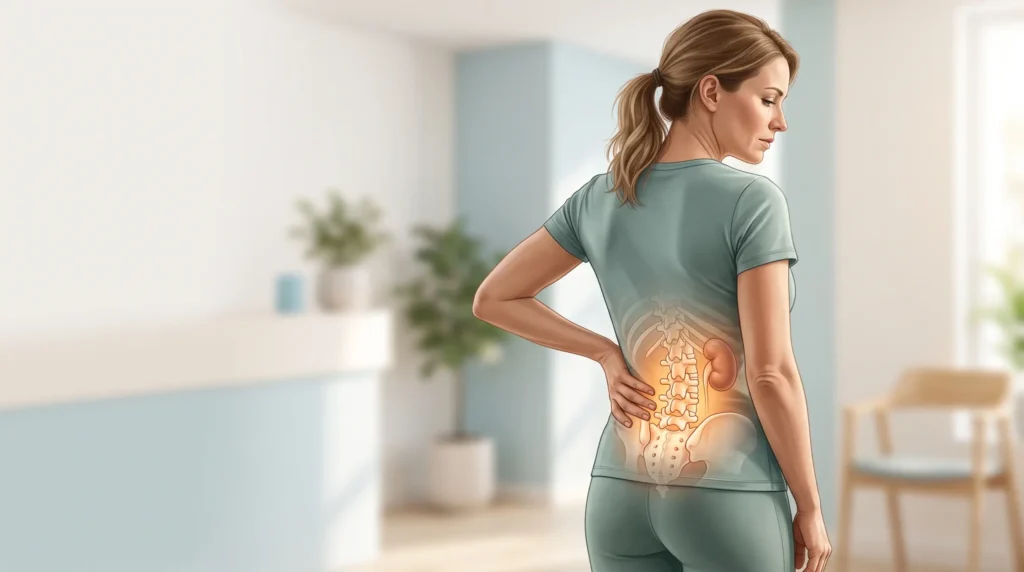
Pain that sits low on the right side of the back has a way of breeding worry, because it sits at a crossroads. Behind that patch of skin are muscles, joints, and nerves of the spine — but also a kidney, a length of ureter, part of the bowel, and, in women, an ovary and the pelvic organs. So when someone searches for answers about lower right back pain in women, the real question underneath is usually sharper than “why does it hurt?” It’s “is this my back, or is it something inside?”
The honest answer is that most of the time it is mechanical — coming from the spine and the tissues around it — and settles with sensible self-management. But “most of the time” is not “always,” and the whole point of an article like this is to help you tell the difference with your eyes open rather than guessing. This is a map of what tends to cause one-sided low back pain in women, how the patterns differ, and the specific signs that mean a problem deserves a proper look rather than a wait-and-see.
Key takeaways
- Right-sided low back pain in women is usually mechanical — muscles, lumbar facet joints, the sacroiliac (SI) joint, or a disc — and it typically changes with movement and position.
- A smaller but important share is referred pain from internal organs: the kidney or ureter, the bowel, or the reproductive organs. This pain often ignores how you move.
- The single most useful clue is whether the pain responds to position and activity. Mechanical pain has a “pattern you can provoke”; organ pain usually does not.
- Certain features — fever, blood in the urine, pain tied tightly to your cycle, one-sided pelvic pain with a positive pregnancy test, or leg weakness — shift this out of self-management and into prompt assessment.
- Imaging is rarely the first step for uncomplicated mechanical pain, but it is exactly the right step when the story points toward an organ or a nerve.
What causes lower right back pain in women?
Lower right back pain in women most often comes from the mechanical structures of the spine on that side — a strained muscle, an irritated lumbar facet joint, a stressed sacroiliac joint, or a disc — and less often from internal organs such as the right kidney, ureter, bowel, or ovary. The distinction matters because mechanical pain changes with movement and position, while organ-referred pain usually follows its own timeline regardless of how you bend or twist.
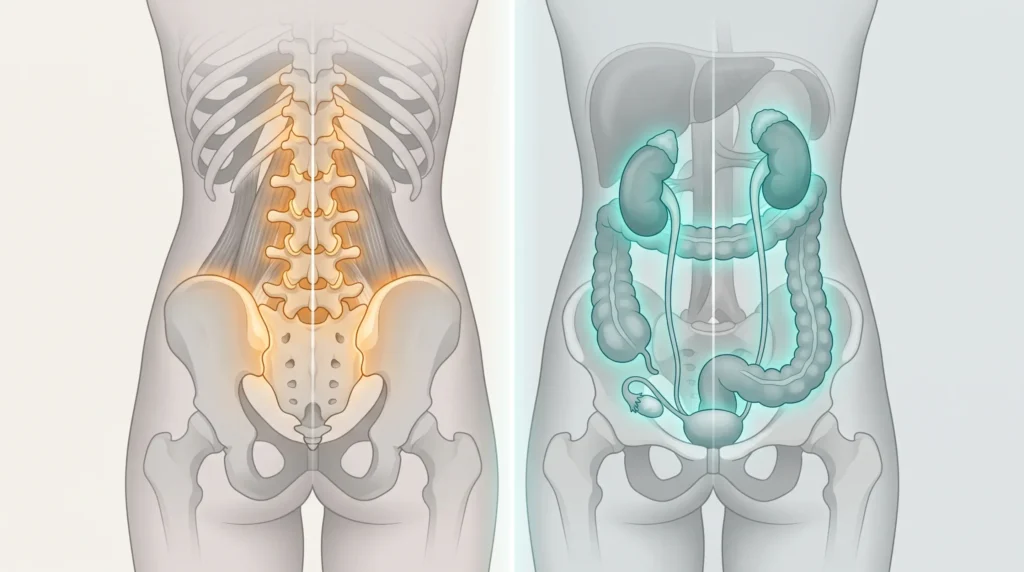
It helps to picture the low back as a layered structure rather than a single “thing.” On the outside are the long paraspinal muscles and the deeper stabilizers; underneath them sit the facet joints, which are the small paired joints that guide and limit how each spinal segment moves. Lower still, where the spine meets the pelvis, is the sacroiliac joint — a broad, low-motion joint that transfers load between your trunk and your legs every time you stand, climb a stair, or step off a curb. Pain becomes “right-sided” when the irritated structure happens to sit on the right, or when the way you move loads one side more than the other. Carrying a toddler on one hip, always driving with the right foot working the pedals, sleeping curled to one side, or favoring a leg after a minor injury all quietly bias load toward one side over weeks and months.
Discs contribute in their own way. A disc that is bulging or irritated on the right can refer pain into the right side of the back and sometimes down the leg if the nearby nerve root is involved. That leg component is worth understanding on its own; if your pain travels below the buttock, this guide to how back problems refer pain into the hip and leg unpacks how a spinal source can masquerade as a hip issue. And because one-sided pain has a long list of possible drivers, it is worth skimming the broader picture of the hidden causes of right-sided low back pain before assuming the worst.
How can I tell if it’s my spine or an internal organ?
The most reliable way to tell spinal pain from organ-referred pain is to test whether movement and position change it. Mechanical pain from the spine can usually be made better or worse on demand — bending, arching, twisting, sitting, or pressing on the sore spot shifts it. Pain referred from an organ tends to be indifferent to all of that; it comes and goes on a schedule of its own, and pressing on your back does not reproduce it.
That single test — does it move when I move? — sorts most cases. But the fuller picture rewards a closer look, because each source tends to announce itself a little differently.
| Likely source | What the pain tends to feel like | What makes it better or worse | What it may suggest |
|---|---|---|---|
| Muscle / facet joint (spine) | Aching or sharp, localized to one side, sometimes stiff in the morning | Worse with specific movements or sustained postures; often eases with position change and gentle activity | A mechanical flare — usually self-limiting |
| Sacroiliac (SI) joint | Deep pain low and to one side, near the dimple above the buttock | Worse rolling in bed, climbing stairs, standing on one leg; eased by even weight-bearing | Load-transfer irritation, common in and after pregnancy |
| Disc / nerve root | Back pain that may travel into the buttock or leg, sometimes with tingling | Often worse with prolonged sitting, bending, or coughing/sneezing | Nerve involvement worth assessing if the leg is affected |
| Kidney / ureter | Deep, colicky pain in the flank that can come in waves; may radiate to the groin | Largely unchanged by back movement; may come with urinary symptoms or fever | Possible kidney or ureteric problem — needs assessment |
| Reproductive organs | One-sided lower pain that may track to the pelvis or lower abdomen | Often linked to the menstrual cycle rather than to movement | A gynecological source worth exploring, especially if cyclical |
| Bowel | Cramping or dragging discomfort, sometimes with bloating or bowel changes | Tied to digestion and bowel habit, not to posture | A digestive contributor rather than a spinal one |
A few female-specific threads deserve their own mention. Because the kidney sits high on the back wall of the abdomen, a urinary infection or a stone on the right can produce genuine one-sided back pain; if your ache is paired with burning urination, urgency, or a fever, the story leans away from the spine and toward the urinary tract, and this explainer on back pain that comes from near the kidneys is a useful next read. Pain that keeps time with your menstrual cycle — arriving mid-cycle or just before a period — points toward a reproductive source rather than a joint, and the way hormonal and menstrual changes drive low back pain is a real, under-acknowledged pattern. And because the bowel is a quiet troublemaker, even something as ordinary as constipation can register as a dull one-sided backache, as covered in this piece on whether constipation can cause lower back pain.
When should lower right back pain be checked urgently?
Certain features move right-sided low back pain out of “watch and manage” and into “get this looked at soon.” These are not meant to frighten you — the vast majority of back pain is benign — but each one points to a problem where waiting has a cost, and each has its own reasoning behind it.
- Fever, chills, or feeling systemically unwell with the pain — this raises the possibility of a kidney infection or, rarely, a deeper infection, neither of which improves by resting your back.
- Blood in the urine, burning, or a sudden colicky flank pain that comes in waves — a pattern that fits a kidney stone or urinary infection rather than a joint or muscle.
- One-sided lower pelvic or back pain with a positive or possible pregnancy test — sudden severe one-sided pain in early pregnancy always warrants urgent assessment to rule out an ectopic pregnancy.
- Progressive leg weakness, numbness spreading in the groin or inner thighs, or new problems controlling your bladder or bowel — these point to nerve compression that needs prompt evaluation, not observation.
- Unexplained weight loss, night pain that wakes you and won’t settle, or a history of cancer — features that justify a careful look rather than reassurance alone.
Seek care promptly if:
- You have back or flank pain with a fever or with blood or burning when you urinate.
- You have sudden, severe one-sided pain and any chance you could be pregnant.
- You notice new leg weakness, spreading numbness, or loss of bladder or bowel control — this is an emergency.
- The pain is severe, steadily worsening, or waking you at night and not responding to sensible self-care over a few days.
Do I need a scan for one-sided back pain?
For most uncomplicated mechanical low back pain, an early scan is not needed and can even be counterproductive. Imaging is genuinely useful when the story points somewhere specific: a possible kidney stone, a suspected infection, nerve involvement that isn’t settling, or any of the warning features above. In those situations the right test — an ultrasound, a urine analysis, blood tests, or an MRI — is chosen to answer a particular question, not to “look at everything.”
The reason clinicians hold back on routine scans is not cost-cutting; it is that images of the spine frequently show changes — mild disc bulges, small areas of wear — that are extremely common in pain-free people and can pull attention toward findings that aren’t actually causing your symptoms. National guidance from the UK’s National Institute for Health and Care Excellence advises against routine imaging for non-specific low back pain precisely because it rarely changes early management and can lead to unnecessary worry and intervention (NICE guideline NG59, Low back pain and sciatica in over 16s). Put simply: a scan is a tool for a question, and for a typical mechanical flare there isn’t yet a question a scan needs to answer.
Which myths about women’s back pain are worth dropping?
One-sided low back pain in women collects myths the way a magnet collects filings. A few are worth naming plainly. The first is that one-sided pain is more dangerous than central pain — it isn’t; the side simply reflects which structure is irritated or how load is distributed. The second is that pain near the kidney means kidney damage; kidney-region back pain is far more often muscular than renal, and the presence or absence of urinary symptoms and fever is what tips the balance. The third, and the most costly, is that back pain in a woman must be either “just hormones” or “just posture” — a framing that flattens a genuinely varied problem into a shrug. The value of thinking in patterns, as this article does, is that it replaces that shrug with a short list of specific possibilities you can actually check.
From the Clinic: Dr. Arora’s Expert Insight
The most useful question in a right-sided back pain assessment is often the one nobody thinks to ask: what is the pain doing across the whole month, not just today? When women come in with one-sided low back pain, the history has usually been collected as if the back exists in isolation — when it hurts, what movement started it, how bad it is out of ten. All reasonable questions. But a pattern that comes up repeatedly is that the timeline nobody mapped is the one that held the answer: pain that quietly tracked the menstrual cycle, or flared alongside urinary symptoms, and got treated for months as a stubborn mechanical problem because no one lined up the dates.
What often gets missed is that the assessment and the self-management can both be technically correct and still aimed at the wrong target. Generic advice — strengthen the core, stretch the hip, improve the posture — is not wrong, and for a true mechanical flare it works. Where it fails in real practice is when it is applied to pain that was never mechanical to begin with. You can do a diligent month of glute and core work against pain that is coming from the ureter or the pelvis and conclude, wrongly, that you have failed at rehab. You haven’t; the rehab was answering a question your body wasn’t asking.
So the practical shift I push for is boring but powerful: before committing to weeks of exercises, spend a few days as a detective. Note whether the pain moves when you move, whether it keeps time with your cycle, whether urinary or bowel symptoms travel with it. That small amount of pattern-mapping is what separates the person who gets better in three weeks from the person who spends three months treating the wrong structure.
What should I do in the first 24 to 72 hours?
If the pattern looks mechanical — it changes with movement, there’s no fever, no urinary blood, no cyclical link, no leg weakness — the early plan is gentle, active, and unglamorous. The goal in the first few days is not to “fix” anything but to keep the area moving enough that it doesn’t stiffen and settle into a guarded, protective pattern. Bed rest, once the standard advice, is now known to slow recovery for ordinary back pain.
What to do today (for a mechanical-pattern flare):
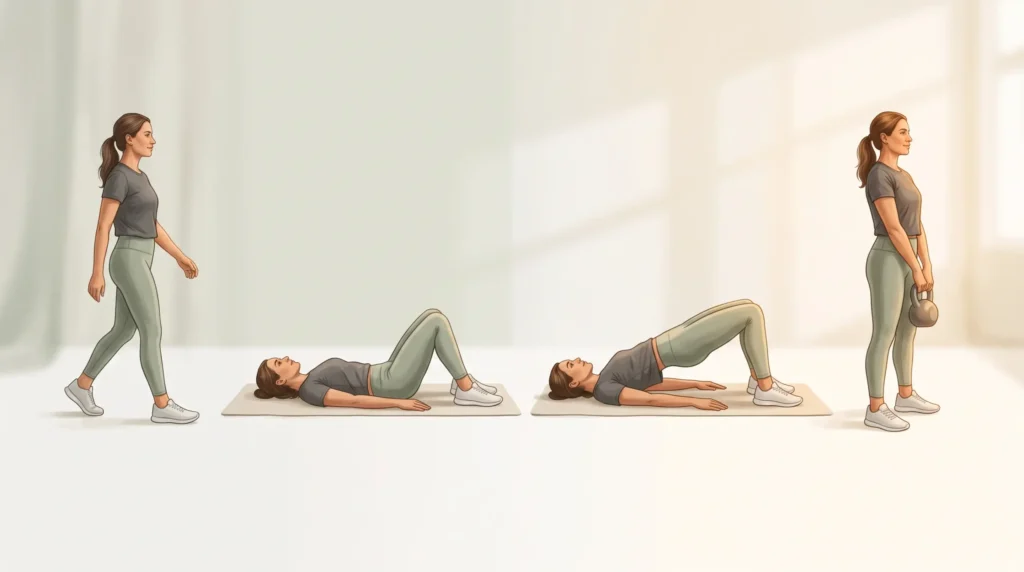
- Keep moving in small doses. Short walks of five to ten minutes, several times a day, beat a single long one or lying still.
- Change position often. Don’t hold any one posture — sitting, standing, or curled up — long enough for it to stiffen and complain.
- Use gentle mobility, not aggressive stretching. Easy movements like a slow pelvic rock or bringing one knee toward the chest, to comfort rather than to a stretch that bites.
- Manage pain so you can move, not so you can stay still — heat, over-the-counter pain relief if appropriate for you, and a comfortable sleeping position.
- Watch the pattern. If a red-flag feature appears, or nothing improves over several days, that is your cue to be assessed rather than to push harder.
How does rehab progress for mechanical right-sided pain?
Recovery from a mechanical flare is best thought of in phases, each with a goal rather than a fixed calendar, because bodies don’t read timetables. What moves you from one phase to the next is not the number of days that have passed but how the pain and your tolerance are behaving.
| Phase | Rough timing | Goal | What it looks like | Move on when… |
|---|---|---|---|---|
| 1. Calm & move | Days 0–7 | Reduce irritation, avoid stiffening | Frequent gentle movement, pain-easing positions, walking in short bouts | Pain is settling and daily tasks feel less guarded |
| 2. Restore motion | Weeks 1–3 | Regain comfortable range on the right side | Controlled mobility for the lumbar spine and hips; gradual return to normal activity | You can move through most ranges without a sharp catch |
| 3. Build capacity | Weeks 3–6 | Rebuild strength and load tolerance, especially posterior chain and SI-supporting muscles | Progressive glute, hip, and trunk work; loading the pattern that used to hurt | Strength and confidence return under everyday and heavier loads |
| 4. Return to full activity | Weeks 6+ | Full return to work, lifting, exercise, sport | Sport- or task-specific loading; addressing the one-sided habits that biased load in the first place | You can do what you need to do without flare-ups |
The reason progression is tied to response rather than dates is that pushing to the next phase while the current one still bites tends to provoke a setback. A useful rule of thumb: a little discomfort during activity that settles within a day is acceptable; pain that climbs during activity and lingers into the next day means the load was too much too soon. If you want a structured starting point for the strengthening phase, this collection of practical ways to ease right-sided low back pain at home pairs well with the phase logic above.
Do’s and don’ts for one-sided mechanical pain
- Do vary how you carry loads — swap the hip you carry a child on, alternate the shoulder for bags — so you stop feeding one side.
- Do load the posterior chain (glutes, hips, back) deliberately once the acute phase settles; one-sided pain often hides a one-sided strength gap.
- Don’t chase a deep stretch into pain on the sore side in the first days; irritated tissue reads aggressive stretching as a threat.
- Don’t interpret a return of mild symptoms during rehab as failure — expect small ups and downs as capacity rebuilds.
- Don’t keep treating the back as mechanical if the pattern quietly says otherwise — cyclical timing, urinary symptoms, or fever change the plan entirely.
When does conservative care stop being enough?
Conservative care — activity, graded loading, time — resolves the large majority of mechanical low back pain within weeks. It stops being the right answer in two situations. The first is when the pain was never mechanical: if an organ source is driving it, no amount of glute strengthening will help, and the fix lives in the relevant medical pathway — urology for a stone, gynecology for a cyclical pelvic source, and so on. The second is when a genuine spinal problem doesn’t follow the expected downward curve: pain and nerve symptoms that persist or worsen over six weeks or so, despite sensible rehab, are a reasonable trigger for imaging and specialist assessment.
Surgery enters the conversation rarely, and almost never for one-sided pain alone. It is considered mainly when there is clear, imaging-confirmed nerve compression that matches your symptoms and hasn’t responded to conservative care over a reasonable period — or, urgently, when there are signs of significant nerve compromise such as progressive weakness or loss of bladder and bowel control. For the typical woman with right-sided mechanical back pain, the realistic outlook is good: most improve substantially with time and graded activity, and the risk of recurrence is best managed by keeping strong, moving often, and breaking the one-sided habits that loaded the area unevenly to begin with.
The bottom line
Lower right back pain in women is usually a mechanical problem with a good prognosis — but its location, sitting so close to the kidney, bowel, and reproductive organs, means it deserves a moment of honest triage before you settle into self-management. Ask whether the pain moves when you move, whether it keeps time with your cycle, and whether anything systemic — fever, urinary changes, a possible pregnancy, or leg weakness — is traveling with it. If the answers point to the spine, gentle early movement and a phased return to strength will carry most people through. If they point somewhere else, the smartest thing you can do is stop treating the wrong structure and get the right question answered.
Frequently asked questions
Is lower right back pain in women usually serious?
No — most of the time it is a mechanical problem from the muscles, joints, or discs of the spine and settles with gentle activity over a few weeks. It becomes a concern mainly when specific features travel with it, such as fever, blood in the urine, pain tied to your menstrual cycle, a possible pregnancy, or new leg weakness, any of which warrants prompt assessment rather than waiting.
Can a kidney problem feel like right-sided back pain?
Yes. The right kidney sits high on the back wall of the abdomen, so a kidney infection or a stone can produce genuine one-sided back or flank pain. The clue is that kidney pain usually doesn’t change when you move or press on your back, and it often comes with urinary symptoms, waves of colicky pain, or fever — a very different pattern from a strained muscle or irritated joint.
How do I know if my back pain is related to my period?
The tell is timing. Pain that reliably appears in the days before or during your period, or around mid-cycle, and then eases, is more likely to have a hormonal or reproductive source than a purely mechanical one. Keeping a simple two-month diary of when the pain shows up against your cycle often makes the link — or the absence of one — obvious.
Should I rest or keep moving with one-sided back pain?
For a mechanical-pattern flare, keep moving in gentle, frequent doses rather than resting in bed. Short walks, regular position changes, and easy mobility keep the area from stiffening and speed recovery, whereas prolonged bed rest tends to slow it. The exception is when a red-flag feature is present, in which case the priority shifts from movement to getting assessed.
Could right-sided back pain be my appendix?
It’s uncommon, but appendicitis can occasionally cause pain that is felt toward the right lower back rather than the classic front-of-abdomen location. What distinguishes it is the company it keeps — worsening pain over hours, nausea, loss of appetite, fever, and tenderness in the lower right abdomen — and the fact that it does not behave like a mechanical joint or muscle. Sudden, worsening right-sided pain with those features needs urgent medical attention.
How long should I wait before seeing someone?
If the pattern is clearly mechanical and improving, giving it a couple of weeks of sensible self-care is reasonable. See someone sooner if there is no improvement over that window, if the pain is worsening or waking you at night, or immediately if any red-flag feature appears — fever, urinary blood, a possible pregnancy with one-sided pain, or leg weakness and numbness.
Why is my back pain only on one side?
One-sided pain simply reflects which structure is irritated or how load is being shared. Everyday habits — carrying a child on the same hip, always twisting the same way, sleeping curled to one side — quietly bias load toward one side over time, so the tissues on that side take the strain. The side of the pain, on its own, does not make it more or less serious.
Medical disclaimer
This article is for general education and is not a substitute for individual medical advice, diagnosis, or treatment. Everyone’s situation is different, and the right course of action depends on your full history and examination. If you have severe, worsening, or red-flag symptoms — or you are unsure — please seek assessment from a qualified healthcare professional. If you may be pregnant and have sudden one-sided pain, treat it as urgent.
Reference
National Institute for Health and Care Excellence (NICE). Low back pain and sciatica in over 16s: assessment and management (NICE Guideline NG59). Available at: https://www.nice.org.uk/guidance/ng59