
“Expert Review: This article includes clinical insights from Dr. Vivek Arora, a physical therapist (physiotherapist) with 20+ years of experience.”
Low back pain on right side is one of the most common presentations in musculoskeletal practice — and one of the most confusing. The “same spot” can be produced by several different structures: a facet joint, a disc, a nerve root, a muscle, the sacroiliac (SI) joint, the hip, or occasionally an organ referring pain to the back.
The short answer: One-sided lower back pain is usually mechanical. A joint, disc, or muscle on that side is carrying more load, or moving less well, than its partner on the other side. Most episodes settle over four to six weeks with graded movement and sensible pacing rather than rest. It becomes a medical concern when it arrives with fever, unexplained weight loss, blood in the urine, or new leg weakness or bladder changes.
Initially, it’s better to think in ‘likely drivers’ rather than one definitive diagnosis. The key is to match your pain pattern to the most likely “driver,” then choose actions that calm irritation quickly while rebuilding strength and movement capacity so the problem does not keep cycling back.
Key takeaways
- Side matters less than pattern. Which side hurts tells you very little on its own. What the pain does when you bend, twist, sit, walk, or cough is what narrows the field.
- Seven drivers cover most cases. SI joint, facet joint, disc or nerve root, quadratus lumborum and gluteal muscle pain, hip referral, thoracolumbar junction stiffness, and non-spinal sources such as kidney or shingles.
- Scans rarely change early management. Imaging is reserved for red flags, progressive neurological loss, or symptoms that stall despite a genuine trial of active care.
- Movement beats rest, but dosed movement beats both. Short, frequent walking intervals and pain-free loading calm symptoms faster than either bed rest or pushing through.
- A few symptoms need same-day assessment. Bladder or bowel changes, saddle numbness, spreading leg weakness, fever, or blood in the urine are not “wait and see” findings.
Educational note: This information is general education and does not replace individualized medical care.
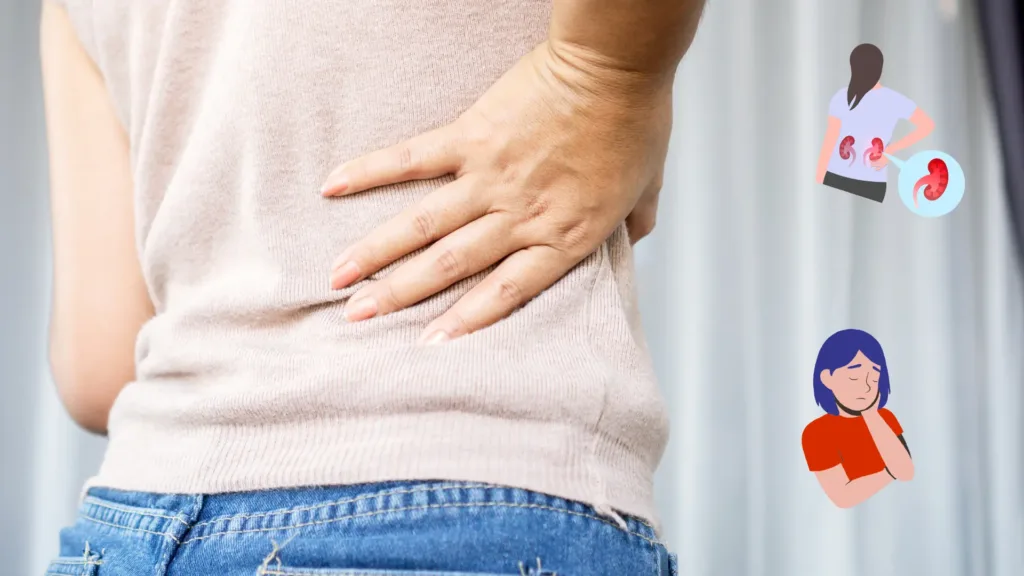
Is my right-sided low back pain urgent?
Most right-sided low back pain is mechanical and settles with conservative care, so urgency is the exception rather than the rule. The screen that matters is simple: does the pain change with position and movement, and is it travelling alone? Pain that ignores position entirely, or arrives alongside fever, urinary symptoms, or new neurological loss, needs assessment rather than exercises.
Seek urgent medical care today if you have any of the following:
- New trouble controlling bladder or bowel, urinary retention, saddle numbness, or rapidly worsening leg weakness
- Fever, chills, unexplained weight loss, or night sweats with back pain
- Recent significant trauma (fall, car accident) or high-risk minor trauma (older age, osteoporosis, long-term steroids)
- Constant, escalating pain that does not change with position and wakes you repeatedly
- Severe flank pain with nausea/vomiting or blood in urine (possible kidney stone)
- Severe right lower abdominal pain, loss of appetite, fever (possible appendicitis)
- A painful blistering rash on one side (possible shingles)
If none of these fit, you can usually start the plan below and monitor progress.
Why does only one side of my lower back hurt?
One side hurts because the lumbar spine is built as a set of paired structures — two facet joints per level, two SI joints, two sets of muscles — and those pairs almost never share load equally. A stiffer hip, a dominant hand, a habitual standing lean, or an old injury all push more work onto one side, and the tissue that gets more work is the tissue that complains first.
“Low back” is often used loosely. The area people point to is usually:
- The lumbar spine (five lumbar vertebrae, L1–L5)
- The facet joints (small paired joints at the back of the spine)
- The discs between vertebrae (shock absorbers)
- The SI joint (where the sacrum meets the ilium)
- Surrounding muscles: quadratus lumborum (QL), erector spinae, multifidus, gluteals, hip flexors
- Nerves that exit the spine (e.g., L4, L5, S1 roots)
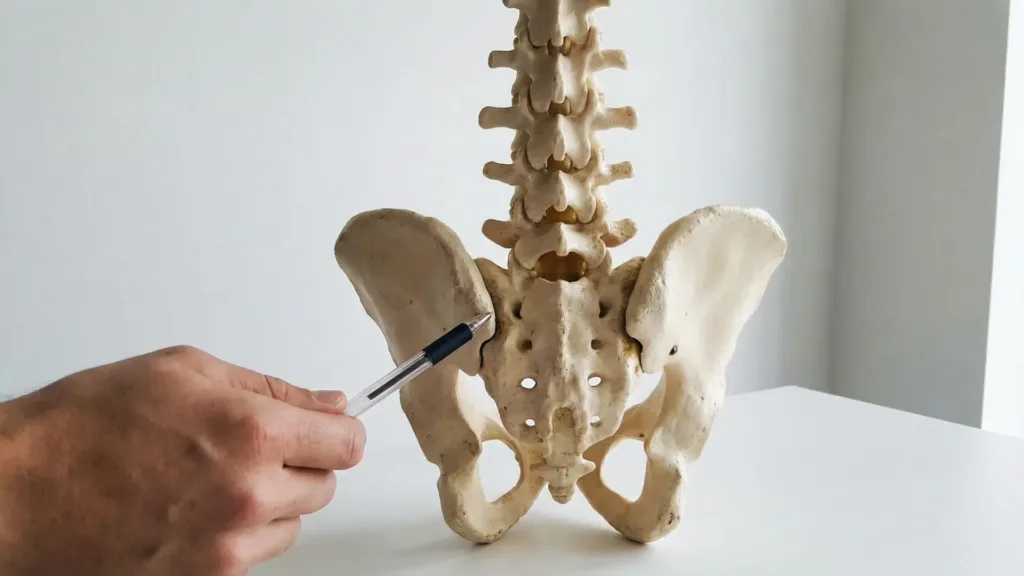
Why one side hurts more than the other
Pain usually becomes “one-sided” when a structure is loaded asymmetrically. Common reasons:
- You hinge/turn more to one side (dominant side patterns, sports, childcare, driving posture)
- One hip is stiffer or weaker, forcing the back to do extra work
- The SI joint or a facet joint is more irritated on one side
- A disc bulge or inflammation biases one nerve root
- A muscle develops protective guarding on one side after a strain
Think of this as a load-management issue: tissue capacity vs. tissue demand. When demand repeatedly exceeds capacity, pain becomes your body’s “overload alarm.
What causes low back pain on the right side?
Seven drivers account for the large majority of one-sided lower back pain: sacroiliac joint irritation, lumbar facet joint irritation, disc or nerve root involvement, quadratus lumborum and gluteal muscle pain, referred pain from the hip, thoracolumbar junction and rib stiffness, and non-spinal sources such as kidney, appendix, or shingles. Each has a recognizable signature in where it hurts and what provokes it.
More than one can run at the same time — a stiff hip alongside an irritated SI joint is a common pairing, and treating only one of them explains a lot of stalled recoveries.
A quick pattern table (use this first)
| Likely driver | Where it hurts | Common triggers | What often helps | What makes you worry |
|---|---|---|---|---|
| SI joint irritation | Dimple area near pelvis, can refer to buttock | Rolling in bed, stairs, single-leg standing | Belt support, glute activation, avoiding asymmetry | New numbness/weakness |
| Facet joint irritation | One-sided, just off the spine | Backward bending, twisting, prolonged standing | Flexion-biased positions, hip hinge | Pain with fever/weight loss |
| Disc/nerve irritation | Back + buttock/leg, tingling | Cough/sneeze, sitting, bending | Directional exercises, walking intervals | Progressive weakness |
| QL/glute trigger points | Deep ache, tight band | Long sitting, side sleeping, overuse | Isometrics, gentle mobility, pacing | Night pain without change |
| Hip joint referral | Groin/buttock + back | Getting in/out of car, putting on socks | Hip strengthening, avoiding deep flexion | Inability to bear weight |
| Thoracolumbar junction/rib | Upper-lumbar flank pain | Rotation, prolonged sitting, rib stiffness | Thoracic mobility, breath mechanics | Rash, fever |
| Kidney/abdominal/shingles | Flank pain, systemic symptoms | Not clearly movement-related | Medical evaluation | Blood in urine, fever, rash |
1) Sacroiliac (SI) joint irritation (the “pelvic dimple” pain)
The SI joint sits between the sacrum and the pelvis. It does not move much, but it transfers load between your trunk and legs. When irritated, it can create a very specific one-sided pain—often around the “dimple” just inside the back pocket area.
Typical pattern
- Pain is low, near the pelvis, often more than the spine itself
- Worse with: rolling in bed, getting out of the car, stairs, standing on one leg (putting on pants)
- Sometimes refers into the buttock, outer hip, or upper thigh
A simple self-check (not a diagnosis)
If pain increases with single-leg loading (stairs, lunging, standing on one leg) more than with bending forward, SI involvement becomes more likely.
Clinical research supports using a cluster of SI joint provocation tests rather than relying on a single test for decision-making. This is why clinicians rely on a validated composite of sacroiliac provocation tests rather than any one test in isolation.
What helps (first principles)
- Reduce asymmetry for a few days: avoid long single-leg tasks, carry loads evenly
- Use gentle glute activation (details in the rehab plan)
- Consider temporary external support (some people feel relief from an SI belt during walking)
2) Lumbar facet joint irritation (the “pinch on extension” pattern)
Facet joints guide spinal motion. They can become irritated from repetitive extension/rotation, prolonged standing, or after a sudden twist. Facet-driven pain often sits just off the midline, and it tends to flare with “arching” or twisting.
Typical pattern
- Localized pain on the right side, close to the spine
- Worse with: back bending, prolonged standing, rolling to the painful side
- Better with: sitting briefly, gentle forward bend, hip hinge strategy
Facet joints are a recognized contributor to chronic spinal pain, and studies using controlled diagnostic blocks have estimated meaningful prevalence in selected chronic back pain populations.
Common mistake
People keep “testing” the pain by repeatedly arching backward to see if it is still there. That repeated irritation prolongs the flare.
3) Disc irritation or a right-sided nerve root flare (not always “sciatica”)
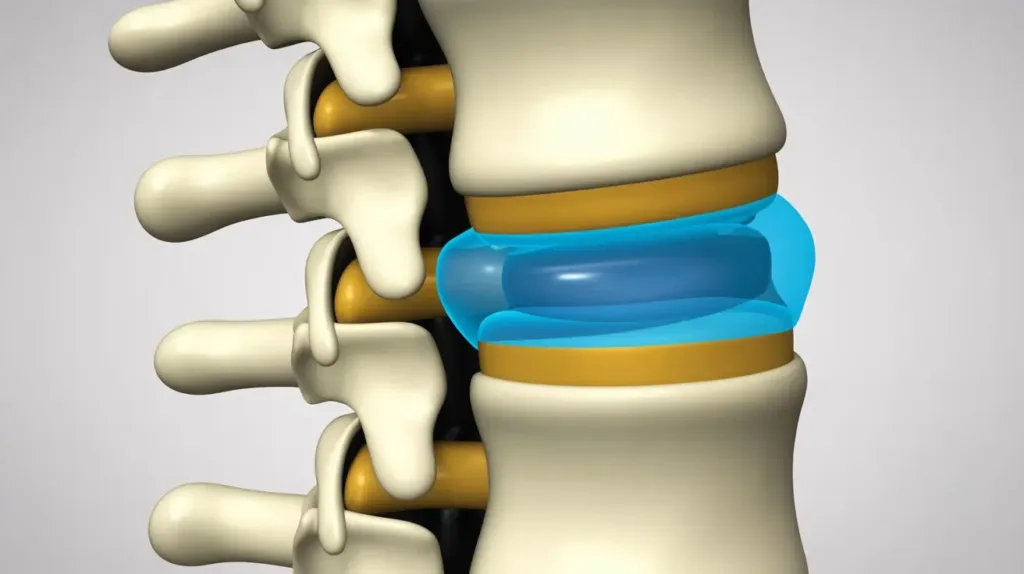
A disc can be sensitive without a dramatic MRI finding. If the disc bulges more to the right, or inflammation irritates a nerve root, you may feel right-sided back pain plus buttock, thigh, or calf symptoms, or tingling.
Typical pattern
- Worse with: prolonged sitting, bending forward, coughing/sneezing, lifting with a rounded back
- Symptoms may travel: back → buttock → leg (sometimes below the knee)
- Relief often comes from changing position, short walks, or specific repeated movements
Large clinical trials have shown that many people with lumbar disc herniation and sciatica improve over time with nonoperative care, even though some benefit faster from surgery when carefully selected.
Two home clues that suggest nerve involvement
- Pain/tingling increases with sustained sitting and eases with walking
- Symptoms feel “electrical,” burning, or travel down the leg
If you have progressive weakness (foot drop, collapsing knee), that is not a home-care situation.
4) Quadratus lumborum (QL) + gluteal myofascial pain (the overlooked driver)
Many people chase flexibility when they feel “tight.” But a large share of one-sided pain that feels like tightness is actually protective guarding and trigger point pain in the QL, gluteus medius, or deep spinal stabilizers.
Typical pattern
- Deep ache, pressure, or “knot” sensation on the right side
- Worse after long sitting, long driving, or side sleeping
- Tender spot reproduces the familiar pain when you press it (not always, but often)
What helps (counterintuitive but effective)
Instead of aggressive stretching, start with low-intensity isometrics (muscle holds) and controlled movement. Isometrics can reduce pain sensitivity and “turn down” guarding without provoking the tissue.
5) Hip joint referral (the hip–spine connection)
Not all right-sided back pain is “from the back.” The hip can refer pain into the buttock and mimic a spinal problem, especially when hip rotation is restricted.
A descriptive study on hip joint pain referral patterns found buttock pain to be a common referral area from symptomatic hip joints.
Typical pattern
- Pain with: getting in/out of car, putting on shoes/socks, deep squats
- Groin discomfort may be present (but not always)
- Hip range feels limited on the painful side (rotation is often the giveaway)
Quick self-check
Compare hip internal rotation left vs right (sitting, knees bent, move foot outward to rotate hip inward). A big side-to-side difference suggests the hip is contributing.
6) Thoracolumbar junction or rib/costovertebral stiffness (flank-like pain)
Sometimes what feels like lower back pain is actually coming from the junction of the lower ribs and upper lumbar spine (T12–L1 area) or the rib joints. This can create a “flank” ache that confuses people into thinking it is kidney pain.
Typical pattern
- Pain is higher than expected (upper lumbar), sometimes wrapping slightly to the side
- Worse with: rotation, prolonged sitting, shallow breathing patterns
- Better with: thoracic mobility, rib expansion breathing, posture breaks
This is particularly common in desk workers who sit rotated toward a second monitor or habitually lean to one side.
7) Non-spine causes you should not ignore (kidney, appendix, shingles, vascular)
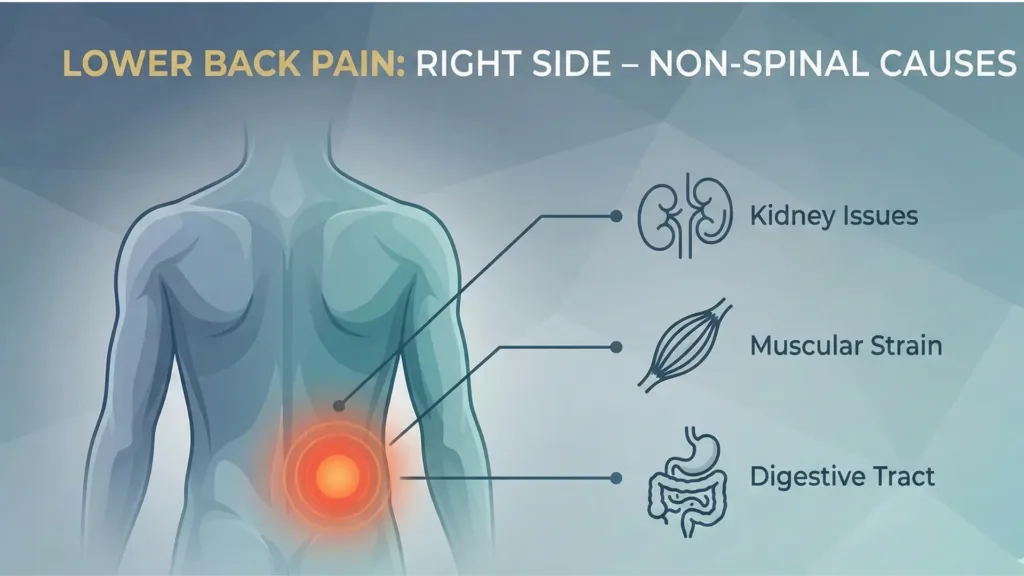
This category matters because it is where one-sided back pain stops being a musculoskeletal story.
Patterns that suggest a medical (non-muscle) source
- Pain is not clearly affected by movement or posture
- You feel systemically unwell: fever, chills, nausea, profound fatigue
- Urinary symptoms: burning, urgency, blood in urine
- A new rash in a stripe on one side (shingles often starts as pain before rash)
- Severe right lower abdominal pain (appendix pattern)
If you suspect one of these, do not “stretch it out.” Seek evaluation.
How do I tell which cause is most likely?
Sort the pain into one of three buckets before chasing a diagnostic label. Bucket A is mechanical joint and muscle pain that clearly changes with position. Bucket B is nerve- or disc-sensitive pain with leg symptoms. Bucket C is pain that does not behave mechanically at all. The bucket, not the label, decides what you do next.
Bucket A: Mostly mechanical joint/muscle pain
- Changes clearly with position or movement
- Better with heat, gentle walking, posture breaks
- No leg numbness/weakness
Bucket B: Nerve-sensitive or disc-sensitive pain
- Leg symptoms, tingling, burning
- Worse with sitting, coughing/sneezing, bending
- May “centralize” (move toward the spine) with certain movements
Bucket C: Possible non-spine pain
- Not movement-dependent, systemic symptoms, urinary/GI signs, rash
If you are in Bucket C, prioritize medical evaluation.
From the Clinic: Dr. Arora’s Expert Insight
In my clinic, the most common reason one-sided back pain becomes “chronic” is not a missed MRI finding—it is a repeated daily asymmetry that patients don’t notice. People will say, “I sit straight,” but when we actually watch their day, they always cross the same leg, lean toward the same armrest, carry the bag on the same shoulder, and rotate toward the same screen. That consistent micro-rotation loads one SI joint and one facet chain hundreds of times a day.
Standard advice like “just stretch your back” often fails because it treats tightness as a flexibility problem. In reality, right-sided tightness is frequently a protective strategy: your nervous system is bracing a sensitive segment.
The faster win is usually “symmetry + short resets + capacity build.” First, remove the daily asymmetric triggers for 7–10 days. Second, use brief, repeatable symptom-relief positions (60–90 seconds) instead of long, aggressive stretches. Third, rebuild hip and trunk endurance so the spine is not forced to handle every load. When patients follow that order, they usually improve faster—and relapses become less frequent.
What should I do in the first 48 hours?
Aim to reduce irritation, not to regain flexibility. Three things do most of the work in the first 48 hours: adopt a comfort-bias position for two to five minutes several times a day, break walking into short frequent intervals instead of one long effort, and temporarily drop the two or three movements that reliably spike your pain. Stretching harder is not on the list.
Step 1: Pick a “comfort bias” position (2–5 minutes, several times/day)
Choose one option that noticeably decreases your pain within 60 seconds:
Option A: Hook-lying reset (neutral bias)
- Lie on your back, knees bent, feet on the floor
- Place a small pillow under knees if needed
- Breathe slowly: inhale 4 seconds, exhale 6 seconds × 6 breaths
Option B: 90/90 supported breathing (reduces guarding)
- Lie on your back with calves on a chair (hips and knees about 90°)
- Keep ribs relaxed; exhale longer than inhale
- Do 6–8 slow breaths
Option C: Gentle prone prop (extension bias, only if it helps)
- Lie on stomach, prop on elbows
- Stay relaxed; no forcing into pain
- 30–60 seconds × 2–3 reps
If any option increases leg pain or produces sharp pain, stop and choose another.
Step 2: Walk in “intervals,” not in one long session
For most mechanical one-sided back pain, short frequent walks beat both bed rest and one long march.
- Walk 3–6 minutes, then rest 1–2 minutes
- Repeat 3–5 rounds across the day
- Keep steps short and easy; avoid speed-walking during an acute flare
Step 3: Avoid the three aggravators (for 72 hours)
These are the most common ways people prolong a flare:
- Repeated forward bending to “test it”
- Twisting while lifting or getting out of bed
- Long unsupported sitting
Use a hip hinge when you must bend, and turn your whole body rather than twisting through the spine.
How do I stop it coming back? A 2–4 week rehab plan
Calming symptoms without rebuilding capacity is why one-sided back pain recurs. The plan below runs in two phases: roughly the first week is spent restoring pain-free activation of the glutes and deep trunk muscles, and weeks two to four build trunk control, anti-rotation strength, and a reliable hip hinge so bending and lifting stop provoking the same side.
Progression is driven by response, not by the calendar. Use the table below to decide when you have actually earned the next phase.
| Phase | Main goal | What you actually do | Ready to progress when |
|---|---|---|---|
| Phase 1 — Days 1–7 | Settle irritation and restore pain-free activation | Comfort-bias positions, posterior pelvic tilt holds, short-range glute bridges, side-lying hip abduction, walking in intervals | You can complete all Phase 1 work with pain no higher than 3/10, symptoms settle within 30 minutes afterwards, and you sleep through most of the night |
| Phase 2 — Weeks 2–4 | Build trunk control, anti-rotation strength, and hinge mechanics | Bird-dog, Pallof press, hip hinge drill, progressively longer continuous walks | You can hold a controlled bird-dog for 10 seconds each side without the painful side flaring, and hinge to pick an object off the floor without a symptom spike |
| Return to loading | Restore tolerance for lifting, carrying, and sport | Reintroduce loaded hinging, carries, and your usual activity — one variable at a time | Two consecutive symptom-free weeks of Phase 2 work, and next-day soreness after a heavier session settles within 24 hours |
How often?
- 4 days/week for strength (15–25 minutes)
- Daily “movement snacks” (2–3 minutes, 3–6×/day)
Phase 1 (Days 1–7): Calm + activate (no heroics)
Exercise 1: Posterior pelvic tilt holds (core “on switch”)
How to do it
- Lie on your back, knees bent.
- Gently flatten your low back toward the floor by tipping the pelvis backward.
- Hold 5 seconds at 20–30% effort (not maximal).
- Relax 5 seconds.
Dosage: 6–10 reps, once or twice/day.
Exercise 2: Glute bridge (short range, pain-free)
How to do it
- Lie on back, knees bent, feet hip-width.
- Brace lightly, squeeze glutes, lift hips 5–10 cm (small lift).
- Hold 3 seconds, lower slowly.
Dosage: 2 sets of 8–10 reps.
Exercise 3: Side-lying hip abduction (glute med support)
How to do it
- Lie on your side with bottom knee bent for balance.
- Keep top leg straight and slightly behind you (prevents hip flexor takeover).
- Lift 20–30 cm, pause 2 seconds, lower slowly.
Dosage: 2 sets of 8–12 reps each side.
If symptoms spike after these, reduce range and effort, not frequency.
Phase 2 (Weeks 2–4): Build trunk control and anti-rotation strength
Exercise 4: Bird-dog (spinal stability without compression)
How to do it
- Start on hands and knees, hands under shoulders, knees under hips.
- Extend one leg back while reaching the opposite arm forward.
- Keep hips level; do not let the low back sag.
- Hold 5 seconds; return slowly.
Dosage: 2 sets of 6–8 reps/side.
Exercise 5: Pallof press (anti-rotation control)
How to do it
- Stand sideways to a resistance band anchored at chest height.
- Hold band at chest, step away until there is tension.
- Press straight out, resist twisting, hold 2 seconds, return.
Dosage: 2 sets of 8–10 reps/side.
Exercise 6: Hip hinge drill (protects back during bending)
How to do it
- Stand with a stick along your spine (head, mid-back, tailbone touch).
- Push hips back as if closing a car door; knees soften.
- Keep the three contact points; return to stand.
Dosage: 2 sets of 8 reps, then use the hinge during daily tasks.
Do’s and don’ts for right-sided low back pain
Do
- Do keep moving within tolerance (short walks, gentle transitions)
- Do use symmetry: alternate the side you carry things, switch which leg crosses
- Do strengthen hips and trunk endurance (not just stretch)
- Do sleep with a pillow between knees if side-sleeping increases symptoms
Don’t
- Don’t force end-range stretching into sharp pain
- Don’t repeatedly “test” painful movements every hour
- Don’t sit for long blocks without a posture break (set a timer)
- Don’t ignore progressive weakness, numbness, or bladder/bowel symptoms
Myths vs facts
Myth: “If it’s on the right side, it must be my kidney.”
Fact: Kidney pain is possible, but most right-sided back pain is musculoskeletal and changes with movement. Kidney causes often come with systemic or urinary features.
Myth: “I should stretch harder because I feel tight.”
Fact: Tightness can be protective guarding. Start with isometrics and controlled movement first, then add mobility once pain calms.
Myth: “An MRI will always show the cause.”
Fact: Many painful conditions are load- and sensitivity-driven and may not correlate neatly with what a scan shows. This is why the UK’s National Institute for Health and Care Excellence advises clinicians not to routinely offer imaging in a non-specialist setting for people with low back pain, with or without sciatica — imaging is reserved for situations where the result would genuinely change the management plan.
When should I see a clinician about right-sided back pain?
Two timelines apply. Arrange an assessment within a week if the pain has not meaningfully improved after ten to fourteen days of sensible self-management, keeps recurring, or comes with leg symptoms that are not settling. Seek same-day care for bladder or bowel changes, saddle numbness, spreading weakness, fever, blood in the urine, or a new one-sided rash with burning pain.
Arrange an assessment soon (within a week) if:
- Pain persists beyond 10–14 days with little improvement
- Pain is recurrent and limiting work, sleep, or walking
- You have leg pain/tingling that is not improving
- You suspect hip involvement (groin pain, marked ROM loss)
Seek urgent evaluation now if:
- New bladder/bowel changes, saddle numbness, progressive weakness
- Fever, unexplained weight loss, history of cancer, IV drug use
- Severe flank pain with urinary symptoms or blood in urine
- New rash with severe burning pain on one side
FAQ
1) Why do I have right-sided low back pain when I wake up?
Morning pain often reflects overnight positions (side sleeping rotation), stiffness, or guarding. Try a pillow between knees, avoid sleeping twisted, and do a 2-minute reset (hook-lying breathing) before you stand.
2) Can my mattress cause one-sided low back pain?
Yes—if your mattress causes you to sink and rotate, your spine and SI joint can be loaded asymmetrically for hours. A temporary test is to sleep 2–3 nights with extra support (firm topper or different bed) and note changes.
3) Is it serious if the pain spikes when I cough or sneeze?
Cough/sneeze pain can increase pressure on discs and nerves. If it is accompanied by leg symptoms or worsening neurological signs, get evaluated. If it is mild and improving, focus on hinge mechanics and symptom-calming positions.
4) Why does the pain radiate into my buttock?
Buttock radiation can be SI joint referral, glute trigger points, facet referral, or nerve irritation. The “bucket” approach helps: if symptoms travel below the knee or include tingling, think nerve-sensitive.
5) How long should right-sided low back pain last?
Many mechanical flares improve meaningfully in 7–14 days. If it is not improving by two weeks, or it keeps recurring, you likely need a better load-management and strengthening plan (not more rest).
6) Should I use heat or ice?
Use what reduces pain. Heat often helps stiffness/guarding; ice may help after an acute strain. Either is a symptom tool—movement and rehab do the long-term work.
7) Can constipation cause low back pain on the right side?
Constipation can increase abdominal pressure and pelvic floor guarding, which may amplify back discomfort. If pain improves after bowel movements and you have bloating, consider addressing bowel habits—but do not assume constipation is the only cause.
8) Is walking good for right-sided low back pain?
Usually yes, in short intervals. Walking reduces stiffness and restores normal motion, but avoid long, fast walks during the first 48–72 hours if they flare symptoms.
9) What is the best exercise for one-sided back pain?
There is no single best. Start with pelvic tilt holds and a small-range glute bridge, then progress to bird-dog and anti-rotation strength. The best exercise is the one you can repeat consistently without flare.
10) When should I get an MRI or X-ray?
Imaging is typically considered when red flags exist, symptoms are severe/persistent, or neurological deficits are present. For many mechanical episodes, conservative care and monitoring are appropriate first.
The bottom line
Low back pain on right side is rarely a mystery once you stop asking which side and start asking what pattern. Match the behavior of your symptoms to the most likely driver, clear the small list of findings that need medical assessment, then spend two to four weeks rebuilding the capacity that let the problem start. Most people improve substantially without a scan, an injection, or a specialist referral — provided the loading is dosed rather than avoided.
Medical disclaimer
This article is general education about a common musculoskeletal presentation. It is not a diagnosis, and it cannot account for your history, examination findings, or other conditions you may have. If your symptoms are severe, worsening, or accompanied by any of the urgent findings described above, arrange an in-person assessment rather than self-managing.
References
- National Institute for Health and Care Excellence. Low back pain and sciatica in over 16s: assessment and management. NICE guideline NG59. Published 30 November 2016; last updated 11 December 2020. NICE guideline NG59