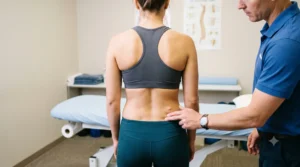
Check for emergency symptoms before resuming lifting. Get emergency care now for new difficulty passing or controlling urine, new loss of bowel control or sensation, numbness around the genitals or anus, or new sciatic pain down both legs. Severe or worsening weakness or numbness in both legs also needs emergency care. The loads and timings below are examples. Return to training depends on your symptoms, strength, previous training and a clinician’s assessment where needed.
“Expert Review: This article includes clinical insights from Dr. Vivek Arora, a physical therapist (physiotherapist) with 20+ years of experience.”
A disc herniation at L5-S1 hits powerlifters in a way it does not quite hit anyone else. The movement patterns at the center of the sport — the deadlift, the squat, the specific bracing and loading demands of competition — are also the patterns most directly affected by this injury. So when the diagnosis arrives, the fear that follows is not just about pain. It is about whether the sport continues.
Returning to powerlifting after an L5–S1 disc herniation requires a plan matched to symptoms, neurological findings, previous training and the demands of the lifts. Education, symptom management and gradually adjusted activity are useful starting points; no single published protocol establishes the right sequence for every powerlifter.
Return to sport is possible, but powerlifting-specific outcome data are limited. Studies of elite athletes in other sports can inform a discussion without predicting your return date, strength or competition result.
Key Takeaways
- L5–S1 is a common site of lumbar disc herniation. Squats and deadlifts load several spinal and hip structures; this does not identify how an individual injury occurred.
- Back and leg symptoms may involve nerve-root irritation, but MRI findings and examination must be interpreted together. Herniation size alone does not predict pain or readiness to lift.
- Many athletes return after either nonoperative or surgical care. Evidence from mixed elite sports is not a powerlifting-specific success rate.
- A flexible, graded return can help organize training. The phases below are examples rather than a validated recovery protocol.
- Cauda equina symptoms require emergency care. New or worsening weakness and other serious warning signs also need timely assessment.
What Actually Happens to the L5-S1 Disc During Heavy Lifting?
The L5–S1 disc lies between the lowest lumbar vertebra and the sacrum. Herniation describes displacement of disc material beyond its usual boundary. Loading, tissue changes and individual factors may contribute, but the diagnosis cannot establish that a particular rep, depth or bracing error caused it.
The disc includes an outer annulus and an inner nucleus. Herniated material can irritate a nearby nerve root through pressure and inflammation. Some herniations cause no symptoms, so the scan must fit the clinical findings.
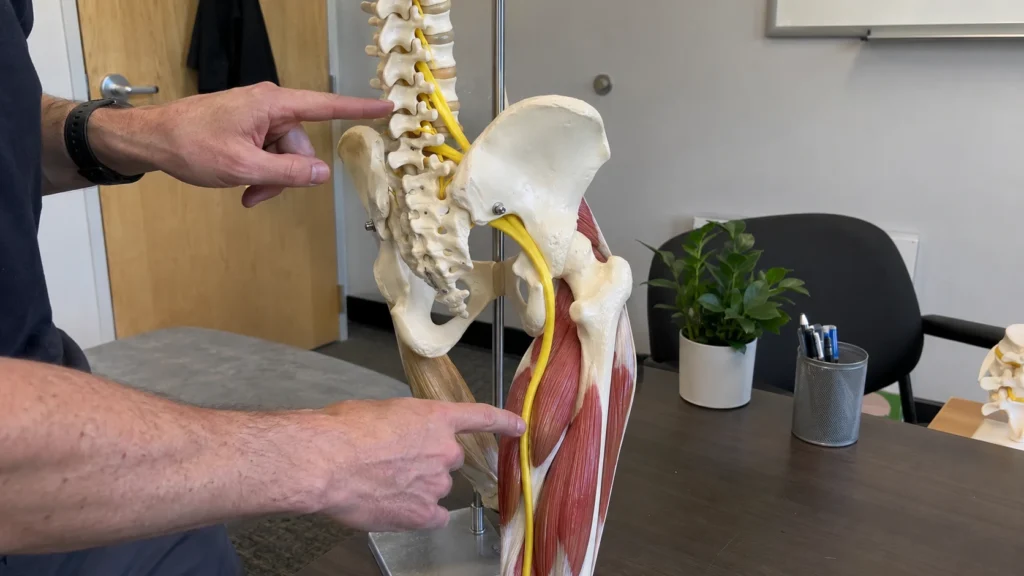
Heavy lifts create substantial demands on the trunk and hips. A clinician and coach can review recent training changes, fatigue and movement options without assuming cumulative disc damage or a failed brace from the diagnosis alone.
At L5–S1, a posterolateral herniation commonly affects the traversing S1 root; a foraminal or far-lateral herniation may affect the exiting L5 root. A large central herniation may affect several roots. Symptom patterns overlap and require a neurological examination.
How Do You Know It’s a Disc Herniation — and Not Something Else?
A symptomatic lumbar disc herniation may cause back pain, radiating leg pain, tingling, numbness or weakness. Coughing and straining can aggravate symptoms, but none of these observations alone confirms the cause.
The following observations help describe symptoms. They cannot distinguish a facet, disc, hip or deep-gluteal diagnosis by themselves.
| Observation | What assessment may consider | Important limitation |
|---|---|---|
| Back pain with extension or standing | Several back, hip or other causes | Cannot diagnose a facet joint by movement alone |
| Buttock pain with sitting | Spinal, deep-gluteal and hip causes | Local tenderness is not a definitive piriformis test |
| Groin pain or limited hip movement | Hip and other sources | Location and movement patterns overlap |
| Fever, weight loss or cancer history | Possible systemic or serious disease | Seek appropriate medical assessment |
| Leg pain with altered sensation or weakness | Possible nerve-root or peripheral nerve involvement | Neurological examination guides interpretation |
L5 involvement may affect big-toe extension or sensation over the top of the foot; S1 involvement may affect push-off strength or sensation toward the outer foot. These patterns are not exact maps, and self-testing cannot replace an examination.
When Is This a Medical Emergency?
Cauda equina syndrome is one emergency to exclude when back or leg symptoms change. New neurological or systemic findings also matter; do not wait for a complete set of symptoms or assume the MRI explains every new problem.
Seek emergency care without delay if any of the following develop:
- New difficulty starting urination, inability to pass urine, or new loss of urinary control — emergency care now.
- New loss of bowel control or awareness — emergency care now.
- New numbness around the genitals, anus or inner thighs — emergency care now.
- New sciatic pain down both legs, or severe or worsening weakness or numbness in both legs — emergency care now.
- New or worsening weakness in one leg, including a dragging foot — urgent medical assessment.
These signs can indicate serious nerve compression, but they do not establish the diagnosis at home. Seek the care indicated immediately rather than continuing to lift or waiting for physical therapy.
Get urgent advice for back pain with fever or feeling unwell, and prompt assessment for unexplained weight loss or a cancer history. Severe pain after a major accident needs emergency care. Rapidly worsening neurological symptoms should not wait several days.
Does an MRI Actually Change Anything at L5-S1?
Routine early MRI is not recommended for uncomplicated back pain or sciatica. Imaging can be important when serious disease or progressive neurological loss is suspected, or when a specialist expects it to change treatment.
Disc findings occur in people without pain as well as in symptomatic people. A scan can help identify relevant nerve compression, but it cannot by itself determine how much pain you should have or when you can lift again.
When imaging is clinically appropriate:
- Neurological signs (weakness, reflex asymmetry, sensory deficit) are present and worsening
- Red flag symptoms suggest a non-mechanical or urgent cause
- Persistent disabling symptoms for which a specialist is considering a treatment that depends on imaging findings.
- Surgical consultation is being actively considered and anatomical detail is needed
When imaging can safely wait:
- Local back pain only, no neurological signs, symptoms are improving
- The clinical goal is reassurance rather than directing a treatment change
An MRI may also mention vertebral endplate signal changes. These findings require clinical interpretation; the guide to Modic changes on MRI explains their limitations.
From the Clinic: Dr. Arora’s Expert Insight
The useful training question is which current activities you can manage and how to build toward the demands of your sport. The answer needs more than a calendar or a scan label.
Training through steadily worsening leg symptoms is a reason to reduce the provoking demand and review the plan. It does not follow that every symptom during exercise delays nerve recovery.
Tell your clinician about spreading numbness, changes in strength and whether symptoms are worsening between sessions. Those details matter more than proving you can complete a reduced-weight workout.
Brief rest for comfort and appropriate activity can coexist. Avoid prolonged bed rest, but also avoid treating heavy barbell work as obligatory when ordinary movement or neurological function is deteriorating.
Hip and trunk exercises are options for rebuilding capacity. A required muscle-activation sequence has not been established, and exercise response does not prove that a weak muscle caused the herniation.
What Should You Do in the First 72 Hours?
If symptoms are new or flaring, screen for warning signs, reduce the activity that clearly aggravates them and maintain manageable daily movement. There is no universal ban on all loaded movement for a fixed 72-hour period.
What to Do Today: First 72 Hours
- Adjust training: Pause painful heavy lifting while you assess the flare. A short comfortable walk or another tolerable activity is optional; the correct duration may be shorter than ten minutes.
- Choose comfortable support: Try a resting position that eases symptoms. Extension is not suitable for everyone, and a response to position does not diagnose the disc or demonstrate healing.
- Modify provoking tasks: Reduce a particular range or load if needed, without treating ordinary bending or sitting as inherently damaging.
- Discuss pain relief: Ask a prescriber or pharmacist about suitability. NSAIDs have potential harms and limited evidence of benefit for sciatica; do not assume that they reliably reduce nerve-root inflammation.
- Act on warning signs: Get emergency care now for new difficulty passing or controlling urine, loss of bowel control or sensation, numbness around the genitals or anus, or new sciatic pain down both legs. Severe or worsening weakness or numbness in both legs also needs emergency care. Get urgent medical assessment for new or worsening weakness in one leg.
The Powerlifter’s Recovery Protocol: Phase by Phase
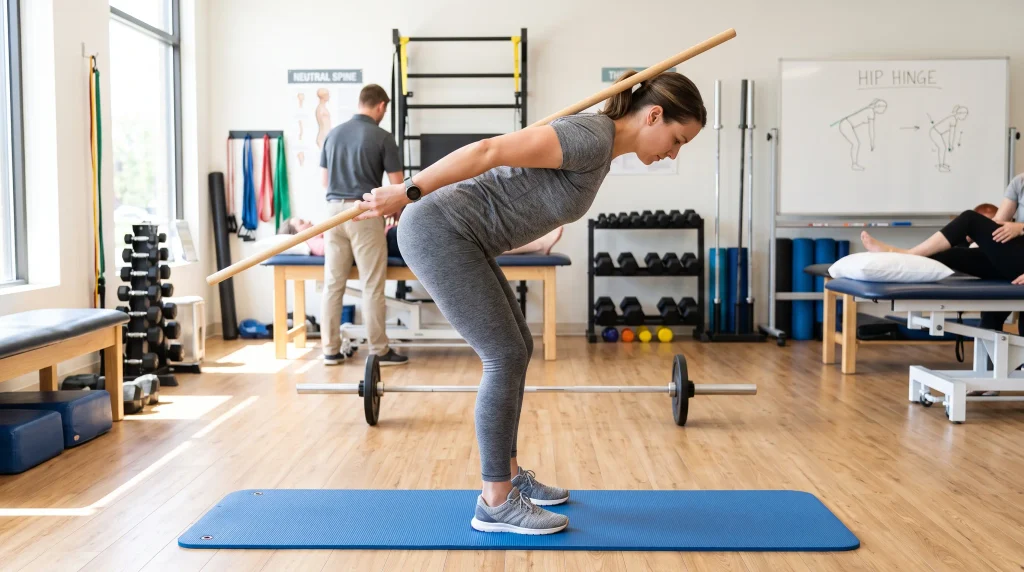
Use the phases as planning examples. Progress depends on function, neurological status, symptom response and training goals, with individual advice where needed. Passing a particular lift does not directly measure disc healing.
| Planning stage | Example focus | Review before progressing |
|---|---|---|
| Manage a flare | Comfortable daily movement and reduced provoking training | Warning signs and neurological changes |
| Build capacity | Tolerable hip, trunk and conditioning exercises | Function and response during and after activity |
| Reintroduce lifting | Adjust range, variation, volume or load | Stable neurological function and manageable recovery between sessions |
| Return toward competition | Gradual exposure to sport demands | Individual goals, training response and clinician advice where needed |
On the specific competition lifts:
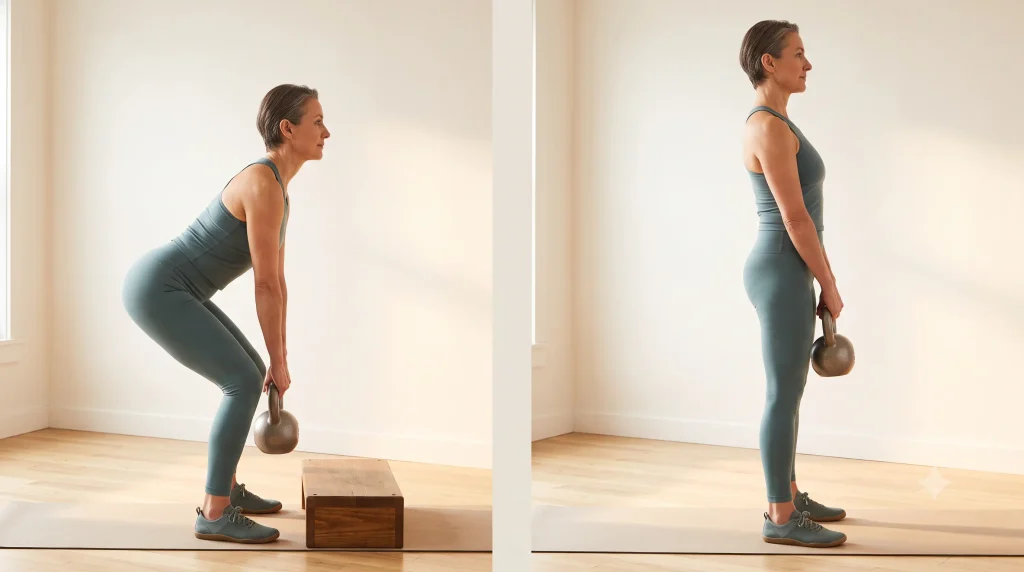
A raised start, lighter bar, trap bar or box squat may change the demands of a lift. None is universally safer after a herniation, and the conventional deadlift does not require a fixed late-stage return. The guide to deadlift-related back pain discusses adjustments to consider.
Bench pressing may be tolerable for some lifters and provocative for others. Adjust the load, arch and setup to the response; the bench-press back-pain guide offers coaching considerations rather than a safety guarantee.
Hip and trunk strengthening can be part of return to lifting. A feeling of gluteal tightness does not demonstrate inhibition or prove extra disc loading; see gluteal tightness and back pain for related discussion.
Do: Select manageable activity, monitor the response and build training gradually. A belt is optional; it is not a proven requirement for recovery or protection from another herniation.
Avoid: Repeatedly pushing through worsening leg symptoms or new weakness. Review progress across symptoms and function rather than assuming pain reduction proves tissue readiness.
When Conservative Care Is Not Enough
Many symptomatic lumbar disc herniations improve over time without surgery. Herniated material can shrink, but symptom improvement does not require a scan to return to normal and is not guaranteed within six to twelve weeks.
Discuss specialist assessment when:
- Weakness is new, substantial or worsening — obtain urgent medical advice rather than waiting six to eight weeks.
- Leg pain or functional limitation remains disabling despite appropriate nonoperative care; the timing of review should reflect severity and your goals.
- Emergency neurological warning signs appear. Herniation size alone does not establish impending cauda equina syndrome or an automatic need for surgery.
A 2021 review of elite athletes reported return to play in 83.0% after surgery and 81.5% after nonoperative treatment, without a statistically significant difference. Mean return times were 5.19 and 4.11 months respectively. These largely observational, mixed-sport data do not establish that one treatment is better or predict a powerlifter’s timeline (Sedrak et al.). Treatment selection depends on the clinical indication.
After surgery, follow the surgeon’s restrictions and an individualized rehabilitation plan. A fixed addition of four to six weeks to each phase is not supported by the cited review.
What Can Powerlifters Actually Expect from L5-S1 Herniation Recovery?
Return to sport is possible, but the outlook varies with symptoms, nerve function, treatment, previous training and personal goals. Baseline fitness does not guarantee a particular outcome.
There is no established powerlifting-specific timetable for return to training or competition. Reassess the plan if neurological function worsens or ordinary activities remain difficult.
Examples of goals to discuss:
- Manage symptoms and preserve comfortable daily activity while checking neurological function.
- Build tolerable hip, trunk and general conditioning work; barbell use is decided individually.
- Reintroduce selected lift variations with a manageable load and review the response.
- Build competition demands only when the preceding work and neurological status support it; there is no guaranteed percentage of previous strength by a given month.
Recurrence can occur despite careful training. Review load progression and useful technique adjustments without assuming that an identifiable movement error caused the original injury or that perfect technique prevents recurrence.
Conclusion
L5–S1 herniation recovery for powerlifters is a graded return to the demands of lifting, guided by the clinical picture and your goals. Many athletes return to sport, but mixed-sport averages cannot promise when you will compete or how much you will lift. Reduce clearly aggravating demands, rebuild manageable activity and act promptly on neurological warning signs.
Frequently Asked Questions
1. Can I deadlift with an L5-S1 disc herniation?
Deadlifting may need modification or a pause during a flare, especially with worsening leg symptoms or weakness. Return timing, variation and load should be individualized; there is no proven universal ten-week threshold or safest deadlift style.
2. How long does L5-S1 herniation recovery take for powerlifters?
Recovery varies. The cited review of elite athletes in mixed sports found average return times of about four months with nonoperative care and five months after surgery; these are not powerlifting prescriptions or deadlines.
3. Is squatting worse than deadlifting for L5-S1 herniation recovery?
Neither is universally worse. Range, load, style and your response matter. A trap bar, box squat or raised start may be a useful option, but none is automatically safe and neither lift has to wait for a fixed rehabilitation week.
4. Will I need surgery for my L5-S1 herniation?
Many people improve without surgery. Persistent disabling symptoms can justify a specialist discussion, while new or worsening weakness needs urgent assessment. Get emergency care now for new difficulty passing or controlling urine, loss of bowel control or sensation, numbness around the genitals or anus, or new sciatic pain down both legs. Severe or worsening weakness or numbness in both legs also needs emergency care. Get urgent medical assessment for new or worsening weakness in one leg.
5. My MRI shows a large herniation. Does that mean a worse recovery?
Size alone does not determine pain severity or recovery. MRI can still identify clinically important compression or another condition, so interpret it with symptoms and neurological findings rather than dismissing it or using it as a return-to-lifting test.
6. Can I compete in powerlifting again after an L5-S1 herniation?
A return may be possible. Mixed elite-sport studies reported that about four in five athletes returned after either treatment approach, but they do not establish a powerlifting-specific success rate or guarantee a return to previous performance.
7. What movements should I avoid during recovery?
Temporarily modify activities that reliably worsen symptoms, especially spreading leg pain or loss of function. Normal bending and impact are not permanently prohibited; their return depends on your assessment, response and goals.
Medical Disclaimer
This article is written for general educational purposes and does not constitute medical advice or replace assessment by a qualified healthcare provider. Disc herniation presentations vary significantly between individuals, and recovery timelines depend on factors that require individual clinical evaluation. If you are experiencing progressive neurological symptoms, loss of bladder or bowel control, or bilateral leg weakness, seek emergency medical attention immediately. All rehabilitation protocols described in this article should be adapted under the direct guidance of a physical therapist (physiotherapist) or physician who has assessed your specific presentation and imaging findings.
References
- Sedrak P, Shahbaz M, Gohal C, Madden K, Aleem I, Khan M. Return to Play After Symptomatic Lumbar Disc Herniation in Elite Athletes: A Systematic Review and Meta-analysis of Operative Versus Nonoperative Treatment. Sports Health. 2021 Sep-Oct;13(5):446–453. doi: 10.1177/1941738121991782. PMID: 33563131.
- NHS. Sciatica. Symptoms, activity advice and emergency warning signs.
- National Institute for Health and Care Excellence. Low back pain and sciatica in over 16s: assessment and management (NG59). Recommendations on assessment, imaging and management.