Expert Review: This article includes clinical insights from Dr. Vivek Arora, a physical therapist (physiotherapist) with 20+ years of experience.
Bench day should not feel like a low-back day. Yet an aching lumbar spine is one of the most common surprises lifters report on the bench, precisely because they are lying down rather than squatting or pulling. The confusion tends to produce two bad outcomes: people train through it until it becomes a genuine flare-up, or they over-correct, flatten out completely, lose stability and irritate their shoulders instead.
Bench press lower back pain usually comes from lumbar extension and compression rather than tissue damage. The ribs flare, the pelvis tips forward, and the low back ends up doing the stabilizing work that the brace and upper back should be doing. Leg drive then pushes the pelvis rather than the torso. Most cases settle within a few sessions once the setup sequence and foot position change.
Key takeaways
- The arch is not automatically the villain. A controlled arch that comes mostly from the upper back is fine for most lifters. An arch that grows as the weight climbs is the one that causes trouble.
- It is usually a sequencing error, not weakness. Plenty of strong lifters get this because they set the arch first and try to brace on top of it, by which point the brace cannot wrap all the way around.
- When the pain appears tells you what to change. Pain at unrack, pain only with leg drive, and pain that builds across sets point to three different fixes.
- Leg drive should stiffen the torso, not shove the pelvis. Moving the feet forward 5–10 cm (2–4 in) is often the single fastest change.
- Radiating symptoms change the plan entirely. Numbness, leg weakness or pain that spikes with coughing is no longer a technique conversation.
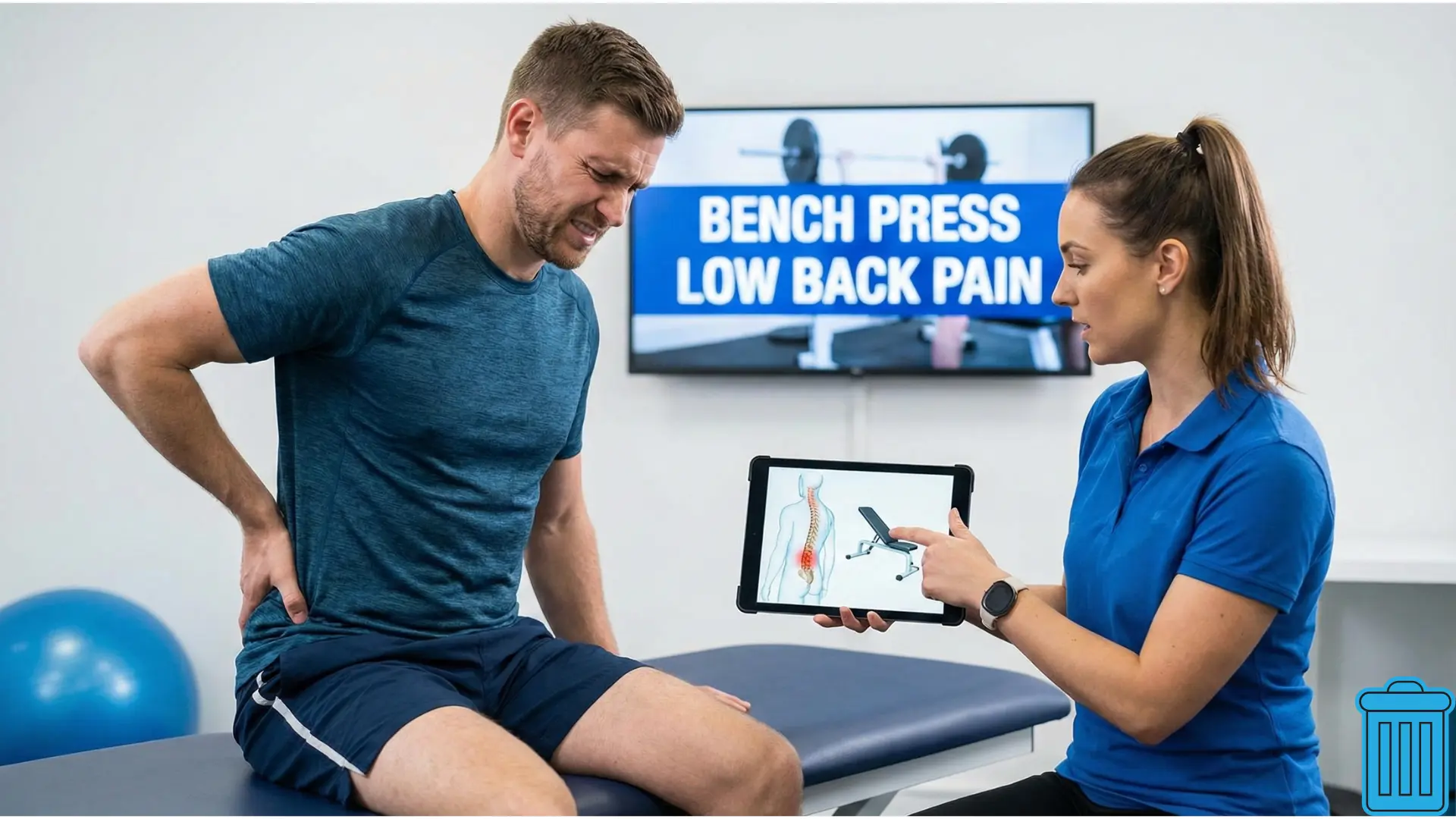
Why does my lower back hurt when I bench press?
Because your spine is still carrying load, just in a different direction. Benching asks you to build a rigid bridge from your feet to your upper back so force transfers into the bar. That bridge involves some lumbar arching, which is normal. Pain starts when the arch stops being a chosen position and becomes a compensation for a stiff upper back or a late brace.
The three structures most likely to complain
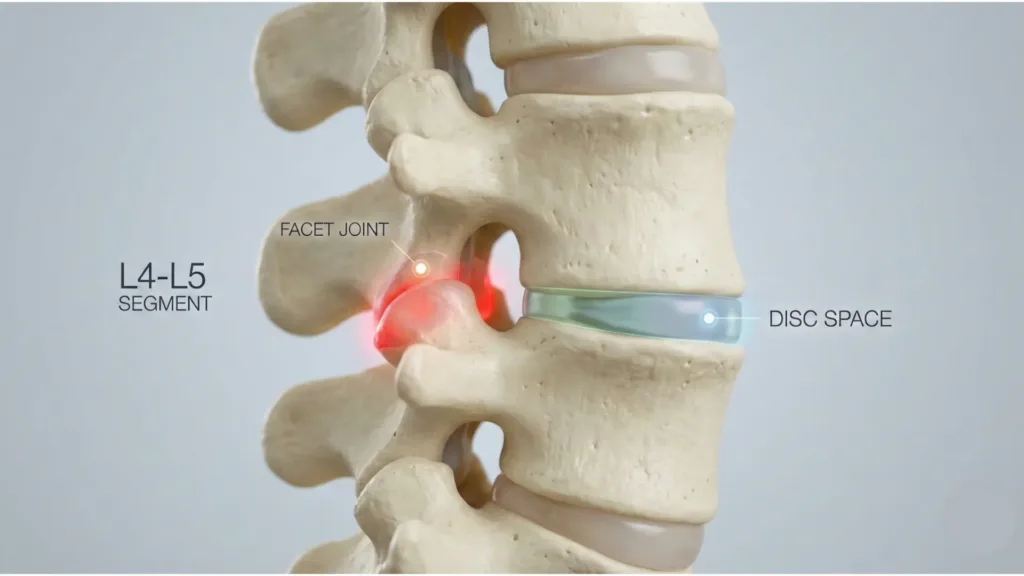
1) Lumbar facet joints (extension intolerance)
Facet joints are the small paired joints at the back of each spinal segment that guide and limit movement. They tolerate repeated end-range extension under compression poorly. If you already stand in a swayback posture, or your hips and mid-back are stiff, the bench arch tends to dump stress straight into them. Facet-driven pain is typically one-sided and pinchy, and it gets worse the harder you arch.
2) Lumbar discs and surrounding tissue
Discs are the fluid-filled shock absorbers between vertebrae, and they are most sensitive to bending combined with twisting. Benching is not a flexion lift, but an aggressive setup can create shear if you slide the pelvis, flare the ribs and lose abdominal control. Pain that feels deep, central, or spreads into the buttock or thigh suggests the disc region may be irritable.
3) Muscles and fascia (erector spinae, quadratus lumborum, hip flexors)
When the abdominal brace is weak or mistimed, the spinal extensors and hip flexors become the stiffness providers by default. That commonly feels like a tight band or a post-set cramp rather than a sharp pinch during the rep, and it usually eases within a day.
The arch is not the enemy — the uncontrolled arch is
When competitive powerlifters were tested using both styles, the arched-back version allowed marginally greater maximal load while the flat-back version produced greater bar displacement and velocity, and the authors concluded that either technique may be used depending on the training goal. That is a long way from calling the arch mandatory, and equally far from calling it dangerous. What matters clinically is where the arch comes from: extension through the thoracic spine and scapular set, not a crank of the lumbar spine into end range.
In practice, you want a shape that is stable and repeatable. If your arch grows rep to rep, set to set, or only shows up when the weight gets heavy, your back is doing the job your brace and setup should be doing.
What actually causes it? 11 common drivers
Eleven distinct mechanisms show up repeatedly, and most lifters have two or three running at once. That overlap is exactly why the standard advice to just flatten your back so rarely solves it.
Cause 1: Rib flare plus anterior pelvic tilt (the “banana bench”)
The ribcage tips up at the front, the pelvis rotates forward, and the lumbar spine takes up the slack in between. Clue: your belly pops up, your belt line tips forward, and your low back feels compressed before the bar has even moved.
Cause 2: Leg drive that pushes the pelvis, not the torso
Leg drive should help you stay tight and press the upper back into the bench. If your feet are placed so that driving pushes your pelvis forward, you add lumbar extension on every rep. Clue: pain rises specifically as you push through the floor.
Cause 3: Rack height that forces a reach
Too high and you shrug, losing the scapular set; too low and you over-arch to clear the hooks. Either way the lumbar spine compensates. Clue: discomfort starts at the unrack, before any pressing.
Cause 4: Limited thoracic extension
If the mid-back will not extend, the body borrows the range from below. Clue: you cannot keep your chest proud without cranking the low back.
Cause 5: Shoulder position that destabilizes the base
Lose scapular retraction and depression and the torso wobbles, so the spine manufactures rigidity instead. Clue: your shoulder blades slide and you feel loose on the bench.
Cause 6: A partial brace, or one applied too late
Raising pressure inside the abdomen stiffens the trunk, and this mechanism can stabilize the lumbar spine without extra erector spinae activity — useful precisely because the erectors are often already working overtime here. Clue: you can talk easily mid-rep, or you only tense the front of your abdomen and not the sides and back.
Cause 7: Chasing a competition arch you do not own
A deep arch is fine if your spine tolerates it and you can reproduce it cold. Shortening the range without the underlying control is a direct route to trouble for an extension-intolerant back. Clue: your arch is dramatically bigger on heavy singles than on warm-ups.
Cause 8: Stiff hip flexors
Short, stiff hip flexors pull the pelvis into anterior tilt on the bench, especially with the feet tucked far back. Clue: pulling at the front of the hips alongside low-back compression.
Cause 9: Fatigue and volume spikes
As the session wears on, positional control fades before strength does, and the back quietly becomes the stability muscle. Lumbopelvic complaints are common in strength sport, and abrupt jumps in weekly pressing volume are a recurring trigger. Clue: pain appears late in the session or the following morning after high-volume benching.
Cause 10: An extension-sensitive back to begin with
If backbends, prolonged standing or walking downhill already bother you, the bench setup is simply another extension provocation. Clue: relief in slight flexion, such as pulling your knees toward your chest, and pain with arching.
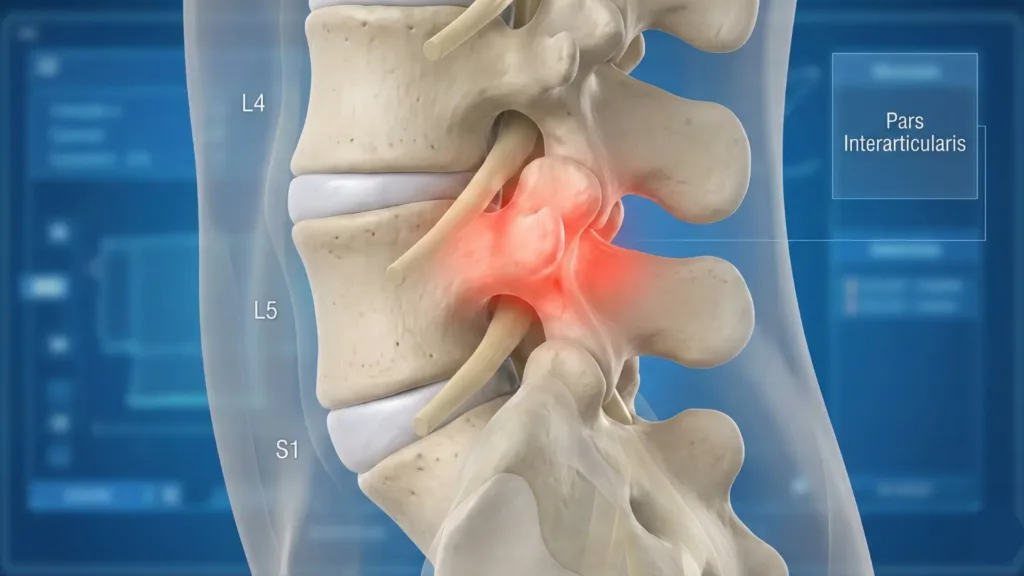
Cause 11: Pars stress reaction in younger lifters
A pars defect is a stress injury to a small bony bridge at the back of a vertebra, commonly at L5, and it is associated with repetitive hyperextension loading. Focal, consistently reproducible extension pain in a teenage or young adult lifter should be assessed rather than trained through.
How do I tell which type of pain I have?
Timing is the most useful diagnostic tool you have. Note the exact moment the pain appears — during the unrack, during leg drive, or gradually across sets — and note what it feels like. Those two pieces of information narrow the likely driver quickly, and they point to different first fixes. The table below maps the common patterns.
| When it shows up | What it usually feels like | Most likely drivers | Change this first |
|---|---|---|---|
| During setup or unrack | Compression, a bracing-for-impact ache | Rack height, reaching, over-arching to clear the hooks, rib flare, stiff mid-back | Lower the rack; set the upper back before the arch |
| Only when you drive through the floor | A push or shove into the low back | Feet too far back, pelvis driven forward, brace applied late, stiff hip flexors | Move feet forward 5–10 cm (2–4 in) and rebrace before unracking |
| Builds across sets, lingers next day | Tight band, cramping, fatigue-type soreness | Volume spike, erector overwork, fading positional control | Cut sets by 30–50%; drop to RPE 6–7 for two weeks |
| Sharp and one-sided, worse the harder you arch | A pinch at a specific spot | Facet joint irritation, extension intolerance | Reduce arch depth; trial feet-up benching |
| Radiates below the buttock, or spikes with cough or sneeze | Electrical, burning, numb or weak | Possible nerve root involvement | Stop pressing heavy and arrange an assessment |
When should I stop benching and get assessed?
Most of this is mechanical and improves with targeted changes. A small subset is not. Stop training and arrange assessment promptly if any of the following are present, because each one suggests something other than an overloaded joint or muscle, and each one changes what should happen next.
- New numbness, tingling or weakness down the leg. This suggests a nerve root may be irritated or compressed rather than a joint being overloaded. Weakness in particular should be checked rather than monitored.
- Loss of bladder or bowel control, or numbness around the groin and inner thighs. This pattern may indicate cauda equina compression, which is a medical emergency and needs same-day emergency assessment.
- Severe pain following a fall, a dropped bar or a crash. Trauma raises the possibility of a fracture, particularly in anyone with reduced bone density or long-term corticosteroid use.
- Fever, unexplained weight loss, a history of cancer, or night pain that does not change with position. Mechanical pain almost always responds to a change in position. Pain that ignores position points away from a training problem and toward infection, inflammatory disease or something systemic.
- Focal extension pain in a teenage or young adult lifter. This may reflect a pars stress reaction, which tends to respond well when identified early and poorly when trained through for months.
- Symptoms that keep worsening despite reduced load and easier sessions. If the tissue is not settling with less work, the problem is unlikely to be technique, and further guessing delays a diagnosis that would change the plan.
Separately, be cautious with aggressive breath-holding if you have uncontrolled high blood pressure, certain cardiac conditions, or are pregnant. Get clearance before using maximal Valsalva bracing.
From the Clinic: Dr. Arora’s Expert Insight
The pattern I see most often is not weak abdominals in isolation — it is a timing problem. Lifters build a big arch first, then try to brace on top of it. By that point the ribs are flared and the pelvis is tipped, so the brace cannot wrap the full circumference. The back becomes the stabilizer by default, and leg drive turns into a pelvic push.
Telling someone to simply arch less usually fails, because it strips out stability without rebuilding the real base: stacked ribs over pelvis, a locked-in upper back, and a brace that switches on before leg drive does. When the sequence changes — stack, set the shoulders, brace, then drive — symptoms often drop within the same session, without touching the rest of the program.
How do I fix bench press lower back pain without giving up the lift?
Change the setup sequence before you change the program. Stack the ribs over the pelvis, set the upper back, brace all the way around, and only then create leg drive. Reposition the feet so driving stiffens the torso instead of tipping the pelvis. Most lifters can keep training throughout, using a modified variation while the pattern is being rebuilt.
Step 1: Rebuild a stacked start position (ribs over pelvis)
- Exhale gently to bring the ribs down — reduce the flare, do not crush them flat.
- Feel the lower ribs connect to the abdominal wall.
- Keep a small, natural arch and avoid the end-range lumbar crank.
Goal: you can hold this shape while breathing into a brace.
Step 2: Set the upper back first
- Pull the shoulder blades down and back (retraction with slight depression).
- Think of building a shelf for your upper back to sit on.
- Lift the chest by extending through the mid-back, not by jamming the lumbar spine.
This removes the need to use lumbar extension as a stability strategy, and for many lifters it changes symptoms immediately.
Step 3: Fix foot position so leg drive helps the torso
- Option A (most lifters): feet slightly behind the knees, full foot contact, knees just below hip line.
- Option B (sensitive back): feet a little further forward to reduce anterior pelvic tilt.
- Option C (temporary regression): feet up on the bench for a few weeks to retrain rib and pelvis control, then reintroduce leg drive.
If symptoms appear specifically at the moment you push through the floor, move the feet forward 5–10 cm (2–4 in) and retest on the next set.
Step 4: Learn a true 360° brace, and time it correctly
- Inhale into your belly and your sides, as if filling a cylinder rather than a balloon.
- Expand into your belt, or into your own hands placed around your waist.
- Hold that pressure as you lower the bar.
- Exhale only after the hardest part of the rep, or between reps on singles.
Brace late and the lumbar spine absorbs the load instead — which is the whole problem in miniature.
Step 5: Control the arch with glute contact
Your glutes stay on the bench. Over-squeezing tips the pelvis backwards and destabilizes some lifters; under-squeezing lets leg drive shove the pelvis forward. Balanced cue: light glute tension, heavy upper-back tension.
Step 6: Check bar path and touch point
A touch point that is too low increases extension demand as the torso reaches to meet the bar.
- Aim for the lower chest or upper sternum region, adjusted for your build.
- Keep wrists stacked over elbows.
- Do not chase a very low touch if your spine has to compensate for it.
Step 7: Adjust equipment and environment
- Use a bench with decent grip — less sliding means less pelvic shear.
- A slightly wider bench helps if you feel unstable.
- A small towel under the upper back can support thoracic extension. Not under the low back.
- Set rack height so you unrack with locked shoulders rather than a reach.
Pain-modifying bench variations
If symptoms persist while you rebuild technique, rotate temporarily rather than stopping:
- Floor press: reduces leg drive demand and physically limits extension.
- Dumbbell bench, neutral grip: usually easier to control rib flare.
- Close-grip bench: often reduces the tendency to arch and flare.
- Tempo bench (3–0–1): forces control without maximal load.
- Feet-up bench: the most direct way to relearn stacked trunk control.
A three-phase return-to-pressing plan
This is a conservative, training-friendly progression. If you have severe symptoms or any of the warning signs above, get assessed before starting it.
Phase 1 (7–14 days): calm the irritation and remove the trigger
Goal: symptoms no higher than 2/10 during training.
- Drop load to RPE 6–7.
- Cut total pressing sets by 30–50%.
- Use feet-forward or feet-up benching.
- Add 5–8 minutes of easy walking after training, which often reduces post-session stiffness.
Daily starter work (8–12 minutes)
- Dead bug, brace focus: 2–3 sets × 6–10 per side. Trains the exact skill that fails on the bench — holding the ribs down while the limbs move.
- Side plank, modified if needed: 2 sets × 20–40 seconds per side. Builds the lateral wall of the brace that rib flare bypasses.
- Gentle hip flexor stretch: 2 × 30–45 seconds per side, targeting the tilt driver from Cause 8.
- Thoracic extension over a foam roller: 6–10 slow reps, so the arch can come from where it should.
Phase 2 (2–6 weeks): build capacity where the bench leaks
Goal: the trunk holds position under full leg drive.
- Glute bridge isometric hold: 3 × 20–30 seconds.
- Bird dog, slow, no lumbar sway: 3 × 6 per side.
- Pallof press: 3 × 10–12 per side, for anti-rotation control under a pushing demand.
- Hip hinge patterning, light RDL or dowel hinge: 2–3 × 8–10.
Reintroduce leg drive gradually across this phase, one variable at a time.
Phase 3 (6–12 weeks): return to performance benching
Goal: increase load without increasing extension stress.
- Add weight weekly only if symptoms stay flat.
- Run the same setup checklist every session.
- Keep trunk work at 2–3 sessions per week.
Return-to-load rule: if pain the next morning is more than 2 points higher than baseline (for example 2/10 rising to 5/10), that session was too much. Reduce load or volume and rebuild from there.
The setup checklist
- Feet placed, not jammed back
- Upper back set, down and back
- Ribs stacked, flare reduced
- Brace 360°, before the unrack
- Unrack without reaching
- Leg drive into torso stability, not a pelvic shove
- Same arch on warm-ups as on work sets
Do’s and don’ts
Do
- Treat this as a technique and tolerance problem first, before assuming injury.
- Keep a small arch if it is controlled and comfortable.
- Manage volume spikes and end-of-session fatigue deliberately.
- Build trunk endurance and hip control alongside pressing strength.
Don’t
- Chase the biggest arch you can manufacture if your back is extension-sensitive.
- Drive your hips forward as a leg drive strategy.
- Train through symptoms that radiate or involve numbness or weakness.
- Stretch the low back aggressively into extension when extension is already the provocation.
Myths vs facts
Myth: “If your back hurts on the bench, your core is weak.”
Fact: Many very strong lifters have this problem. It is far more often a stacking and timing error than a raw strength deficit.
Myth: “Flattening your back fixes everything.”
Fact: Over-flattening reduces stability and tends to shift stress to the shoulders. A controlled arch with a full brace is the better target.
Myth: “Back pain while benching always means a disc problem.”
Fact: Facet joints and muscles are at least as common. The pattern and the presence or absence of leg symptoms matter more than the label.
Myth: “Belts are bad.”
Fact: A belt is a useful feedback tool for learning what a full brace feels like. It does not replace the setup sequence.
The bottom line
Bench press lower back pain is, for most lifters, a solvable setup problem rather than a structural one. Find the moment it appears, match it to the driver in the table above, and change one variable at a time — usually foot position, brace timing, or where the arch is coming from. Give it two weeks of reduced load while you rebuild the pattern. If symptoms radiate into the leg, involve numbness or weakness, or keep worsening despite less training, that is the point to stop self-managing and get properly assessed.
FAQ
Should I stop benching if my lower back hurts?
Not necessarily. If symptoms are mild (0–3/10), stay local to the low back and improve when you change your setup, you can usually keep pressing with modifications. Stop and get assessed if symptoms radiate below the buttock, involve numbness or weakness, or keep escalating.
Is the arch always the reason?
No. An arch is only a problem when it is excessive for your spine, uncontrolled, or paired with rib flare and forward pelvic tilt. A repeatable arch driven by the upper back is well tolerated by most lifters.
Why does it only hurt when I use leg drive?
That timing usually means the drive is pushing your pelvis forward rather than pressing your torso into the bench, or that you lose the brace at the moment you push. Move the feet forward 5–10 cm (2–4 in) and set the brace before the unrack.
Can tight hip flexors cause it?
They can contribute. Stiff hip flexors pull the pelvis into anterior tilt on the bench, which increases lumbar extension and compression — particularly with the feet tucked far back under the bench.
Which bench variation is safest during a flare-up?
Feet-up bench, floor press and neutral-grip dumbbell bench are the usual choices. Each removes some combination of leg drive and end-range extension while letting you keep training the press.
How do I tell muscular pain from joint pain?
Muscular pain usually feels like tightness or fatigue that appears after sets, is tender to touch over a broad area, and eases with heat and gentle movement. A sharp, one-sided pinch that appears the harder you arch points more toward facet joint irritation.
How long does it take to settle?
When the driver is purely technical, many lifters notice a change within one to three sessions. If a joint or disc is genuinely irritated, expect two to six weeks of steady improvement with managed load rather than a single dramatic fix.
Why does it come back every time I go heavy?
That is a tolerance mismatch. Either your arch deepens under maximal effort beyond what your spine currently accepts, your weekly volume is spiking, or the brace fails at high intensity. Rebuild with slower progressions and a fixed setup checklist.
Medical disclaimer
This article is for general education and does not replace an individual assessment. Training advice that suits one lifter may be wrong for another, and any persistent, severe or neurological symptom should be evaluated by a qualified clinician who can examine you in person.
References
- Bartolomei S, Caroli E, Coloretti V, Rosaci G, Cortesi M, Coratella G. Flat-Back vs. Arched-Back Bench Press: Examining the Different Techniques Performed by Power Athletes. Journal of Strength and Conditioning Research. 2024;38(7):1200–1205.
- Cholewicki J, Juluru K, McGill SM. Intra-abdominal pressure mechanism for stabilizing the lumbar spine. Journal of Biomechanics. 1999;32(1):13–17.