
Low back pain by tailbone when sitting has a particular signature. Standing is fine. Walking is fine. Then you lower yourself into a chair, a car seat or a train seat, and something at the very base of your spine objects — sharply on the way down, and again on the way back up. Most people can point to the spot with one finger.
This pattern almost always means the coccyx is taking load that should be going through your sitting bones. Slumping tilts the pelvis backward and rolls body weight onto the tailbone. Add a hard seat, a previous fall, childbirth, or a tight pelvic floor pulling on the coccyx, and the tissue around the sacrococcygeal joint becomes irritated. Around 90 percent of cases settle with conservative care.
Key takeaways
- The pelvis position decides the load. Sitting tall puts weight on the sitting bones. Slumping rotates the pelvis back and transfers it onto the coccyx, which is not built to carry it.
- Cushion choice is not cosmetic. A wedge or coccyx cut-out unloads the tailbone directly. A donut ring often does not, and for some people makes things worse.
- Getting out of a chair is where most flares happen. Rolling back onto the coccyx to gain momentum is the single most reliable way to reignite the pain.
- The pelvic floor attaches to the coccyx. Levator ani and coccygeus insert directly onto it, so sustained pelvic floor tension can pull on the bone without any injury having occurred.
- Unload first, strengthen second. Trying to stretch or strengthen through an actively compressed, irritated coccyx usually prolongs the problem.

What does tailbone pain when sitting feel like?
Usually a sharp, focal, bruised pain right at the base of the spine between the buttocks, worst on the initial contact with a seat and again on standing up. Some people describe a burning or aching quality that spreads slightly upward or into the buttocks. The defining feature is that it is position-driven: sitting provokes it, standing and lying relieve it.
- Pain that spikes on hard, narrow or unpadded seats and eases on softer, wider ones
- Worse when leaning back, better when leaning slightly forward with weight on the thighs
- A distinct jolt when rising from a chair or getting out of a car
- Clear tenderness when you press over the bone itself
- Sometimes discomfort with bowel movements, or after a long drive or flight
- The sensation of sitting on a stone or marble that is not there
The forward-lean detail is diagnostically useful. If shifting your weight onto your thighs and off the back of the pelvis produces immediate relief, the problem is very likely compressive loading of the coccyx rather than a lumbar disc or nerve, which tends not to care much about that particular change.
What is actually happening down there?
The coccyx is a small triangular bone of three to five segments at the very base of the spine, joined to the sacrum by a fibrocartilaginous sacrococcygeal joint that permits a small amount of movement. It is not a vestigial leftover. Several muscles and ligaments anchor into it, which is why it can hurt without ever having been struck.
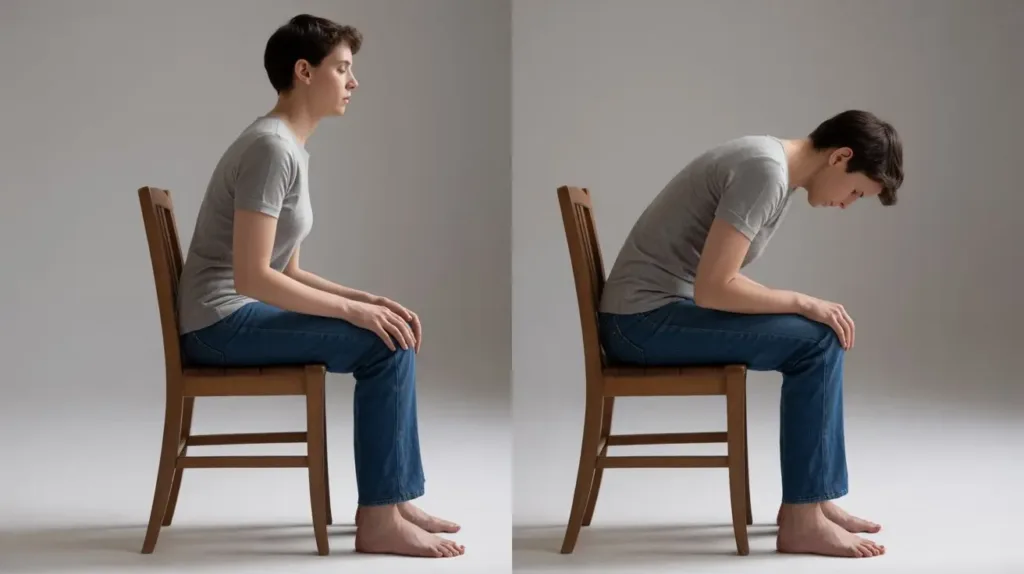
When you sit upright, most of your body weight travels down through the ischial tuberosities — the two hard bony points you can feel under each buttock. The coccyx sits behind and above them and carries very little. Roll the pelvis backward, though, as happens the moment you slump or slide forward on a chair, and the loading triangle tips. Weight moves off the sitting bones and onto the tailbone, which has neither the surface area nor the padding to distribute it.
The soft-tissue attachments matter just as much. The levator ani and coccygeus muscles of the pelvic floor insert directly onto the coccyx, as do the sacrotuberous and sacrospinous ligaments and part of gluteus maximus, according to published anatomical descriptions of the coccygeal vertebrae. A pelvic floor held under sustained tension therefore exerts a constant pull on the bone. That is the mechanism behind a large share of tailbone pain in people who never had a fall.
What causes low back pain by tailbone when sitting?
Four causes account for most cases: a previous fall directly onto the tailbone, childbirth, prolonged sitting on hard surfaces, and pelvic floor tension pulling on the coccyx. Referred pain from the lumbar spine or sacroiliac joint accounts for much of the remainder, and rapid weight change can tip a borderline situation into a painful one. Often more than one is operating.

1. A previous fall onto the tailbone
Landing on your backside on stairs, ice, a slippery bathroom floor, or missing a chair entirely can bruise, sprain or occasionally displace the coccyx. This is coccydynia in its most literal form, and direct vertical trauma is one of the most commonly recorded causes. What surprises people is the delay: the original fall may have been months or even years earlier, with a long quiet period before sitting tolerance quietly deteriorated.
Pointers that this is your mechanism: a clear memory of the impact, a very sharp pain on first contact with a seat, and marked tenderness on direct pressure over the bone.
2. Childbirth
During vaginal delivery the coccyx is pushed backward as the baby passes, and the sacrococcygeal joint and its ligaments can be strained or, less commonly, the bone itself injured. Prolonged second stage, instrumental delivery and larger babies all increase the loading. Childbirth is recognized as a common cause of coccyx pain, and it is one of the situations where symptoms may begin immediately and then persist well beyond the expected postpartum recovery window.
Pelvic floor changes after delivery frequently sit alongside this, which is why postpartum tailbone pain often responds better to pelvic health physical therapy than to cushions alone.
3. Prolonged sitting on hard surfaces
Repetitive low-grade loading does the same job as a single impact, just more slowly. Hard stools, benches, bike saddles, wooden dining chairs, cheap office chairs, long-haul flights, long commutes — anything that combines a firm unforgiving surface with hours of unchanged position. This is the classic repetitive microtrauma mechanism, and it is the most preventable of the four.
Slumping is the accelerant. A chair that encourages you to slide forward, or a sofa that swallows your pelvis into a posterior tilt, will load the coccyx harder than a firm upright chair ever does, which is why many people find soft seating worse rather than better.
4. Pelvic floor tension
Because levator ani and coccygeus attach onto the coccyx, muscles held chronically at high tone pull on it continuously. No fall is required. This is common in people who brace or clench under stress, in those who habitually hold the pelvic floor tight, and after any period of guarding around the pelvis.
Clues pointing this way include pain during or after bowel movements, a deep sense of pressure or fullness low in the pelvis, discomfort with penetration, urinary urgency, and pain that does not change much with cushion choice. If a well-fitted cushion makes no difference at all, the pull from above is usually a bigger factor than the pressure from below. Pelvic floor physical therapy is the appropriate response here, and importantly it may mean learning to release rather than to strengthen.
5. Referred pain and other contributors
- Lumbar or sacroiliac referral. A lower lumbar disc, facet joint or the sacroiliac joint can project pain into the region just above the tailbone. The distinguishing feature is that pressing directly on the coccyx does not reproduce it, and pain often eases with walking rather than with standing still.
- Weak or poorly coordinated glutes and trunk. When the hip and trunk muscles do not share the load, more of it reaches passive structures. Related patterns such as tight and overworked glutes contributing to lower back pain commonly travel with tailbone symptoms.
- Rapid weight change. Significant weight gain increases the compressive load through the pelvis when seated, while rapid weight loss thins the fat pad that normally cushions the area, so ordinary pressure starts to register as pain.
Which cushion should you actually use?
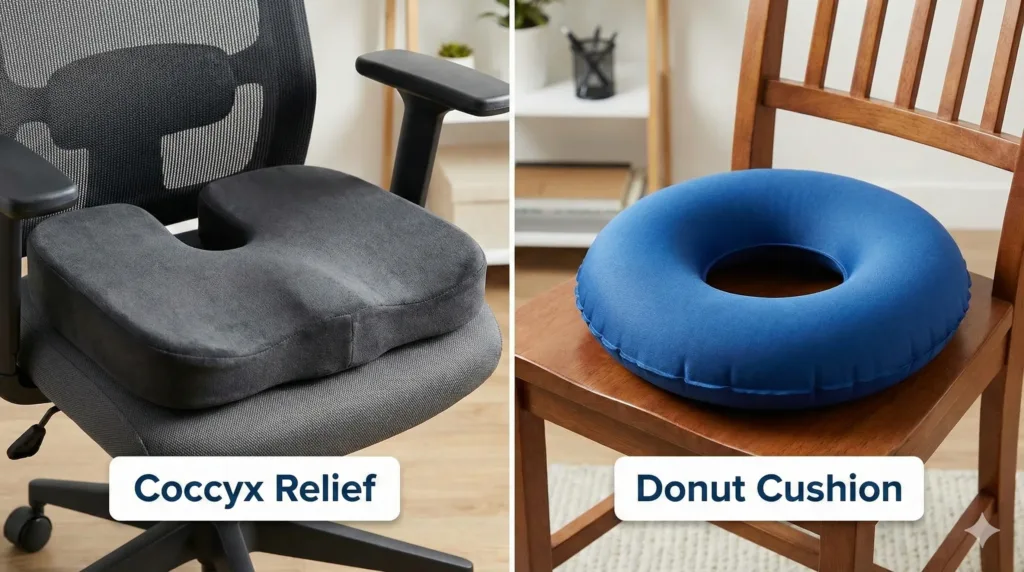
A wedge cushion with a coccyx cut-out is the best first choice for most people, because it does two things at once: the cut-out removes contact under the tailbone, and the forward slope tilts the pelvis so weight returns to the sitting bones. Donut rings are the popular choice and frequently the wrong one. Firmness matters more than thickness.
| Seat or cushion | What it does to coccyx load | Best for | Watch out for |
|---|---|---|---|
| Wedge with coccyx cut-out | Removes direct contact and tilts the pelvis forward onto the sitting bones | Most presentations, especially desk work and driving | Cut-out must sit under the tailbone, not behind it. Check placement each time you sit. |
| Flat coccyx cut-out cushion | Removes direct contact but does not correct pelvic tilt | People who already sit upright without slumping | Less helpful if slumping is the main driver |
| Plain wedge, no cut-out | Tilts the pelvis forward, redistributing weight to the sitting bones | Pain driven mainly by posterior pelvic tilt rather than point tenderness | Still leaves direct pressure on the bone if the seat is hard |
| Donut ring | Variable. Often concentrates pressure into a ring that can sit right on the sore area | Occasionally helpful for perineal rather than coccygeal pain | If pain increases or does not change within a week, switch to a cut-out design |
| Soft memory foam or a deep sofa | Lets the pelvis sink and roll backward, increasing coccyx load | Rarely the right answer for tailbone pain | Feels comfortable for the first minute and worse by minute twenty |
| Hard flat seat with no cushion | Maximum direct pressure on the bone | Nothing, while symptoms are active | Wooden chairs, benches, bleachers, bike saddles, jump seats |
Two practical points. First, firmness: a cushion soft enough to compress fully under your weight has stopped supporting anything, and you end up back on the bone. Medium-firm foam holds its shape. Second, placement: a cut-out cushion positioned even a few centimetres too far back will have the rim pressing exactly where you do not want it. Sit down, then reach behind and check the gap is under the tailbone before settling in.
How should you sit, and how do you get up without the jolt?
Sit with hips slightly higher than knees, weight clearly on the two sitting bones, and a small forward lean of about 10 to 15 degrees from the hips rather than a rounded back. To stand, walk your feet back under you, hinge your chest forward over your knees, and push up through your legs — never rock backward onto the tailbone to build momentum.
Sitting that unloads the coccyx
- Find the sitting bones deliberately. Sit, then rock gently side to side until you feel the two hard points under each buttock. That is where your weight should be. If you cannot feel them, you are probably sitting behind them, on the coccyx.
- Raise the seat so hips are above knees. Even 3 to 5 cm (1 to 2 inches) of height difference rotates the pelvis forward and shifts load away from the tailbone. This single change often does more than any cushion.
- Keep a small forward lean. Around 10 to 15 degrees of hip hinge, chest slightly forward, back long rather than rounded. Reclining back into a chair is what rolls weight onto the coccyx.
- Support the lumbar curve, not the tailbone. A rolled towel or lumbar cushion at belt level helps you hold the forward pelvic tilt without effort. Anything padding the very base of your back can push the pelvis into the exact position you are trying to avoid.
- Change position before it hurts. Shift weight to one buttock, then the other, every ten minutes or so, and stand every 30 to 45 minutes. Waiting until pain forces you up means the tissue has already been loaded too long.
Getting out of a chair without loading the tailbone
This is where most people undo their own progress. The instinctive sit-to-stand involves a small backward rock to generate momentum, which drives body weight straight through the coccyx at the exact moment the muscles around it are tightening. Replace it with a deliberate sequence:
- Slide forward to the front edge of the seat first, while still seated, so the coccyx is already off the surface.
- Walk both feet back until your ankles sit under or slightly behind your knees. This is what removes the need to rock.
- Hinge your chest forward over your knees with a long back, nose travelling forward past your toes.
- Push through both feet and stand, using your legs rather than pulling with your back. Exhale as you rise.
- Reverse it exactly to sit down — hinge forward, lower with the legs, land on the front of the seat, then slide back. Dropping the last few inches into a chair is a small impact directly onto the sore bone.
Getting out of a car deserves its own note, because low seats and a twisting exit make it the worst offender. Open the door fully, swing both legs out together before attempting to rise, plant both feet, then hinge forward and push up. Twisting your torso while still seated grinds the pelvis against the seat.
👨⚕️ Dr. Arora’s Clinical Note
The mistake I see repeatedly with tailbone pain is trying to stretch it away — hard hamstring work, aggressive glute stretches, deep forward folds — when the actual driver is compression and irritation sitting directly on the coccyx. If your pain spikes most when you slump or lean back, the order matters: unload first, strengthen second.
Try this for 48 to 72 hours before adding any exercise:
- Create a slight forward tilt by placing a small folded towel under the front of your cushion, beneath the front half of the sitting bones. That tiny wedge shifts pressure off the coccyx more effectively than trying to hold perfect posture by effort.
- Use the lean-forward test. Sitting, hinge forward roughly 10 to 15 percent from the hips without rounding your back. If pain drops noticeably, that points to pressure sensitivity rather than weakness needing more repetitions today.
- Avoid repeated hard pelvic tucks. For many people with coccyx pain, the end-range posterior tilt mechanically drives load back onto the tailbone and provokes symptoms, even though the movement looks gentle.
Once sitting is calmer, breathing work and glute activation become far more effective — and far less likely to trigger a flare.
What should you do in the next 72 hours?
Take direct pressure off the bone, shorten every sitting bout, change how you stand up, and hold off on new exercise until sitting is tolerable again. Most people can make a noticeable difference within three days on those four changes alone, because the tissue is being re-irritated many times a day and simply stopping that is a treatment in itself.
- Get a wedge or cut-out cushion into every seat you use regularly. Desk chair, car, sofa. One cushion left at the office does nothing for the two hours you spend commuting.
- Cap continuous sitting at 20 to 30 minutes while symptoms are active, even if that means taking calls standing up.
- Practise the sit-to-stand sequence deliberately five or six times, slowly, until it stops requiring thought.
- Lie on your side or front rather than your back when resting, and sleep however is comfortable — the coccyx is unloaded in all sleeping positions.
- Keep bowel movements easy. Straining loads the pelvic floor and the coccyx together. Adequate fluid, fibre and a low footstool under the feet all reduce the strain.
What to add once sitting is calmer
Only when you can sit for 20 minutes without a clear flare is it worth adding load. Start with these, in this order:
- Diaphragmatic breathing, lying down. One hand on the lower ribs, one on the belly. Slow inhale through the nose feeling the ribs widen, long relaxed exhale. This down-regulates a pelvic floor held at high tone, which directly reduces the pull on the coccyx.
- Glute squeezes in lying or standing. Gentle five-second holds, avoiding a hard pelvic tuck. This restores gluteal support without compressing the tailbone.
- Small-range pelvic tilts in lying. Stay well away from end range. If the posterior tilt provokes symptoms, work only into the anterior half of the movement.
- Bridges, then side-lying hip abduction, then bird-dog. Add these across two to three weeks. A structured physical therapy home program for low back pain sets out how to progress them without provoking the area.
Progress when 24 hours after a session your symptoms are no worse than before it. That rule is more reliable than any fixed timeline, because it accounts for how much sitting your week actually contained.
When is tailbone pain a red flag?
Coccyx pain is usually mechanical and unthreatening, but a small number of presentations are not, and the tailbone region is one place where infection and malignancy can present as ordinary-sounding pain. Seek prompt assessment, and same-day care for the first two, if you have:
- Numbness around the groin, genitals or inner thighs, or new difficulty starting or controlling urination or bowel movements. This saddle pattern may indicate cauda equina syndrome, compression of the nerve roots at the base of the spinal cord. It is a surgical emergency where delay costs function permanently.
- Sudden significant weakness in one or both legs. Progressive neurological loss points to nerve compression rather than local irritation, and how fast it is changing determines how urgently it is investigated.
- Severe pain immediately after a fall from height or a road accident. Sacral or coccygeal fracture becomes considerably more likely with high-energy trauma, and more likely again with osteoporosis or long-term steroid use.
- Fever, chills, night sweats, or a swelling, redness or discharge near the natal cleft. Infection in this region, including pilonidal disease and rarely deeper abscess, needs treatment rather than a cushion.
- Unexplained weight loss, or a history of cancer with new tailbone pain. Sacrococcygeal tumours are uncommon but real, and this is one of the areas where they present as persistent local pain. A prior cancer diagnosis lowers the threshold for imaging considerably.
- Pain that is constant, unrelieved by any position, and wakes you at night. Mechanical coccyx pain is defined by being position-dependent. Pain that ignores position is behaving differently and needs explaining.
Do you need imaging, injections or surgery?
Usually none of the three. Reported success rates for conservative treatment of coccyx pain are around 90 percent, so cushions, sitting modification, activity change and physical therapy resolve the large majority. Imaging is reserved for red flags, significant trauma, or pain that refuses to settle despite a properly executed conservative plan.
When imaging is used, plain X-rays taken in both sitting and standing can show abnormal coccygeal movement that static films miss, and MRI is added where infection, tumour or a soft-tissue cause is being considered. A scan taken in the first few weeks of ordinary mechanical pain rarely changes what anyone does next, which is the practical test of whether it is worth having.
If conservative care genuinely fails, the escalation runs in stages. Injections around the sacrococcygeal joint or a ganglion impar block may be offered for persistent pain, and surgical removal of the coccyx is a last resort reserved for a small minority with severe, prolonged, well-localized symptoms who have exhausted everything else. Recovery from that operation is slow, which is exactly why the conservative route is given a fair run first. StatPearls provides a clinician-facing summary of the causes and management of coccyx pain including the reported conservative success rate.
Myths worth dropping
- “Pain this sharp means something is broken.” Focal, stabbing pain is characteristic of irritated soft tissue and joint surfaces in a small bone with almost no padding over it. Most cases show nothing structural on imaging.
- “I should avoid movement until it settles.” It is sitting that needs modifying, not moving. Walking, standing and gentle activity are generally comfortable and help rather than hinder.
- “A donut cushion is the standard fix.” It is the best-known option, not the best one. A wedge with a coccyx cut-out is the more logical first choice for pain arising from the bone itself.
- “Only surgery fixes tailbone pain.” Coccygectomy is a genuine last resort. The overwhelming majority of people improve without it.
- “Pain near the tailbone must be a spine problem.” The pelvic floor, sacroiliac joints and, occasionally, bowel or gynecological conditions can all present here, which is why the assessment should look wider than the bone.
Frequently asked questions
How long does low back pain by tailbone usually take to settle?
Mild irritation from a long drive or a firm chair often settles within days once the pressure is removed. Pain following a fall or childbirth commonly takes several weeks to a few months. The strongest predictor is how consistently you unload it, since a coccyx re-irritated every day at work has no opportunity to calm down.
Is a donut cushion or a wedge cushion better?
A wedge with a coccyx cut-out is the better starting point for pain coming from the tailbone itself, because it removes contact and tilts the pelvis forward at the same time. Donut rings can concentrate pressure into a circle that sits right on the sore area. If a donut has not helped within about a week, switch.
Why does it hurt most when I stand up from a chair?
Because the usual way people stand involves rocking backward first to build momentum, which drives weight straight through the coccyx. Slide to the front of the seat, walk your feet back under you, hinge your chest forward over your knees, and push up through your legs instead. Most people notice the difference immediately.
Can tailbone pain start without any injury?
Yes, and it frequently does. Repetitive loading from hard seats and long sitting causes it gradually, and pelvic floor muscles held at high tension pull on the coccyx continuously with no impact ever involved. A significant proportion of cases have no identifiable trauma at all.
Is it related to pregnancy and childbirth?
Often. The coccyx is displaced backward during vaginal delivery and the joint and ligaments can be strained, while late pregnancy adds postural and hormonal changes on top. Postpartum tailbone pain tends to respond well to pelvic health physical therapy, which addresses the muscular attachments rather than just the seating.
Should I sit on the floor or use a kneeling chair?
Cross-legged floor sitting on a firm surface usually makes it worse, since it encourages a backward pelvic tilt straight onto the tailbone. Kneeling chairs and saddle seats help some people because both tilt the pelvis forward, but neither is a cure on its own and both need building up to gradually.
Do I need an X-ray or MRI?
Not routinely. Most people recover without any imaging, and a scan in the early weeks rarely changes management. It becomes worthwhile if there was significant trauma, if red flag symptoms are present, or if a properly followed conservative plan has failed over a reasonable period.
Can stress make it worse?
Indirectly, yes. Stress raises muscle tone throughout the pelvic floor, and those muscles attach directly to the coccyx, so tension translates into a mechanical pull. Poor sleep also lowers the threshold at which any given pressure registers as pain, which is why bad weeks tend to feel disproportionately worse.
References
- Bain HL, Mabrouk A, Foye PM. Coccyx Pain. StatPearls Publishing; updated 2025. https://www.ncbi.nlm.nih.gov/books/NBK563139/
- Mostafa E, Varacallo MA. Anatomy, Back, Coccygeal Vertebrae. StatPearls Publishing; updated 2023. https://www.ncbi.nlm.nih.gov/books/NBK549870/
This article is for general education and does not replace individual medical assessment. If your symptoms are severe, changing, or accompanied by any of the warning signs above, arrange a proper evaluation.