
Expert Review: This article includes clinical insights from Dr. Vivek Arora, a physical therapist (physiotherapist) with 20+ years of experience.
Lower back pain while driving is one of those problems that creeps up on you. The first fifteen minutes feel fine. By the thirty-minute mark, there’s a dull pull. By the time you reach your destination and try to get out of the car, your lower back has locked into something it does not want to leave quietly. You straighten up slowly, take a few shuffling steps, and wonder how a car journey — not a heavy lift, not a workout — did that to you.
Lower back pain while driving can be associated with prolonged sitting, limited opportunities to move, an uncomfortable setup and, especially in driving occupations, whole-body vibration. These factors do not establish the cause in an individual. Comfortable seat adjustments and breaks may help, while severe, persistent or neurological symptoms need assessment.
The duration of a journey, previous symptoms, fatigue and the demands before and after driving can all affect comfort. A painful drive does not show that your discs are damaged or your hip flexors have shortened.
This article explains exactly what is happening, why your seat position matters more than most people realize, what driving-related lower back pain usually indicates (and occasionally does not), and how to manage it effectively — from today’s commute through to a structured rehab plan.
Key Takeaways
- A sustained seated position can aggravate symptoms, but there is no single spinal curve everyone must maintain.
- Occupational whole-body vibration is associated with back pain and sciatica; this does not establish the risk from an ordinary commute.
- Comfortable adjustments, safe breaks and an individualized activity plan are reasonable options.
- Pain location and symptoms during car entry or exit help describe the problem but cannot diagnose a disc, SI joint or muscle.
- Routine back imaging is usually unnecessary; a clinician should request it when the findings are likely to change care.
Why does driving make my lower back hurt?
Driving limits how often you can change position. Some people find the seat, pedal reach or a long journey uncomfortable. Consider these practical factors alongside symptoms outside the car; there is no reliable home test that identifies a specific painful tissue from the driving pattern.
The lumbar spine has a natural inward curve that changes with position. Neither a flatter curve when sitting nor a more upright posture is, by itself, a diagnosis or evidence of injury.
Vehicle seats differ. Adjust the seat and controls while parked so your back is supported, you can operate the pedals fully and you can steer without overreaching. Follow the vehicle manufacturer’s safety guidance.
Connective tissues change shape under sustained load, a property called creep. That laboratory observation cannot explain every episode of driving pain or predict a safe sitting limit for an individual.
Some people feel stiff when standing after a journey. This does not prove permanent hip flexor shortening; a brief walk and a comfortable position change may help.
A review by Burström and colleagues included 28 occupational studies, with 20 in its meta-analysis. Whole-body vibration exposure was associated with higher odds of back pain and sciatica. The studies do not prove that vibration caused a particular commuter’s symptoms or provide a safe mileage threshold.
For a deeper look at how specific muscle groups contribute to lumbar pain, the article on low back pain muscles and hidden causes covers the relevant anatomy in detail.
Common Causes of Lower Back Pain While Driving
Not all driving-related lumbar pain has the same origin, and the cause matters because it shapes the fix.
Back-related pain: Muscles, joints and discs may contribute, but pain building during a drive and easing afterward cannot distinguish them.
Pelvic or hip symptoms: Pain when getting out of a car can occur with several back, hip and pelvic conditions. It is not a telltale SI-joint test.
Stiffness: A sense of tightness after sitting does not establish a shortened muscle or a pulling force that damages the spine.
Joint-related pain: Position can influence symptoms, but a central or one-sided ache does not identify a painful facet joint.
Leg symptoms: Tingling, numbness or pain down a leg may warrant a neurological examination. Seat pressure alone cannot distinguish a lumbar nerve problem from another cause.
What does your pain pattern actually suggest?
Use symptom patterns to plan questions for a clinician, rather than to select a tissue diagnosis. The timing of pain, changes with walking and symptoms in the leg are useful details; they overlap across conditions.
| Pattern to describe | What it can tell you | Next step |
|---|---|---|
| Pain builds during a drive | The task may aggravate symptoms; source remains uncertain | Try safe breaks and comfortable adjustments |
| Pain on leaving the car | Back, hip or pelvic symptoms can overlap | Use stable support; assess persistent difficulty |
| Ache after a long journey | May have several contributors | Review duration, fatigue and activity response |
| Leg symptoms with standing or walking | May warrant assessment for nerve or other conditions | Arrange a clinical evaluation |
| Numbness, weakness or spreading leg pain | Needs neurological review | Use the urgent and emergency guidance below |
Pain that builds during a drive and eases on walking suggests that changing the task may help. There is no proven 30–60 minute disc-pain threshold or 10–20 minute fluid-reset period.
Pain on car exit may involve the back, hip or pelvis. Try an unhurried transition with stable support; persistent catching, difficulty bearing weight or worsening symptoms need assessment.
A diffuse ache after a journey may reflect several factors. It cannot establish fatigue in a named muscle or rule out a structural or medical problem.
Leg symptoms with standing or walking that ease on sitting can occur in spinal stenosis and other conditions. Describe the pattern to a clinician rather than using comfortable driving as a diagnostic test.
Arrange assessment for persistent or worsening leg pain, numbness or tingling. New weakness needs urgent attention; new bilateral leg symptoms or saddle/bladder/bowel changes need emergency care.
Pain that sits near the tailbone or coccyx rather than the central lower back has its own distinct pattern. The article on low back pain by the tailbone when sitting addresses this presentation specifically.
Red Flags: When to Seek Urgent Assessment
Seek care according to the warning signs below. A history of pain during driving should not be used to dismiss a new medical problem.
- Loss of bladder or bowel control, or difficulty initiating urination: This may indicate cauda equina syndrome — compression of the nerve bundle at the base of the spine. This is a medical emergency requiring immediate emergency assessment.
- Saddle area numbness — numbness or altered sensation in the groin, inner thighs, or genitals — is another cauda equina warning sign and should be treated with the same urgency.
- New or worsening weakness in one leg, including foot drop: Get urgent medical assessment. New pain, weakness or numbness in both legs needs emergency care.
- Back pain accompanied by unexplained weight loss, persistent night pain that wakes you from sleep, or fever: These suggest non-mechanical causes — including rare but important ones such as infection or neoplasia — that require investigation regardless of driving habits.
- Back pain after a serious collision or other major trauma: Get emergency assessment. Do not drive yourself to emergency care.
Do You Actually Need a Scan?
For uncomplicated low back pain, imaging is not routinely needed. Findings such as disc degeneration are also seen in people without pain and must be interpreted with the history and examination.
Imaging may help when serious disease is suspected or the result would change treatment. Lack of improvement after several weeks is a reason to reassess, rather than an automatic indication for MRI.
Arrange assessment sooner for severe, worsening or unexplained symptoms. A duration under six weeks does not exclude a condition that needs investigation.
Three Things Most People Get Wrong About Driving and Back Pain
“Massage will sort it.” Massage may offer temporary relief. If symptoms recur, review the journey, activity demands and assessment findings; recurrence does not prove disc or joint damage.
“Farther from the pedals is always better.” Choose a distance that lets you operate the pedals fully and steer comfortably, while maintaining the manufacturer’s recommended clearance from the airbag.
“A hard seat is always better.” Seat comfort varies. Support and pressure distribution matter, but no firmness guarantees relief.
From the Clinic: Dr. Arora’s Expert Insight
How you enter and leave the car is useful functional information. Difficulty with that transition does not show how the spine was loaded throughout the journey or identify a compromised posture.
A practical plan can include adjustments before departure, appropriate breaks and activity after arrival. No single break time or preparatory stretch works for everyone.
Driving-related back pain does not establish weak multifidus or inactive deep stabilizers. Exercise can build general strength and endurance without isolating a specific muscle or treating ordinary sitting as harmful.
How should you set up your car seat?
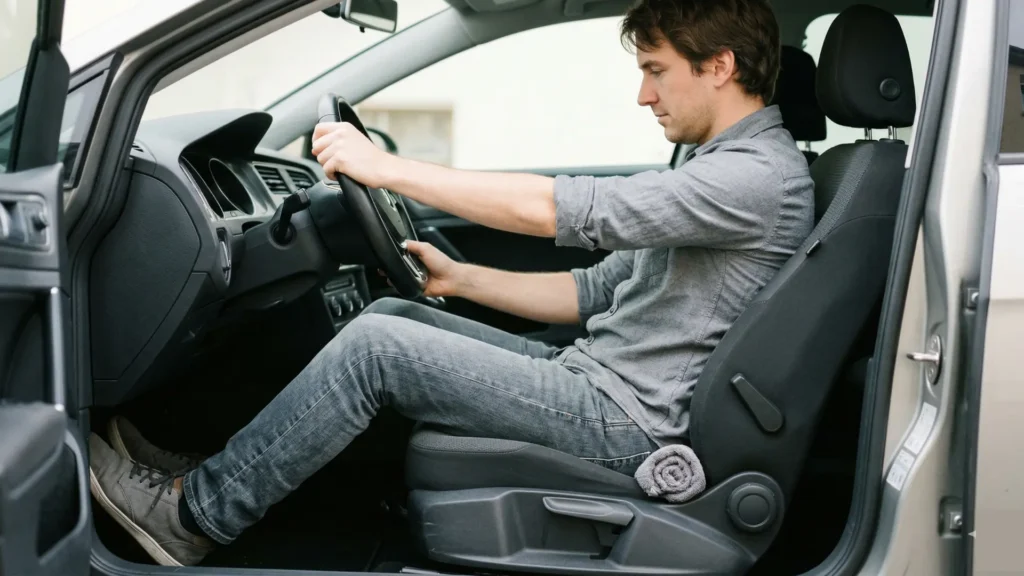
Test small adjustments while parked. Full control of the vehicle, visibility, seat-belt fit and airbag clearance take priority over a suggested posture or angle.
Pedal reach: You should be able to press the pedals fully without stretching or shifting out of the seat. Follow the vehicle’s adjustment instructions.
Backrest: Try a comfortable supported position that preserves steering control, visibility and safe belt/airbag geometry. A particular angle is not a proven treatment.
Back support: Adjust built-in support for comfort. Stop using added support if it increases symptoms or changes how safely you sit.
Seat height: Maintain clear visibility, comfortable headroom and safe pedal control.
Steering wheel position: The arms should reach the wheel with a slight elbow bend — not a full stretch. Reaching forward to the wheel pulls the shoulders and upper back forward, which reverses any lumbar positioning you’ve carefully set.
If testing a small towel or cushion, ensure it does not interfere with the belt, airbags, pedals or your ability to reach the controls. More padding is not necessarily better.
Managing the Pain: From Today Through Full Recovery
First 24–48 Hours
If the pain is acute following a long drive, the immediate priority is to reduce the static load the spine has been carrying and encourage gentle movement. Prolonged rest is not helpful — the spine needs circulation, fluid exchange in the disc, and muscle activation.
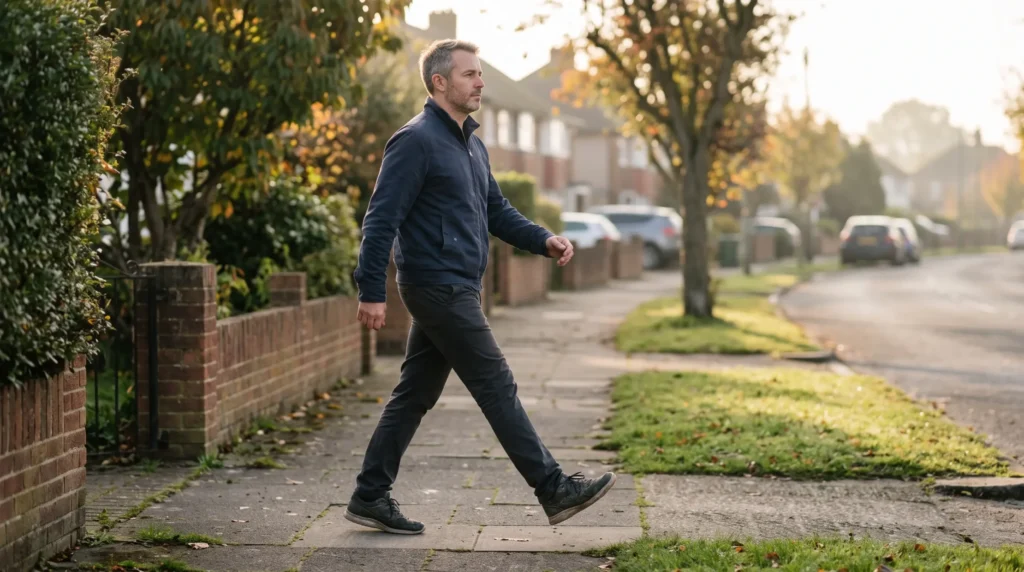
- Take a 10–15 minute gentle walk as soon as you can after a flare-inducing drive. Walking encourages lumbar extension and disc fluid exchange.
- A wrapped heat or cold pack may help temporarily after the journey. Use it briefly on skin with normal sensation and circulation; do not use a loose pack while driving.
- Avoid prolonged sitting in low, soft furniture immediately after a long drive. If you must sit, sit in a firm chair with a lumbar roll and maintain the curve you just lost in the car.
- Ask a pharmacist or clinician about suitable pain relief, especially with pregnancy, breastfeeding, kidney disease, stomach ulcers, anticoagulants or other medicines. Do not drive if a medicine makes you sleepy or impairs concentration.
Phase 1: Comfortable movement
Keep necessary journeys within your current comfort and safe-control limits, with planned safe stops. There is no universal 30-minute limit. Do not drive if pain or leg symptoms impair braking or steering.
Gentle movement and gradually progressed exercise are options. The following examples are not a required sequence or a diagnosis-specific prescription.
- Knee-to-chest: If comfortable, try a small gentle movement without forcing the range. It bends the lower back; it does not reverse sitting or prove that the discs are decompressed.
- Hip flexor stretch: An optional gentle supported stretch if it feels comfortable. Avoid forcing an arch or assuming every driver needs muscle lengthening.
- Pelvic tilt: Try a small comfortable movement with normal breathing. It is a mobility option, not a selective test of deep-muscle activation or a movement with zero spinal load.
Phase 2: Build activity tolerance
Progress exercise when ordinary activity and the current dose are manageable without a sustained flare. A specific driving duration does not establish readiness.
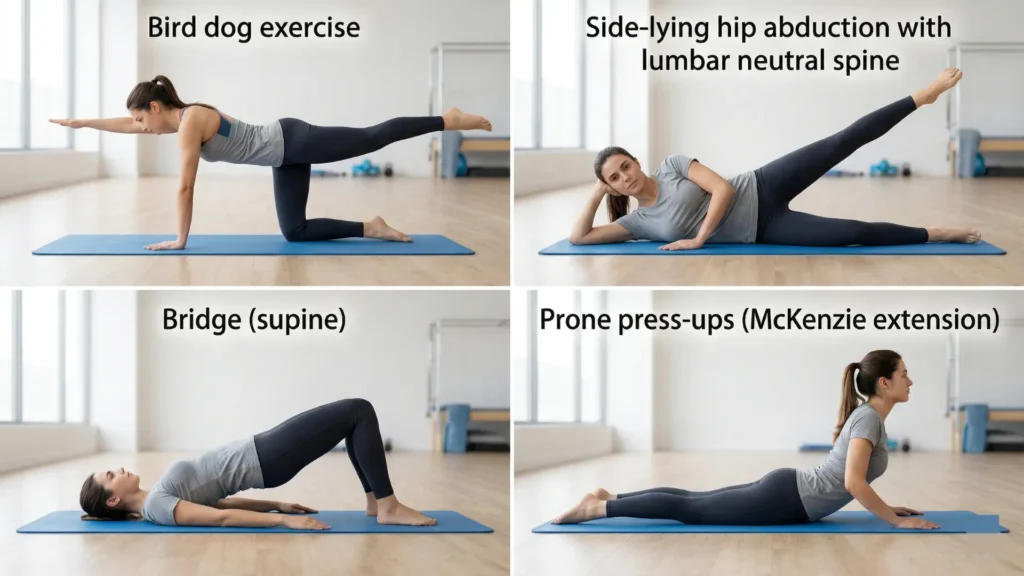
- Bird-dog: Begin with a small supported arm or leg movement if comfortable. Progress reach or repetitions gradually; extra weights are optional.
- Side-lying hip exercise: Can build hip strength if tolerated. Pain during driving does not establish gluteal weakness or pelvic instability.
- Bridge: An optional strength exercise. Use a comfortable range and stop if symptoms increase or spread into a leg.
- Repeated extension: Press-ups are not appropriate for everyone with driving or suspected disc pain. A clinician can assess whether a particular direction helps. Centralization means leg pain moves toward the back during assessment; pain that was only in the back is not evidence of centralization. Stop for spreading leg pain, numbness or weakness.
For a structured home exercise program covering these movement phases in detail, the low back pain physical therapy home program provides a step-by-step approach.
Taking Movement Breaks on Long Drives
Plan stops at safe places and change position before symptoms compromise comfort or control. A short walk may help; the ideal interval varies. Mileage is an unreliable guide because traffic and speed differ. Do not stretch or adjust the seat while the vehicle is moving.
Do’s and Don’ts for Driving With Lower Back Pain
Do:
- Use a comfortable supported seat position that preserves safe vehicle control.
- Plan safe movement breaks; arrange reminders before departure without interacting with a phone while driving.
- Use a gentle movement after a journey if it helps; a hip flexor stretch is optional.
- Build an activity or exercise routine matched to your goals and symptoms.
- Get out of the car carefully: rotate your whole body to face the door, use your arms to assist, and push up from both legs together rather than twisting out of the seat.
Don’t:
- Do not change pedal reach or seat position in ways that impair control or airbag clearance.
- Brace or tense the back muscles throughout the drive in an attempt to “sit up straight.” Sustained muscular co-contraction fatigues faster than a well-supported passive posture.
- Do not rely on a massage cushion to make an unsafe or painful journey tolerable; check accessory compatibility with the vehicle.
- Do not avoid all movement after a journey, but brief comfortable rest is reasonable when needed.
- Do not continue driving when pain, numbness, weakness or medication affects safe control.
Return to Normal Driving
The progression back to unrestricted driving depends on the underlying cause and severity. As a general guide:
Increase journey duration gradually after shorter journeys are manageable and you can safely perform all driving tasks. Recovery cannot be predicted from a fixed three-to-six-week schedule.
With leg symptoms, seek advice about safe driving and the underlying condition. Changes in symptom location do not prove a disc has healed; vehicle control and the overall assessment matter.
When Conservative Management Is Not Enough
If adjustments and activity changes are not helping, reassess the symptoms and working diagnosis.
A clinician can examine the back, hip and neurological function and assess daily demands. Pain patterns alone cannot reliably identify an individual disc, joint or muscle.
Reassessment does not automatically require MRI. Imaging should answer a question likely to change management.
Injections are not routine treatment for nonspecific low back pain. A specialist may discuss selected procedures for a defined condition, with their benefits and risks.
Surgery is considered for specific conditions, such as persistent sciatica with matching imaging after nonsurgical care, or urgent neurological compression. Driving-related pain alone does not establish a surgical target.
Conclusion
Lower back pain while driving can sometimes improve with comfortable adjustments, safe breaks and manageable activity. There is no single posture, muscle deficit or recovery deadline that explains every case. Check your ability to control the vehicle and seek assessment if symptoms persist or worsen.
Get urgent help for the warning signs above. For continuing symptoms, bring a record of journey duration, leg symptoms and what helps to your assessment.
Frequently Asked Questions
1. How long should I drive before taking a break to protect my lower back?
Plan safe stops before discomfort affects driving. An interval such as 30–60 minutes can be a practical trial, not an evidence-based protection threshold. Take breaks sooner when needed and walk briefly if comfortable.
2. Can my car seat cause permanent damage to my spine?
Pain during driving does not show permanent spinal damage. Occupational vibration research cannot establish the effect of a particular commute or seat. Persistent symptoms deserve assessment rather than an assumption of degeneration.
3. My pain is worse getting out of the car than during the drive itself. What does that mean?
Several back, hip or pelvic conditions can cause that symptom. An unhurried exit with stable support may help, but the response cannot diagnose an SI-joint problem. Arrange assessment if it persists or worsens.
4. Does it help to use a back support cushion in the car?
A small support may improve comfort for some people. Test it while parked and ensure it does not affect seat-belt fit, airbags or control of the vehicle; there is no standard towel diameter that treats back pain.
5. Should I avoid driving completely while my lower back is painful?
Drive only if you can operate the controls and perform all required maneuvers safely. Pain, leg weakness or numbness, and sedating medicines may make driving unsafe even on a short trip. Seek advice if uncertain.
6. Can sciatica be triggered or worsened by driving?
Sitting can aggravate leg symptoms in some people, but this does not establish that a disc is pressing farther on a nerve. Persistent or worsening symptoms need assessment; follow the emergency advice for bilateral symptoms or saddle/bladder/bowel changes.
7. What exercises specifically help lumbar pain from driving?
Comfortable walking, mobility and gradually progressed strength work are options. No exercise selectively reverses driving; press-ups, flexion stretches and hip exercises should be chosen according to response and assessment.
8. I have a long road trip coming up. How do I prepare and manage my back during it?
Check the seat, belt and controls while parked, plan safe stops and share driving if possible. Use comfortable movement at breaks. Postpone driving if symptoms or medicines affect control, and avoid a fixed mileage target.
Medical Disclaimer
This article provides general information. It cannot assess your symptoms or give you an individual treatment plan. Get emergency care now for new difficulty passing or controlling urine, loss of bowel control or sensation, or numbness around the genitals or anus. New sciatic pain down both legs or severe or worsening weakness or numbness in both legs also needs emergency care. Get urgent medical assessment for new or worsening weakness in one leg. Seek assessment for severe, worsening or unexplained pain. Ask a clinician before beginning a new program after a recent injury.
References
- Burström L, Nilsson T, Wahlström J. Whole-body vibration and the risk of low back pain and sciatica: a systematic review and meta-analysis. International Archives of Occupational and Environmental Health. 2015;88(4):403–418. doi:10.1007/s00420-014-0971-4.
- NHS. Back pain. Self-management and urgent-care guidance.