Expert Review: This article includes clinical insights from Dr. Vivek Arora, a physical therapist (physiotherapist) with 20+ years of experience.
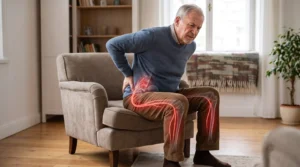
Knee pain without a knee story is one of the more confusing complaints in musculoskeletal practice. No twist, no fall, no swelling — the joint just aches, and nothing about the knee explains why. So when people ask can sciatica cause knee pain, the answer is yes. The pain is produced at an irritated nerve root in the lower back and felt in the strip of leg that root supplies.
This is referred pain, and it fools people because it does not feel referred. A nerve root under pressure sends no return address, so the brain reports a knee problem — and knees get scanned, injected and occasionally arthroscoped for pain arising two regions away.
Key takeaways
- Nerve root irritation can be felt as knee pain, and it can stop at the knee without reaching the foot.
- The root level predicts the location. L3 and L4 refer to the front and inner knee; L5 and S1 to the outer knee and calf.
- Referred knee pain has no local joint signs — no swelling, no joint line tenderness, no locking.
- Spinal position is the giveaway. Pain that shifts with sitting, bending or coughing is behaving like a nerve, not a joint.
- Progressive thigh weakness or a buckling knee is not a rehab problem. It may indicate L3–L4 motor involvement and needs prompt assessment.
Can sciatica cause knee pain, or is the knee itself the problem?
Sciatica — pain caused by irritation or compression of a lumbar nerve root — can absolutely be felt at the knee. The root is pinched or inflamed in the low back, usually by a disc bulge, a narrowed exit canal or arthritic overgrowth, and the pain is projected along that nerve’s territory. The knee sits inside several of those territories.
One clarification changes where a clinician looks. True sciatica involves the sciatic nerve, built from the L4 to S2 roots. Front and inner knee pain travels a different road — the L3 and L4 roots feeding the femoral nerve. Both get called sciatica in everyday use, but the distinction tells the examiner which muscles to test. The same mechanism explains many cases of hip pain that turns out to be a back issue.
Which nerve roots refer pain to which part of the knee?
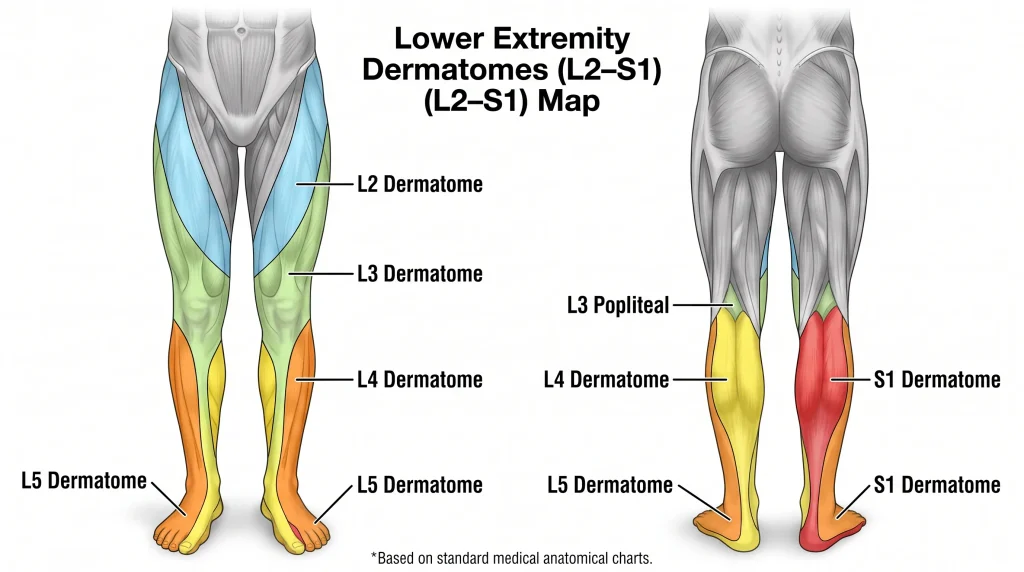
Each lumbar nerve root supplies a predictable band of skin, called a dermatome, and a predictable group of muscles, called a myotome. Irritate a root and symptoms appear along those two maps. Around the knee, L3 and L4 cover the front and inner side, L5 the outer side, and S1 the back.
- L3 — front of the thigh to just above the kneecap; contributes to quadriceps strength and knee extension.
- L4 — inner (medial) knee and shin; also feeds the quadriceps and drives the knee-jerk reflex.
- L5 — outer knee and shin to the top of the foot. A nagging outer-knee ache with nothing to find locally is a familiar L5 pattern.
- S1 — back of the knee, calf and heel. Pain behind the knee blamed on a hamstring strain is sometimes S1.
These maps overlap between individuals, so location narrows the field rather than naming a culprit. Referred pain also need not fill a whole dermatome — it can settle in one segment and stay there, which is why people end up with a knee complaint and no back complaint. Quality matters as much as location, so the sensations that identify sciatica are worth knowing.
How do I tell referred knee pain from a true knee problem?
The cleanest test is whether the knee behaves like a joint or like a wire. A true knee problem hurts when you load the knee, produces local signs such as swelling or joint line tenderness, and ignores your spine. Referred pain has no local signs, is not reliably reproduced by knee movement, and changes with sitting, bending or coughing.
| Feature | Suggests referred spinal origin | Suggests knee joint origin |
|---|---|---|
| Swelling | Absent, even after a painful day | Often present, fluctuates with activity |
| Joint line tenderness | Pressing the joint line changes nothing | Reproducible tenderness at a specific point |
| Locking or true giving way | Not a feature; the joint moves freely | Common with meniscal or ligament problems |
| Response to knee movement | Squats and stairs vary day to day | The same movement hurts the same way every time |
| Response to spinal position | Sitting, slumping or standing up clearly changes it | Spinal position makes no difference |
| Cough or sneeze | May send a jolt into the leg | No effect on the knee |
| Back or buttock symptoms | Often present, even if mild | Usually absent |
| Quality of pain | Burning, electric, numb, hard to pinpoint | Sharp on loading, easy to point to |
The spinal position row is the most useful: a knee joint has no opinion about whether you are slumped in a car seat, while a compressed nerve root has a strong one. The same logic underpins telling lower back pain apart from genuine hip pain — and not all back-generated leg pain starts at the root, since piriformis symptoms and true nerve root sciatica overlap.
Can an arthritic knee cause back pain, the other way around?
Yes, and this reverse pattern is missed just as often. A knee that hurts or will not straighten fully changes how you walk: less time on that leg, a shorter stride, a pelvis that rotates differently. Over months, that altered gait can generate genuine low back pain in someone whose real problem is the knee.
Loss of terminal knee extension does most of the damage: push-off is never clean, the hip does not extend behind you, and the lower back takes over. In older adults both problems often contribute — which is why back and hip pain often appear after a total knee replacement.
When should knee pain with back symptoms be assessed promptly?
Most referred knee pain is uncomfortable rather than dangerous, but a few presentations are not, and they are recognizable. Progressive weakness, loss of bladder or bowel control, saddle numbness, fever with a hot swollen joint, or unexplained weight loss with night pain all move this out of self-management, on a timescale of hours to days rather than weeks.
- Progressive quadriceps weakness, or a knee that buckles under load. If the thigh is losing strength and the knee gives way on stairs without joint instability, this may reflect L3 or L4 motor involvement. Strengthening a muscle whose nerve supply is compromised does not work, and the falls risk is real.
- Difficulty lifting the front of the foot. Foot drop suggests L5 motor involvement, and weakness is treated more urgently than pain because recovery is less predictable.
- Saddle numbness, difficulty controlling urination, loss of bowel control, or new symptoms in both legs. This raises the possibility of cauda equina compression, a surgical emergency. Go to an emergency department the same day.
- A hot, red, swollen knee with fever. This points toward joint infection rather than referred pain. Septic arthritis damages cartilage quickly and needs same-day care.
- Unexplained weight loss, a history of cancer, or night pain no position relieves. Mechanical pain almost always eases in some position; pain that ignores it warrants investigation.
- Significant trauma, or inability to bear weight. Fracture must be excluded before any referred-versus-local reasoning applies.
Seek care if
- Your thigh is visibly losing bulk, or the knee has started giving way on stairs
- Numbness or weakness is spreading rather than staying in one patch
- A knee procedure is being discussed and nobody has examined your lumbar spine
Do you need a scan, and of which joint?
Usually not at the start, and this is where time and money get spent in the wrong place. Imaging earns its place when the result would change what happens next — confirming nerve root compression before an injection or surgery, or excluding a serious cause. NICE guidance is explicit that imaging should not be routinely offered outside a specialist setting.
The trap is scanning the wrong structure. A knee MRI performed on referred pain will still find something, because knees accumulate wear the way faces accumulate lines. A degenerate meniscal edge reported alongside a painful knee reads as an explanation — and if the pain comes from an L4 root, that report has redirected the whole plan toward an uninvolved structure. Examination first, imaging second.
Which beliefs about this cause the most trouble?
Three assumptions do most of the damage: that sciatica must reach the foot to count, that absent back pain rules out the spine, and that temporary relief from a treatment confirms where pain comes from. Each keeps attention on the wrong structure for months.
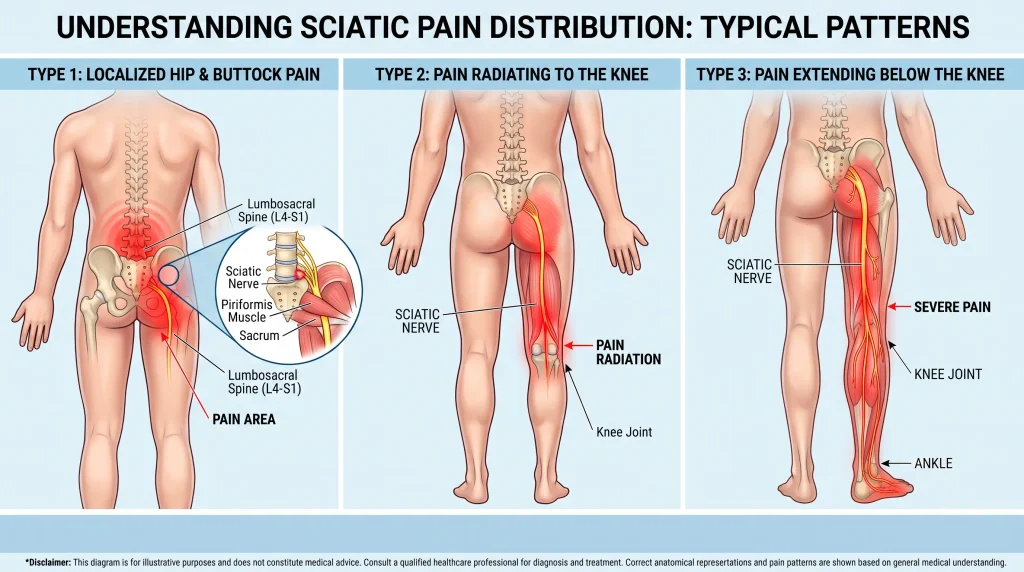
- “Sciatica always goes all the way down the leg.” Referred pain can stop anywhere along the territory. Pain ending at the knee is common, not a reason to rule out the spine.
- “The knee injection helped, so it must be the knee.” Brief, partial relief after any injection is a weak diagnostic signal — it has not localized the source.
From the Clinic: Dr. Arora’s Expert Insight
A fair number of the knees I assess have already been imaged, injected and discussed at length by the time anyone gives the lumbar spine a minute of attention. The file arrives thicker than the problem deserves — a scan report, an injection or two, a strengthening program that plateaued, sometimes a surgical opinion. Months of effort aimed at a structure that was never generating the pain. What frustrates me is not that the diagnosis was hard, but that the examination which redirects all of it takes four minutes.
The tell I rely on most is not on any standard checklist: ask the person to show you the movement that hurts. Someone with a genuine knee problem finds it within seconds — they squat or step down and there it is, same spot, every repetition. Someone with referred pain tries three or four things, none convincing, then says “it usually comes on later, in the car.” Pain that arrives after the activity rather than during it, and tracks with sitting time rather than joint load, is behaving like a nerve.
Generic advice fails here specifically in how it reads quadriceps weakness. Standard knee rehab treats a weak, quickly fatiguing quad as a strength deficit and escalates load — more terminal knee extensions, more leg press, more volume. If that weakness comes from an L3 or L4 root, the muscle does not respond as the program assumes, the numbers stall, and the conclusion drawn is that the patient is not trying hard enough. Nobody questions the target. The reverse error is just as common: told “it’s your back,” people stop loading the knee entirely, and a deconditioned quadriceps ends up sitting on an unresolved root problem.
What should you do in the first few days?
Keep moving, reduce the positions that provoke the leg, and collect information rather than treatments. For the first 48 to 72 hours the goal is not to fix anything but to establish whether the knee responds to spinal position or to knee loading. NICE guidance emphasizes self-management and encouragement to continue normal activities.
What to do today
- Break up sitting every 20 to 30 minutes, and note whether standing changes the knee.
- Set the car seat and desk chair upright, hips slightly higher than knees — slumped flexion loads a lumbar disc most reliably.
- Run a two-day test. Day one: stairs and sit-to-stands, minimal sitting. Day two: long sitting, no knee loading. Compare each next morning.
- Keep a two-line daily note: what you did, and what the leg did 24 hours later.
Resist the reflex to immobilize: bed rest and a week off your feet will dull the pain and cost you range, strength and confidence you then have to rebuild. Go easy on hard hamstring stretching too — pulling an irritated nerve taut tends to make the next day worse.
How does rehab progress once the pain settles?
In stages, each driven by a specific signal rather than the calendar. The early aim is calming the nerve root and getting symptoms to retreat toward the back and buttock. After that you rebuild hip and trunk control so the lumbar spine stops absorbing load it should not, then reload the quadriceps, then return to sport.
| Phase | Window | Goal | What it looks like | Ready to progress when |
|---|---|---|---|---|
| 1. Settle the root | Weeks 0–2 | Reduce nerve irritation | Short frequent walks, position changes, lumbar movement in the easing direction | Knee symptoms recede toward the buttock, sitting tolerance reaches 20–30 minutes, no flare past 24 hours |
| 2. Hip and trunk control | Weeks 2–6 | Stop the spine absorbing hip and knee workload | Hip hinge practice, glute bridging, hip abduction, isometric quad holds | You hinge to mid-shin without leg symptoms, hold a 45-second bridge, do 10 hands-free sit-to-stands |
| 3. Reload the leg | Weeks 6–12 | Rebuild quadriceps and posterior chain strength | Split squats, step-downs, light Romanian deadlift, loaded carries | Step-downs from 20 cm (8 in) are symmetrical and painless, and added load gives muscle soreness, not leg symptoms |
| 4. Return to demand | Week 12 onward | Restore impact, speed and heavy load | Graded return to running, jumping, sport or barbell work, one variable at a time | You complete a full session and the next 48 hours pass without leg symptoms |
The signal worth watching is centralization — symptoms migrating from the knee back toward the buttock. Counterintuitively that is progress; pain moving further down means the last change was too much. A structured set of exercises selected by physical therapists for low back pain (physiotherapists) is a reasonable starting framework.
Do’s and don’ts specific to this presentation
- Do change your sitting setup before your knee exercises — the higher-yield variable when the source is spinal.
- Do keep some quadriceps loading even when the source is the back — referred pain does not require an unloaded leg, and every change is judged by what happens 24 hours later.
- Don’t stretch a knee that is not stiff. Referred pain does not restrict range, and forcing deep flexion adds irritation without touching the source.
- Don’t push into deep lumbar flexion — slumped sitting, toe touches, rounded-back lifting — while the leg is symptomatic.
What happens when conservative care stalls, and when is surgery relevant?
If six to twelve weeks of well-directed rehabilitation has not shifted the symptoms, the plan needs reviewing rather than repeating: a fresh examination, imaging of the region it implicates, and a discussion about whether an injection or surgical opinion is appropriate. Surgery for referred knee pain is spinal surgery, not knee surgery — and only when imaging matches the clinical picture.
NICE recommends considering spinal decompression for people with sciatica when non-surgical treatment has not improved pain or function and the radiological findings are consistent with the sciatic symptoms. A bulge at L4–L5 means little if your examination points to L3.
The mirror image deserves stating plainly. Knee arthroscopy on a knee that hurts because of an L4 root will not help, and the recovery period — less walking, more sitting, more time flexed — can make the referred pain worse. If a knee procedure is proposed for pain with no swelling, no mechanical symptoms and no reproduction on knee testing, ask for a lumbar examination first. Most nerve root pain does settle over weeks to a few months with conservative care.
The bottom line
So, can sciatica cause knee pain? Yes — a lumbar nerve root under pressure can project pain to the front, inner, outer or back of the knee depending on the level involved, and it can do so with no back pain at all. What separates it from true knee pathology is behavior: no swelling, no joint line tenderness, no locking, and a clear reaction to spinal position.
The most useful thing you can do this week is gather evidence instead of opinions. Spend seven days logging two things daily: what your spine did, and what your knee did the next morning. If the knee reacts to sitting, driving and bending rather than to stairs and squats, take that log to an assessment and ask for a lumbar neurological examination before any knee imaging or injection is arranged.
Frequently asked questions
Can sciatica cause knee pain without any back pain at all?
Yes. A nerve root can be irritated enough to project pain into the leg while producing little or no local back pain, which is why many people present with an isolated knee complaint. Absent back pain lowers the likelihood slightly, not decisively.
Can nerve pain from the back be felt behind the knee?
Yes — the back of the knee is typically S1 territory, and it is often mistaken for a hamstring strain. An S1 referral usually brings calf or heel symptoms and reacts to spinal position; a local structure hurts when loaded directly.
Does knee pain from sciatica cause swelling?
No. Referred pain from a nerve root produces no fluid in the joint, because nothing inside the knee is inflamed. Measurable swelling shifts the picture toward a local knee cause, and a hot swollen knee with fever needs same-day assessment.
Why does my knee give way if the problem is my back?
Because the quadriceps can be weakened by irritation of the L3 or L4 root that supplies it, so the knee buckles under load without the joint being unstable. True giving way comes from ligament or meniscal problems and involves a twisting moment. Progressive buckling needs prompt assessment, not more training.
Will a knee MRI tell me whether my back is the cause?
No — a knee MRI can only report on the knee, and it will usually find some age-related change that looks like an explanation. Investigating a spinal source needs a neurological examination first, and a lumbar MRI only if that raises a question a scan can settle.
Can I have a knee problem and sciatica at the same time?
Yes, and past roughly age 50 this is common rather than unusual, since lumbar degenerative change and knee osteoarthritis share an age window. The useful question is which one drives the symptom bothering you most right now — treat that first, and keep the other from deconditioning.
Medical disclaimer
Separating referred knee pain from a genuine knee joint problem depends on things a written article cannot do: testing reflexes, comparing muscle strength side to side, mapping sensation, palpating the joint line, and watching how symptoms respond to spinal position. The patterns here should help you ask sharper questions and spot when a knee-focused plan is aimed at the wrong region — not rule a diagnosis in or out on your own. If you have progressive weakness, bladder or bowel changes, saddle numbness, a hot swollen knee with fever, or symptoms in both legs, seek assessment urgently.
References
- National Institute for Health and Care Excellence. Low back pain and sciatica in over 16s: assessment and management (NG59). 2016, updated 2020. https://www.nice.org.uk/guidance/ng59
- Rizzo RN, Cashin AG, Wand BM, Ferraro MC, Sharma S, Lee H, et al. Non-pharmacological and non-surgical treatments for low back pain in adults: an overview of Cochrane reviews. Cochrane Database of Systematic Reviews. 2025;(3):CD014691. https://doi.org/10.1002/14651858.CD014691.pub2