Expert Review: This article includes clinical insights from Dr. Vivek Arora, a physical therapist (physiotherapist) with 20+ years of experience.
People ask how long sciatica lasts because pain is disrupting real plans and daily life. It often improves over a few weeks to a few months, but some episodes persist longer or recur. A calendar cannot predict an individual recovery.
This guide explains what recovery studies can and cannot tell you, which changes are worth tracking and which symptoms need care without waiting for a deadline.
Key takeaways
- Sciatica often improves over weeks to months; four to six weeks is not a reliable deadline for everyone.
- Recovery is stepped, not smooth — good days and bad days alternating is normal and is not evidence of failure.
- Track pain, function, strength and sensation together. Pain moving toward the back can be one useful observation, but it is not required for recovery.
- Numbness or tingling can persist after pain improves. New, spreading or persistent sensory symptoms merit assessment rather than automatic reassurance.
- Get emergency care now for new difficulty passing or controlling urine, loss of bowel control or sensation, or numbness around the genitals or anus. New sciatic pain down both legs or severe or worsening weakness or numbness in both legs also needs emergency care. Get urgent medical assessment for new or worsening weakness in one leg.
How long does sciatica last?
Sciatica often improves within a few weeks to a few months, but it can last longer. There is no universal first-two-week peak or date by which symptoms should have gone. Seek review if pain worsens, prevents ordinary activity or is not improving after a few weeks.
In the ATLAS primary-care cohort, 55% met the study’s definition of improvement at twelve months: at least a 30% reduction in disability, not complete symptom resolution. Participants had back-related leg pain, with a clinically assessed sciatica subgroup. That result cannot predict an untreated person’s recovery or establish that the remainder did not improve at all.
Leg symptoms can have several causes. Lack of tingling or pain below the knee does not prove a muscle problem or a faster recovery. See possible sciatica symptoms and piriformis versus spinal sciatica for assessment limitations.
Why does sciatica take weeks rather than days?
Recovery can involve changes in inflammation, nerve sensitivity, activity tolerance and, in some cases, the size of herniated material. These do not follow one fixed sequence and do not explain every persistent symptom.
A spinal nerve root may be affected by pressure and inflammation, but a painful everyday movement does not show how much damage or irritation exists. Other causes of leg symptoms need consideration when the picture changes.
Three practical consequences follow, and they account for most of the confusion people have about their own recovery:
- Pain and function do not always improve together. Consider daily tasks, strength, sleep and symptom response before substantially increasing a demanding activity.
- Numbness can last longer than pain, but that does not prove sensory fibres are regenerating normally. Discuss persistent numbness; new or spreading sensory loss or weakness requires earlier review.
- Symptoms may fluctuate. Compare the overall trend while taking a substantial new deterioration seriously rather than calling every bad day a normal recovery step.
What makes one person’s sciatica last longer than another’s?
Prognosis is uncertain. The ATLAS study found associations involving symptom duration and illness perceptions, but no single symptom map, age or scan finding reliably predicts an individual return date.
An expectation that symptoms would persist was associated with poorer outcome in that cohort. This observational association does not prove that negative thoughts or inactivity caused delayed recovery, and it should not be used to blame patients.
The table separates useful observations from predictions that the evidence cannot support.
| Observation | What it may mean | What to do |
|---|---|---|
| Radiating leg pain | Possible nerve-root or other source | Assess the whole clinical picture; do not assign a fixed timeline |
| Buttock pain without distal symptoms | Several spinal, hip or other causes | Do not assume a muscle problem or a faster recovery |
| Numbness with or without pain | Possible sensory nerve involvement or another cause | Discuss persistent symptoms; review new or spreading changes |
| New or worsening weakness | Potential significant neurological problem | Obtain urgent medical assessment |
| Walking-related leg pain eased by rest | Spinal or vascular causes are possible | Arrange assessment rather than diagnosing stenosis yourself |
| Symptoms lasting more than twelve weeks | Persistent symptoms with variable causes and outcomes | Review diagnosis, function and management options |
How do you know your sciatica is actually improving?
Centralization describes distal pain retreating toward the back during some movements. It may be useful in an examination, but its presence does not prove healing and its absence does not establish poor progress. Pain relief and improving function remain meaningful.
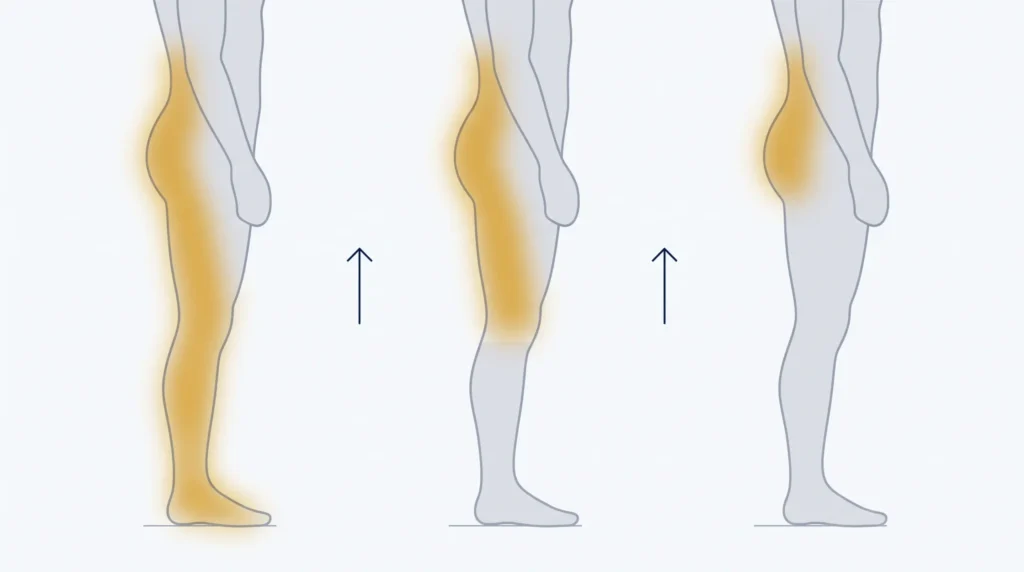
Useful markers include pain intensity and frequency, sleep, walking or sitting tolerance, strength, sensation and ability to manage daily tasks. No one measure is necessarily earlier or more reliable for everyone.
Quick check: are you on track at week two?
Use these questions for reflection, not a validated score. Three “yes” answers do not certify recovery or make warning signs safe to ignore.
- Has the furthest point your pain reaches down the leg moved upward compared with week one?
- Are the sharp spikes happening less often, even if they are still sharp?
- Can you sit for more minutes than you could a week ago before the leg objects?
- Are you waking fewer times at night because of the leg?
- After a bad flare, are you bouncing back faster than you did at the start?
Lack of progress or a worsening trend can justify assessment at any time. Do not wait until week six for new weakness or emergency signs.
Which symptoms mean the timeline no longer applies?
The findings below change the urgency, but they do not all establish one diagnosis. Use the specific care pathways rather than a recovery timetable.
- Emergency now: New difficulty starting or controlling urine, inability to pass urine, or new loss of bowel control or sensation.
- Emergency now: New numbness around the genitals, anus or inner thighs.
- Urgent assessment: New or worsening weakness in one leg, such as a dragging foot. Do not wait to see whether it progresses for several days.
- Emergency now: New sciatic pain down both legs, or severe or worsening weakness or numbness in both legs.
- Medical review: Fever with worsening back or leg pain needs urgent advice; unexplained weight loss, persistent night pain or a cancer history also warrants assessment.
- Emergency assessment: Severe pain after a major accident. Lesser trauma may still need prompt assessment when fracture risk is high.
Will a scan tell you how long it will last?
An MRI cannot give an exact recovery date. It can identify clinically relevant compression or another condition, but it must be interpreted with symptoms and examination findings rather than treated as either a timetable or irrelevant.
NICE discourages routine imaging for uncomplicated back pain or sciatica outside specialist settings. A specialist considers imaging when it could change management, rather than ordering a scan solely to predict a recovery date.
Disc and joint findings can occur without symptoms. Interpret a report with the examination and the clinical question; a finding alone cannot establish when it developed or whether it explains the pain. The X-ray report guide offers general context.
Four beliefs worth reconsidering
- “I should stay in bed until it stops.” Prolonged bed rest is generally discouraged, while manageable activity is recommended. Trials do not establish a specific activity dose that accelerates sciatica recovery.
- “If it were healing, it would improve every day.” Symptoms can fluctuate. Reviewing the overall trend may be more useful than judging one day alone, while new neurological changes or marked deterioration need assessment.
- “Numbness always means permanent damage.” Sensory symptoms may improve, but persistent numbness deserves discussion. New or spreading numbness, especially with weakness, warrants earlier assessment.
- “Harder stretching will speed recovery.” Do not force a stretch that clearly worsens leg symptoms. Stretching response cannot predict how many extra weeks recovery will take.
From the Clinic: Dr. Arora’s Expert Insight
Where pain travels is useful information, alongside how intense it is and what you can do. A shorter symptom area can be encouraging, but it is not the single best recovery clock.
A symptom map can change, just as pain intensity can. Neither should override worsening strength, reduced function or the person’s experience of pain.
Instead of waiting passively for a deadline, record a few meaningful measures such as pain, sleep and an activity you want to regain. Review the trend with a clinician when needed; no two-number rule can certify progress within a fortnight.
What should you do while the clock runs?
Use manageable activity and comfortable support if there are no warning signs, and reduce a task that causes sustained worsening. A pain-retreating position is not obligatory and should not replace clinical review.
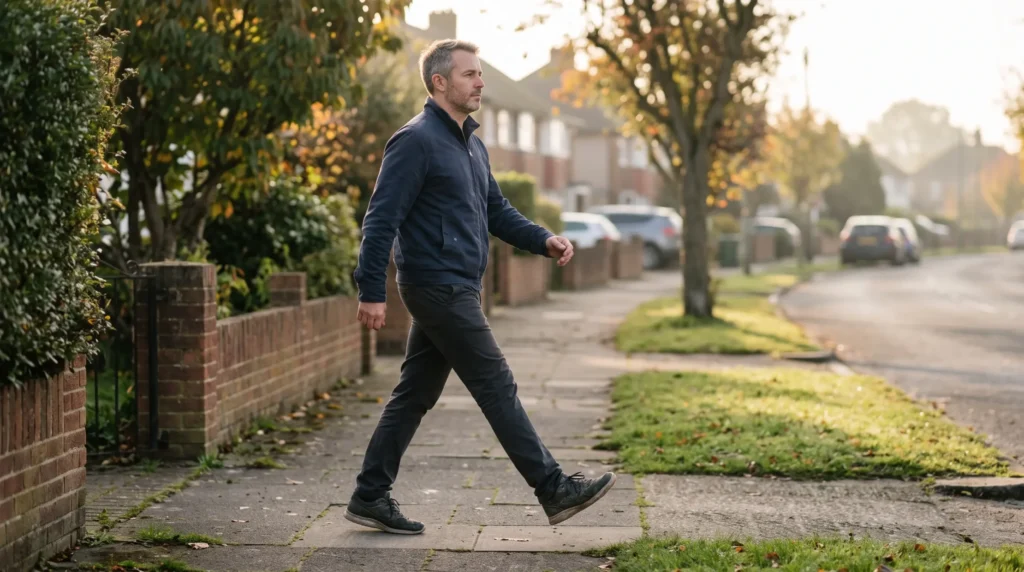
What to do in the next 72 hours
- Try a brief comfortable walk or another activity that suits you. Five to ten minutes is an example, not a superior or required dose.
- Change sitting position or take a break when useful and practical, without a fixed therapeutic limit.
- Use a comfortable resting position. Prone lying and extension do not suit everyone and are not tests of the pain source.
- Record pain, function and any strength or sensation changes alongside activity tolerance.
- Avoid forcing a stretch that aggravates symptoms. There is no established ranking of stretches as the most common cause of early setbacks.
Progress can begin when appropriate to the individual assessment and response. There is no required point at which pain must cross above the knee before strengthening is permitted.
- If leg symptoms persist, choose manageable activity and discuss appropriate exercises; distal pain alone is not a universal ban on loading.
- Mobility or strengthening can be introduced at a suitable level without using the knee as a diagnostic or progression boundary.
- Increase a task’s load, range or duration gradually according to function and response; sitting for 20–30 minutes is not a validated clearance gate.
- Return toward gym, work or sport demands at an individualized pace, considering neurological findings and any relevant clinical restrictions.
- Reduce or change an activity that produces sustained worsening. New weakness or substantial sensory change needs assessment rather than simply repeating a phase.
The physical therapy exercise guide offers options to discuss rather than a required sequence for everyone.
Do’s and don’ts that specifically affect the timeline
- Track pain and meaningful function together, with attention to strength and sensation.
- Drive only if you can control the vehicle and observe safely without impairing medicine effects. Plan breaks that suit the journey and symptoms rather than a mandatory 30–40-minute sciatica rule.
- Use a comfortable sleeping setup and discuss persistent sleep disruption. A pillow can help comfort but cannot guarantee nerve recovery.
- Don’t judge the week by its worst hour. Compare this week with last week instead.
- Review treatment that is not helping rather than continuing indefinitely. Manual therapy may be considered alongside exercise, but an arbitrary three-week stopping rule is not established.
- Reintroduce demanding lifting or driving gradually when function and the clinical picture allow; pain stopping does not by itself establish readiness or require another fixed period of restriction.
What happens if it is still there after twelve weeks?
Symptoms lasting more than about twelve weeks are often called persistent or chronic. This describes duration, not irreversible damage or proof of sensitization; reassess the diagnosis, neurological findings, function and treatment options.

Persistent disabling symptoms can justify a specialist discussion, but twelve weeks is not a required waiting point. Selected severe acute sciatica may warrant consideration of an epidural injection; decompression is considered when non-surgical care has not improved pain or function and imaging fits the symptoms. New neurological loss and emergency signs change the urgency.
Seek care promptly if…
- New or worsening weakness or a dragging foot needs urgent medical assessment.
- Nothing has moved in the right direction after two to three weeks of sensible self-management.
- Pain is spreading further down the leg week on week rather than retreating.
- New sciatic pain down both legs needs emergency care now.
- New difficulty passing or controlling urine, loss of bowel control or sensation, or saddle numbness needs emergency care now, not a later same-day appointment.
Conclusion
How long does sciatica last? Often a few weeks to a few months, but some episodes last longer or recur. Published averages and symptom patterns cannot give an individual deadline, and persistent numbness should not be dismissed automatically.
Monitor pain, activity, sleep, strength and sensation rather than relying on a calendar or a symptom-map score. Seek assessment for persistent or worsening limitations and act immediately on neurological emergency signs.
Frequently asked questions
How long does sciatica last without any treatment?
Some episodes improve over weeks to months without formal treatment, while others persist. The cited cohort studied people receiving care, so it cannot predict untreated recovery. Seek assessment for worsening symptoms, activity limits or a lack of improvement.
Why is my sciatica worse at night if it is supposed to be improving?
Position, sleep disruption and several pain mechanisms may contribute, but chemical pooling is not an established explanation for your symptoms. New, severe or persistent night pain deserves review, especially with fever or other warning signs.
How long does numbness in the foot last after sciatica?
It may last longer than pain, but the duration varies and cannot be predicted from this article. Discuss persistent numbness; seek earlier assessment for new or spreading sensory loss, and urgent care for new or worsening weakness.
Can sciatica come back after it has gone?
Yes. Recurrence can happen despite sensible care. Gradual activity and an individualized exercise plan may support function, but a particular hinge pattern or strength routine cannot guarantee prevention.
Does sciatica in pregnancy follow the same timeline?
Pregnancy-related pelvic or back pain is not automatically sciatica. Leg pain or sensory symptoms should be assessed on their own merits with your maternity or medical team, rather than assumed to resolve after delivery.
How long before I can go back to the gym or lift heavy again?
Return timing and load depend on symptoms, strength, sensation, function and the demands of the activity. Pain staying above the knee or sitting for half an hour is not a validated gate, and six to twelve weeks is not a universal gym timetable.
At what point should I stop waiting and see someone?
Arrange assessment if symptoms are worsening, prevent normal activity or are not improving after a few weeks. Get emergency care now for new difficulty passing or controlling urine, loss of bowel control or sensation, numbness around the genitals or anus, or new sciatic pain down both legs. Severe or worsening weakness or numbness in both legs also needs emergency care. Get urgent medical assessment for new or worsening weakness in one leg.
Medical disclaimer
This article describes general recovery patterns, not an individual forecast. It cannot diagnose leg pain or replace assessment. Get emergency care now for new difficulty passing or controlling urine, loss of bowel control or sensation, numbness around the genitals or anus, or new sciatic pain down both legs. Severe or worsening weakness or numbness in both legs also needs emergency care. Get urgent medical assessment for new or worsening weakness in one leg.
References
- Konstantinou K, Dunn KM, Ogollah R, Lewis M, van der Windt D, Hay EM. Prognosis of sciatica and back-related leg pain in primary care: the ATLAS cohort. The Spine Journal. 2018;18(6):1030–1040. https://doi.org/10.1016/j.spinee.2017.10.071
- National Institute for Health and Care Excellence. Low back pain and sciatica in over 16s: assessment and management (NG59). Recommendations on assessment, imaging and management.
- NHS. Sciatica. Symptoms, activity advice and emergency warning signs.