Expert Review: This article includes clinical insights from Dr. Vivek Arora, a physiotherapist with 20+ years of experience.
People searching for sciatica in both legs are asking two things at once. Why do both legs hurt, when everything they have read describes sciatica as one-sided? And, more quietly, should I be worried?
Nerve pain down both legs is usually mechanical and manageable — most often narrowing of the spinal canal. It is also one of the recognized warning features of a rare condition needing same-day emergency assessment. That is why the threshold for getting checked is lower here, and why the safety information comes first.
Key takeaways
- Both legs plus any bladder, bowel or saddle change is an emergency — an emergency department the same day, not an appointment.
- Most bilateral leg pain is not an emergency. Lumbar canal narrowing is the commonest cause after 50, and often responds without surgery.
- The walking pattern is the most useful clue. Symptoms that build on walking and ease within minutes of sitting or leaning forward point to canal narrowing.
- Not every bilateral leg symptom is spinal. Peripheral neuropathy and poor arterial circulation both mimic sciatica and take different referral routes.
- Imaging is a decision tool, not a diagnosis. Outside the emergency scenario, a scan earns its place only when the result would change what happens next.
Seek emergency care today if
Go to an emergency department today if symptoms in both legs come with any one of these:
- Difficulty starting or stopping urine flow, or no longer sensing a full bladder
- Loss of bowel control, or losing the sensation that a movement is coming
- Numbness around the genitals, inner thighs or the area a saddle touches
- New genital numbness during sex, or a sudden change in erectile function
- Weakness in both legs worsening over hours or days, or feet that catch and drag
Do not wait to see whether it settles overnight.
What does sciatica in both legs actually mean?
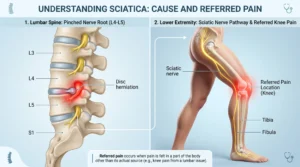
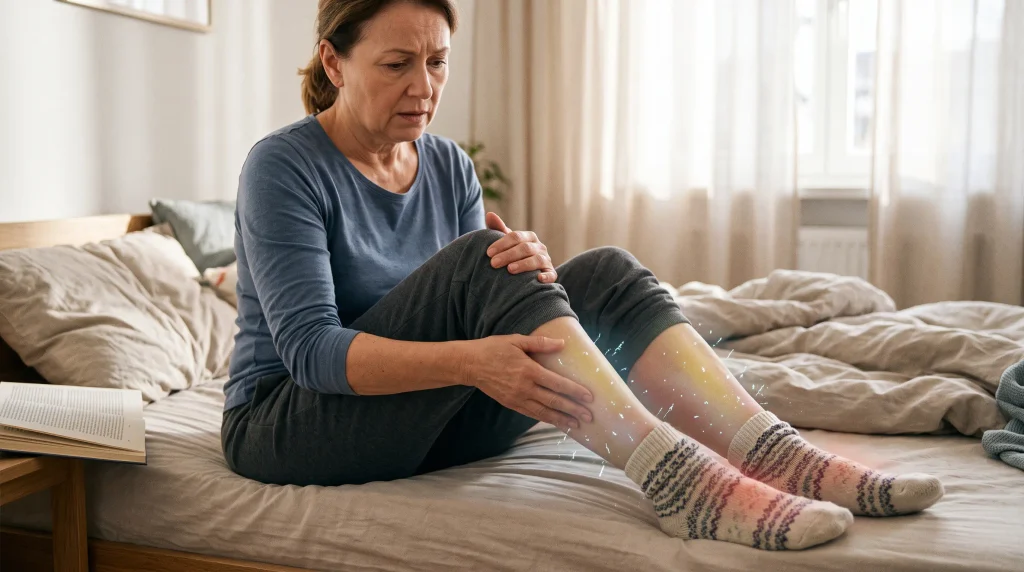
It means nerve-related symptoms — pain, burning, pins and needles, numbness or weakness — are travelling down both limbs rather than one. Sciatic symptoms come from irritation of the lumbar and sacral nerve roots as they leave the spine. When both sides are involved together, the source usually sits near the middle of the spinal canal, where left and right nerve supply run close together.
Each root can be pinched in two places: the foramen, the small side window it exits through, or the central canal, the larger tunnel it travels first. One narrowed foramen affects one leg; a narrowed central canal can affect both. The spinal cord ends around the first or second lumbar vertebra, and below that the roots continue as a loose bundle — the cauda equina, Latin for horse’s tail — supplying the legs, bladder, bowel, sexual function and saddle sensation.
The canal also changes size with posture: bending forward opens it, arching backward closes it. That is why symptoms track position so closely, and why the specific sensations that identify true sciatica tell you more than pain intensity does.
When is sciatica in both legs a medical emergency?
It becomes an emergency when bilateral leg symptoms appear alongside any change in bladder control, bowel control, saddle sensation or sexual function. That combination raises the possibility of cauda equina syndrome — compression of the whole bundle of nerve roots below the end of the spinal cord. It is uncommon, but it is a surgical emergency, because the window for protecting bladder, bowel and sexual function is short.
The reason is anatomical: the sacral roots at the bottom of the bundle carry leg sensation and the nerve supply to the pelvic floor, bladder and bowel, so compression severe enough to reach both legs sits exactly where those roots run. National health service guidance lists bladder or bowel change, loss of feeling around the genitals or anus, and pain, tingling, weakness or numbness in both legs as reasons to go straight to emergency care (NHS, Back pain). Each is worth unpacking.
- Bladder change is the most commonly missed. People expect sudden incontinence; early on it is a weaker stream, straining to start, or losing the sense that the bladder is filling.
- Saddle numbness is a sensory map, not a vague feeling. The practical test is whether wiping after using the toilet feels normal.
- Bowel change may be lost sensation before lost control. Not registering that a movement is coming carries the same weight as frank incontinence.
- Sexual dysfunction belongs in the same picture. New genital numbness or an abrupt change in erectile function reflects the same sacral supply.
- Progressive weakness matters more than pain severity. Feet that catch on steps, or legs weaker than yesterday, suggest motor involvement that is advancing.
Severe back pain is not required: cauda equina syndrome can present with modest back discomfort and striking pelvic findings. Early symptoms may also fluctuate, and a few hours of improvement does not remove the need for assessment that day.
What else causes both legs to hurt at the same time?
Most bilateral leg symptoms are not cauda equina syndrome. The commonest explanation is lumbar spinal canal stenosis, meaning the central tunnel has narrowed enough to crowd the nerve roots inside it. Large central disc herniations, degenerative slippage of one vertebra on another, and narrowing of the side exit windows on both sides account for most of the rest.
Lumbar canal stenosis develops as discs lose height, the facet joints thicken and the ligament lining the canal buckles inward — less room for the nerve bundle, and less again whenever you extend the spine. Hence the signature pattern: legs feel heavy or unreliable after a few minutes of walking, then settle within minutes of sitting or leaning over a counter.
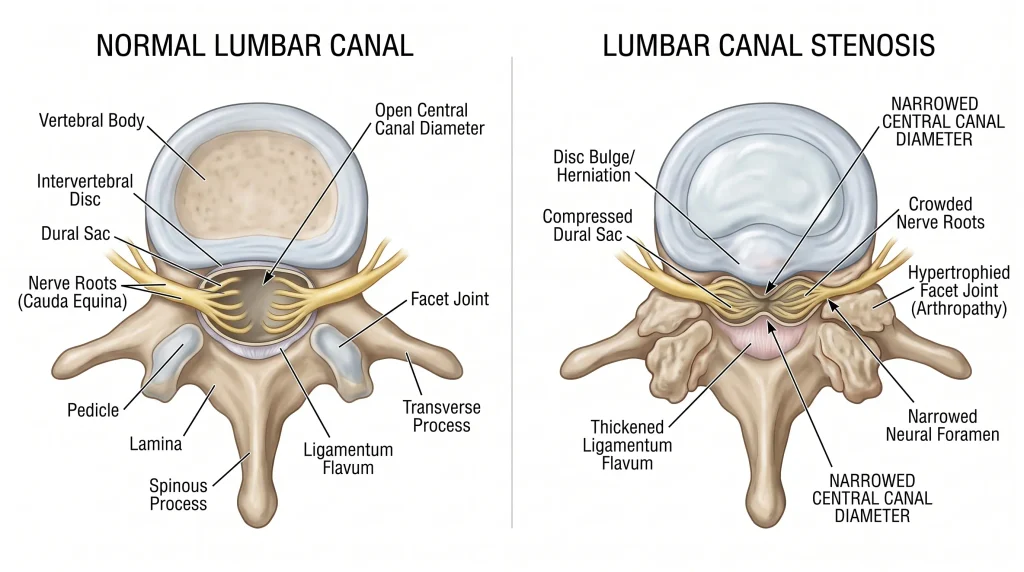
A large central disc herniation pushes backward toward the middle of the canal rather than off to one side, reaching roots headed for both legs. It arrives in days rather than years and behaves in reverse: sitting, bending and coughing aggravate, standing may relieve. It is also the commonest structural cause of cauda equina syndrome, so sudden bilateral symptoms after lifting deserve prompt review.
Degenerative spondylolisthesis — one vertebra drifted forward on the one below from facet wear — reduces canal diameter and produces the same pattern, and the side windows can narrow on both sides too, so each leg may follow a different line. That asymmetry does not argue against a spinal cause. Genuinely muscular problems, such as the overlap between piriformis-related pain and true nerve root sciatica, are typically one-sided.
How do you tell these causes apart?
Three things separate them: how fast symptoms started, what position reliably changes them, and whether anything outside the legs is involved. Cauda equina compression declares itself through pelvic symptoms. Canal narrowing declares itself through the walking-and-sitting cycle. Disc problems declare themselves through sitting and bending. Non-spinal causes ignore spinal position entirely.
| Cause | Onset | Symptom pattern | Better / worse with | Urgency |
|---|---|---|---|---|
| Cauda equina syndrome | Hours to days | Both legs plus saddle numbness and bladder, bowel or sexual change | Little positional change; does not resolve | Emergency department same day |
| Lumbar canal stenosis | Months to years | Heaviness or tingling in both legs on walking or standing | Worse standing and arching; better sitting or leaning forward | Routine; urgent if weakness progresses |
| Large central disc herniation | Days, often after lifting | Sharp radiating pain down both legs with back pain | Worse sitting, bending, coughing; better standing | Prompt; emergency if pelvic symptoms appear |
| Peripheral neuropathy, including diabetic | Months to years | Symmetrical burning or numbness from the toes upward | Worse at night; unchanged by spinal posture | Medical review, including blood glucose |
| Vascular claudication | Months | Cramping calf pain at a consistent walking distance; cold feet | Eased by standing still; no bending needed | Vascular assessment; urgent if pain at rest |
Neurogenic versus vascular claudication
Claudication means leg pain brought on by walking, and two very different problems cause it. Neurogenic claudication comes from a crowded spinal canal: the limiting factor is a heavy, tingling, unreliable feeling in both legs, and relief needs forward bending rather than rest — which is why pushing a cart beats walking unaided. Vascular claudication comes from narrowed arteries: cramping calf pain arrives at a consistent distance and eases once the muscle stops working, so standing still is enough and uphill walking is harder. Cold feet, thinning leg hair or weak foot pulses point that way.
So the test you can run yourself is this: when symptoms stop you, does standing still fix it, or do you need to sit or lean forward? That one question decides the referral pathway, and it is the reasoning behind why walking pace and distance change leg symptoms. Peripheral neuropathy sits outside both: it starts in the toes, creeps upward over months, is worst at night, and ignores spinal position.
When is imaging actually needed?
Urgently, when cauda equina syndrome is suspected — that needs an emergency MRI, not a scheduled one. Outside that, imaging earns its place when the result would change the plan: progressing weakness, a specialist weighing an injection or surgery, or a presentation that does not fit a mechanical pattern. Scanning to explain ongoing pain rarely improves outcomes.
UK national guidance says routine imaging should not be offered in non-specialist settings for low back pain, and that imaging in a specialist setting should be considered only if the result is likely to change management (NICE guideline NG59). Canal narrowing and disc bulges are common on scans of people with no symptoms, so a report can accurately describe something that is not causing your pain.
Interpretation therefore matters more than the scan. Moderate narrowing means something only if the level matches the legs and the walking pattern, which is why understanding what a stenosis finding on an MRI report means for treatment beats requesting a second scan. Plain X-rays show alignment and can reveal a slip, but not nerve roots, discs or the ligament inside the canal.
Myths that delay the right decision
- “My back barely hurts, so my spine is fine.” The link between back pain intensity and nerve compression is weak; significant presentations often come with modest back pain.
- “Bladder symptoms mean an infection.” Usually they do. But arriving alongside new symptoms in both legs, that assumption is the one that costs people function.
- “Stenosis is wear and tear, so nothing can be done.” Canal diameter cannot be exercised larger, but walking tolerance often improves with hip mobility, trunk endurance and flexion-biased conditioning.
From the Clinic: Dr. Arora’s Expert Insight
There is a point in an assessment where I stop working at my usual pace, and bilateral leg symptoms are the most common thing that triggers it. Normally I take my time — full history, what the job demands, a movement screen, neurological testing near the end once I have a picture. When someone tells me both legs are involved, that order collapses and the pelvic questions move to the very front. I would rather know within ninety seconds whether this is a rehabilitation conversation or a phone call to arrange emergency assessment.
What I have changed over the years is how those questions get asked. “Any problems with your bladder?” is close to useless — almost everyone says no, because they hear it as a question about incontinence, and they are not incontinent. What surfaces real information is asking about mechanics: has the stream become weaker, do you wait or strain for it to start, and when you wipe, does that feel the way it normally does? A pattern that comes up repeatedly is someone answering no to the general question, then mentioning thirty seconds later that they have been struggling to get going at the toilet for two days.
The failure I see most often is generic sciatica advice applied unchanged to bilateral cases. The standard script — keep moving, most sciatica settles in six to eight weeks — suits one-sided nerve root pain and is quietly wrong as a default here, because it carries no safety net and no re-check point. Walking advice has the same flaw: for a canal narrowing pattern, telling someone to walk more prescribes the exact task that provokes them. Interval walking with a forward-lean break taken before symptoms arrive works better.
What should you do in the first 72 hours?
With no emergency features, the first three days are about screening yourself carefully, protecting sleep, and keeping movement going in positions that do not provoke the legs. Complete bed rest is not the answer, and neither is pushing through a walk that leaves both legs numb. Find the activity level you can repeat tomorrow without a worse morning.
Quick check — answer yes or no, twice a day
- Does wiping after using the toilet feel normal?
- Does your urine stream start normally, without waiting or straining?
- Can you tell when your bladder is filling and when it is empty?
- Can you rise onto your toes ten times on each leg without one side giving way?
- Is your walking distance before symptoms the same as yesterday, or better?
Any “no” to the first three means emergency care today. A “no” to the last two means arranging assessment within days.
- Find your two comfortable positions. For a stenosis pattern that is usually sitting, side-lying with knees drawn up, or lying with calves on a chair; for a disc-dominant pattern it is more often standing or walking. Which pair works tells you a lot about which problem you have.
- Convert one long walk into several short ones. If both legs complain at eight minutes, walk five, lean forward for two, repeat. Three short bouts usually total more distance than one long attempt, with far less flare afterward.
How does rehab progress from here?
Progression is driven by what the legs tolerate, not by the calendar. Each stage has an entry test: you advance when a specific function is repeatable without a next-day flare, not when a set number of weeks has passed. For bilateral symptoms, the two that matter are continuous walking time and the ability to load hips and trunk without the legs joining in.
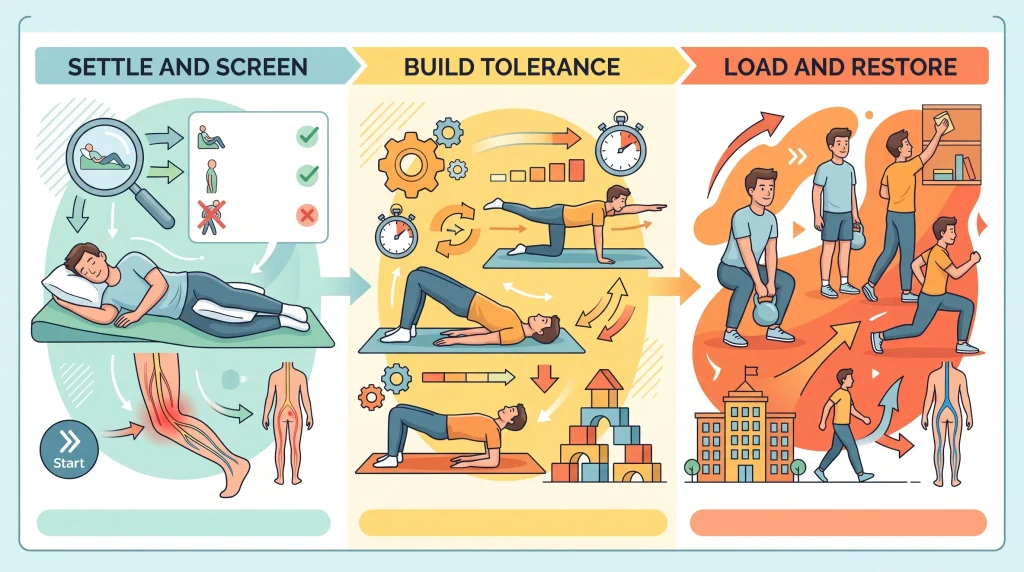
| Phase | Goal | Typical work | Ready to progress when |
|---|---|---|---|
| 1. Settle and screen (week 1–2) | Calm nerve irritation; confirm no emergency features | Positions of relief; short walking intervals; hip and hamstring mobility | Self-check stays clear and walking reaches 8–10 minutes without symptoms spreading below the knee |
| 2. Build tolerance (week 2–6) | More pain-free walking time and hip strength | Sit-to-stand progressions; low-load hip hinge; glute and calf work; forward-lean cycling | 20 minutes’ continuous walking (about 1.5 km / 1 mile), settling within 5 minutes, plus 10 single-leg heel raises each side |
| 3. Load and restore (week 6–12) | Loaded tasks and longer distances | Progressive hinge and squat; step-ups; carries; longer walks on varied ground | Carrying 10 kg (22 lb) up a flight of stairs and walking 30–40 minutes with no next-day flare |
Exercise selection matters more here than in one-sided sciatica, because the two main drivers pull in opposite directions. Where canal narrowing dominates, flexion-biased work is better tolerated: knee-to-chest positions, forward-lean cycling, hip flexor length work so the pelvis stops dragging the spine into extension while walking. Where a central disc dominates, repeated end-range flexion aggravates and gentle extension tolerance works better. Getting this backward stalls programs, which is why a set of exercises chosen by a physical therapist beats a generic routine here.
Do’s and don’ts for bilateral leg symptoms
- Do run the bladder, bowel and saddle check daily while symptoms are active.
- Do use a forward-lean support — a cart, a slightly short walking pole, a counter — to extend walking time rather than abandoning walking.
- Don’t spend long periods standing still upright while symptoms settle; that is usually harder on a narrowed canal than walking.
- Don’t stretch into positions that reproduce symptoms in both legs — reproducing nerve symptoms is not evidence the stretch is working.
When does surgery become relevant?
Care has stalled when walking tolerance has not moved after six to eight weeks of consistent, well-chosen work, or is going backward. Surgery becomes a genuine consideration when function stays meaningfully limited, the scan findings match the symptoms, and non-surgical treatment has had a fair trial. Cauda equina syndrome is the exception — there, decompression is an emergency.
UK guidance supports considering spinal decompression for sciatica when non-surgical treatment has not improved pain or function and radiological findings are consistent with the symptoms (NICE guideline NG59). That second clause matters as much as the first: decompressing a level that does not match the affected legs is unlikely to change walking distance. Before surgery enters the conversation for a stenosis pattern, confirm that rehabilitation included progressive hip and trunk strengthening rather than stretching alone, and that no non-spinal contributor was overlooked.
Realistically, the goal with canal narrowing is a real gain in walking and standing tolerance rather than a scan that looks different, and many people reach it without an operation. Returning to heavy lifting takes longer, and the principles behind rebuilding load tolerance after an L5-S1 disc injury apply once symptoms settle. After emergency decompression for cauda equina syndrome, recovery of bladder and bowel function depends heavily on how much function remained at the time of surgery — the entire reason the same-day rule exists.
What this means for you
Sciatica in both legs is not a diagnosis. It is a finding that narrows the field and raises the stakes. Most of the time a narrowed spinal canal explains it and targeted rehabilitation works; occasionally it is the first sign of something that cannot wait.
So do two concrete things today. Run the bladder, bowel and saddle check honestly, and act immediately if any answer has changed. If it is clear, time your next walk: minutes before symptoms start, minutes until they settle. Bring those numbers to your first assessment — they shape the plan faster than any pain score.
Frequently asked questions
Can sciatica really affect both legs at once?
Yes, though it is less common than the one-sided version. When the problem sits centrally in the spinal canal rather than at one side exit, roots travelling to both legs can be affected together — often with different intensity on each side.
Does pain in both legs always mean cauda equina syndrome?
No — it is rare, and most bilateral leg pain has an ordinary mechanical explanation. What makes it a genuine concern is leg symptoms combined with a bladder, bowel, saddle or sexual change. Leg symptoms alone, with pelvic function normal, warrant assessment but not an emergency visit.
What exactly does saddle numbness feel like?
It feels like reduced or absent sensation across the area a bicycle saddle would touch — inner thighs, genitals and the skin around the anus. Most people notice it when wiping feels muffled, or when a toilet seat no longer feels normal against the skin.
Is it safe to keep walking when both legs hurt?
Usually yes, provided pelvic function is normal and leg strength is not declining. The useful change is shorter walking intervals with a forward-lean break taken before symptoms arrive. Seek review if your distance is shrinking week on week.
Can diabetes cause leg pain that feels like sciatica?
Yes — diabetic peripheral neuropathy commonly produces symmetrical burning, numbness or tingling in both feet. The giveaway is that it begins in the toes and moves upward, is often worst at night, and does not change when you sit, stand or lean forward.
Will I definitely end up needing surgery?
No — most people with bilateral leg symptoms from canal narrowing or a disc problem are managed without an operation. Surgery is reserved for cases where function stays limited despite a fair trial of rehabilitation and the scan clearly matches the symptoms.
Medical disclaimer
This article explains how bilateral leg symptoms are reasoned through clinically. It cannot replace an in-person neurological examination, the only way to confirm what is compressing which nerve roots. Nothing here should be used to talk yourself out of an emergency assessment: if symptoms in both legs come with any change in bladder, bowel, saddle or sexual function, attend an emergency department the same day. Otherwise, a qualified clinician should assess you before you begin or change an exercise program.
References
- National Institute for Health and Care Excellence. Low back pain and sciatica in over 16s: assessment and management (NG59). 2016, last updated 2020. https://www.nice.org.uk/guidance/ng59
- National Health Service. Back pain. NHS. https://www.nhs.uk/conditions/back-pain/