Expert Review: This article includes clinical insights from Dr. Vivek Arora, a physical therapist (physiotherapist) with 20+ years of experience.
Ask the internet is walking good for sciatica and you will get an unusually confident yes, usually accompanied by an instruction to walk thirty minutes a day. Ask someone three days into a genuine flare, halfway down the street with their leg on fire, and the answer feels considerably less obvious. Both experiences are real, and the gap between them is the interesting part.
The short version is that walking is worth doing for almost everyone with sciatica, but the reasons are more modest than the enthusiasm suggests — and the trial evidence specific to sciatica is weaker than the advice implies. What follows is what the research genuinely shows, why walking soothes some people and provokes others, how to dose it, and the presentations where walking is the wrong first move.
Key takeaways
- Walking is safe and worth doing for most sciatica, but the case rests more on avoiding the harms of rest than on proven acceleration of nerve recovery.
- The evidence for staying active is stronger for ordinary low back pain than for sciatica specifically — an honest distinction most articles skip.
- Short and frequent beats long and heroic. Five to ten minutes several times a day outperforms one thirty-minute march in an acute flare.
- Your response to walking is diagnostic information. Symptoms easing, staying flat, or moving up the leg is a green light; symptoms travelling further down is a signal to change something.
- If walking reliably brings on leg symptoms that disappear the moment you sit or lean forward, that pattern points away from disc-related sciatica and needs a different plan.\
Is walking good for sciatica?
For most people, yes. Walking keeps the lumbar tissues and the nerve moving, prevents the stiffness and deconditioning that come with rest, supports sleep and mood, and does not load the spine heavily. It is generally the safest activity to start with. What it will not reliably do is speed up the nerve’s own healing — and being clear about that distinction changes how you use it.
The practical framing that holds up best is this: walking is not a treatment aimed at the nerve root. It is the vehicle that keeps everything else — circulation, tissue tolerance, confidence, sleep — in reasonable shape while the irritated nerve settles on its own schedule. That is a genuinely valuable role. It is just a different claim from “walking cures sciatica”, which is the version usually on offer.

What does the evidence actually say?
The evidence supports staying active over resting in bed, but it is noticeably stronger for general low back pain than for sciatica. A Cochrane systematic review comparing advice to rest in bed with advice to stay active found that people with acute low back pain may get small benefits in pain and function from staying active — while for people with sciatica, there was little or no difference between the two approaches.
That finding surprises people, so it is worth being precise about what it does and does not mean. It does not mean bed rest is a good idea — nothing in that comparison showed rest to be superior, and the wider consequences of prolonged rest, from muscle loss to low mood to reduced fitness, sit outside what these trials measured. What it means is that the specific claim “staying active makes sciatica resolve faster” is not well supported by trials directly comparing the two, even though it is repeated constantly.
Clinical guidance lands in the same place while framing it more usefully. NICE recommends giving people with low back pain and sciatica tailored advice that includes encouragement to continue with normal activities, and recommends exercise programs as a core part of management. Note the wording — continue with normal activities. The guidance is not prescribing walking as a nerve treatment; it is discouraging the withdrawal from ordinary life that used to be standard advice and that reliably leaves people worse off.
So the honest position is a qualified yes. Walk because rest has real costs and walking has almost none, because it maintains the capacity you will need when the nerve calms, and because it gives you a daily read on what your symptoms are doing. Do not walk expecting it to shorten the four-to-six week arc that most sciatica follows.
Why does walking help some people and flare others?
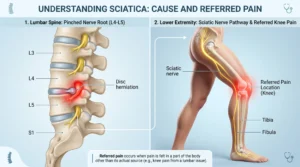
It comes down to what walking does to the space around your nerve root. Walking involves gentle, repeated extension of the lumbar spine — the opposite of the slumped, flexed position that most disc-related sciatica dislikes. For those people it genuinely eases symptoms. But in someone whose nerve is irritated by a narrowed canal, extension reduces the space further, and walking predictably builds symptoms instead.
Three mechanisms are worth knowing, because they explain nearly every walking response people report. First, spinal position: upright walking places the lumbar spine in mild extension, which for a posteriorly bulging disc tends to move pressure away from the nerve root — the same reason standing often feels better than sitting. Second, nerve gliding: each stride slides the sciatic nerve a few millimeters through its surrounding tissues, and a nerve that moves freely is generally a happier nerve than one held still for hours. Third, circulation and fluid exchange: rhythmic movement helps clear the inflammatory chemicals that accumulate around an irritated nerve root, which is part of why stiffness after long sitting eases within a few minutes of walking.
The flip side is the pattern where symptoms build with distance and vanish almost instantly on sitting or leaning over a shopping cart. That is more suggestive of narrowing in the spinal canal than of a disc herniation, and it is more common with age. Walking is still valuable there, but it needs a different setup — which the next section covers.
Gait itself matters too. People in a flare tend to walk stiffly, with short strides and a braced trunk, which reduces the very hip movement that would otherwise spare the back. If walking has become uncomfortable in a general, non-nerve way, the mechanics behind low back pain that comes on during walking are worth understanding separately, because the fixes are different.
What is your walking response telling you?
Rather than asking whether walking is good in the abstract, use it as a test. What your leg does during and after a short walk is one of the most informative pieces of self-assessment available, and it takes ten minutes.
| What happens when you walk | What it likely reflects | What to do next |
|---|---|---|
| Leg symptoms ease, or retreat up toward the buttock | Extension-tolerant, disc-related pattern responding well | Walk more often; this is your best tool. Build duration gradually |
| Symptoms unchanged during and after | Neutral tolerance — walking is safe but not therapeutic on its own | Keep walking for general benefit; add targeted directional exercise |
| Back feels more worked but the leg is quieter | Load shifting from the nerve to the muscles — a favorable trade | Continue; this is progress, not a setback |
| Symptoms build steadily with distance and ease within a minute or two of sitting or leaning forward | Pattern more suggestive of spinal canal narrowing than a disc | Walk in shorter bouts, use inclines or a cart to lean on, get assessed |
| Pain travels further down the leg and stays there afterward | Nerve root is being provoked, not soothed | Cut duration by half, slow the pace, and stop before the point it starts |
| Leg gives way, foot catches or drags | Motor involvement, not a tolerance issue | Stop and arrange prompt assessment rather than adjusting the walk |
How much should you walk, and how fast?
In an acute flare, start with five to ten minutes at an easy conversational pace, repeated three or four times through the day, rather than a single long walk. Total daily time matters less than frequency, because the aim is to interrupt long static periods. Increase by roughly ten to twenty percent per week, and only when the previous week produced no increase in leg symptoms over the following 24 hours.
The progression below is driven by symptom response rather than dates. Each step is unlocked by the one before it.

- Start where you are, not where you were. If five minutes is what you can do without provoking the leg, five minutes is the correct dose. Walking to a distance target you set before the flare is the most common early error.
- Stop before symptoms start, not after. If the leg reliably speaks up at eight minutes, walk six. Repeatedly walking into provocation teaches the nervous system that walking is threatening, which is precisely backwards.
- Add frequency before duration. Four ten-minute walks is a better week-two target than one forty-minute walk, because the benefit comes largely from breaking up sitting.
- Once a session produces no next-day increase in leg symptoms, extend it by two or three minutes — roughly one increase per week, not per day.
- Add pace last. A brisker walk increases trunk rotation and hip extension range, which is useful later but provocative early. Duration first, then speed, then terrain.
- If a step backfires, drop to the previous level for four or five days and try again. One bad session is information, not a reason to stop walking altogether.
Quick check: is walking working for you?
Take one easy ten-minute walk, then answer these. Three or more “yes” answers means walking is a tool you should be using daily.
- During the walk, did your leg symptoms stay the same or improve?
- Did the furthest point of your pain stay put or move up the leg rather than down?
- Two hours later, were symptoms no worse than before you set off?
- The next morning, was stiffness the same or better than the previous day?
- Did you feel steadier on your feet at the end than at the start?
Mostly “no” does not mean stop walking — it means shorten the walk considerably and get the pattern assessed rather than pushing the same dose again tomorrow.
Which walking mistakes make sciatica worse?
Most people who report that walking flared their sciatica were not wrong to walk — they were wrong about how. Five errors account for the large majority of bad experiences.
- The single long walk. Attempting a thirty- or forty-minute walk in the first week loads a sensitized nerve well past its current tolerance, and the flare arrives that evening or the next morning rather than during the walk itself.
- Pushing through leg pain that is escalating. With a muscle problem, working through discomfort is often fine. With an irritated nerve root, symptoms that march further down the leg during activity mean the tissue is being provoked, and continuing extends the recovery rather than proving toughness.
- Walking on a treadmill while holding the handrails. Gripping the rails locks the trunk, removes the arm swing and rotation that make walking useful, and produces a stiff shuffle that irritates the low back. If you need the rails, walk outdoors or shorten the session.
- Long walks straight after long sitting. A drive followed immediately by a walk is a common flare recipe, because the discs and nerve tissue are least tolerant right after sustained flexion. Move gently for a couple of minutes before setting off — the same reason managing lower back pain while driving matters more than most people assume.
- Treating walking as the entire plan. Walking maintains capacity but does not build it. Without progressive hip and trunk strengthening, people plateau at “able to walk, unable to lift” and stay there for months.
When is walking not the right first move?
A small set of situations call for assessment rather than a walking program, because they suggest the problem is not simply an irritable nerve root that needs time and movement.
- Any change in bladder or bowel control, or numbness in the saddle area — the groin, genitals or inner thighs. This suggests compression of the nerve bundle at the base of the spine and requires emergency assessment the same day; no exercise plan applies until that is excluded.
- Weakness that is worsening — a foot that drags or catches on steps, a knee that buckles. This reflects motor fibers under sustained pressure, and progressive weakness is assessed promptly rather than exercised around.
- Symptoms in both legs. Sciatica almost always affects one side; bilateral symptoms suggest a more central problem in the canal and deserve a closer look before starting a program.
- Leg symptoms that appear only on walking and vanish within a minute of sitting. This claudication-style pattern is not dangerous, but treating it like disc sciatica does not work — the aggravating and easing positions are reversed, and the plan needs to be built around that.
- Fever, unexplained weight loss, night pain unrelieved by any position, or a history of cancer alongside the leg pain, all of which shift the priority toward excluding other causes first.
Three claims about walking worth retiring
- “Walk 10,000 steps a day and your sciatica will clear up.” Step targets are a general health tool, not a rehabilitation dose. In an acute flare that number is arbitrary and frequently provocative; frequency and symptom response are the variables that matter.
- “If walking hurts, your sciatica is getting worse.” Discomfort during walking is common and often reflects tissue that is stiff and unaccustomed rather than an injury progressing. The meaningful signal is direction — symptoms travelling further down the leg — not the presence of pain.
- “Walking is enough; you do not need exercises.” Walking preserves what you have. Rebuilding hip strength, hinge mechanics and load tolerance is what reduces the chance of the next episode, and walking does not deliver any of the three.
From the Clinic: Dr. Arora’s Expert Insight
Walking is almost never the wrong idea for sciatica, and almost always the wrong dose. That is the whole problem in a sentence. People are told to walk, they are not told how much, so they default to whatever they used to do — the loop around the park, the thirty minutes on the treadmill — and then report back that walking made it worse. Walking did not make it worse. Thirty-two minutes made it worse; eleven would have helped.
The detail that most often gets missed is what happens after the walk rather than during it. Nerve tissue responds on a delay. Someone finishes a walk feeling fine, concludes they are ready to double it, and then spends the following evening wondering what went wrong. In practice the useful question is never “how did it feel while you were walking” but “what was your leg doing two hours later, and the next morning.” That 24-hour window is where the real answer lives, and almost nobody is watching it.
The other thing worth saying plainly: walking gets over-credited. It is a good habit, it prevents the deconditioning spiral, and it gives people something constructive to do while a nerve settles — all genuinely worth having. But I see people who have walked faithfully every day for two months and still cannot pick a laundry basket off the floor, because nothing in their week ever asked their hips and trunk to produce force. Walking maintains. It does not build. The people who come through an episode and stay through it are the ones who started loading the hinge pattern again once the leg allowed it, and treated the daily walk as the floor of their rehab rather than the ceiling.
What should walking be combined with?
Walking works best as one component of three: frequent movement to keep the nerve mobile, positional work to draw symptoms out of the leg, and progressive strengthening to rebuild what the episode cost you. Walking covers the first, contributes nothing to the second, and only marginally to the third — which is why walking-only plans stall.
In the first week or two, pair walking with a directional exercise that consistently pulls symptoms up the leg — for many disc-related presentations that is gentle backward arching, done in small, frequent sets rather than pushed hard. Add short, deliberate sitting breaks and a comfortable resting position; for some people a supportive reclined position genuinely offloads the area, and the question of whether a recliner helps or hinders lower back pain has a more nuanced answer than either camp claims.
From roughly the point at which leg symptoms stay consistently above the knee, strengthening becomes the priority — glute bridges, side-lying hip work, sit-to-stand, and then a loaded hip hinge. This is also the stage where an accurate diagnosis starts to matter more, because a deep buttock problem and a true nerve root problem need different loading, and telling apart piriformis-related pain from genuine sciatica changes what you should be doing. If you are still unsure whether your symptoms fit the nerve pattern at all, the sensations that characterize true sciatica are the starting point.

Do’s and don’ts for walking with sciatica
- Do walk on flat, even ground early on. Uneven terrain and camber add rotation and one-sided loading that a sensitized nerve does not need in week one.
- Do let your arms swing. Restricting arm movement stiffens the trunk and removes the gentle rotation that makes walking therapeutic rather than merely tiring.
- Do check in two hours after the walk and again the next morning, and treat those readings as the real result.
- Don’t walk with a heavy shoulder bag or a child on one hip during a flare. Asymmetric load turns a neutral activity into a provocative one.
- Don’t combine the walk with deep hamstring stretching, particularly before it. Tension on an already irritated nerve is the most common self-inflicted setback in early sciatica.
- Don’t jump straight from walking to running. Impact should be reintroduced only once you can walk 30 minutes symptom-free and complete loaded hinge work without a next-day increase in leg symptoms.
What if walking is not helping at all?
If two to three weeks of sensible walking and self-management have produced no movement in the right direction — symptoms no further up the leg, no improvement in sitting tolerance, no reduction in the frequency of sharp episodes — the plan needs revising rather than repeating. That usually means a physical therapy assessment to identify the direction your symptoms actually prefer, whether hip strength or mobility is the limiting factor, and whether the presentation is disc-related at all.
Escalation beyond that follows a familiar sequence. An epidural steroid injection may be discussed where radicular pain is severe enough to block rehabilitation. Surgery is considered only when leg pain remains genuinely disabling after a fair trial of well-directed conservative care and imaging confirms compression matching the symptoms — NICE frames spinal decompression as an option when non-surgical treatment has not improved pain or function and the radiological findings correspond to the clinical picture. Progressive weakness moves that timeline forward considerably.
Seek care if…
- Walking now brings on leg symptoms that were not there last week, or your walking distance is shrinking rather than growing.
- Your foot catches, slaps or drags toward the end of a walk.
- Symptoms have appeared in the second leg.
- Two to three weeks of consistent walking and self-care have changed nothing.
- Any bladder, bowel or saddle-numbness change — stop and seek emergency care the same day.
Conclusion
So, is walking good for sciatica? Yes — with a more honest justification than the usual one. Walking is safe, it prevents the stiffness and deconditioning that make recovery harder, it keeps the nerve moving, and it hands you a daily readout of what your symptoms are doing. What the trial evidence does not support is the confident claim that walking accelerates the healing of an irritated nerve root, and pretending otherwise sets people up to feel like they have failed when their four-to-six week timeline runs its normal course.
Use it accordingly. Walk short and often rather than long and heroic, stop just before symptoms start rather than just after, judge the session by how your leg feels two hours later and the next morning, and treat walking as the floor of your rehabilitation rather than all of it. If your foot starts catching, symptoms appear in both legs, or anything changes with your bladder or bowel, put the walking plan aside and get assessed.
Frequently asked questions
How far should I walk with sciatica?
Start with whatever distance you can cover without symptoms travelling further down the leg — for many people in an acute flare that is five to ten minutes, roughly 400 to 800 metres (a quarter to half a mile). Repeat it three or four times daily rather than extending any single walk, and increase by about ten percent per week.
Is walking better than stretching for sciatica?
Early on, usually yes. Aggressive hamstring and forward-bending stretches place direct tension on an already irritated nerve and are a frequent cause of self-inflicted flares in the first fortnight. Walking applies gentle, repeated movement without sustained stretch, which sensitized nerve tissue tolerates far better.
Why does my sciatica hurt more after walking, not during?
Nerve tissue responds on a delay, so the inflammatory reaction to a session that felt tolerable often surfaces two to twelve hours later. That delayed pattern almost always means the dose was slightly too high rather than that walking is unsuitable. Halve the duration for several days and rebuild more slowly.
Should I walk on a treadmill or outside?
Outside is generally preferable because natural variation in pace and surface encourages a more normal gait. Treadmills are fine provided you do not hold the handrails, which locks the trunk and removes the arm swing that makes walking useful. A slight incline of one to two percent suits people whose symptoms ease with a little forward lean.
Can I walk if I have numbness in my foot?
Stable numbness that is not spreading, with normal strength, is not a reason to stop walking — sensory recovery is slow and often lags months behind the pain. Take extra care on uneven ground and stairs, since reduced sensation affects balance. Numbness that is expanding, or accompanied by new weakness, should be assessed before you continue.
When can I go back to running?
The usual gates are 30 minutes of continuous walking with no symptom increase, loaded hip hinge work completed without a next-day flare, and even strength between the two legs. Most people reach that between weeks six and twelve, and a walk-jog progression is safer than resuming previous mileage directly.
Is walking safe with sciatica during pregnancy?
Walking is generally well tolerated in pregnancy-related leg pain, which is more often driven by pelvic girdle mechanics and changing load distribution than by a disc herniation. Shorter, more frequent walks tend to suit better as pregnancy progresses, and any new pelvic pain, numbness or weakness should be raised with your maternity team rather than managed independently.
Medical disclaimer
The guidance here describes general principles for activity in nerve-related leg pain and cannot account for your particular diagnosis, medical history or stage of recovery. Symptoms that appear similar can arise from quite different causes, and the right level of activity is one of the things a physical examination is genuinely needed to establish. Treat this as background rather than a personal exercise prescription, and seek urgent medical attention for any change in bladder or bowel control, numbness around the groin, or leg weakness that is getting worse.
References
- Dahm KT, Brurberg KG, Jamtvedt G, Hagen KB. Advice to rest in bed versus advice to stay active for acute low-back pain and sciatica. Cochrane Database of Systematic Reviews. 2010;(6):CD007612. https://doi.org/10.1002/14651858.CD007612.pub2
- National Institute for Health and Care Excellence. Low back pain and sciatica in over 16s: assessment and management (NG59). Published 2016, last updated 2020. https://www.nice.org.uk/guidance/ng59