A change when you lean on a counter or start walking can help you describe your standing tolerance. It cannot tell you on its own whether you have spinal stenosis. Get assessed if walking is becoming harder or you notice new weakness or numbness.
Expert Review: This article includes clinical insights from Dr. Vivek Arora, a physical therapist (physiotherapist) with 20+ years of experience.
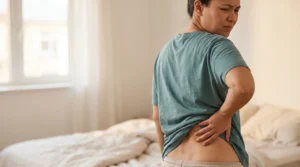
Lower back pain when standing still usually comes from a spine held in one position for too long. The lower back settles deeper into its curve, the same small joints and muscles carry the load minute after minute, and nothing moves to share it. Walking or sitting eases it because both change that load.
The quieter worry: if ten minutes in a checkout line hurts, is something wearing out? For most people, no. Standing pain is mostly a tolerance problem, and tolerance can be trained. Here is how to read your pattern, spot the signs of stenosis or something serious, and stand longer.
Key takeaways
- Stillness is the trigger. Someone who aches after 20 minutes at a counter can often walk an hour.
- Small movements seem protective. In laboratory studies, people who develop standing pain shift their lower back less often.
- Your relief position is a clue. Easing when you lean on a counter or prop a foot up points to a back that dislikes arching.
- Leg symptoms change the picture. Heavy, tingling legs that ease only when you sit or bend forward suggest spinal stenosis.
- Standing time can be rebuilt. Side-hip endurance work and planned position changes lengthen it over weeks.
Why does your lower back hurt when you stand still?
Your lower back hurts when you stand still because upright stillness loads the same tissues without a break. As muscles tire, the lumbar curve tends to deepen, pressing the small facet joints at the back of the spine together, while hip and trunk muscles hold a low, constant tension that never gets to rest.
Facet joints are the paired, fingertip-sized joints linking each vertebra to the next, and they take more load when the lower back arches. Picture a tired person in a long line: knees locked, weight sunk into one hip, pelvis drifting forward. Each shortcut moves load off working muscle and onto joints and ligaments.
A 2023 systematic review pooled 52 laboratory studies in which 1,070 adults without significant back pain history stood for long periods, and 528 developed pain (Khoshroo and colleagues). Those pain developers showed more co-activation of the gluteus medius, the side-hip muscle that keeps the pelvis level, made fewer “lumbar fidgets” (quick, large lower-back shifts most people make unnoticed) and scored worse on a side-lying hip lift test. In short, they tended to stand more rigidly.
Why walking feels better than standing in one place
Walking hands the load from leg to leg with every step, so no tissue holds one job for long. That is why a shopping mall can feel worse than a trail of the same length: the problem is the pausing, not the distance.
Who gets lower back pain when standing, and who usually doesn’t?
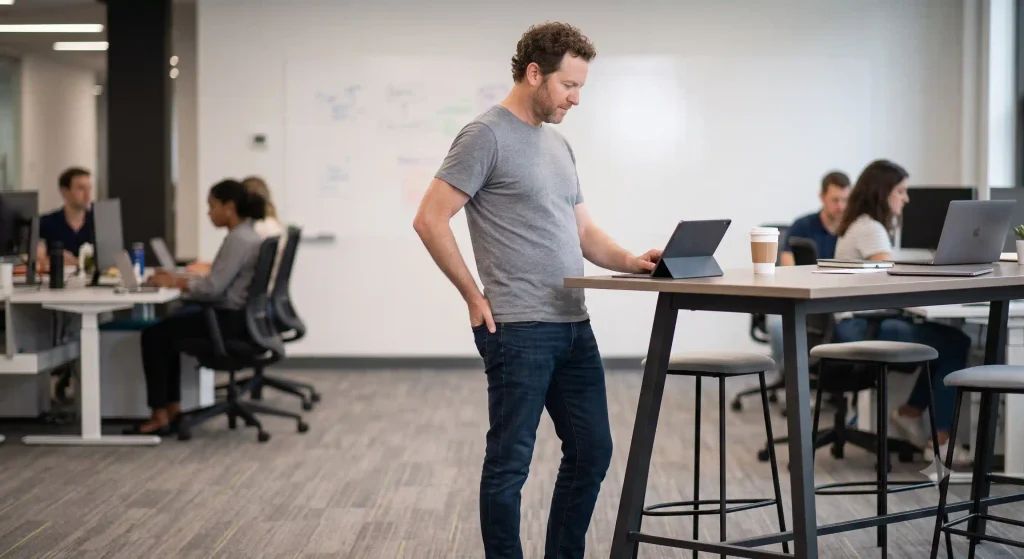
Standing pain is most common in people whose days involve long, still standing: retail staff, teachers, hairdressers, surgeons, factory workers and standing-desk users. Pregnancy, a larger abdomen and older age with a narrowing spinal canal raise the odds. People who shift and fidget while upright tend to get it less.
Weight in front of the spine matters. Pregnancy, abdominal weight and a heavy chest move your center of mass forward, and many people counter it by leaning back into a sway stance, hips forward and chest behind, deepening the arch. The same mechanism drives lower back pain from large breasts.
Young athletes who arch repeatedly, such as gymnasts, dancers and fast bowlers, are a separate group: their standing pain can signal spondylolysis, a stress fracture at the back of a vertebra that needs assessment, not stretching.
Which standing pain pattern is yours?
Where the pain sits, how soon it starts and what relieves it usually separate the causes. An ache that builds after 15 to 60 minutes of standing still and fades with walking suggests postural overload. Pain on standing and walking that eases only when you sit or bend forward points toward spinal stenosis.
| What you notice | Worse with | Easier with | Often suggests |
|---|---|---|---|
| Dull belt-line ache after 15–60 minutes still | Lines, cooking, locked knees | Walking, shifting weight | Postural overload |
| Sharp, one-sided pain low in the back | Arching, leaning back | Leaning on a counter, one foot up | Irritated facet joint |
| Heavy, tingling or numb legs, often both | Standing and walking | Sitting, bending forward, leaning on a cart | Lumbar spinal stenosis |
| Ache over one dimple at the back of the pelvis | One-leg standing, stairs, hanging on one hip | Even weight on both feet | Sacroiliac joint region |
| Groin pain, stiffness putting on socks | Standing on that leg, pivoting | Shifting to the other leg | Hip joint |
| Deep ache in a young athlete who arches a lot | Arching, long standing | Sitting, a break from sport | Possible spondylolysis |
The relief column is the most revealing: a back that settles when you lean forward or lift a foot dislikes sustained extension, the backward-arching direction. Pain over a pelvic dimple may instead come from the joint where spine meets pelvis; this guide to sacroiliac joint dysfunction and how it is tested explains what a physical therapist (physiotherapist) checks.
When is back pain from standing a red flag?
Get emergency care now for new difficulty passing or controlling urine, loss of bowel control or sensation, or numbness around the genitals or anus. New sciatic pain down both legs or severe or worsening weakness or numbness in both legs also needs emergency care. Get urgent medical assessment for new or worsening weakness in one leg. Seek medical advice for persistent pain that no position relieves. Get urgent advice for fever with worsening back pain.
- Saddle numbness, new trouble passing urine, incontinence, or weakness in both legs. Possible cauda equina syndrome, pressure on the nerve bundle at the base of the spinal canal; delay risks permanent loss of function, so go to emergency care now.
- A foot that drags or slaps, or spreading leg numbness. Weakness means a nerve is losing function, not just being irritated; get urgent assessment.
- Sudden pain after a minor fall, cough or lift, with osteoporosis or long-term steroid use. A vertebral compression fracture often hurts most upright and eases lying down; it needs prompt assessment, usually with an X-ray.
- Pain the same in every position, pain that wakes you, fever, weight loss or a cancer history. Pain that ignores position may point to infection, a tumor or an internal organ.
- Sudden, severe back or belly pain with a pulsing feeling in the abdomen. This can signal an abdominal aortic aneurysm; call emergency services.
Do you need an X-ray or MRI?
Usually not, because disc wear and facet arthritis also appear in many people without pain. A standing X-ray helps when spondylolisthesis, one vertebra slipping forward on the next, is suspected; MRI, the preferred test for stenosis, earns its place when leg symptoms are bad enough to consider an injection or surgery, or with a red flag. This guide to low back X-ray findings decodes report terms.
Could it be spinal stenosis, the hip or something else?
The main look-alike is lumbar spinal stenosis, a narrowing of the spaces around the spinal nerves that becomes more common after about 50. Its signature is leg heaviness, aching or tingling with standing and walking that eases when you sit or bend forward. Hip, sacroiliac and leg circulation problems can also mimic it.
Standing upright and arching back narrow the canal a little further. StatPearls describes symptoms appearing when the back extends during standing and settling promptly on leaning forward about 20 to 40 degrees at the waist (Munakomi and colleagues). The everyday version is the shopping cart sign: fine leaning on a cart around the store, struggling in the checkout line.
Narrowed leg arteries cause a different problem, vascular claudication: calf cramping on walking that eases within minutes of simply stopping, even on your feet. It needs a medical check. If an MRI already mentions narrowing, this guide to what spinal stenosis on MRI really means puts the wording in context.
Quick check
- Stopwatch test: stand still at a counter and time how long until the familiar pain starts. That is your standing tolerance, your baseline.
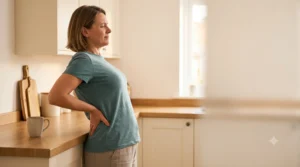
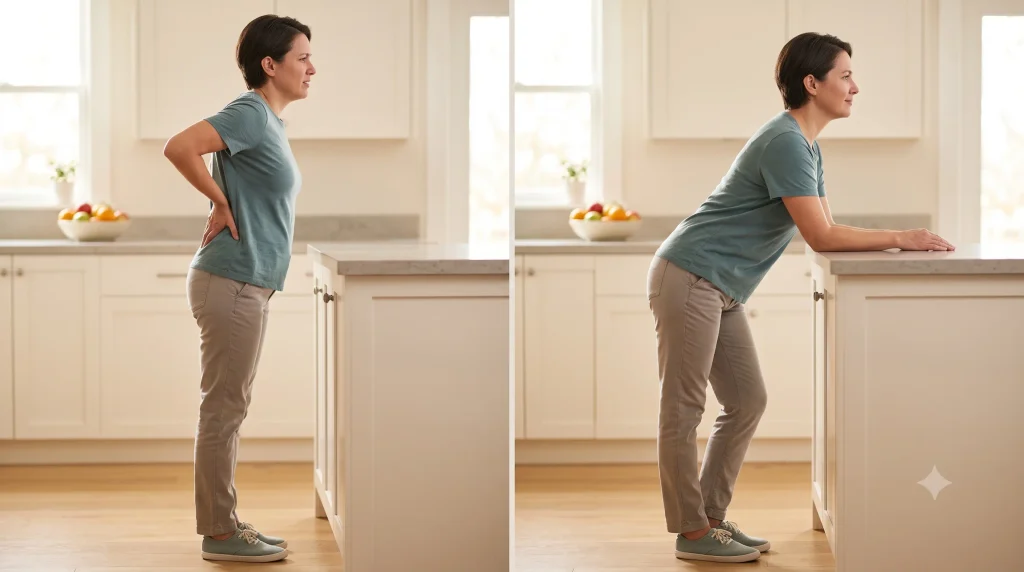
- Counter lean: when it starts, rest your forearms on the counter and let your hips drift back for 60 seconds. Relief suggests a back that dislikes arching.
- Foot up: put one foot on a step 15 to 20 cm (6 to 8 in) high. Easing within a minute or two points the same way.
- Walk it off: walk briskly for two minutes. Easing fits postural overload; heavy or tingling legs that force you to sit fit stenosis.
- Below the knee: numbness or pins and needles in a leg deserve assessment within days.
Numbness between the legs, new bladder or bowel changes, or weakness in both legs means get emergency care now.
The counter lean works because tipping the pelvis back slightly opens the joints and spaces at the back of the lumbar spine. Once it helps, it becomes a 30-second reset for any kitchen, workbench or line.
Is standing bad for your back?
No. Standing is a normal, healthy position, and the pain it brings on is usually about stillness and dose, not damage. A back that aches after 40 motionless minutes at a counter often copes with the same time on its feet when that time includes weight shifts and short walks.
Myth: a standing desk cures back pain. Eight hours of standing is just as static as eight hours of sitting; the benefit comes from alternating.
From the Clinic: Dr. Arora’s Expert Insight
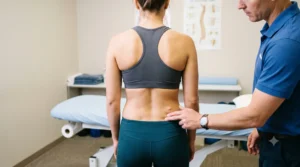
The waiting room usually shows me how someone copes with standing before I have asked a single question. Some patients drift to the wall within a minute and rest a shoulder or their back against it; others rock from foot to foot as if waiting for a delayed train; a few stand statue-still, arms folded, until the discomfort sends them to a chair. Each style tends to come with a different story.
The statues interest me most. They are often the most posture-conscious people I see, many told for years to stand tall, pull the stomach in and squeeze the glutes. They follow that advice faithfully, which is exactly the problem: the harder they hold a correct shape, the less they move, and stillness is what their back tolerates least. Generic posture advice fails here because it treats standing as a position to hold rather than an activity to vary.
The wall-leaners have already solved half the puzzle. Flattening the back against a wall tells me that back wants less arch, and I would rather build on a relief position someone discovered than hand them a new one.
So my plan rarely starts with better posture. It starts with permission to move: shift weight every few minutes, prop a foot, and use the lean they already found as a planned reset before pain builds, not a rescue afterward. The strengthening, mostly side-lying hip work, happens off the feet so standing itself can stay loose. When the statues learn to fidget on purpose, their standing time is often the first thing that changes.
What should you do in the first 72 hours?
In the first 72 hours, keep standing, but in bouts shorter than your current pain-free time, reset with a walk, a counter lean or a raised foot before the ache builds, and keep walking daily. Short, frequent changes usually calm standing pain faster than bed rest or pushing through.
What to do today
- Stand in bouts about three-quarters of your stopwatch time: if pain starts at 20 minutes, reset at 15.
- Reset for 30 to 60 seconds: walk, lean on a counter, or rest one foot on a low step.
- Walk 10 to 20 minutes, two or three times a day, if walking eases your pain.
- If bending forward brings relief, lie on your back and hug your knees to your chest for 20 to 30 seconds, three to five times; skip it if pain travels down a leg.
Stopwatch time creeping up by day three? Start the plan below.
How do you rebuild your standing tolerance?
You rebuild standing tolerance with standing bouts kept just under your pain threshold and lengthened gradually, hip endurance exercises done off your feet, and planned movement while you stand. Judge progress by your stopwatch time and how your back feels the next morning, not by the calendar.
| Phase | Timing | Main work | Move on when |
|---|---|---|---|
| 1. Settle | Days 1–7 | Short bouts with resets; daily walks | Pain settles within 30 minutes of stopping; stopwatch time rising |
| 2. Build | Weeks 2–4 | Exercises below, three times weekly; add about 5 minutes to bouts each week | Standing time up by about half, no next-morning flare |
| 3. Load upright | Weeks 4–8 | Split-stance tasks, suitcase carries, step-ups; fewer resets | 45–60 minutes on your feet with one or two resets |
| 4. Full day | Week 6 onward | Real shifts with planned movement; exercises twice weekly | Two full standing days in a row without a flare |
Why these exercises
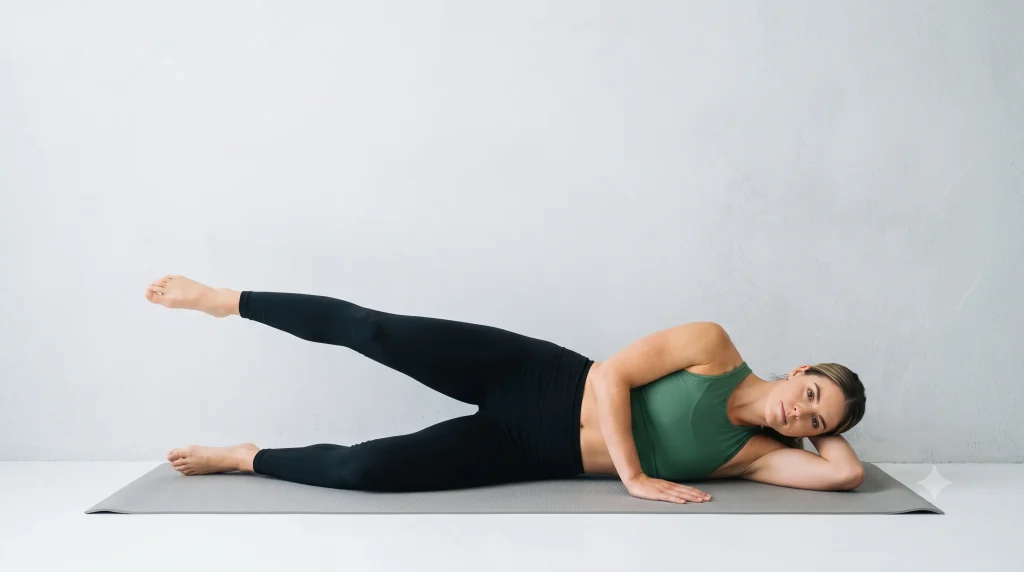
- Side-lying hip abduction trains the side-hip muscles that keep your pelvis level each time you shift weight, the very test pain developers score worse on.
- Glute bridges teach the hips to straighten without the lower back arching, carrying over to standing without the sway.
- Standing pelvic tilts, gently tucking the tailbone and releasing, are a movement to repeat while you stand, not a posture to hold.
Start with two to three sets of 8 to 15 slow repetitions; they slot easily into a broader physical therapy home program for low back pain.
For side-lying hip abduction, lie on your side with your back against a wall and the lower knee bent. Slide the top heel up the wall about 30 cm (12 in) without letting your pelvis roll backward, then lower slowly. The 2023 review also highlights early work in which a hip abduction exercise before prolonged standing increased movement and reduced co-contraction, so a set before a long shift may help.
What helps at a standing job or standing desk?
At work, aim for standing that keeps changing: a foot rail or low box, a work surface near elbow height, sitting and standing in turns, and a short walk every 20 to 30 minutes. The 2023 review notes that walking breaks and anti-fatigue mats can both reduce standing-related back discomfort.
- Do keep a box or rail 15 to 20 cm (6 to 8 in) high underfoot and switch feet every few minutes.
- Do use a split stance, one foot a half-step ahead, when there is no rail, and swap often.
- Don’t lock your knees and hang on one hip for long stretches.
- Don’t rest by leaning your buttocks against a counter with your hips pushed forward; it deepens the arch.
How long until you can stand comfortably again?
With postural standing pain, many people notice longer pain-free standing within two to three weeks of changing how they stand, and manage full working days within about six to eight weeks. Lower back pain when standing that comes with stenosis, nerve symptoms or years of daily flares usually takes longer.
If progress stalls after four to six weeks of consistent work, see a physical therapist or physician. A PT can check your hips and sacroiliac joints, test for a directional preference (a movement direction that reliably eases symptoms) and look for stenosis or a slipped vertebra.
Are injections or surgery ever needed?
Not for standing pain on its own. With stenosis and disabling leg symptoms, an epidural steroid injection may give short-term relief, and decompression surgery, which widens the space around the nerves, is considered after repeated non-surgical treatment fails. A slipped vertebra with instability may prompt a fusion discussion. Emergency surgery is reserved for cauda equina syndrome or rapidly worsening weakness.
The outlook is good: most standing pain reflects how long a back has been asked to hold still, and that can change this week.
The bottom line on lower back pain when standing
Treat the ache as a timer, not a warning. Today, time how long you can stand before it starts, keep each standing bout a few minutes shorter, reset with a walk or counter lean before the pain builds, and add about five minutes a week as your hips get stronger.
Frequently asked questions
1. Can standing all day cause permanent damage to your back?
Pain after standing can have several causes. Get emergency care now for new difficulty passing or controlling urine, loss of bowel control or sensation, or numbness around the genitals or anus. New sciatic pain down both legs or severe or worsening weakness or numbness in both legs also needs emergency care. Get urgent medical assessment for new or worsening weakness in one leg.
2. Is a standing desk bad for lower back pain?
A standing desk is not bad for your back, but standing at it all day can be. If standing triggers pain within minutes, use it in short bouts that grow as tolerance improves, and sit for the rest.
3. Why does my back hurt when I stand at the kitchen sink?
A sink often sits low for your height, so your back muscles hold a slight forward lean while you stand still. Stepping closer, bending at the hips and resting one foot on the open cabinet base usually help.
4. Why does my lower back hurt when I stand up after sitting?
That first-steps pain is a different pattern from standing-still pain: after a long sit, a sensitive disc or joint can protest as the lower back straightens. Rising slowly, pushing through your legs and walking for a minute usually settles it.
5. Is lower back pain when standing a sign of spinal stenosis?
Only sometimes. Stenosis is more likely if you are over about 50, your legs feel heavy, tingly or weak with standing and walking, and only sitting or bending forward helps. A telling clue: many people with stenosis can cycle comfortably, spine bent forward, for longer than they can walk.
6. Can I keep working a standing job with back pain?
Usually, yes, with adjustments: a foot rail or mat, a stool for short sits and brief walking breaks while you rebuild tolerance. Time off is rarely needed unless you have leg weakness, numbness or pain that no position eases.
Medical disclaimer
This article explains common reasons the lower back hurts during prolonged standing; it cannot examine you or rule out stenosis, a fracture or poor leg circulation. If you are pregnant, have osteoporosis or had recent spinal surgery, get individual advice before starting the exercises. Seek emergency care now for numbness between the legs, new bladder or bowel problems, weakness in both legs, or sudden severe back or abdominal pain.
References
- Khoshroo F, Seidi F, Bayattork M, et al. Distinctive characteristics of prolonged standing low back pain developers’ and the associated risk factors: systematic review and meta-analysis. Scientific Reports. 2023;13(1):6392.
- Munakomi S, Foris LA, Varacallo MA. Spinal Stenosis and Neurogenic Claudication. StatPearls [Internet]. Treasure Island (FL): StatPearls Publishing; updated 2023 Aug 13.