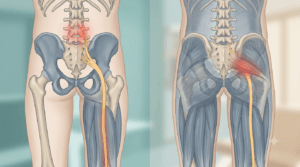
Expert Review: This article includes clinical insights from Dr. Vivek Arora, a physical therapist (physiotherapist) with 20+ years of experience.
Most people arrive at sciatic nerve stretches the same way: leg pain running from the buttock into the calf, a search bar, and a video of someone folding forward over a straight leg. They hold it a minute, feel a deep pull behind the thigh, and wake up with the pain sitting lower down the leg than it was yesterday.
The reason is a category error. Sciatica is not a tight muscle but an irritated nerve, and nerve tissue does not behave like a hamstring under tension. What follows is a technique manual: six movements that help, and two that set people back.
Key takeaways
- Nerves glide, they do not stretch. Sustained end-range pulling on a sensitized nerve provokes it rather than lengthening it.
- Alternate tension and slack. Load one end of the nerve while releasing the other, so it slides without ever being pulled taut.
- Dosing differs for nerve and muscle. Glides are 8 to 10 slow repetitions, no hold, two or three times daily. Muscle stretches are held 20 to 30 seconds.
- Direction of travel is the master signal. Symptoms retreating toward the buttock mean progress. Symptoms pushing further down the calf mean stop.
- Two popular stretches cause most flares. The straight-leg hamstring stretch and the deep forward fold both tension an already irritated nerve.
Why do most sciatic nerve stretches backfire?
Most sciatic nerve stretches backfire because they treat a nerve like a muscle. Muscle tolerates sustained tension and adapts. A sensitized nerve root answers the same tension by becoming more protective, and the flare usually arrives hours later rather than during the stretch. What helps instead is gliding: moving the nerve through its tunnels while total tension stays roughly constant.
A peripheral nerve is a bundle of fascicles inside connective tissue sheaths, built to slide relative to the muscle and bone around it. When a root is compressed or chemically irritated by disc material, both the sliding and the tolerance drop. Hence two useful terms: a slider adds tension at one end while releasing the other, and a tensioner loads both ends at once, which is what a straight-leg hamstring stretch does.
Three beliefs keep people pulling anyway. Tightness behind the thigh is often protective guarding, not a short muscle. “No pain, no gain” does not transfer to neural tissue. And waiting for a disc to heal before moving wastes months, since symptoms improve well ahead of structure.
What is actually going on along the sciatic nerve?
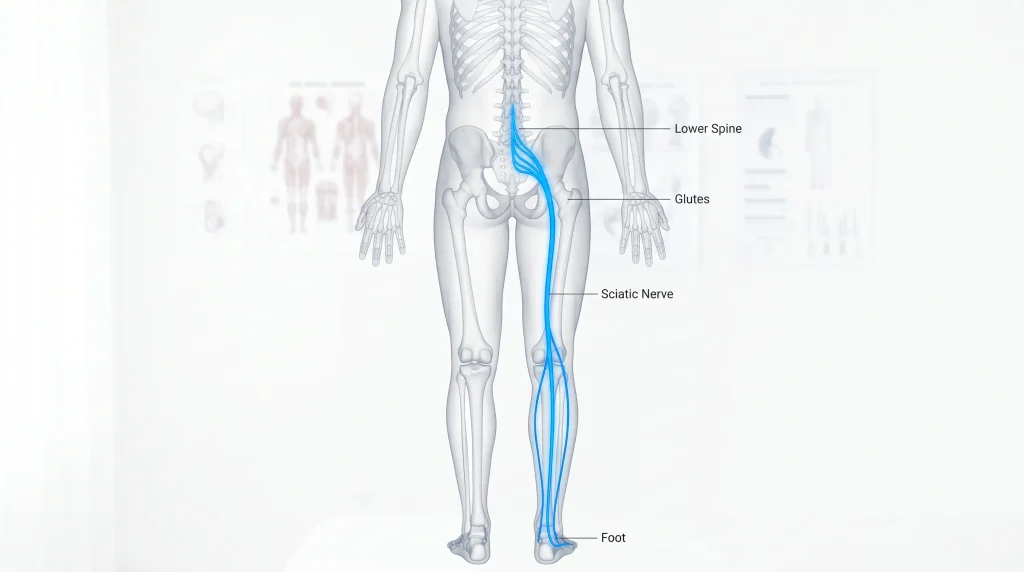
The sciatic nerve is built from roots leaving the spine at roughly L4 through S3. They merge in the pelvis, pass through the deep buttock, run down the back of the thigh and divide behind the knee. Sciatica almost always begins at the root end, where a disc bulge, a narrowed exit canal or inflammation irritates the root, not in the nerve trunk.
That matters for technique, because the nerve is mechanically linked to every joint it crosses. Slumping draws the root and its dural sleeve upward, straightening the knee pulls from below, dorsiflexing the ankle pulls further, and tucking the chin adds tension from the top of the spinal canal. Four levers, one rope. If you are unsure your pain is nerve-driven, the sensations that identify true sciatica are the better starting point.
Is it the nerve, the muscle, or the joint?
The most useful clue is not where the pain sits but which direction it travels and what moves it. Nerve root pain runs in a narrow band below the knee and sharpens with sitting, coughing and knee extension. Muscle and tendon pain stays local and rarely produces pins and needles. One self-test: sitting tall, slowly straighten the affected knee. If that alone reproduces the leg pain, the nerve is the likely driver.
| Pattern | Where you feel it | Worse with | Better with | What it suggests |
|---|---|---|---|---|
| Nerve root irritation | Narrow line below the knee, often with pins and needles | Slumped sitting, coughing, straightening the knee | Short walks, standing, knees supported | Disc or foraminal irritation of L4, L5 or S1 |
| Deep gluteal or piriformis-related | Deep ache in the back pocket of the hip, rarely past the knee | Hard seats, long drives, crossing the legs | Standing up, softer seating | Irritation in the deep gluteal space |
| High hamstring tendinopathy | Sharp pain at the sit bone, no pins and needles | Sprinting, lunging, hard chair edges | Isometric loading | A tendon problem, not a nerve problem |
| Neurogenic claudication | Heaviness in both legs that builds as you walk | Walking distance, standing tall, extension | Sitting, leaning forward | Central canal narrowing |
When should you stop stretching and get assessed?
Stop stretching and seek prompt medical assessment if you develop bladder or bowel changes, numbness around the saddle area, weakness that is getting worse, symptoms in both legs at once, or leg pain alongside fever, unexplained weight loss or a history of cancer. These suggest something other than ordinary mechanical nerve root irritation, and exercise is not the right first response.
- Bladder or bowel changes, or numbness in the inner thighs, genitals or buttocks. This may indicate compression of the cauda equina, the bundle of nerve roots at the base of the spinal cord. It is a same-day emergency; the window for preserving function is short.
- Weakness that is progressing rather than holding steady. Catching a toe on a kerb, or a calf that can no longer manage 10 heel raises, suggests motor fibres are affected and changes how urgently a specialist opinion is needed.
- Radiating symptoms in both legs at once. A single irritated root gives a one-sided pattern, so bilateral symptoms raise the possibility of central compression.
- Fever, unexplained weight loss, pain no position relieves, or a cancer history. These point toward non-mechanical causes such as infection or tumour, which need investigation, not exercise.
- Significant trauma, or new severe pain in an older adult with osteoporosis risk. Fracture should be excluded before loaded movement is added.
Do you need a scan before you start stretching?
For most people, no. National guidance advises against routinely offering imaging in a non-specialist setting for low back pain with or without sciatica, and recommends imaging in specialist settings only where the result is likely to change management. A scan answers a specific question. It is not a prerequisite for starting to move sensibly.
Disc bulges are common in people with no symptoms, so a scan taken mid-flare often finds something real that is not your pain source, and reports mentioning stenosis on an MRI cause needless alarm. Imaging earns its place with red flags, progressive weakness, or a stalled recovery where surgery is on the table, and then its job is to check whether the finding matches the leg you are complaining about.
From the Clinic: Dr. Arora’s Expert Insight
Almost everyone who comes to me with leg pain has already tried the same movement before they arrive: foot up on a step, knee locked straight, chest reaching toward the toes, held for a minute because a friend or a video said it loosens sciatica. They describe it the same way too. It felt like it was getting right into the spot. That sentence is the problem. What they feel is not a hamstring lengthening, it is a nerve saying it does not want to be there.
The detail that separates the two is timing, and it is the thing I most often have to teach. Muscle stretch discomfort fades a minute or two after releasing the position. Nerve provocation is delayed, showing up two to six hours later, or as a sharper line down the calf on first standing the next morning. That delay breaks the link between cause and effect, so people repeat the stretch daily and blame the mattress. When someone starts a new movement I never ask how it felt during it. I ask what their leg was like at bedtime and on the first three steps out of bed.
The other quiet saboteur is what the rest of the body does during the stretch. Reaching toward a raised foot flexes the lumbar spine and drops the chin, so the nerve is loaded from the pelvis, knee, ankle and top of the spinal canal at once. Generic hamstring advice never mentions the neck, because for a hamstring the neck is irrelevant. For a sensitized sciatic nerve it is one of the four levers.
The 6 sciatic nerve stretches that work
Two are true nerve glides, done as slow repetitions with no hold, designed to slide the nerve rather than lengthen it. Three are mobility work for the hip structures around it, held 20 to 30 seconds. One is a directional movement for people whose symptoms improve with back extension.
1. Seated sciatic nerve glide (slump-based slider)
How to do it: Sit tall on a firm chair, feet flat. As you slowly straighten the affected knee and draw your toes toward you, look up and extend your neck. As you bend the knee back down and let the foot relax, tuck your chin to your chest. The neck is what keeps the nerve sliding instead of being pulled from both ends.
Dose and signal: 8 to 10 repetitions, two seconds each direction, no pause at end range, two or three times daily. Done right it gives a mild pull that appears and vanishes with each repetition and is gone seconds after stopping. If symptoms linger, halve the range tomorrow.
2. Supine nerve glide with ankle pumping
How to do it: Lie on your back, knees bent. Bring the affected thigh to roughly 70 to 90 degrees of hip flexion, hold behind it or loop a towel around it, and keep the thigh still. Straighten the knee to about 80 percent of available range while pointing the toes away, then bend it back down while pulling the toes toward your shin. Knee and ankle work in opposition, which keeps total tension steady while the nerve travels.
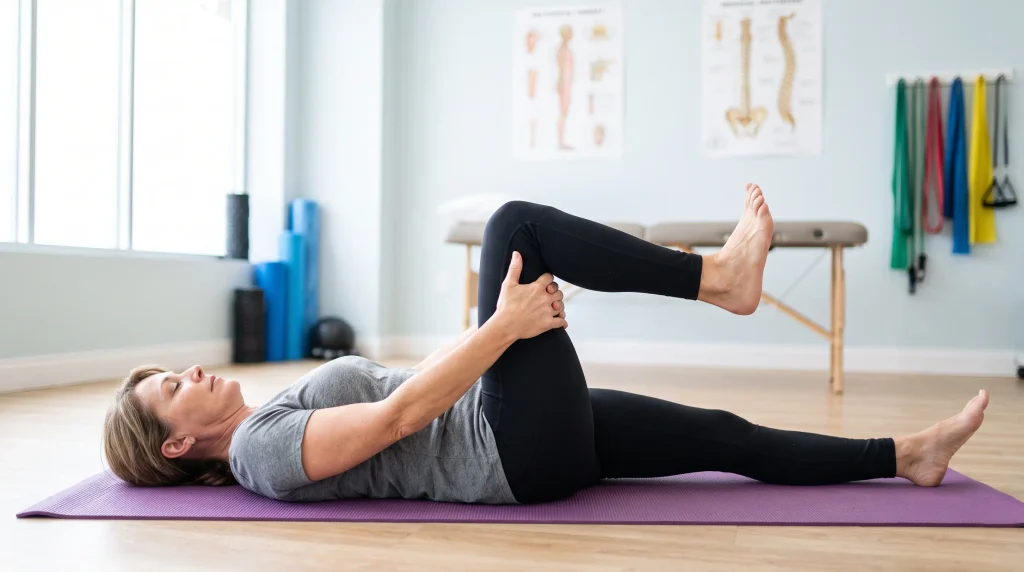
Dose and signal: 8 to 10 repetitions per side, no hold, two or three times daily. This is the gentler glide and the better start if sitting is your worst position. You should be able to talk through the set. Stop if it becomes a sustained burn, or if pins and needles settle in the foot.
3. Seated figure-four with a neutral spine
How to do it: Sit toward the front of a firm chair. Cross the affected ankle over the opposite knee so the ankle bone sits clear of the kneecap, letting that knee fall outward. Hands on the crossed shin, lengthen through the crown of your head, then hinge forward from the hips so chest and belt line travel together. The moment your lower back rounds, you have stopped stretching the hip rotators and started tensioning the nerve.
Dose and signal: 20 to 30 seconds, two or three repetitions per side, once or twice daily. You want a broad, dull stretch across the back pocket of the hip. If it narrows into a defined line down the thigh or calf, that is neural, not muscular, so sit back up. Because stiff glutes and low back pain travel together so often, this one feels productive fast, which is why people overdo it.
4. Supine knee to opposite shoulder
How to do it: Lie on your back, knees bent. Hold behind the affected knee and draw it diagonally toward the opposite shoulder, keeping both sides of the pelvis on the floor so the movement happens at the hip rather than by twisting the back. The knee stays bent throughout, and that is the safety feature: it keeps the nerve slack while the gluteals and deep external rotators lengthen.
Dose and signal: 20 to 30 seconds, two or three repetitions per side. Expect deep, dull tension in the buttock with no change in your leg symptoms. Straightening that knee turns this into a nerve tension test, so if the leg drifts straight as you pull, hold lower down behind the thigh.
5. Prone press-up, for extension responders
How to do it: Lie face down, hands flat under the shoulders, hips and legs relaxed. If lying flat is uncomfortable, spend a minute propped on your forearms first. Press your chest up only as far as your hips stay in contact with the surface, exhale at the top, lower with control. Keep the buttocks soft, since clenching the glutes blocks the extension you want.
Dose and signal: 8 to 10 repetitions with a one to two second pause at the top, every two to three hours in the early days rather than one long session. The response you want is leg symptoms retreating upward across the set, calf toward thigh or thigh toward buttock, even if the back feels more worked. If symptoms travel further down, skip it. People whose pain eases when they lean on a shopping trolley usually do better with knees-to-chest positions.
6. Standing hip flexor stretch
How to do it: Split stance with the affected leg behind, feet about hip width apart rather than in line, one hand on a counter for balance. Squeeze the glute on the back leg first to tuck the tailbone under, then shift your weight forward by only two to five centimetres, about one to two inches. Keep the back knee soft. Feeling it as an arch in your lower back means you have lost the tuck.
Dose and signal: 20 to 30 seconds, two or three repetitions per side, felt across the front of the hip with nothing behind the leg. It belongs here because long sitting shortens the hip flexors and encourages the slumped, tailbone-sitting posture that keeps the nerve under low-grade tension for hours, which is why car set-up matters as much as the exercise for back and leg pain that builds while driving.
The 2 stretches that make sciatica worse
Two movements account for most self-inflicted sciatica flares, and both are widely recommended for it. Each applies sustained end-range tension to the exact nerve that is already sensitized, and each is held long enough to matter. Both are poorly chosen while a nerve root is irritable.
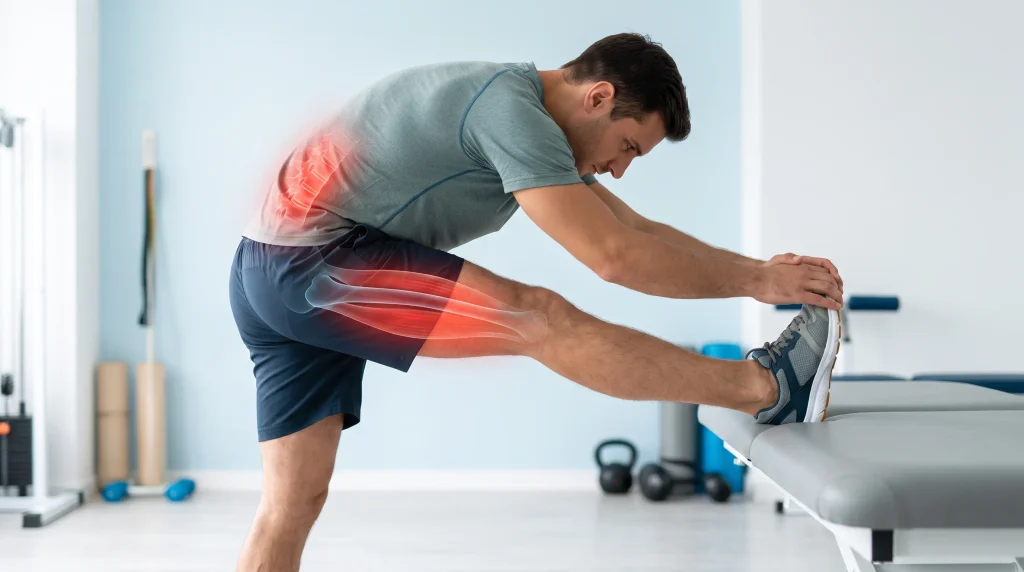
1. The aggressive straight-leg hamstring stretch
Foot up on a bench or railing, knee locked straight, toes pulled back, chest reaching toward the shin, held 30 to 60 seconds. When a nerve root is involved this is not a hamstring stretch. It is an unsupervised straight leg raise test, the clinical manoeuvre used to provoke a sensitized sciatic nerve, held far longer than any clinician would. Hip flexion loads the nerve at the pelvis, knee extension at the thigh, dorsiflexion at the calf, and the forward reach adds lumbar flexion with the chin dropping. Every lever at once, then held.
2. Deep seated forward folds and toe touching
The sit-and-reach, the seated forward fold, the standing toe touch and the slow roll-down all combine the two things a sensitized lumbar root tolerates least: sustained flexion and tension at both ends of the nerve at once. Flexion also shifts pressure toward the back of the disc, the direction already causing trouble in most disc-related sciatica. Discs are least tolerant of flexion in the first hour after waking, exactly when the morning stretch routine happens, and a flare provoked at seven may not declare itself until mid-afternoon.
How do you know when to progress?
Progression in sciatica is driven by where symptoms sit, not by how many days have passed. The governing rule is direction of travel: movements that draw symptoms up toward the buttock or spine are working, and movements that push symptoms further down the leg should be stopped. Advance only when the current stage stops producing symptoms below the knee, judged the next morning.
What to do today
- Supine nerve glide only: 8 to 10 slow repetitions, three times today, at half range.
- Break up sitting every 20 to 30 minutes, even if it is only 60 seconds of standing.
- Walk in short bouts of 5 to 10 minutes rather than one long walk.
- Stop all hamstring stretching and all forward bending done for stretch for 72 hours.
- Note how far down your leg the pain reaches at bedtime, and again on your first three steps out of bed. That comparison, not how the stretch felt, is your data.
| Phase | Window | What you do | Ready to progress when |
|---|---|---|---|
| 1. Settle the nerve | Days 1 to 7 | Supine glide at half range, positional relief, short walks, no static hamstring work | Symptoms no longer reach below the knee at rest and you can sit 15 to 20 minutes without a spike |
| 2. Restore glide and hip mobility | Weeks 2 to 4 | Both glides at full range, figure-four, knee to opposite shoulder, hip flexor stretch, press-ups for extension responders | Straightening the knee in sitting no longer reproduces leg symptoms and mornings are stable |
| 3. Load the system | Weeks 4 to 8 | Glute bridges, hip hinge patterning, split squats, loaded carries, calf raises on the affected side | A full session leaves the next morning no worse and heel raises match side to side |
| 4. Return to what you want | Week 8 onward | Graded return to running, lifting or heavy manual work, adding load before range | Two consecutive weeks with no symptoms below the knee under normal load |
- Do your glides before a long drive rather than after it, and raise your seat so your hips sit slightly above your knees.
- Keep walking. National guidance for low back pain with or without sciatica specifically includes encouragement to continue normal activities.
- Do not hold any position that produces a defined line of symptoms down the leg, however good the release feels.
- Do not stretch in the first 30 to 60 minutes after waking, and do not keep testing yourself by bending forward. Each test is another dose of what irritated it.
- Do not foam roll hard down the back of the thigh or behind the knee, where the nerve runs relatively superficially.
Return-to-activity decisions work better against functional milestones than against a date. Before running, manage 30 minutes of brisk walking, roughly 2 to 3 kilometres or 1.5 to 2 miles, without a limp or a symptom spike the next morning. Before loaded hinging, a bodyweight hip hinge to shin height should produce no downward symptom travel and single-leg calf raises should match the other side, since the S1 root supplies that muscle and weakness there recovers last. Anyone rebuilding toward heavy barbell work will get more from a structured plan such as this guide to returning to lifting after an L5-S1 herniation than from any stretch.
What if the pain does not settle?
Most sciatica improves substantially over six to twelve weeks, and leg pain usually settles well before any structural finding changes. If you have been consistent with gliding and graded loading for six to eight weeks with no shift in how far symptoms travel, seek reassessment rather than trying harder with the same exercises. Worsening weakness moves that timeline forward.
Rest is not the answer to a plateau. For acute low back pain, advice to stay active is modestly better than advice to rest in bed, although a Cochrane review comparing bed rest with staying active found little or no difference between the two specifically for sciatica. Bed rest offers nothing worth having, but the honest framing is that activity alone is not a cure for radicular pain.
When care genuinely stalls, the next steps usually involve specialist review, imaging read alongside your symptoms, and a discussion of whether an epidural injection or surgical decompression fits. The surgical standard is specific: decompression is considered for people with sciatica when non-surgical treatment has not improved pain or function and the radiological findings are consistent with the sciatic symptoms. A dramatic-looking scan alone is not an indication for surgery, and a modest-looking scan in someone with progressive weakness may well be.
The bottom line on sciatic nerve stretches
The most useful sciatic nerve stretches are not really stretches at all. They are gliding movements that ask the nerve to slide through its tunnels while never being pulled tight from both ends, paired with mobility work for the hip structures around it. The ones that fail hold a sensitized nerve at end range and call the resulting pull progress.
So take away the tracking habit. Each evening, note the furthest point down your leg that symptoms reached, then check it again on your first three steps out of bed. A programme that is working moves that point upward week by week, and one that is not will tell you within about ten days. Start with the supine glide tomorrow, at half range.
Frequently asked questions
Can you actually stretch a nerve?
Not usefully, no. Nerves are built to slide relative to the tissue around them rather than to lengthen the way muscle does, so the aim is to restore sliding rather than gain length. Sustained end-range tension on a sensitive nerve tends to increase its protective response.
How long before nerve glides start helping?
Many people notice symptoms retreating slightly up the leg within seven to ten days of correctly dosed glides. Full resolution usually takes six to twelve weeks. If ten days produces no change in how far symptoms travel, the exercise selection or the dose likely needs adjusting.
Should nerve glides hurt while I am doing them?
They should produce a mild pull that comes and goes with each repetition and disappears within seconds of finishing. Anything that reproduces your radiating pain, burns, or leaves tingling behind means the range was too large. Halve the knee extension and rebuild from there.
Should I rest in bed until the leg pain settles?
There is no good reason to. For sciatica specifically, the available evidence suggests little or no difference between bed rest and staying active, so bed rest costs you conditioning and confidence without buying anything back. Lying down briefly for relief is a comfort measure, not a treatment.
Why is my sciatica worse in the morning after stretching at night?
Because nerve provocation is delayed, typically appearing two to six hours after the offending movement rather than during it. An evening tensioning stretch frequently declares itself as a sharper symptom line on the first steps out of bed. Dropping it for three days usually confirms the culprit.
Does this mean I will end up needing surgery?
Most people with sciatica do not need surgery, and the majority improve substantially with conservative care over weeks to a few months. Surgery is considered when non-surgical treatment has not improved pain or function and the imaging matches the symptoms, or when there is progressive weakness or a cauda equina presentation.
Medical disclaimer
The techniques here are written for people with mechanical, one-sided leg pain assessed as sciatica, and assume no red flag features are present. They are not a substitute for individual examination, which is the only way to establish which nerve root is involved, whether the presentation is extension-responsive or flexion-responsive, and whether motor loss exists. Anyone with saddle numbness, bladder or bowel changes, progressive leg weakness, symptoms in both legs, or leg pain alongside fever or unexplained weight loss should seek assessment rather than begin an exercise programme. If a movement here consistently pushes your symptoms further down the leg, stop it and get assessed.
References
- National Institute for Health and Care Excellence. Low back pain and sciatica in over 16s: assessment and management (NG59). 2016, last updated 2020. https://www.nice.org.uk/guidance/ng59
- Dahm KT, Brurberg KG, Jamtvedt G, Hagen KB. Advice to rest in bed versus advice to stay active for acute low-back pain and sciatica. Cochrane Database of Systematic Reviews. 2010;(6):CD007612. https://doi.org/10.1002/14651858.CD007612.pub2