Expert Review: This article includes clinical insights from Dr. Vivek Arora, a physical therapist (physiotherapist) with 20+ years of experience.
Lower back popping is usually normal and harmless. Most pops are tiny gas pockets forming in the small joints at the back of the spine as their surfaces briefly separate, like a cracking knuckle. A painless pop that leaves you looser needs no treatment.
The usual worry is that all this cracking is wearing something out, and usually it is not. What deserves attention is what comes with the sound: pain afterward, a clunk with a catch, or tingling down a leg.
Key takeaways
- Most pops are gas, not bone. Joint surfaces separate and a gas pocket forms; nothing slips out or back in.
- What follows matters more than the noise. Pain, a catch or leg symptoms after a pop deserve a closer look.
- Relief does not need the sound. In spinal manipulation research, pain outcomes were similar with or without a pop.
- A constant urge is a clue. It usually points to long, still postures and a stiff upper back or hips.
Is lower back popping normal, or a sign of a problem?
Most of the time it is normal. A painless pop during a stretch or twist that leaves you looser, with no pain, catch or leg symptoms, is ordinary joint behavior at any age. Check it when pain follows within hours, the sound comes with a catch, or tingling spreads into a leg.
Quick check
- Replay test: straight after a pop, repeat the twist gently. Nothing? That fits a harmless gas pop, which needs time to reset. A click every time suggests a tendon or joint surface.
- Straighten-up test: bend forward and come up slowly. A clunk, a catch, or pushing on your thighs to get upright deserves assessment.
- Leg check: tingling, numbness or weakness below the knee after a pop? Get assessed within days, the same day if the leg is weak.
- Bone check: osteoporosis, long-term steroid tablets or older age, plus sudden sharp midline pain after the pop? Get checked promptly for a fracture.
Numbness between the legs, new bladder or bowel trouble, or weakness in both legs means emergency care today.
What causes lower back popping?
Most pops are cavitation. When a facet joint, one of the small paired joints at the back of each vertebra, is stretched quickly, its surfaces separate, pressure in the joint fluid drops and dissolved gas forms a small cavity with an audible pop. Less often, a tendon flicks over bone or roughened cartilage grinds.
Facet joints are synovial joints, sealed capsules lubricated by fluid just like knuckles, and that fluid holds the surfaces together like two wet glass slides until they suddenly give. Real-time MRI of finger joints has captured the crack at the instant a gas-filled cavity appears, and the cavity stays visible afterward (Kawchuk and colleagues).
Twisting is the classic trigger. The lumbar facet joints face mostly sideways and backward, allowing easy bending forward and back but blocking rotation after a few degrees per level. At the end of that small range one joint jams while its partner gaps open, which is why seated twists, rolling over in bed and reaching into a back seat so often pop.
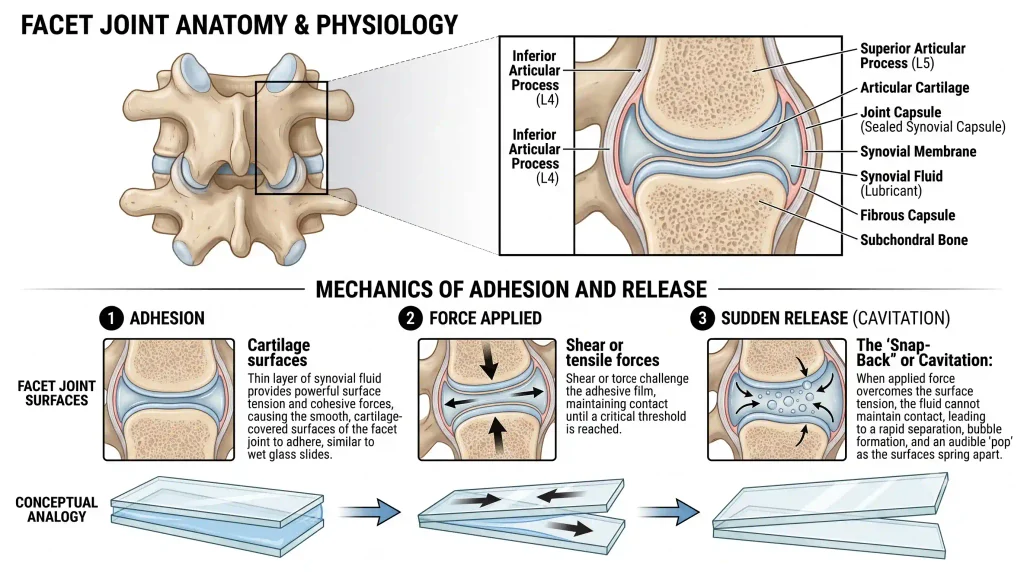
This infographic is for educational and informational purposes only and does not constitute medical advice, diagnosis, or treatment. And may contain errors.
A joint that has just popped usually cannot pop again straight away. Knuckles need roughly 20 minutes before cracking again, and spinal joints commonly behave the same way: the first twist pops, the next few do nothing. It is also the sound of spinal manipulation, and soreness after a chiropractic adjustment has separate causes.
| What you notice | Often suggests | What to do |
|---|---|---|
| One pop during a twist, then you feel looser | Gas cavitation in a facet joint | Nothing to fix |
| A click on every repetition, same spot | Tendon or ligament flicking over bone | Check if painful |
| Grinding or crunching through the movement (crepitus) | Roughened facet surfaces | Movement and strength work |
| Clunk or catch as you rise from a bend | A segment moving more than it should | Get assessed |
| Deep snap at the front of the hip | Hip flexor tendon or hip joint | Check if painful |
| Pop while lifting, pain building soon after | Muscle or ligament strain, sometimes a disc | Manage as a flare |
Is it your lower back, your hip or your pelvis?
Many pops blamed on the lower back come from the hip or pelvis. A deep snap at the front of the hip as the leg moves usually points to the hip flexor tendon, and a clunk low on one side near a pelvic dimple suggests the sacroiliac joint. A pop beside the spine during a twist is most likely a facet joint.
Try the lying leg-slide test. On your back, bend one knee and let it drop out to the side, then slowly slide the leg straight. A deep snap at the front of the hip as it straightens suggests snapping hip, the iliopsoas tendon (main hip flexor tendon) flicking over the pelvis. A pop that only comes when you twist with the hips still is more likely spinal; this guide to telling lower back pain from hip pain covers other clues.
The sacroiliac joint, where the spine meets the pelvis, moves only slightly but can clunk, particularly around pregnancy. One-sided pain over a dimple, worse on stairs or rolling in bed, fits this region; sacroiliac joint dysfunction has its own tests.
The spinal pattern to take seriously is a clunk with a catch as you straighten from bending, with a need to walk your hands up your thighs. That can suggest spondylolisthesis, a forward slip of one vertebra on the one below.
Who notices it most? People who sit still for long stretches, are naturally flexible or crack habitually; frequent movers notice it less. Grinding grows more common with age, often painlessly.
When is a pop in your lower back a red flag?
A pop is a red flag when it comes with nerve changes, happens during a fall or collision, occurs in bone likely to be fragile, or arrives with signs of illness. The sound itself is incidental; the problem underneath matters, and stretching into it can make some of these worse.
- Saddle numbness (between the legs), new trouble passing urine, incontinence, or weakness in both legs. Possible cauda equina syndrome, compression of the nerve roots at the base of the spinal canal; delay raises the risk of permanent loss, so go to emergency care now.
- Leg pain, tingling or numbness below the knee, or a foot that slaps or catches. A disc may be irritating a nerve root; weakness means the nerve is losing function, so assessment is urgent.
- Sudden sharp midline pain after a minor bend, cough or sneeze, with osteoporosis, long-term steroid use or older age. This can signal a vertebral compression fracture, where weakened bone partly collapses; stop twisting until it is ruled out.
- A pop during a fall, collision or car crash. Trauma can fracture bone or tear ligaments even in young spines.
- Fever, unexplained weight loss, a cancer history, or constant pain that is worse at night. Joint mechanics explain none of these; they can point to infection, a tumor or inflammatory disease.
Do you need an X-ray or MRI for a popping back?
Not for the noise itself. A scan cannot explain a pop, and it often shows facet wear or disc changes common in pain-free people, making a harmless sound seem sinister. Imaging helps when the answer changes the plan; this explainer on what a low back X-ray report really means helps if you have one.
- X-ray: suspected fracture after trauma or in fragile bone.
- Flexion-extension X-rays (standing films taken while bending forward and back): a clunk with a catch that suggests a slipping segment.
- MRI (magnetic resonance imaging, showing discs, nerves and bone marrow): red flags, or nerve symptoms not settling after about six weeks.
Is it bad to crack your own lower back?
Occasional, gentle self-cracking is generally not harmful for healthy adults. Habitual knuckle cracking has not been shown to increase joint degeneration, and although spine research is limited, a painless stretch that happens to pop is not known to damage the back. Trouble comes from forcing it.
Myth: the pop means a bone went back into place. The sound is joint surfaces separating as a gas cavity forms; nothing was out, and nothing went back in. A systematic review of spinal manipulation studies found no evidence that a pop improved pain outcomes (Moorman and Newell, 2022).
The difference is easy to see: a controlled twist turns slowly and stops at the stretch for a breath, while a forced crack hooks an arm around the chair back and yanks past that point.
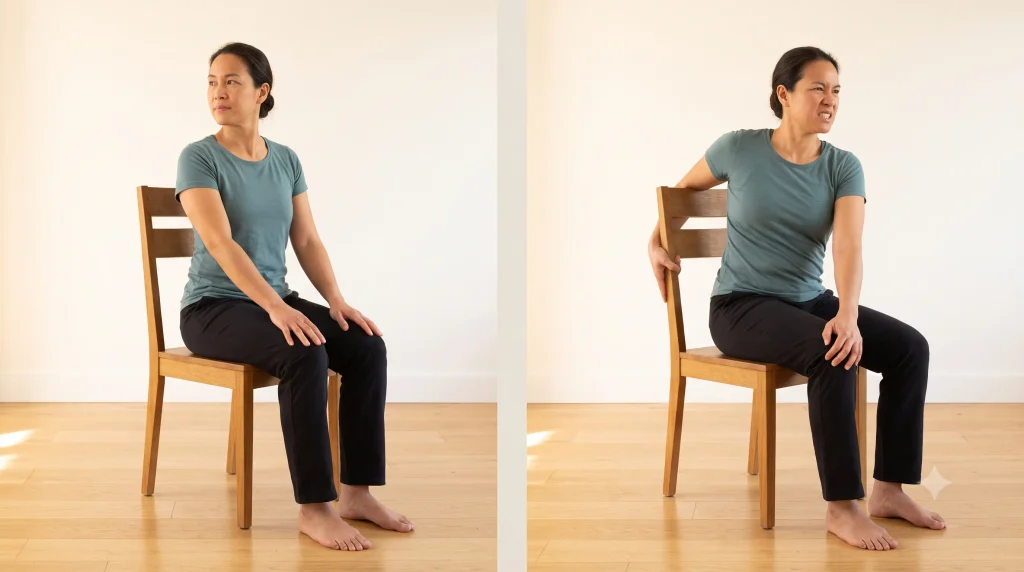
Skip forceful self-cracking if you have osteoporosis or a past fragility fracture, a spinal fusion or recent back surgery, a known spondylolisthesis or the catch-and-clunk pattern, or ankylosing spondylitis, an inflammatory disease in which a stiffened spine fractures more easily.
From the Clinic: Dr. Arora’s Expert Insight
When a patient says their lower back pops and offers to do it for me right there, I say yes, and then I stop listening for the pop and watch the ten seconds that follow it. Some people exhale, drop their shoulders and move on. Others are twisting again before those ten seconds are up, a hand drifting back to the same spot. The sound is identical. What differs is whether the pop finished something or started the next round.
That second group taught me something rarely spelled out: the joint that pops is usually the one that gives way most easily, not the one that feels stuck. A back that is tight at one level often gaps the looser level beside it, so the stiff segment stays stiff while the easy one gets cracked all day. This is where standard advice fails. Telling someone to just stop pits willpower against a real sense of pressure, and sending them for more adjustments teaches them the fix lives in someone else’s hands.
What works better is making the pop unnecessary rather than forbidden. I ask for the same twist done slowly, without the snap, held near end range for one full breath. If most of the relief arrives with no sound, the sound was never the point, and knowing that alone loosens the habit for many. Then we work on the stiff level’s neighbors: upper back rotation, hip extension and sitting endurance. If someone cannot get through those ten seconds without pain or guarding, it is not a habit at all, and my assessment changes.
What should you do if your lower back popped and now hurts?
Treat it as a minor strain first. Stop testing it, keep moving gently in ranges that feel easy, and avoid the movement that caused the pop for a few days. Pain after a pop commonly settles within one to two weeks; leg symptoms, weakness or bladder changes need prompt assessment.
The pop itself is usually a joint gapping under sudden load, not the injury. The pain that follows tends to come from irritated muscle, ligament or joint capsule, often with a protective spasm; see why back muscle spasm happens and what stops it.
What to do today
- Stop checking it. Test twists keep the joint at end range and the muscles guarding.
- Walk on flat ground for 10 to 15 minutes, two or three times today; gentle knee rocks (below) are fine if pain-free.
- Rest in your easiest position, such as side-lying with a pillow between the knees, changing position every 20 to 30 minutes.
- Use heat for 15 to 20 minutes if it helps, and over-the-counter pain relief only as labeled (ask a pharmacist first if you have kidney, stomach or heart problems).
Easing by day three? Start the plan below. Worse, or pain spreading down a leg? Get assessed.
How do you stop the urge to crack your lower back?
Replace the pop rather than resisting it. Each time the urge arrives, do a slow, controlled version of the stretch without the jerk, then build the hip and trunk endurance that makes long sitting less stiff. In practice, the urge often fades within a few weeks.
The 60-second reset
- Knee rocks: on your back, knees bent, sway both knees side to side 10 times, stopping short of any pop.
- Open-book rotation: side-lying, knees bent to 90 degrees and stacked, sweep the top arm open to the other side and follow it with your eyes; 5 slow reps per side, 3-second hold. This turns the thoracic spine (upper back), which is built to rotate.
- Half-kneeling hip flexor stretch: 30 seconds per side, tailbone slightly tucked; hip flexors shortened by sitting tug the lower back into an arch.
- A two-minute walk: stillness builds the urge; walking ends it.
Why these? The lower back rotates only a few degrees per level, while the upper back and hips are built for much more. When those neighbors stiffen from sitting, the lumbar joints are asked for movement they are not designed to give, and a quick gap-and-pop becomes the easiest release.
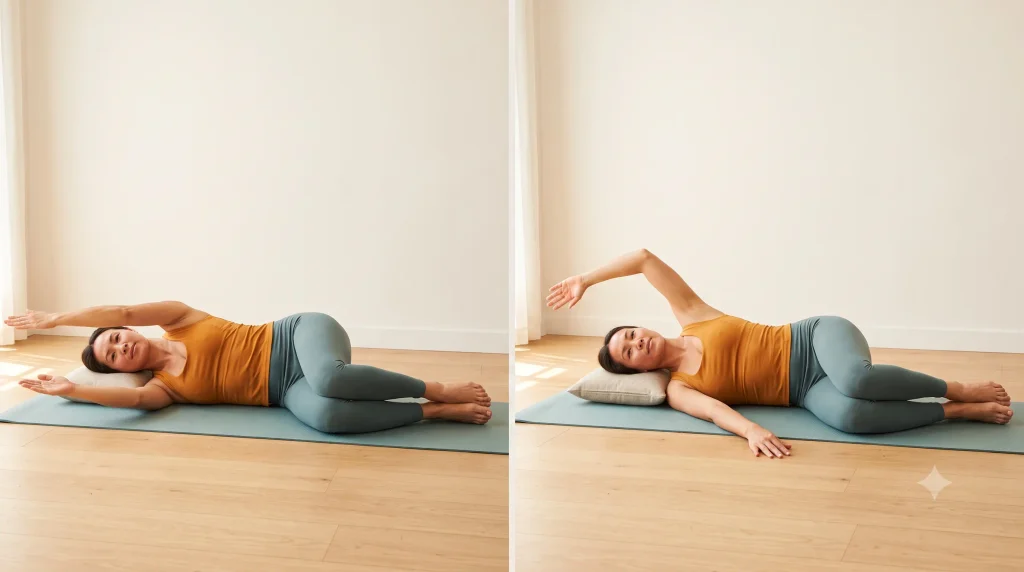
For three days, tally each crack or urge and what you were doing beforehand. Tallies often cluster around a long drive, one chair or the first hour after waking, showing where the reset belongs.
A phase plan with clear progression
| Phase | Timing | Main work | Move on when |
|---|---|---|---|
| 1. Replace | Weeks 1–2 | The reset whenever the urge arrives; stand every 30–45 minutes of sitting | Daily tally roughly halved; the reset causes no pain |
| 2. Build endurance | Weeks 2–6 | Side plank (20 building to 45 seconds), bird dog (8–10 slow reps per side), glute bridge (2–3 sets of 10–12), three times weekly | An hour of sitting without a strong urge; morning stiffness clears within 30 minutes |
| 3. Load | Week 6 onward | Suitcase carry with 8–12 kg (18–26 lb) for 20–30 m (65–100 ft) per side, band anti-rotation press, hip hinge | Full workdays and workouts without pain |
Endurance matters more than stretching here, because the stiffness behind frequent cracking tends to come from muscles holding one posture too long. Carries and the anti-rotation press (pushing a band straight out from your chest against its pull) teach the trunk to resist twisting; this physical therapy home program for low back pain adds progressions.
Do’s and don’ts for a back that pops
- Do slow the stretch and hold near end range for a breath instead of bouncing.
- Don’t lever against a chair back or door frame, or let anyone walk on or bear-hug your back.
- Don’t keep twisting to repeat a pop that has already happened; the joint needs time to reset.
How long until it settles, and when is more needed?
Painless popping needs no recovery time. A pop followed by a simple strain often settles within one to two weeks, with a gradual return to the gym, sport and heavy lifting over two to six weeks. Persistent catching, nerve symptoms or pain beyond six weeks warrants assessment.
- Desk work and driving: usually straight away, with breaks every 30 to 45 minutes at first.
- Gym: once bending and gentle twisting are pain-free, at about half your usual loads (a clinical starting point), rebuilding over two to three weeks.
- Golf and racket sports: once rotation feels equal both ways and easy swings cause no next-morning flare.
- Heavy lifting: once your hinge is pain-free and phase 3 carries feel easy.
If progress stalls
If four to six weeks of steady work changes little, or the pop keeps arriving with a catch, a physical therapist (physiotherapist) or physician can pin down the source by testing each level, the hip and the sacroiliac joint by hand.
Is surgery ever needed for a popping back?
Never for the sound itself. Surgery may be considered for a problem underneath after good non-surgical care fails: a spondylolisthesis with excessive movement on flexion-extension X-rays and persistent leg symptoms, or a disc herniation (disc material pressing on a nerve) with leg-dominant pain after six to twelve weeks. Cauda equina syndrome usually needs urgent surgery.
The outlook is very good: painful pops usually trace back to a strain or stiff neighbors, both very treatable.
The bottom line on lower back popping
Judge the pop by what follows it, not by how loud it is. For the next week, swap every urge to crack for the 60-second reset and keep your tally. If the tally falls and nothing hurts, you have your answer; if pain, a catch or leg symptoms appear, get assessed.
Frequently asked questions
1. Why does my lower back pop every time I stand up?
Usually because the first stretch after sitting gaps a facet joint enough to form a gas pocket. That is normal if painless. A catch that makes you push up with your hands deserves assessment.
2. Can cracking your lower back cause a herniated disc?
It is very unlikely from a gentle, self-directed stretch. Discs tend to be irritated more by sustained or sudden loaded bending than by a brief rotation pop. Leg pain, tingling or numbness after a forceful twist deserves assessment.
3. Why does my back feel tight again an hour after I crack it?
Because the pop briefly eases joint and muscle tension but does not change the posture that built the tightness. Return to the same chair and the feeling commonly returns; changing position before stiffness builds lasts longer.
4. Is lower back cracking a sign of arthritis?
A single pop is not; it is gas forming in a healthy joint. Grinding through a movement, especially with morning stiffness, can reflect age-related facet changes, which are common and often painless.
5. Is it normal for my lower back to pop during squats or deadlifts?
An occasional painless pop during a warm-up set is common and usually harmless. A pop under heavy load followed by pain, or a painful click on every rep, suggests your back is doing work your hips should; drop the weight and film your hinge.
6. Will my back get stiffer if I stop cracking it?
No, stopping does not make the spine seize up. The stiff feeling that prompts cracking comes from posture and time, and it responds to movement whether or not a joint pops.
Medical disclaimer
This article explains why the lower back pops, clicks or grinds; it cannot examine you or rule out a fracture, a slipping vertebra or an irritated nerve. The stretches may not suit you after spinal surgery or with osteoporosis, inflammatory spinal disease or pregnancy-related pelvic pain, so check with your clinician first. Seek same-day emergency care if a pop is followed by numbness between the legs, new bladder or bowel problems, or leg weakness.
References
- Moorman AC, Newell D. Impact of audible pops associated with spinal manipulation on perceived pain: a systematic review. Chiropractic & Manual Therapies. 2022;30(1):42.
- Kawchuk GN, Fryer J, Jaremko JL, et al. Real-time visualization of joint cavitation. PLOS ONE. 2015;10(4):e0119470.