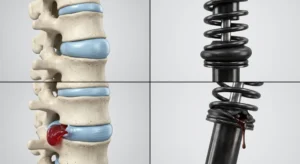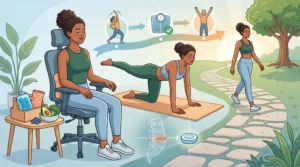
Read the MRI report alongside your symptoms. Get emergency care now for new difficulty passing or controlling urine, new loss of bowel control or sensation, numbness around the genitals or anus, or new sciatic pain down both legs. Severe or worsening weakness or numbness in both legs also needs emergency care. Disc signal changes are common in people without pain. A scan finding or home movement test cannot identify the pain source on its own.
Expert Review: This article includes clinical insights from Dr. Vivek Arora, a physical therapist (physiotherapist) with 20+ years of experience.
Disc desiccation means a spinal disc holds less water than a young disc does, so it looks darker on MRI. It is one of the most common findings on adult back scans, usually reflects ordinary aging, and on its own does not prove that disc is causing your pain.
The word does most of the damage. “Desiccated” sounds like a spine drying up and crumbling, and many people start guarding every bend the day they read it. Here is what the report actually says, how often pain-free people share the finding, and what helps.
Key takeaways
- It describes a signal, not a disease. The disc shows less water on the MRI sequence that makes water bright.
- It is common without pain. Pooled studies found it in a third of pain-free 30-year-olds and most people over 50.
- It cannot pinpoint your pain. Your symptoms and examination tell more than the picture.
- Other report lines matter more. A herniation, nerve contact or bone edema can change the plan.
- Movement is the treatment. Graded bending and lifting rebuild tolerance; avoiding them tends to backfire.
What does desiccation mean on your MRI report?
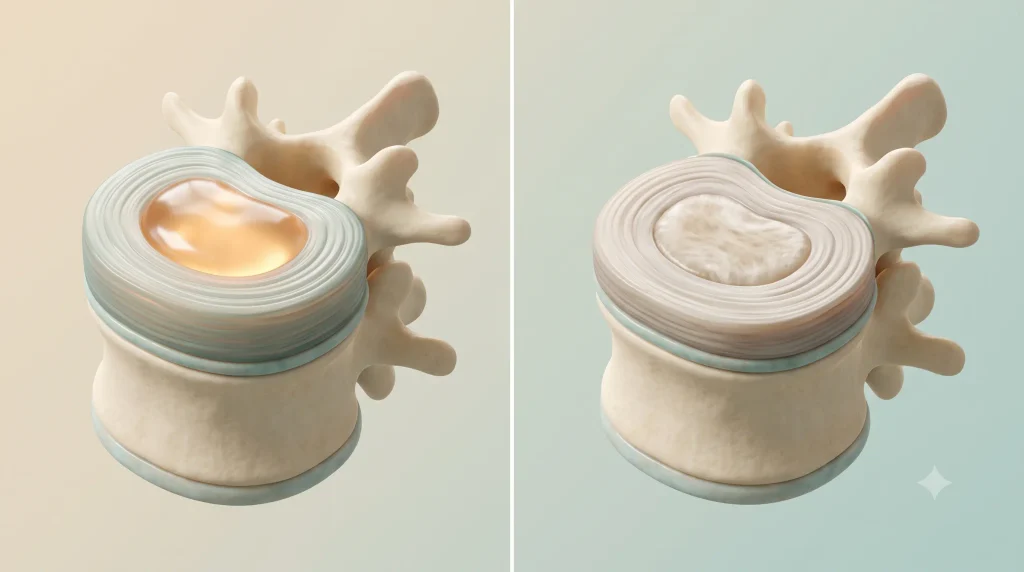
On an MRI report, desiccation means the center of a disc holds less water than it once did, so it looks gray or black instead of bright white on T2-weighted images, the sequence radiologists use to show water. It describes how the disc looks, not how it feels, and radiologists note it whether or not you have symptoms.
Each disc has a gel-like center, the nucleus pulposus, inside a tough wall of layered collagen rings, the annulus fibrosus. Discs also lose a little fluid each day and regain it overnight, which is why you are slightly taller in the morning; desiccation is a slower, long-term change, not a sign you drink too little.
How radiologists grade a dark disc
Many radiologists use the five-grade Pfirrmann system. Your report may name a grade, say mild or moderate, or simply say desiccation.
| Grade | How the disc looks on T2 MRI | What it usually means |
|---|---|---|
| 1 | Evenly bright, normal height | A young, well-hydrated disc |
| 2 | Bright, slightly uneven | Normal at almost any adult age |
| 3 | Gray, blurred center, height normal or slightly lower | Early to moderate water loss |
| 4 | Gray to black, no visible center, height normal or reduced | More advanced; common after midlife and can be painless |
| 5 | Black, disc space collapsed | Advanced; may narrow the openings where nerves exit |
X-rays cannot see disc water, only the gap between vertebrae, so this guide to reading a low back X-ray report explains the disc space narrowing you may find there instead.
Why do discs lose water, and who gets it?
Discs lose water mainly through age-related change in the nucleus, strongly shaped by genetics, with earlier disc injury and smoking adding to it. Nearly everyone develops some desiccation eventually, most often at L4-L5 and L5-S1, the two lowest lumbar levels, which carry the most load and movement.
The nucleus stays plump because it is packed with proteoglycans, molecules that pull water in and hold on to it. When you sit or lift, pressure inside it rises and pushes outward, spreading load evenly onto the vertebra below. With age the nucleus makes fewer proteoglycans and turns more fibrous, so it binds less water, and more load passes through the outer rings and the facet joints at the back of the spine.
- Genes: disc degeneration tends to run in families.
- Earlier injury: a disc that has herniated or torn its outer wall often desiccates sooner than its neighbors.
- Smoking: commonly associated with earlier disc degeneration.
The most useful context is how often pain-free people show the same thing. A systematic review pooling 33 studies of 3,110 adults without back pain produced these estimates (Brinjikji and colleagues, 2015).
| Age | Disc signal loss (desiccation) | Disc height loss |
|---|---|---|
| 20 | 17% | 24% |
| 30 | 33% | 34% |
| 40 | 54% | 45% |
| 50 | 73% | 56% |
| 60 | 86% | 67% |
| 70 | 94% | 76% |
| 80 | 97% | 84% |
Find your row first. At 50 a dark disc is the majority experience; at 20 it is less typical and sometimes follows an earlier disc injury.
Is disc desiccation serious?
Usually not. Desiccation is a description of a disc’s water signal, not a diagnosis, and it is common in adults with no pain at all. It matters more when it sits beside findings that affect nerves or bone, or when your symptoms clearly match that level of the spine.
It is not meaningless, though. A 2015 meta-analysis by the same research group, covering 14 studies of adults aged 50 or younger, found MRI signs of disc degeneration, the category desiccation belongs to, at roughly twice the odds in people with back pain. Yet so many pain-free people have a dark disc that the image cannot tell whether yours is the source.
Which report lines matter more than desiccation?
- Protrusion, extrusion or herniation: disc material beyond its normal edge, most relevant when it matches leg symptoms on the same side and level.
- Nerve root contact or foraminal narrowing: crowding where a nerve leaves the spine, relevant with pain, numbness or weakness in that leg.
- Modic type 1 changes: edema, meaning excess fluid, in the bone beside a disc. In the same meta-analysis its association with back pain was larger than that of disc degeneration; this explainer on Modic changes on MRI covers it.
Does a dark disc explain your symptoms?
Sometimes it contributes, but rarely on its own. Pain from a sensitive disc tends to feel deep and central, builds with long sitting or bending, and eases with walking or a change of position. Pain that is mainly one-sided, travels below the knee, or ignores movement suggests another source and deserves assessment.
Quick check
- Central and worse sitting? Pain that builds with sitting and eases with walking can fit a sensitive disc, though it is not proof.
- One-sided and worse arching? Pain on leaning back or standing still can point toward the facet joints; the dark disc may be incidental.
- Below the knee? With leg pain, pins and needles or numbness, check the report for protrusion or foraminal narrowing at that level, and get assessed within days.
- Get emergency care now for new difficulty passing or controlling urine, loss of bowel control or sensation, or numbness around the genitals or anus. New sciatic pain down both legs or severe or worsening weakness or numbness in both legs also needs emergency care. Get urgent advice if you have fever or new or worsening weakness in one leg.
The facet joints, the sacroiliac joint where the spine meets the pelvis, the hip and the muscles can all hurt in someone whose scan happens to show desiccation, so how your pain behaves counts for more than the image.
When should a dark disc on MRI worry you?
Desiccation itself is not an emergency finding. What should worry you is a set of symptoms pointing to a nerve, bone or infection problem, whatever the report says about disc water, because the cause behind those symptoms, not the disc’s signal, carries the risk.
- Numbness between the legs, new trouble passing urine, or bladder or bowel incontinence: possible cauda equina syndrome, compression of the nerve bundle at the base of the spine, where delay risks permanent damage. Go to emergency care now.
- A foot or leg weakening over days: a nerve root losing function needs urgent review, especially if the foot slaps or catches.
- Back pain with fever, chills, or a recent spinal injection or operation: disc infection (discitis) makes a disc look brighter and inflamed on MRI, the opposite of desiccation.
- Cancer history, unexplained weight loss, or constant pain worst at night: these need checks for causes unrelated to disc aging.
- A fall, or minor trauma with osteoporosis or long-term steroid use: possible vertebral fracture.
Do you need another scan to track it?
Rarely. Treatment follows symptoms and function, not disc brightness, so a repeat MRI to monitor desiccation seldom changes anything. A new scan makes sense for a red flag, new or worsening nerve loss, or planning a procedure.
What myths about a desiccated disc hold people back?
Two myths do the most harm: that the disc can be refilled with water, and that it must be protected from bending. Both sound logical once you picture something drying out, and both steer people toward the wrong priorities.
- Myth: drinking more water rehydrates the disc. Disc water is held by proteoglycans, not topped up from your bottle. General dehydration can make the lower back ache in other ways, but extra glasses will not change your MRI.
- Myth: you should stop bending and lifting. Discs respond to load. Graded bending and lifting are standard rehab, and banning them tends to leave the back stiffer and easier to provoke.
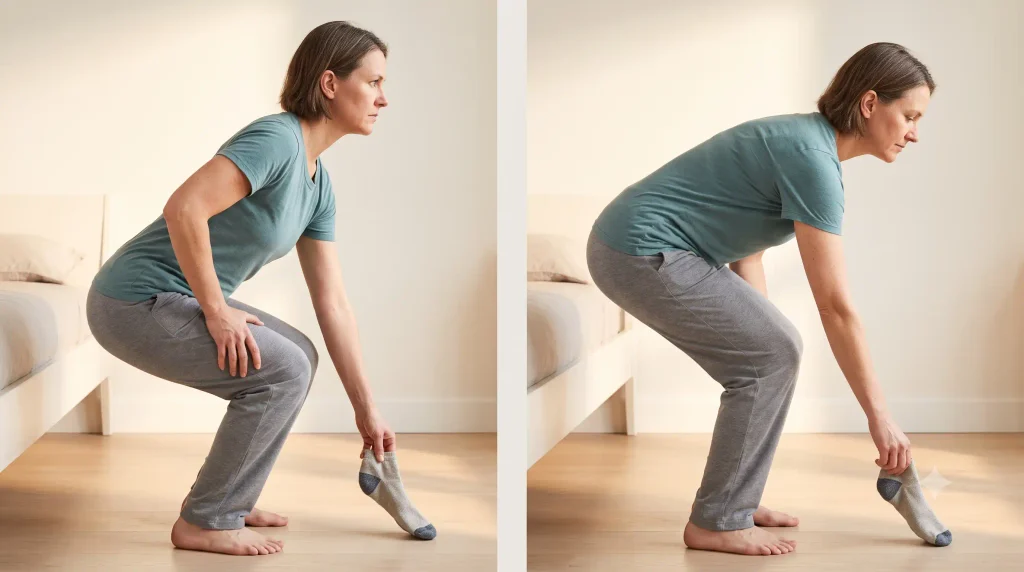
Try a quick self-test: pick a sock up off the floor. If you lock your trunk and squat stiffly for something that light, you are protecting your back more than it needs, and a relaxed bend with soft knees is the movement to bring back.
From the Clinic: Dr. Arora’s Expert Insight
Most people who hand me a report with desiccation on it have already translated the word into “my spine is drying out,” when all the radiologist recorded is that one disc returns a darker signal than it would have at twenty. Those are very different sentences. The first describes something active, progressive and somehow your fault; the second describes a photograph of an ordinary age change, taken on one afternoon, in a person who happened to have back pain that week.
What I notice again and again is that the report changes behavior faster than the pain ever did. Within days people are squatting to load the dishwasher, bracing their stomach before a cough and pausing the gym. The generic advice they then find, stay hydrated, avoid bending, strengthen your core, fits the drying-out story perfectly, and that is the problem: it treats the picture instead of the person. A back held rigid and kept away from bending for months usually becomes stiffer and easier to provoke, and the dark disc then gets blamed for stiffness the avoidance created.
What works better starts with a second translation. I set the report beside the age figures, point out the lines that matter more, and ask which movements the person has quietly stopped since the scan. Those movements become the rehab plan: bending with a light load, sitting a little longer, carrying the groceries, each built up in small steps until it feels ordinary again. The disc will probably look much the same on a future scan. The person using it usually does not.
What should you do after reading disc desiccation on your report?
Usually nothing urgent. Keep your routine, avoid inventing new restrictions, and take the full report to the clinician who ordered it or to a physical therapist (physiotherapist), who can match it against your examination. In a flare, the first 72 hours are about calming symptoms with movement and position changes, not bed rest.
What to do today
- Read the Impression section of the report first; it lists what the radiologist considers most relevant.
- Check your age in the pain-free prevalence table in this article.
- Walk 10 to 20 minutes, two or three times today, on flat ground.
- Break up sitting every 30 to 45 minutes; if sitting hurts, lie on your back with your calves on a chair seat.
- List three movements that provoke your pain and three that ease it, for your appointment.
- Add no new bans on bending or lifting based on the report alone.
How do you rebuild a back with desiccated discs?
Settle the flare, restore the movements you have been avoiding, then add load in small steps. Advance when your back tolerates the current phase, meaning pain after activity settles within 24 hours and the next morning is no worse, rather than when a set number of weeks has passed.
| Phase | Typical timing | Main work | Move on when |
|---|---|---|---|
| 1. Settle | Days 1–14 | Walks of 10–30 minutes, 2–3 times daily; gentle cat-camel; stand up every 30 minutes | A 30-minute walk and 30 minutes of sitting leave you no worse next morning |
| 2. Restore bending | Weeks 2–6 | Dowel hip hinge; sit-to-stand; bird dog; side plank 20–30 seconds; floor reach with soft knees | You pick up light objects from the floor without guarding |
| 3. Add load | Weeks 4–10 | Kettlebell deadlift from a step at 8–12 kg (18–26 lb); suitcase carries of 20–30 m (65–100 ft); split squats | Lifting 10 kg (22 lb) from the floor feels routine |
| 4. Return | Week 8 onward | Running, sport or heavier lifting; two strength sessions a week long term | Usual activities leave only mild soreness, gone by the next day |
For the step deadlift, set a kettlebell on a sturdy step between your feet, push your hips back with a long spine, grip the handle and stand by driving through your heels. If your lower back rounds sharply before your hands reach the handle, raise the step; if two sessions feel easy, lower it.

Why these exercises suit a desiccated disc
- Walking gives discs rhythmic, moderate loading, which supports the fluid exchange they depend on, and is usually tolerated during flares.
- The hip hinge and floor reach retrain the bending most people drop after reading their report.
- Raised-start deadlifts load bending at a height you tolerate today; the step comes down as tolerance grows.
- Bird dog, side plank and carries build trunk endurance to control the spine as the outer disc wall and facet joints take more load.
Two or three weekly sessions of two or three sets suit most people; change one thing at a time, such as 2 to 4 kg (4 to 9 lb) or a lower step. This physical therapy exercise program for low back pain adds variety.
Do’s and don’ts with a desiccated disc
- Do keep bending and lifting in your week, scaled to today’s tolerance.
- Do break up long slumped sitting, which tends to aggravate disc-sensitive pain.
- Don’t pay for traction or injection packages that promise to rehydrate discs; none has been shown to do so reliably.
- Don’t brace your trunk rigidly through everyday tasks.
When can you get back to normal activity?
With a flare on top of desiccated discs, many people return to normal daily activity within two to six weeks, and to running, heavier lifting or contact sport within six to twelve. Useful milestones: sitting 45 to 60 minutes, lifting 10 kg (22 lb) from the floor, and a 45-minute walk without a next-morning setback.
What if it is not improving, and is surgery ever needed?
If eight to twelve weeks of consistent, graded rehab brings little change, rethink the plan rather than repeat it. A physical therapist or physician can check whether the hips, sacroiliac or facet joints are the real driver, test nerve function, and address sleep, stress and fear of movement. Surgery does not treat desiccation itself.
Surgery is considered only for problems that can travel with it. Decompression may be offered when disc material or narrowing compresses a nerve, causing persistent disabling leg pain or progressive weakness, and cauda equina syndrome needs emergency surgery. Fusion or disc replacement for pain blamed on a worn disc is reserved for carefully selected people after long, well-delivered rehab, with variable results.
The outlook is good: the disc will likely stay darker on future scans, but many people with very dark discs live and work without back pain.
The bottom line on disc desiccation
Treat the word as a description of age, not a warning. This week, pick one movement you stopped after reading your report, such as bending to the dishwasher or lifting a laundry basket, and practice a smaller, easier version every day until it feels ordinary again.
Frequently asked questions
1. Is a desiccated disc the same as degenerative disc disease?
Not exactly. Desiccation is one MRI feature, reduced water signal, while degenerative disc disease is a loose label used when degenerative changes are thought to explain pain. Despite the word disease, both usually describe common age-related changes, not an illness.
2. Can a dehydrated disc cause sciatica or leg numbness?
Not on its own. Leg pain, tingling or numbness come from an irritated nerve root, usually through a herniation or a narrowed nerve opening that can accompany desiccation at the same level. This guide to bulging versus herniated discs explains the report terms to look for.
3. What does desiccation at multiple levels mean?
It usually reflects age and genetics rather than a string of injuries. Several dark discs are common from middle age onward and do not mean your pain is more widespread or serious. What matters is whether any level also shows nerve involvement matching your symptoms.
4. Can disc desiccation be reversed?
Not reliably. No proven treatment restores the MRI signal of a desiccated disc, and the appearance usually changes slowly, if at all. Pain and function, however, can improve fully while the scan looks the same.
5. Can I keep running or lifting weights with a desiccated disc?
Usually, yes, if you build back gradually and your back feels no worse the morning after each session. Dark discs are common in active people who have no symptoms. Raise volume before intensity, and ease off for a week if pain lingers beyond 24 hours.
6. Why does my MRI show desiccation when I am only in my 20s or 30s?
Because it is less common at that age but far from rare: pooled data from pain-free adults found disc signal loss in about one in six 20-year-olds and one in three 30-year-olds. Early desiccation often reflects genetics or an earlier disc injury, not anything you did wrong.
Medical disclaimer
This article provides general information. It cannot assess your symptoms or give you an individual treatment plan. A radiology report needs to be interpreted alongside your symptoms. Ask for individual exercise advice after recent surgery, with osteoporosis or in pregnancy. Get emergency care now for new difficulty passing or controlling urine, loss of bowel control or sensation, or numbness around the genitals or anus. New sciatic pain down both legs or severe or worsening weakness or numbness in both legs also needs emergency care. Get urgent advice for back pain with fever or new weakness in one leg.
References
- Brinjikji W, Luetmer PH, Comstock B, et al. Systematic literature review of imaging features of spinal degeneration in asymptomatic populations. American Journal of Neuroradiology. 2015;36(4):811-816.
- Brinjikji W, Diehn FE, Jarvik JG, et al. MRI findings of disc degeneration are more prevalent in adults with low back pain than in asymptomatic controls: a systematic review and meta-analysis. American Journal of Neuroradiology. 2015;36(12):2394-2399.