
Expert Review: This article includes clinical insights from Dr. Vivek Arora, a physical therapist (physiotherapist) with 20+ years of experience.
If your back suddenly feels tight, achy or stuck on a hot day — or after a long flight, a stomach bug, or a sweaty session in the gym — you are not imagining the connection. But the relationship between dehydration and lower back pain is more indirect, and more modestly evidenced, than most articles on the subject suggest.
Being under-hydrated does not injure your spine. What it plausibly does is lower the threshold: tired, irritable muscles guard more readily, sitting tolerance drops, and the same routine bend that was fine last week becomes the tipping point. Direct human evidence that fluid intake causes or treats back pain is limited, so treat hydration as one contributing factor worth correcting — not as the diagnosis.
Key takeaways
- The evidence here is plausible, not proven. There are no trials showing that drinking more water treats low back pain. The mechanisms are reasonable; the direct proof is thin, and honest articles should say so.
- Fluid status is a modifier, not a cause. It stacks with heat, poor sleep, long sitting and one awkward lift — and the stack is what produces the flare.
- The feel of the pain is a clue. Crampy, band-like tightness that eases with walking fits this pattern. Sharp, radiating or position-independent pain does not.
- Water alone is not always the right replacement. After heavy sweating or gastrointestinal illness, electrolytes matter alongside fluid.
- Rule out the kidneys first. Flank pain with fever, nausea or urinary changes is a medical problem, not a hydration and posture problem.

Can dehydration really cause lower back pain?
It can contribute, through indirect routes, but it is rarely the sole cause. Think of it as a state problem — your body’s chemistry and recovery on a given day — rather than damage to a specific structure. Three pathways are physiologically plausible: increased muscle irritability, reduced tolerance to sustained postural load, and, separately, urinary tract conditions that produce pain in the same region.
1) Muscle irritability and protective spasm
Muscle contraction depends on water, sodium, potassium, calcium and magnesium moving across cell membranes. When you are under-hydrated — or you have sweated out sodium and replaced it with plain water only — muscles can fatigue sooner and become more excitable. The lumbar extensors and hip flexors are particularly exposed, because they work at low intensity all day simply to keep you upright.
That is why fluid-related flares tend to feel crampy, tight and rope-like rather than sharp; get worse with prolonged standing and end-of-day fatigue; and ease with gentle walking. Whether this specifically explains back symptoms has not been tested directly, but the muscle physiology is well established, and it fits what people describe.
2) Disc behavior and load tolerance across the day
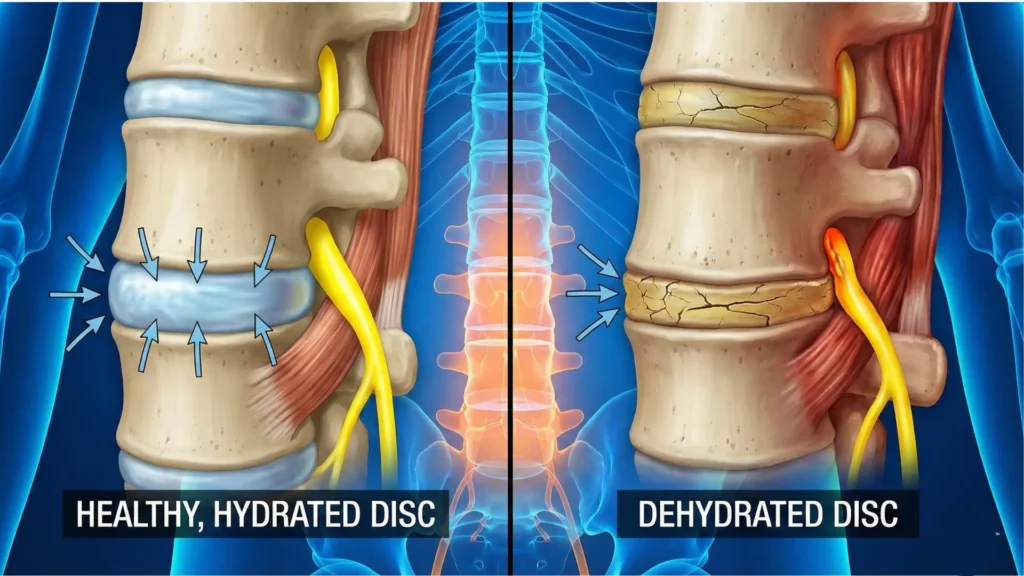
Intervertebral discs — the fluid-rich cushions between vertebrae — lose water under compression during the day and regain it during unloaded rest. This diurnal variation is measurable on MRI and is why most people are marginally taller in the morning.
Here is the honest caveat: that fluctuation is driven by spinal loading and unloading, not by how much you drank at lunch. A glass of water does not rehydrate a disc. What matters practically is that when your overall recovery state is poor, the same posture and the same load feel considerably more irritating — which is why these episodes cluster after long sitting, bending-heavy chores or travel days.
3) Kidney and urinary conditions that feel like back pain
This is the one pathway with genuinely solid evidence behind it. Low fluid intake concentrates urine and raises the risk of kidney stones in susceptible people; NIDDK describes adequate fluid intake as the single most important thing most people can do to prevent kidney stones, suggesting six to eight 8-ounce glasses a day for those without kidney failure.
That matters because not every ache on a dehydrated day is musculoskeletal. In some cases the fluid-and-posture frame is simply the wrong one, and what is actually needed is a urine test and a medical assessment.
Why does my back hurt more on hot days, travel days and busy weeks?
Because these are the days when several risk factors arrive together. Fluid loss rarely acts alone — it turns up alongside static posture, disrupted sleep, irregular meals and reduced movement breaks. Any one of those on its own is usually tolerable. Stacked, they lower the threshold enough that an ordinary bend produces an extraordinary reaction.
- Heat and sweating: fluid loss plus electrolyte loss plus general fatigue
- Flights and long drives: low intake plus hours of static flexed sitting plus stiff hips
- Alcohol and caffeine: a mild diuretic effect plus disrupted sleep plus raised resting muscle tone
- Vomiting or diarrhea: rapid fluid and electrolyte shifts over hours rather than days
- Long desk days: low intake plus sustained flexion plus almost no position change
Sustained slumped sitting is the mechanical amplifier in most of these. It loads spinal tissues in flexion for hours at a stretch, and it is far more likely to be doing the damage on a travel day than the two glasses of water you skipped.
Is this my back or my kidneys?
Position is the fastest way to tell. Musculoskeletal pain changes clearly when you move — it eases in some postures and worsens in others, and the muscles are usually tender to press. Kidney and urinary pain sits higher, under the ribs toward one side, tends to ignore posture entirely, and often arrives with fever, nausea or changes in urination. If those features are present, stop self-managing and get assessed.
| Feature | More consistent with muscle or joint pain | More consistent with kidney or urinary causes |
|---|---|---|
| Location | Across the beltline, buttock or one side of the low back | Higher, under the ribs toward one side (flank) |
| Effect of position | Changes clearly with movement, sitting, standing or lying | Largely unchanged by position; may come in waves regardless |
| Tenderness | Muscles are sore when pressed | Pressing the back does not reproduce it well |
| Accompanying symptoms | Stiffness after sitting; eases with gentle walking | Fever, chills, nausea, vomiting |
| Urinary changes | None | Burning, urgency, frequency, or blood in the urine |
| What to do | Reasonable to self-manage for a few days | Seek medical assessment, not a rehab plan |
Nine signs your back pain is at least partly a fluid problem
None of these prove dehydration is the cause. They tell you when hydration, electrolytes and recovery are meaningful levers worth pulling, rather than a distraction from the real issue.
- The flare follows heat or heavy sweating. Outdoor work, a long summer walk, a sauna, or an intense session. Sweat loss reduces plasma volume, increases fatigue and can raise protective muscle tone.
- Thirst and darker urine show up the same day. Urine color is an imperfect marker — some supplements darken it regardless — but the timing is what counts. Low intake, thirst and symptom onset arriving together is meaningful.
- The pain is tight and band-like rather than sharp. Pressure, gripping, and stiffness during transitions such as sit-to-stand. Sharp pinpoint pain can still occur, but crampy tightness is the more typical presentation.
- Other muscles are cramping or twitching too. If calves, hamstrings or feet are cramping, the lumbar muscles are plausibly in the same irritable state — and that points toward fluid and electrolytes rather than a spinal structure.
- Travel days reliably trigger it. Dry cabin air, low intake, hours of static sitting and one awkward suitcase lift is the most common combination there is.
- You improve noticeably within 12–24 hours of steady rehydration. Time course is a strong clue. A flare that resolves that quickly with fluids, electrolytes where appropriate and gentle movement was almost certainly a state problem rather than a structural one.
- You also feel headachy, lightheaded or unusually fatigued. Back pain alone is tiring. Dehydration adds systemic signals — headache, dizziness on standing, heavy legs, brain fog.
- It began after vomiting, diarrhea, fasting or a crash diet. These shift fluid and electrolytes within hours. If the timeline fits, the problem is a short-term chemistry deficit, not a fragile spine.
- You notice urinary changes alongside the pain. This one runs the other way — burning, urgency, fever, nausea or blood in the urine shifts the probability toward a urinary cause and away from self-management entirely.
Myths vs facts
Myth: “Drinking water rehydrates my discs.”
Fact: Disc water content is governed mainly by loading and unloading across the day, not by systemic fluid intake. Hydration is part of the system, but it is not a lever you can pull directly on a disc.
Myth: “Dehydration is a main cause of back pain.”
Fact: Most low back pain is multifactorial — load, sleep, stress, conditioning and tissue sensitivity. Fluid status amplifies those factors on a bad day. It is very rarely the root cause on its own, and no study has shown that increasing water intake treats back pain.
Myth: “More water is always better.”
Fact: If you have lost electrolytes through heavy sweating or illness, replacing only water can leave you worse off. And anyone with heart failure, kidney disease or a prescribed fluid restriction should follow their clinician’s guidance rather than a general rule.
From the Clinic: Dr. Arora’s Expert Insight
Patients who fit this pattern almost never open with “I think I was dehydrated.” They open with “my back suddenly locked up,” usually convinced something has slipped. When we map the previous 48 hours, the same picture keeps appearing: heat or travel, long sitting, irregular meals, low fluids, poor sleep — and then one entirely routine bend that became the tipping point.
The common mistake is treating hydration as an emergency button: almost nothing all day, then a litre of plain water at night once the pain arrives. That fails for two reasons. The nervous system is already guarding by then, and after heavy sweating or a stomach bug, water without electrolytes is not the replacement the body actually needs. What I want to add, though, is a note of caution about how this topic is usually written up online. Hydration is a sensible thing to correct and a poor thing to blame. When someone tells me they have fixed their water intake and the back pain has not moved, that is not a hydration failure — it is information that we were looking at the wrong variable.
What should I do today? A safe 24-hour reset
Rehydrate steadily rather than in one go, spend ten minutes on low-load movement to reduce guarding, and cut your compressive load for a day. That is the whole plan. Before starting it, rule yourself out: fever, urinary symptoms, severe one-sided flank pain, fainting, confusion, new leg weakness, saddle numbness or changes in bladder or bowel control all mean urgent assessment instead.
Step 1: Rehydrate steadily, without chugging
- Sip through the day rather than forcing large volumes at once.
- After heavy sweating, diarrhea or recurrent cramps, use an oral rehydration solution or an electrolyte drink. Water alone is not the right replacement for sodium losses.
- If you have heart failure, kidney disease or a prescribed fluid restriction, follow your clinician’s instructions instead of this section.
Step 2: Ten minutes of low-load movement
The aim is to reduce guarding without provoking symptoms.
- Crook-lying breathing, 2–3 minutes. On your back, knees bent. Inhale gently, exhale longer, and let the ribs soften down on the exhale rather than bracing hard.
- Pelvic tilts, 1–2 sets of 8–10. Rock the pelvis to flatten the low back slightly, then return to neutral. Small and smooth — this is a movement input, not a stretch.
- Easy walking, 5 minutes. Relaxed pace, even breathing. Walking is the most reliable way to reduce protective tone in the lumbar extensors.
Step 3: Reduce compression triggers for 24 hours
For one day, avoid prolonged sitting without breaks, deep end-range stretching while you are cramping, and heavy lifting from a rounded back. Instead, stand and walk for 60–90 seconds every 30–45 minutes, and rehearse a gentle hip hinge every time you bend.
Step 4: Sleep in a position that unloads the spine
Side-lying with a pillow between the knees, or on your back with a pillow under the knees. Since discs recover fluid during unloaded rest, a comfortable night genuinely contributes here — more, in all likelihood, than the last glass of water before bed.
A two-week prevention plan
Week 1: make hydration automatic and restore tolerance
Anchor fluid intake to events rather than to a target number: a glass on waking, one mid-morning, one mid-afternoon, one with dinner. On hot or high-sweat days, increase intake and consider electrolytes. Consistency beats rescue drinking, and a boring routine is the entire point.
Alongside it, ten minutes of daily movement: five minutes walking, two minutes of breathing reset, three minutes of pelvic tilts and hip hinge rehearsal.
Week 2: build capacity, three days a week
Choose loads that feel easy enough to repeat tomorrow.
- Glute bridge: 2–3 sets × 8–12
- Supported split squat, hands on a wall: 2 × 6–8 per side
- Light farmer carry: 4 × 30–60 seconds
Capacity work matters because a fluid deficit is usually only the spark. Low tissue tolerance is the fuel, and it is the part that determines whether next month’s hot day costs you a week.
Do’s and don’ts
Do
- Spread fluid intake across the day rather than concentrating it
- Add electrolytes when sweating is heavy or cramps keep recurring
- Use low-load movement early — walking and pelvic tilts, not rest
- Treat travel days and heat waves as higher-risk if this has happened before
Don’t
- Ignore fever, urinary symptoms or blood in the urine
- Attempt heavy deadlifts to loosen it off in the first 48 hours
- Stretch a cramping lumbar region aggressively — it tends to provoke more cramping
- Assume hydration is the answer if a week of correcting it changes nothing
The bottom line
Most episodes that look like a mystery back injury are a predictable stack: low fluids, poor sleep, hours of sitting and one sudden load. Dehydration and lower back pain belong in the same conversation because fluid status is one of the easiest parts of that stack to fix — not because water is a treatment for back pain. If your pattern matches the signs above, start with steady rehydration, electrolytes where appropriate, gentle movement and one day of reduced compression, then spend two weeks rebuilding capacity. If a week of consistent hydration changes nothing, believe the result and look elsewhere.
FAQ
Can dehydration cause back pain even if I have not exercised?
It can contribute. Heat, travel, alcohol, low intake or illness all create a recovery deficit that raises muscle guarding and tissue sensitivity, and that can be enough to turn an ordinary movement into a flare. It is a contributing factor rather than a cause on its own.
How do I know it is not a disc problem?
Speed of recovery is the best clue available at home. Symptoms that settle substantially within 12–24 hours of fluids, gentle walking and a decent night’s sleep point to a state-dependent flare. Pain that radiates below the knee, or comes with numbness or weakness, needs assessing regardless of how much you have drunk.
Is kidney pain the same as back pain from dehydration?
No. Kidney pain sits higher and more to one side, under the ribs, and usually does not change much when you move. Fever, nausea, burning on urination or blood in the urine make it a medical problem rather than a musculoskeletal one.
Should I drink only water, or add electrolytes?
Water is enough for ordinary daily losses. After heavy sweating, vomiting or diarrhea, or if you cramp easily, add electrolytes — replacing large sodium losses with plain water alone can leave you feeling worse rather than better.
Can sitting make this worse even when I am well hydrated?
Yes, and it frequently does. Sustained slumped sitting loads spinal tissues in flexion for hours, and few movement breaks compounds it. On a long travel day the posture is usually doing more than the fluid deficit.
Why is my back stiffer at the end of the day?
Discs lose water under compression through the day and regain it during unloaded rest, so most people are slightly shorter and stiffer by evening. Add fatigue and low fluids and the whole system tolerates less.
Can I keep training during a flare?
Usually yes, scaled down. Avoid heavy spinal loading for 24–48 hours, keep walking and low-load movement going, and reintroduce strength work as symptoms settle. Any new weakness or numbness means stop and get assessed.
When should I stop self-treating?
Fever or chills, vomiting that prevents you drinking, blood in the urine, severe one-sided flank pain, new leg weakness, saddle numbness, or any change in bladder or bowel control. Each of these points to something other than a fluid and posture problem.
Medical disclaimer
This article is general education and does not replace individual medical assessment. Fluid and electrolyte advice is not appropriate for everyone — particularly anyone with kidney disease, heart failure or a prescribed fluid restriction — and back pain accompanied by fever, urinary symptoms or neurological change should be evaluated by a qualified clinician.
References
- National Institute of Diabetes and Digestive and Kidney Diseases. Eating, Diet, & Nutrition for Kidney Stones. NIDDK, National Institutes of Health.
- National Institute for Health and Care Excellence. Low back pain and sciatica in over 16s: assessment and management (NG59). NICE guideline, published 2016, last updated 2020.