Expert Review: This article includes clinical insights from Dr. Vivek Arora, a physical therapist (physiotherapist) with 20+ years of experience.
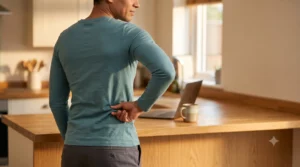
You lifted a suitcase awkwardly, twisted while carrying a toddler, or simply stood up from a low sofa the wrong way — and something in the lower back let go. A day later you can barely get your socks on. If a clinician has written lumbosacral strain on your notes, or you have found the term while trying to make sense of the pain, it describes an injury to the soft tissues where the lumbar spine meets the sacrum: the muscles, tendons and ligaments that hold the bottom of your back together.
It is one of the most common causes of sudden low back pain, and one of the most reliably survivable. It is also a diagnosis that gets used loosely, which leaves people unsure whether they have a minor tissue injury that will settle in a fortnight or something that deserves a scan. This guide separates the two, explains what actually gets injured and why, and gives you a healing timeline built on what your back can do rather than how many days have passed.
Key takeaways
- A lumbosacral strain is a soft-tissue injury at the lumbar–sacral junction, not a spinal or disc injury, and it does not damage bone.
- The signature pattern is pain that stays local — a band across the low back or the top of the buttock — with stiffness rather than travelling leg symptoms.
- Two to six weeks covers most cases, with the sharpest phase usually done inside the first week.
- Muscle spasm can make the first 48 hours feel catastrophic. Severity of early pain predicts very little about eventual recovery.
- Imaging is rarely useful for a straightforward strain and often finds age-related changes that were already there and are not the cause.
What is a lumbosacral strain?
A lumbosacral strain is an injury to the muscles, tendons or ligaments in the region where the five lumbar vertebrae meet the sacrum — roughly the area between your beltline and the top of your buttocks. Overstretching or overloading these tissues causes small tears and a protective inflammatory response, producing localized pain, stiffness and often muscle spasm. The spine itself, its discs and its nerves are not injured.
Two terms often get bundled together here, and the distinction is worth thirty seconds. A strain involves muscle or tendon — the tissue that contracts and the cord that anchors it to bone. A sprain involves ligament — the passive strapping that connects bone to bone. In the lower back the two are almost impossible to separate on clinical examination, and they behave and heal so similarly that the practical plan is the same either way. That is why you will see “lumbosacral strain”, “lumbosacral sprain” and “lumbosacral strain-sprain” used more or less interchangeably in medical notes.
The word people fixate on is “strain”, which sounds trivial, and then they feel ambushed when they cannot straighten up the next morning. That reaction is not because the injury is worse than described — it is because the surrounding muscles have splinted the area to protect it, and splinting hurts.
What does a lumbosacral strain feel like?
Most people describe a deep, aching band of pain across the lower back, sometimes spreading into the top of the buttock, that sharpens abruptly with specific movements — bending forward, twisting, standing up from a chair, rolling over in bed. It is typically worst in the morning and after periods of sitting still, eases somewhat with gentle movement, and does not send tingling, numbness or shooting pain down the leg.
A few features are especially characteristic. The pain is usually load- and position-dependent — there is almost always a position that provides genuine relief, which is quite unlike inflammatory or sinister causes of back pain. It is often worse the morning after the incident than at the moment of injury itself, because inflammation and spasm build over the following twelve to twenty-four hours. And it commonly produces a visible guarded posture: people move as a single block, turn their whole body rather than twisting, and lower themselves into chairs with both hands. Some end up temporarily leaning noticeably to one side, which looks alarming but is usually protective muscle spasm rather than a structural problem.
How is it different from a disc problem or SI joint pain?
The quickest differentiator is where the pain goes and what makes it worse. A lumbosacral strain stays local and hates movement in every direction roughly equally. A disc-related problem tends to send symptoms down the leg and has a clear directional preference — usually much worse with sitting and bending. Sacroiliac joint pain sits lower and to one side, and lights up with single-leg loading such as stairs or getting out of a car.
| Feature | Lumbosacral strain | Disc-related pain | Sacroiliac joint pain | Facet joint irritation |
|---|---|---|---|---|
| Where it sits | Broad band across the low back, may reach the upper buttock | Low back plus buttock, often travelling down the leg | One side, just below the beltline near the dimple | One side of the low back, deep and localized |
| Travels below the knee? | No | Frequently | Occasionally to the back of the thigh, rarely lower | No |
| Nerve symptoms | None | Tingling, numbness or weakness common | None | None |
| Worst with | All movement early on, especially bending and rolling in bed | Sitting, forward bending, coughing, sneezing | Stairs, standing on one leg, getting out of a car | Arching backward, standing still for long periods |
| Eases with | Gentle movement, supported positions, gradual loading | Standing, walking, gentle backward arching | Offloading that side, a pelvic belt for some | Sitting, bending forward slightly |
| Typical onset | A clear lift, twist or awkward movement | Bending or lifting, sometimes with a delayed leg component | Pregnancy, a fall onto one buttock, or repetitive one-sided loading | Often gradual, or after prolonged standing |
One honest caveat: these categories overlap in real people. A strain and a grumpy facet joint can coexist, and an episode that begins as a clean strain can leave a sensitized area that behaves oddly for weeks. The distinction that genuinely changes management is whether nerve symptoms are present — because that shifts the plan, the timeline and the threshold for further assessment.
What actually gets injured, and why there?
The lumbosacral junction is where a mobile column meets a fixed base. The lowest lumbar segments still rotate, bend and extend; the sacrum, wedged between the two pelvic bones, essentially does not. Every force travelling from your upper body into your legs has to cross that transition — which is why the tissues guarding it are the ones that tear when the movement is faster, heavier or more twisted than they were ready for.
Three tissue groups take the brunt. The erector spinae muscles run vertically either side of the spine and are what stop your trunk collapsing forward when you bend — they are working hardest, and are most vulnerable, in exactly the position most people injure themselves in. The thoracolumbar fascia, a broad sheet of connective tissue across the low back, transmits load between the trunk and the hips and is richly supplied with pain receptors, which is part of why the pain often feels diffuse rather than pinpoint. And the iliolumbar and sacroiliac ligaments anchor the bottom lumbar vertebrae to the pelvis; these are the tissues most likely to be sprained when a lift is combined with a twist. If you want more on how these low back muscles generate pain in their own right, that mechanism deserves its own look.
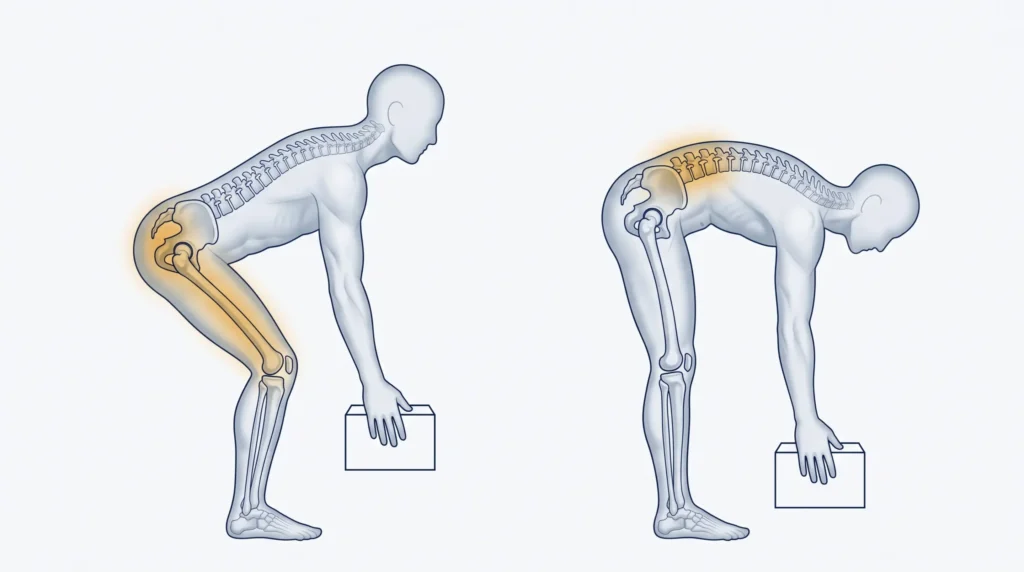
Biomechanically, most lumbosacral strains share a common story: the hips stopped contributing. In a well-organized lift, the hips hinge and the powerful glutes and hamstrings do the heavy work while the lumbar spine holds a relatively steady position. When hip mobility is limited, or the load is picked up at arm’s length, or someone is simply tired at the end of a long day, the movement migrates upward into the lumbar spine. The low back tissues then find themselves lengthening under load — the exact condition under which muscle fibers tear. This is why strains cluster around bending and lifting incidents rather than around dramatic impacts.
What makes a strain more likely?
Strains rarely happen to well-prepared tissue doing something familiar. They happen when demand outruns current capacity — usually through a combination of a sudden or awkward load, tissue that was not conditioned for it, and a body that was already fatigued.
- Lifting with the load away from the body — a box held at arm’s length multiplies the leverage acting on the lumbar tissues far more than its weight suggests.
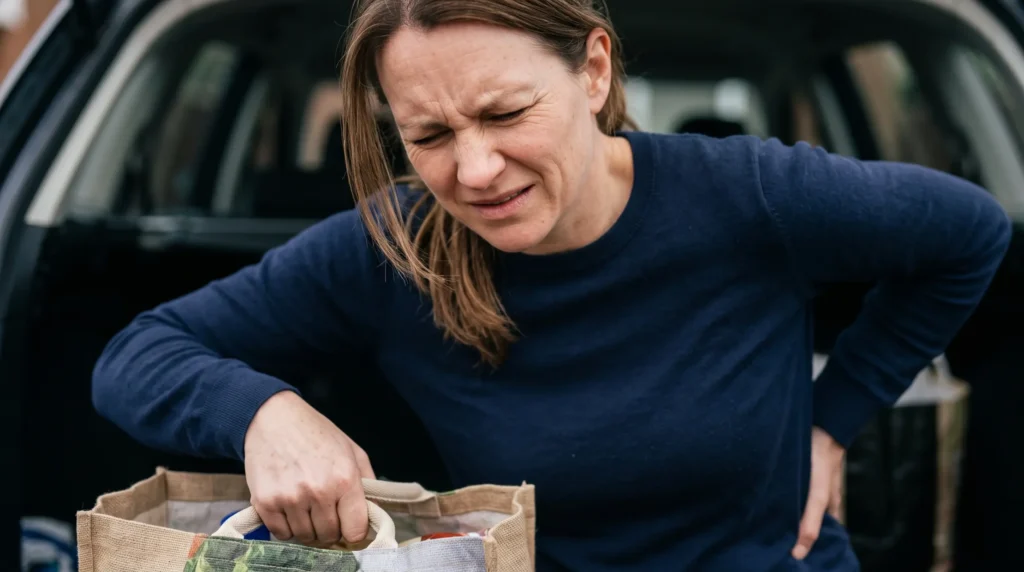
- Bending combined with twisting, such as lifting shopping out of a car boot or a child out of a cot. Rotation under load is where ligament sprains concentrate.
- Stiff hips or short hamstrings, which force the lumbar spine to supply movement the hips should have provided.
- A sudden jump in activity — a weekend of garden work, a house move, or a return to the gym after months away.
- Fatigue and poor sleep, both of which reduce the coordination and timing of the trunk muscles that would otherwise protect the area.
- Long periods of sitting before the lift, which leaves the posterior chain slow to switch on when suddenly asked to work.
When is back pain not just a strain?
The overwhelming majority of sudden low back pain is exactly what it appears to be. A small number of presentations, though, point away from a simple soft-tissue injury — and each one matters for a specific reason rather than as a generic warning.
- Loss of bladder or bowel control, or numbness in the saddle area (groin, genitals, inner thighs). This suggests compression of the nerve bundle at the base of the spine and is a same-day emergency, because the window for preserving function is short.
- Progressive leg weakness — a foot that catches on steps, a leg that gives way. Muscle tissue does not weaken from a strain; weakness indicates nerve involvement and needs prompt assessment.
- Pain that is genuinely worse at rest and at night, and that no position relieves. Mechanical strains almost always have an easing position; pain that ignores position is the pattern that raises questions about inflammatory or other causes.
- Fever, unexplained weight loss, or a history of cancer alongside the back pain, which shifts the priority toward excluding infection or other pathology before assuming a mechanical injury.
- Significant trauma, or milder trauma in someone with osteoporosis or on long-term steroids, where a vertebral fracture needs to be excluded rather than assumed away.
- Age under 20 or a first episode over 55, simply because the range of likely causes is different at both ends and deserves a proper look.
Do you need an X-ray or MRI for a lumbosacral strain?
Almost never, and understanding why saves both money and worry. Muscle and ligament strains are largely invisible on X-ray, which images bone. MRI can show soft tissue, but for a straightforward strain the result does not change what anyone would advise you to do — which is the actual test of whether a scan is worth having.
National guidance is explicit about this. NICE recommends against routinely offering imaging for low back pain outside specialist settings, and suggests considering it only where the result is likely to change management. Imaging becomes genuinely useful in three situations: to exclude a red flag, to investigate nerve symptoms that are severe or progressing, and to plan an intervention that is actively being considered.
There is also a specific downside to scanning a simple strain. Disc bulges, degenerative changes and mild narrowing are so common in people with no pain at all that a scan will very likely find something. Attaching that finding to your current pain is a mistake with consequences: people who believe their back is structurally damaged move more cautiously, avoid loading, and recover more slowly from an injury that would have settled on its own.
Three myths that slow a strain down
- “I should rest until the pain has completely gone.” Prolonged rest weakens the very tissue that needs to be reloaded, and stiffens the segment further. Guidance and evidence both point the other way: staying active beats bed rest for acute low back pain, and a Cochrane overview of non-drug treatments found that advice to stay active probably produces small improvements in pain and function compared with resting.
- “The spasm means something has slipped out of place.” Spasm is a protective reflex from irritated tissue, not evidence of displacement. Vertebrae do not slip in and out with a lift; the muscles simply brace hard around an area that has been hurt.
- “Once your back goes, it always goes.” Recurrence is common, but it is not inevitable and it is not a property of your spine. It largely tracks whether hip strength, hinge mechanics and load tolerance were rebuilt after the first episode, or whether the pain simply faded and life resumed unchanged.
From the Clinic: Dr. Arora’s Expert Insight
The word “strain” does a surprising amount of quiet damage in this diagnosis, and not because it is inaccurate. It is accurate. The trouble is that it sets an expectation of something minor and self-limiting, and then the person spends three days unable to put on their own shoes. At that point one of two things happens: either they decide the diagnosis was wrong and start hunting for a scan, or they decide their back is fragile in some permanent way. Both conclusions come from the mismatch between a mild-sounding label and a genuinely brutal first week.
What often gets missed in the initial consultation is the hip. Someone comes in with a low back that was injured lifting, we treat the low back, the pain settles, and nobody ever checks why the lumbar spine was doing the hip’s job in the first place. A pattern that comes up repeatedly is a person on their third or fourth “strain” in two years, each one treated as a fresh accident, when the underlying issue has been a hinge pattern that runs out of hip range about a third of the way down and hands the rest to the lower back. The strain is the symptom. The movement is the cause.
The other place generic advice fails is the instruction to “take it easy for a week or two.” In practice that phrase gets interpreted as avoiding everything that hurts, and because a fresh strain hurts with almost all movement, people end up doing very little for ten days — arriving at the point where the tissue has technically healed but the back is stiff, weak and deeply unconfident. What works better is a specific floor rather than a vague ceiling: keep walking daily from day one even if it is only five minutes at a time, and reintroduce a light hip hinge in the second week whether or not the back feels ready for it. Tissue that is loaded gently while it heals ends up stronger and far less likely to be back in the clinic next spring.
How long does a lumbosacral strain take to heal?
Most lumbosacral strains settle substantially within two to six weeks. The acute phase — when the pain is sharp and movement is genuinely limited — usually lasts three to seven days. Muscle fibers repair over roughly two to four weeks; ligament injuries take longer, often six to twelve. Full confidence under load typically returns a few weeks after the pain itself has gone, which is why the last phase is the one people skip.
The phases below are driven by what you can do, not by dates. The timings are typical rather than prescriptive, and moving forward depends on meeting the criterion in the final column.
| Phase | Typical timing | Goal | What it looks like | Move on when |
|---|---|---|---|---|
| Protect and keep moving | Days 0–4 | Reduce spasm without going stiff | Short walks of 5–10 minutes several times daily; frequent position changes; heat for comfort; sleeping with knee support | You can get in and out of bed without bracing for it |
| Restore movement | Days 4–14 | Regain bending and rotation | Pelvic tilts, knee rolls, cat–camel, gentle standing extension; walking extended to 15–20 minutes continuously | You can bend to roughly knee height and rotate both ways without a sharp catch |
| Rebuild the hinge | Weeks 2–4 | Get the hips doing the work again | Glute bridges, hip hinge with a dowel, sit-to-stand practice, side planks, split-stance work; light deadlift pattern with 5–10 kg (10–20 lb) | You can hinge to pick an object off a low stool without back pain |
| Reload and build capacity | Weeks 4–8 | Restore strength and tolerance | Progressive loaded hinge and squat, carries, gradual return to gym or manual work loads | Strength feels even side to side and a full working day passes uneventfully |
| Return to full demand | Weeks 6–12 | Confidence under speed and load | Sport-specific or job-specific movements; heavier lifting; rotation under load reintroduced last | You stop thinking about your back before you lift |
What to do today
If you injured your back in the last 72 hours, these five things matter more than anything else you could do.
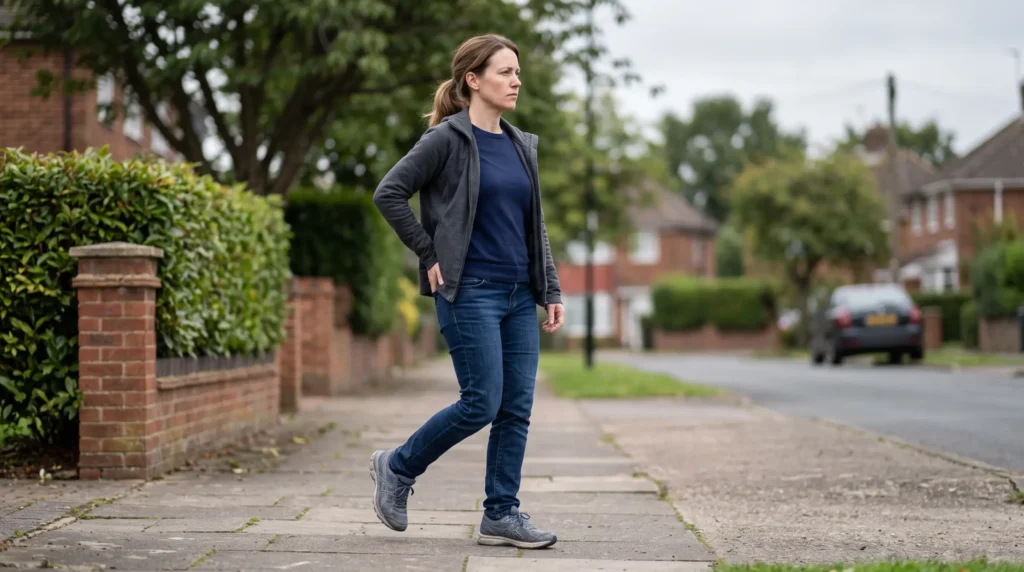
- Walk, even badly. Five minutes, several times a day, at whatever pace and posture you can manage. This is the single highest-value thing in the first week.
- Do not lie down all day. Rest in a comfortable position when you need to, but cap it at 20–30 minutes at a time before getting up and moving.
- Use heat for spasm. A heat pack for 15–20 minutes helps guarded muscles let go; some people prefer cold in the first day. Either is reasonable — the choice between ice and heat matters less than staying mobile.
- Set up your bed and chair. A pillow between the knees on your side or under the knees on your back removes a surprising amount of overnight pain.
- Log two markers. How long you can sit before pain builds, and how far down your legs you can reach. These become the numbers you track instead of guessing.
Do’s and don’ts for a lumbosacral strain
- Do keep bending — in a modified range. Complete avoidance of forward bending for two weeks produces a back that has forgotten how, and the return is worse than the injury.
- Do hinge from the hips for everything low — loading the dishwasher, picking up shoes — from about week two onward. This is rehearsal, not restriction.
- Do keep working if you reasonably can, adjusting tasks rather than stopping. Extended time off is associated with slower recovery, not faster.
- Don’t stretch into sharp pain in the first week. Injured muscle that is already lengthened and irritable does not want more length; it wants gentle, repeated movement.
- Don’t rely on a back brace beyond the first few days. Short-term support can help you keep moving; worn continuously it lets the trunk muscles stand down at precisely the moment they need to work.
- Don’t return to your previous lifting loads the week the pain stops. Tissue strength trails symptom relief by weeks, and that gap is where re-injury happens.
What if it is not settling?
If there is no meaningful improvement after two to three weeks of sensible self-management, the assumption that this is a simple strain should be revisited rather than repeated. That does not usually mean something sinister — more often it means the diagnosis needs refining, or that the recovery has stalled at a stage that needs guided loading rather than more time.
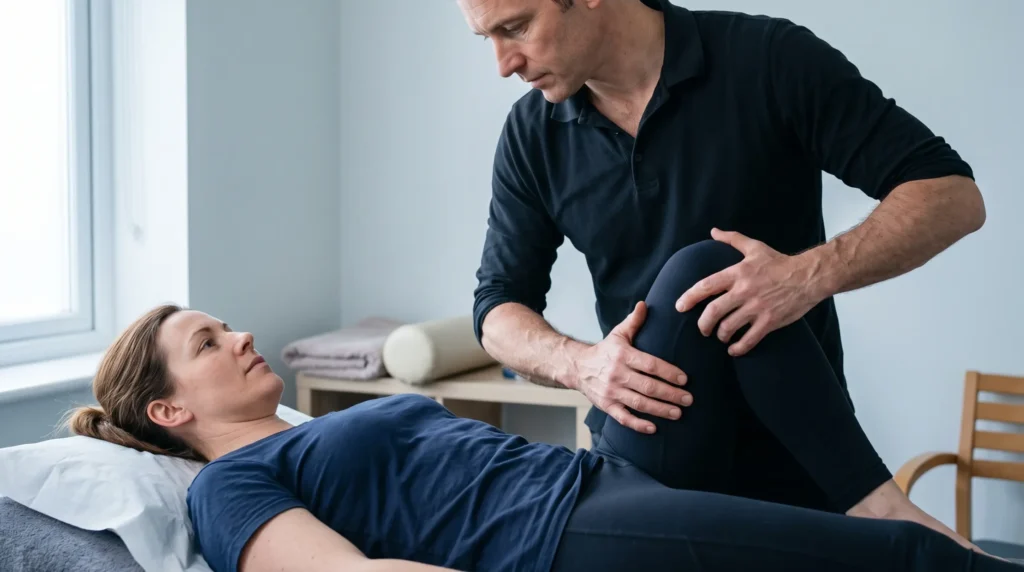
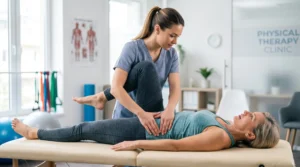
A physical therapy assessment at that point is aimed at three questions: is a joint or disc contributing that was not obvious at the start, has hip mobility or glute strength become the limiting factor, and has the pain outlasted the tissue healing time in a way that suggests sensitization. A structured progressive exercise program for the lower back handles the majority of these cases; the Cochrane overview of non-drug options found exercise therapy probably reduces pain and slightly improves function in persistent low back pain, which is a modest but real effect and considerably better than waiting.
Surgery has essentially no role in a soft-tissue lumbosacral strain. There is nothing to repair surgically, and an operation cannot rebuild load tolerance. Surgical opinions belong to a different set of problems — nerve compression with progressing weakness, instability, fracture, or a structural cause identified on imaging that clearly matches the symptoms.
Seek care if…
- Pain begins travelling down the leg when it started out purely local.
- You notice numbness, tingling or weakness anywhere in the leg or foot.
- Nothing has improved after two to three weeks, or symptoms are worsening week on week.
- Pain is severe at night and unrelieved by any position.
- Any bladder or bowel change, or saddle numbness — this is an emergency, not an appointment.
Conclusion
A lumbosacral strain is a soft-tissue injury at the junction where your lumbar spine meets your sacrum — painful, often dramatically so in the first few days, and reliably self-limiting. The features that mark it out are pain that stays local, stiffness that eases with gentle movement, and the complete absence of tingling, numbness or leg weakness. Most people are substantially better inside two to six weeks.
Two decisions shape how that period goes. The first is whether you move in the first week, because early gentle activity beats rest and the evidence on that point is not close. The second is whether you rebuild the hip hinge afterward rather than stopping when the pain does — that is the difference between an episode and a pattern. Keep the small list of warning signs in mind, and treat any leg symptoms or bladder and bowel changes as a reason to be assessed rather than a reason to wait.
Frequently asked questions
Is a lumbosacral strain serious?
In itself, no — it is a soft-tissue injury that heals, and it does not damage the spine, discs or nerves. What makes any episode of back pain serious is the company it keeps: leg weakness, spreading numbness, or bladder and bowel changes point to something other than a strain and need prompt assessment.
Can I still go to work with a lumbosacral strain?
Usually yes, with modifications. Desk workers should stand and move every 20–30 minutes; manual workers should avoid heavy or twisted lifting for one to two weeks and delegate the worst tasks. Staying at work in a modified capacity is generally associated with faster recovery than extended time off.
Why does my back hurt more the day after the injury?
Because the inflammatory response and protective muscle spasm both build over the following twelve to twenty-four hours. Adrenaline masks a good deal at the moment of injury, and the tissue swelling that follows genuinely does increase stiffness and pain. A worse second day is expected and does not mean the injury has extended.
Should I use a back brace?
For a few days at most, and only if it lets you keep moving rather than replacing movement. Worn continuously beyond the first week, a brace allows the trunk muscles to offload at exactly the point they should be recruiting again, which tends to prolong stiffness and weakness.
Is it a strain or did I herniate a disc?
Leg symptoms are the deciding feature. A strain stays local and does not produce tingling, numbness or shooting pain below the knee, whereas a herniation irritating a nerve root usually does. If coughing or sneezing sends a jolt down your leg, that points toward the disc rather than the muscle.
Will this happen again?
It can, and the strongest predictor is whether anything changed after the first episode. Recurrence rates fall when hip mobility, glute strength and a genuine hinge pattern are rebuilt; they stay high when people simply wait for the pain to stop and then resume the same loading habits.
Are painkillers or muscle relaxants worth taking?
Short-term pain relief can be useful specifically because it lets you move, sleep and return to normal activity sooner — movement is the treatment, and medication is the thing that makes movement possible. Suitability depends on your medical history and other medications, so that choice belongs with your doctor or pharmacist.
Medical disclaimer
This article describes general patterns in soft-tissue back injuries and cannot substitute for an examination of your back by a qualified clinician. Several conditions produce pain that resembles a strain in the first few days, and telling them apart requires a history and physical assessment. Use this as background for a conversation with a health professional rather than as a replacement for one, and seek urgent medical care for any change in bladder or bowel control, numbness around the groin, or leg weakness that is worsening.
References
- Rizzo RN, Cashin AG, Wand BM, Ferraro MC, Sharma S, Lee H, et al. Non-pharmacological and non-surgical treatments for low back pain in adults: an overview of Cochrane reviews. Cochrane Database of Systematic Reviews. 2025;(3):CD014691. https://doi.org/10.1002/14651858.CD014691.pub2
- National Institute for Health and Care Excellence. Low back pain and sciatica in over 16s: assessment and management (NG59). Published 2016, last updated 2020. https://www.nice.org.uk/guidance/ng59