Expert Review: This article includes clinical insights from Dr. Vivek Arora, a physical therapist (physiotherapist) with 20+ years of experience.
Almost nobody asks how long does sciatica last out of idle curiosity. People ask because there is a wedding in three weeks, a job that involves standing all day, a flight already booked, or simply because the leg pain has gone on long enough that the mind starts drifting toward worst-case scenarios. The honest answer comes with a reassuring headline and an uncomfortable footnote: most sciatica improves substantially within four to six weeks, and a real minority takes considerably longer than anyone would like.
What follows is the timeline as it actually plays out in practice — why nerve pain runs on a slower clock than a pulled muscle, which features genuinely shift the schedule, how to tell at week two whether you are on track, and the specific symptoms that mean the timeline no longer applies to you.
Key takeaways
- Four to six weeks is the realistic window in which most sciatica eases substantially, with many cases largely resolved by three months.
- Recovery is stepped, not smooth — good days and bad days alternating is normal and is not evidence of failure.
- Where the pain sits matters more than how loud it is. Symptoms retreating up the leg toward the back is progress even when the back itself feels busier.
- Numbness and tingling routinely outlast the pain by weeks or months, because nerve tissue repairs slowly.
- A short list of symptoms — spreading weakness, both legs, bladder or bowel change — cancels the timeline entirely and needs prompt assessment.

How long does sciatica last?
Most sciatica improves substantially within four to six weeks, and a large share of episodes settle within three months without injections or surgery. Pain is usually at its loudest in the first one to two weeks, then eases in uneven steps rather than a straight line. A meaningful minority still has symptoms at twelve months, which is why early signs of direction matter far more than counting days.
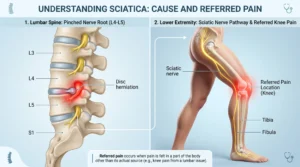
That last point deserves a number rather than a vague reassurance. In a large primary care study following adults with back-related leg pain, roughly 55% had meaningfully improved at twelve months — genuinely encouraging, and also a reminder that “it always goes away on its own” is a comfortable oversimplification. Sciatica is a symptom of an irritated lumbar nerve root, most often from a disc that has bulged or herniated backward, and the speed at which that irritation calms varies more than most people are told.
One clarification worth making early, because it changes the timeline you should expect: not all leg pain is sciatica. Deep buttock pain with no tingling, no numbness and nothing travelling below the knee often behaves like a muscular problem and settles faster. If you are still working out whether your symptoms fit the nerve pattern at all, the specific sensations that point to true sciatica are the place to start, and it is also worth ruling in or out the difference between piriformis-related buttock pain and genuine nerve root sciatica, because the two run on noticeably different schedules.
Why does sciatica take weeks rather than days?
Sciatica takes weeks because two separate processes have to resolve, and neither is fast. The mechanical part — disc material pressing on or crowding a nerve root — shrinks and is gradually reabsorbed over weeks to months. The chemical part — inflammatory irritation of the nerve itself — settles sooner but leaves the nerve temporarily hypersensitive. A muscle strain has one healing curve. A nerve root has three overlapping ones.
The anatomy explains why the clock runs the way it does. Each lumbar nerve root leaves the spine through a narrow bony corridor with very little spare room, passing right beside the back edge of a disc. When the disc’s outer wall weakens and its softer inner material pushes backward, it does not simply squash the nerve like a garden hose. It also triggers a local inflammatory response, and inflamed nerve tissue becomes mechanically sensitive — meaning movements that were previously unremarkable now provoke symptoms. That is why a flare can be set off by something as mundane as reaching into the back seat of a car.
Three practical consequences follow, and they account for most of the confusion people have about their own recovery:
- Pain settles before function does. The nerve stops screaming well before it tolerates a full day of driving or a heavy shopping run. People who return to normal loading the moment pain drops are the ones who tend to flare in week three.
- Numbness and tingling lag behind. Sensory nerve fibers regenerate slowly. A patch of dulled feeling on the shin or outer foot commonly persists for weeks or months after the pain has gone, and by itself it is rarely a reason for alarm.
- Recovery arrives in steps. Nerve irritation fluctuates with inflammation, activity, sleep and even how much you have been sitting. A bad Tuesday after a good Monday is a normal feature of the curve, not a relapse.
What makes one person’s sciatica last longer than another’s?
The strongest predictors of a slower recovery are how long the leg pain has already been present before treatment starts, how far down the leg symptoms travel, whether genuine muscle weakness is present, and — perhaps surprisingly — how long the person expects it to last. Age, sitting-dominant work and disturbed sleep also drag the timeline out. The size of a disc bulge on a scan predicts far less than most people assume.
That expectation finding is not motivational fluff. In the primary care cohort mentioned above, a patient’s belief that the problem would last a long time was one of the independent predictors of a poorer twelve-month outcome, alongside longer leg pain duration. The plausible mechanism is behavioral rather than mystical: people who expect a long haul move less, guard more, sit longer, and get deconditioned — which is precisely what an irritated nerve root does not need.
Different presentations also carry genuinely different arcs. The table below reflects the patterns that show up repeatedly in conservative care.
| How it presents | What it usually reflects | Typical arc | What stretches the timeline |
|---|---|---|---|
| Sudden leg pain past the knee after bending or lifting | Fresh disc-related nerve root irritation | Loudest in week 1–2, clearly easing by week 4–6 | Prolonged sitting, bed rest, aggressive early hamstring stretching |
| Deep buttock ache, nothing below the knee, no tingling | More often muscular or joint-related than nerve root | Frequently settles in 1–3 weeks | Returning to full gym loading before hip strength recovers |
| Leg pain plus a defined patch of numbness | Sensory fibers of one nerve root affected | Pain eases on the usual 4–6 week curve; numbness may linger months | Nothing — the numbness tail is expected, not a setback |
| Leg pain plus true weakness (foot catching, weak push-off) | Motor fibers involved — needs assessment, not patience alone | Variable; requires review rather than a fixed timeline | Waiting it out; weakness that is progressing needs prompt attention |
| Older adult, leg symptoms that build on walking and ease on sitting or leaning forward | Pattern more suggestive of spinal canal narrowing than disc herniation | Slower, more fluctuating, measured in months | Treating it like disc sciatica; the aggravating positions are reversed |
| Leg pain still meaningful past 12 weeks | Persistent radicular pain with added sensitization | Improvement continues but slows; structured rehab matters more | Repeating passive treatments without progressive loading |
How do you know your sciatica is actually improving?
The most reliable early sign of improvement is not less pain — it is pain that has retreated closer to the spine. Leg symptoms withdrawing from the calf to the thigh, or from the thigh to the buttock, indicate the nerve root is calming even if the back feels temporarily busier. Clinicians call this centralization, and it often shows up days before the overall pain score drops.
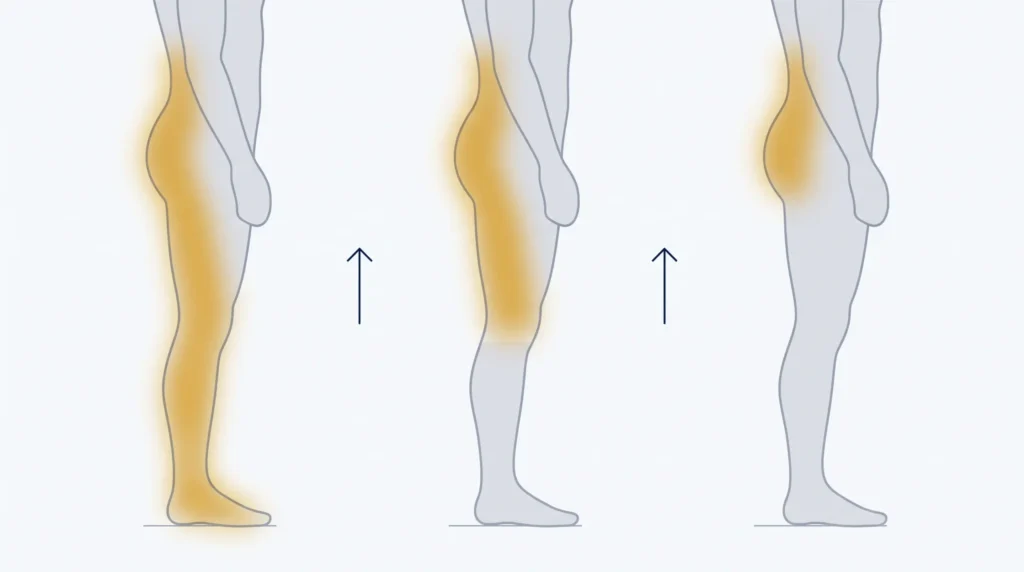
Four other markers are worth tracking, because they change earlier and more honestly than a pain rating out of ten. First, the frequency of spikes: sharp jolts happening four times a day instead of fifteen is progress even if each jolt is just as sharp. Second, sitting tolerance in minutes — going from eight minutes to twenty before the leg complains is a measurable win. Third, night waking: fewer wake-ups usually precedes daytime improvement. Fourth, recovery time after a flare; early on a bad episode might cost you two days, and later the same provocation costs an afternoon.
Quick check: are you on track at week two?
Answer yes or no. Three or more clear “yes” answers suggests your recovery is heading the right way and time is on your side.
- Has the furthest point your pain reaches down the leg moved upward compared with week one?
- Are the sharp spikes happening less often, even if they are still sharp?
- Can you sit for more minutes than you could a week ago before the leg objects?
- Are you waking fewer times at night because of the leg?
- After a bad flare, are you bouncing back faster than you did at the start?
Mostly “no” at the two-week mark, or any answer moving in reverse, is a reasonable trigger to get assessed rather than wait for week six.
Which symptoms mean the timeline no longer applies?
A small number of findings change the question from “how long will this take” to “this needs looking at now”. They matter because each one suggests the problem may involve more than a single irritated nerve root — and in that situation, waiting is the risk rather than the strategy.
- Any change in bladder or bowel control, including difficulty starting or stopping urination, or not registering that the bladder is full. This can indicate compression of the nerve bundle at the base of the spine, where the window for treatment is measured in hours, not weeks. Seek emergency care the same day.
- Numbness in the saddle area — the groin, genitals, or the inner thighs you would sit on. Reduced sensation noticed when wiping counts, and carries the same urgency as the point above.
- Weakness that is getting worse rather than better. A foot that has started slapping the floor, or a leg that gives way on stairs, points to motor fibers under sustained pressure. Weakness that progresses over days is assessed promptly, not observed for six weeks.
- Symptoms appearing in both legs. Sciatica overwhelmingly picks one side. Bilateral leg symptoms suggest the problem sits more centrally in the canal and deserves a closer look.
- Fever, night sweats, unexplained weight loss, or a history of cancer alongside the back and leg pain. These raise the possibility of infection or other pathology rather than a mechanical disc problem, and they change the diagnostic pathway completely.
- Significant trauma — a fall from height, a road accident — where a fracture has to be excluded before anything else is assumed.
Will a scan tell you how long it will last?
No — and this is one of the most useful things to understand early. An MRI shows the current shape of the disc and the space around the nerve, but it does not measure how irritated that nerve is, how fast the body is reabsorbing the herniated material, or how you will feel in a month. Large herniations often settle quickly; modest ones sometimes linger. The picture and the timeline are only loosely related.
National guidance reflects this. The UK’s National Institute for Health and Care Excellence advises against routinely offering imaging for low back pain and sciatica outside specialist settings, and recommends considering it only where the result is likely to change management. In plain terms, a scan is ordered to answer a decision — is this person a candidate for an injection or surgery, is there a red flag to exclude — not to explain pain that is already improving on schedule.
There is a practical cost to scanning too early, too. Disc bulges, degenerative changes and narrowing are extremely common findings in people with no symptoms whatsoever, so an early scan frequently produces alarming vocabulary attached to changes that were probably there last year. If you have already had imaging and the report has left you rattled, it helps to know what those standard report phrases actually mean in plain language, and — if narrowing was mentioned — how stenosis findings should and should not influence your plan.
Four beliefs that quietly make sciatica last longer
- “I should rest until it stops hurting.” Extended rest is one of the few interventions that reliably lengthens the arc. Nerve tissue tolerates gentle, frequent movement better than stillness, and deconditioning adds weeks nobody accounted for.
- “If it were healing, it would improve every day.” Nerve irritation fluctuates. Judging recovery by yesterday versus today produces panic; judging it by this week versus last week produces an accurate picture.
- “The numbness means permanent nerve damage.” A stable patch of reduced sensation that is not spreading, with normal strength, is the ordinary slow tail of sensory recovery. Spreading numbness or new weakness is the version that warrants assessment.
- “Stretching it harder will speed it up.” Deep forward-bending hamstring stretches pull directly on an already sensitized nerve. People who stretch aggressively in week one often find themselves in week five still describing week one symptoms.
From the Clinic: Dr. Arora’s Expert Insight
Patients time their sciatica by how much it hurts. I time it by where it hurts — and those two clocks run at completely different speeds. Someone will tell me the week has been terrible, and then mention almost in passing that the pain now stops at the back of the knee when a fortnight ago it was reaching the outer ankle. That is the single most useful sentence in the consultation, and it is usually the one the person did not think was worth saying.
This matters because pain intensity is a poor progress marker in nerve problems. It swings with sleep, stress, how long someone sat in a car, and how much they did the day before. Location is far more stable. A pattern that comes up repeatedly is a person becoming discouraged in week three, ready to escalate to injections, when their symptom map has actually been quietly shrinking the whole time — they were simply reading the wrong instrument.
The place generic advice fails hardest here is the phrase “give it six weeks”. It sounds sensible, but as a plan it is empty, because it gives the person nothing to observe and no way to know whether they are on the good curve or the bad one. So they wait passively, guard, sit more, and arrive at week six deconditioned and no clearer. What works better in practice is embarrassingly simple: pick two things you can actually count — the furthest point the pain travels, and how many minutes you can sit before the leg objects — write them down twice a week, and let those numbers, not the pain score, tell you whether time is working for you or against you.
What should you do while the clock runs?
In the first two or three days the aim is not to fix anything but to stop feeding the irritation: move often in small amounts, break up sitting aggressively, and find one or two positions that pull symptoms out of the leg. After that, progression is driven by what the leg does — not by dates on a calendar.
What to do in the next 72 hours
- Walk little and often. Five to ten minutes every hour or two beats one long walk, and beats no walking by a wide margin.
- Cap your sitting. Set a limit a few minutes below where the leg usually starts complaining, and stand before you reach it rather than after.
- Find your easing position and use it deliberately. For many people that is lying face down propped on forearms, or lying on the back with knees supported. Whatever draws symptoms up the leg is the right one for you.
- Write down two numbers today — how far down the leg the pain reaches, and your sitting tolerance in minutes. These become your baseline.
- Skip the deep hamstring stretches for now. Tension on a sensitized nerve root is the most common self-inflicted setback in the first fortnight.
From roughly the end of the first week, progression follows symptom behavior rather than the date. The sequence below is what advancement actually looks like, and each step is unlocked by the one before it — not by a number of days having passed.
- While symptoms still reach below the knee: stay with frequent short walks, position changes, and gentle movements in the direction that draws pain upward. Do not add loaded exercise yet.
- Once pain consistently stays above the knee: add gentle hip and trunk mobility, and begin unloaded strength work — glute bridges, side-lying hip work, controlled sit-to-stand.
- Once sitting tolerance passes roughly 20–30 minutes without a leg flare: introduce a proper hip hinge pattern with light load, and start rebuilding the movement that likely provoked the episode in the first place.
- Once strength feels even side to side and daily loads are uneventful: return to gym lifting, longer drives, and impact — one variable at a time, roughly one step per week.
- If a step provokes symptoms further down the leg: drop back one level for several days, then retry. That is a normal part of the process rather than a failure of it.
A structured home physical therapy program for the lower back can carry most people through steps two to four, as long as leg symptoms rather than ambition are setting the pace.
Do’s and don’ts that specifically affect the timeline
- Do track location and sitting minutes rather than a pain score — they change earlier and mislead less.
- Do keep driving trips short in the first fortnight, and get out of the seat every 30–40 minutes on longer journeys.
- Do protect sleep actively — a pillow between the knees when side-lying, or under the knees when on your back — because poor sleep measurably worsens nerve pain.
- Don’t judge the week by its worst hour. Compare this week with last week instead.
- Don’t keep repeating passive treatments past the three-week mark if nothing is trending. Hands-on work has a place alongside exercise, but not as a substitute for progressive loading.
- Don’t resume heavy deadlifting or long-haul driving the same week the pain stops. Function trails pain, and that gap is where most avoidable flares live.
What happens if it is still there after twelve weeks?
Sciatica that persists beyond about twelve weeks is usually described as chronic, but that word is more administrative than predictive — improvement typically continues, just more slowly. At this stage the priority shifts from calming an acutely inflamed nerve to rebuilding load tolerance and addressing the sensitization that develops when a nerve has been irritable for months.

This is also the point where escalation is reasonably discussed. An epidural steroid injection may reduce severe radicular pain enough to allow rehab to proceed. Surgery — most often a microdiscectomy — is considered when leg pain remains genuinely disabling after a fair trial of well-directed conservative care, and imaging confirms compression that matches the symptoms. NICE guidance frames spinal decompression as an option where non-surgical treatment has not improved pain or function and the radiological findings align with the clinical picture. Two things are worth holding onto: surgery targets leg pain from nerve compression rather than back pain generally, and a scan finding on its own is never the reason to operate.
Seek care promptly if…
- Leg weakness is increasing, or your foot has started catching or dragging.
- Nothing has moved in the right direction after two to three weeks of sensible self-management.
- Pain is spreading further down the leg week on week rather than retreating.
- Symptoms have appeared in the second leg.
- Any bladder, bowel or saddle-numbness change — same day, not next week.
Conclusion
So, how long does sciatica last? For most people, the sharp phase burns out within one to two weeks, meaningful improvement arrives by four to six, and the episode is largely behind them within three months — with a numb patch on the shin sometimes hanging around after everything else has gone. A minority take longer, and the features that predict that are reasonably well known: symptoms that have already run for a while, pain travelling well below the knee, genuine weakness, and the expectation that recovery will be slow.
The practical move is to stop asking the calendar and start measuring two things you can actually observe — how far the pain travels, and how long you can sit before the leg complains. Those numbers will tell you within a fortnight whether time is on your side. And if weakness is increasing, both legs are involved, or anything changes with your bladder or bowel, the timeline stops being the question and getting assessed becomes it.
Frequently asked questions
How long does sciatica last without any treatment?
Many episodes settle over four to twelve weeks even with no formal treatment, because the inflammation calms and herniated disc material is gradually reabsorbed. The catch is that “no treatment” usually means less movement, more sitting and more guarding, all of which tend to slow the curve rather than leave it untouched.
Why is my sciatica worse at night if it is supposed to be improving?
Nights are commonly worse because you stay in one position for hours, inflammatory chemicals accumulate around an irritated nerve, and there is less distraction competing for attention. Night pain that is easing week on week fits a normal recovery; night pain that is severe, unrelenting and unrelated to position deserves review.
How long does numbness in the foot last after sciatica?
Numbness frequently outlasts the pain by weeks to several months, since sensory fibers recover slowly. A stable, non-spreading patch of reduced feeling with normal strength is generally expected. Numbness that is expanding, or that arrives alongside new weakness, should be assessed rather than waited out.
Can sciatica come back after it has gone?
Yes, recurrence is reasonably common, particularly in the first year and particularly if the underlying loading habits have not changed. Rebuilding hip and trunk strength, keeping a genuine hinge pattern for lifting, and breaking up long sitting are the measures that most reliably lower the odds.
Does sciatica in pregnancy follow the same timeline?
Not reliably. Pregnancy-related leg pain is often driven by changing load distribution, pelvic girdle mechanics and ligament laxity rather than a disc herniation, so it frequently tracks the pregnancy itself and improves substantially after delivery. It should be assessed on its own terms rather than mapped onto the standard four-to-six week curve.
How long before I can go back to the gym or lift heavy again?
Most people restart light hinge and glute work once pain stays consistently above the knee, and return to meaningful loading somewhere between weeks six and twelve. The gate is functional rather than temporal: even strength side to side, sitting tolerance of half an hour or more, and no increase in leg symptoms over the 24 hours after a session.
At what point should I stop waiting and see someone?
Two to three weeks with no movement in the right direction is a sensible trigger for assessment, and worsening weakness or symptoms spreading further down the leg is a reason to go sooner. Any bladder, bowel or saddle-numbness change is an emergency and should not be scheduled at all — it should be acted on immediately.
Medical disclaimer
The timelines described here are population patterns, not a prediction for any individual. Leg pain has several possible sources, and an accurate plan depends on a history and physical examination that this article cannot perform. Nothing here replaces individual medical assessment, and it should not be used to delay care that your symptoms warrant. If you develop any change in bladder or bowel control, numbness around the groin, or weakness that is worsening, treat it as an emergency and seek immediate medical attention.
References
- Konstantinou K, Dunn KM, Ogollah R, Lewis M, van der Windt D, Hay EM. Prognosis of sciatica and back-related leg pain in primary care: the ATLAS cohort. The Spine Journal. 2018;18(6):1030–1040. https://doi.org/10.1016/j.spinee.2017.10.071
- National Institute for Health and Care Excellence. Low back pain and sciatica in over 16s: assessment and management (NG59). Published 2016, last updated 2020. https://www.nice.org.uk/guidance/ng59