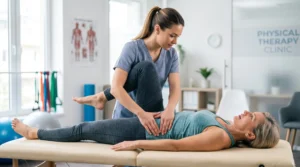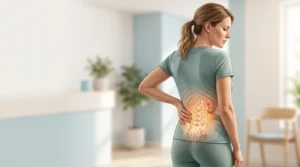
Expert Review: This article includes clinical insights from Dr. Vivek Arora, a physiotherapist with 20+ years of experience.
When the lower back aches and the pelvis feels heavy, full, or under pressure at the same time, the brain runs two stories in parallel. One says, I must have strained something — it’s mechanical. The other says, Something inside me is wrong — this is more than a back problem. Both stories can be true at different times, and that is exactly why lower back pain and pelvic pressure as a combined symptom pattern confuses people more than either symptom alone.
Lower back pain and pelvic pressure occurring together is most often mechanical — sacroiliac joint irritation, pelvic girdle pain, or an overactive pelvic floor, since the lumbar spine and pelvis share both nerve supply and load. But the combination also has a wider differential than back pain alone, taking in gynaecological, urological and bowel causes. How the symptoms behave with movement is what separates them.
This article is built to give you a clinician’s framework for sorting the picture out: what is usually happening when the two symptoms travel together, which patterns point toward mechanical causes, which patterns deserve a medical workup, when imaging genuinely earns its place, and what early management looks like when the cause is musculoskeletal. The goal is for you to leave with a clearer sense of what to do in the next 72 hours and what would change your decision to seek care sooner.
A short caveat upfront. Everything below is a framework, not a diagnosis. If your symptoms include any of the red flags discussed later — saddle numbness, new bowel or bladder changes, fever, severe sudden abdominal pain, or pregnancy bleeding — stop reading and seek urgent medical assessment.
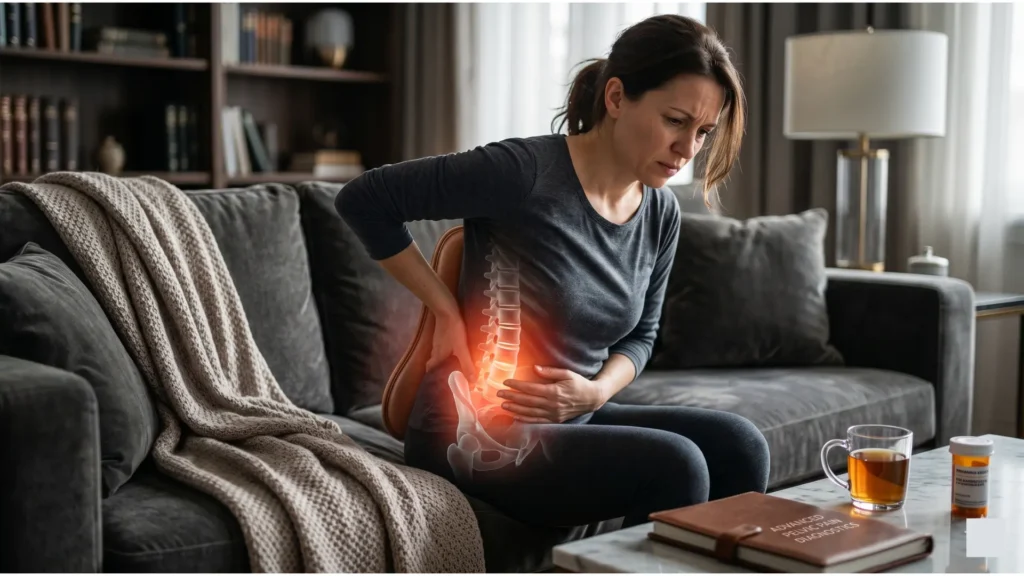
Key Takeaways
- The lower back and pelvis are one functional unit; signals from one region routinely overlap with the other through shared innervation and shared load demands.
- Combined back and pelvic symptoms have a wider differential than back pain alone — including pelvic floor dysfunction, pelvic girdle pain, gynecological, urological, and bowel-related causes.
- Most cases are mechanical and respond to conservative care. A smaller subset needs medical workup, and a very small subset is urgent.
- Symptom patterns — what makes the pain better, worse, when it happens, and how it behaves — are usually more informative than imaging in the first weeks.
- Generic core training and untargeted Kegels are common reasons rehab fails for this presentation.
- Conservative care involves load management, breathing-pelvic floor coordination, lumbopelvic stability, and progressive loading — not rest and waiting.
What’s actually happening when lower back pain and pelvic pressure show up together?
The lower back and pelvis behave as a single mechanical and neurological unit, which is why a problem in one region often expresses itself in the other. The lumbar spine, sacroiliac (SI) joints, hip joints, deep abdominal wall, and pelvic floor all load each other every time you stand, walk, lift, cough, or stabilize against gravity. They also share nerve supply from roughly the lower thoracic and upper sacral spine, so a single irritated structure can produce symptoms across both regions.
A few specific mechanisms explain most overlapping presentations:
- Shared neurology. Pain fibers from lumbar facet joints, SI joints, lumbar discs, and pelvic floor muscles converge on overlapping spinal cord segments. Your brain often cannot precisely localize the source, and pelvic pressure can be the central nervous system’s interpretation of a mechanical problem one segment higher.
- Shared load. The SI joints sit between the spine and the pelvis as living shock absorbers. When the deep core or hip muscles are not contributing well, these joints take a heavier share of the load, producing both low back ache and a deep pelvic heaviness.
- Shared muscular envelope. The pelvic floor, transverse abdominis, multifidus, and diaphragm form a coordinated pressure system. Loss of coordination in one component — for example, a tight, guarded pelvic floor — alters lumbar control and can produce both back stiffness and pelvic heaviness simultaneously.
- Visceral referral. Pelvic and abdominal organs share spinal innervation with structures in the lower back. A bowel, bladder, prostate, or uterine problem can present as lumbopelvic pain even when nothing is mechanically wrong with the spine.
Understanding this overlap matters because it changes how you assess yourself. If you treat the back as a back problem and the pelvis as a pelvic problem, you frequently miss the link. The lumbopelvic view is what produces clean diagnosis and clean treatment.
What are the most common causes of lower back pain and pelvic pressure?
Most cases of combined lower back pain and pelvic pressure fall into one of four buckets: mechanical lumbopelvic dysfunction, pregnancy or postpartum-related, gynecological or urological, and a smaller group of serious conditions that need urgent medical assessment. The most useful first step is not finding “the diagnosis” but figuring out which bucket you are in, because the management path is very different for each.
1. Mechanical lumbopelvic causes (most common):
- Sacroiliac joint dysfunction — pain across the back of the pelvis, often worse with single-leg activities like climbing stairs or rolling in bed; frequently shows up with tight glutes that pull on the SI joint and lower back.
- Pelvic girdle pain (PGP) — a specific form of low back pain located between the posterior iliac crest and the gluteal fold, often radiating into the posterior thigh, sometimes including symphysis pain. PGP can occur separately or together with general low back pain.
- Pelvic floor dysfunction — typically a hypertonic (overly tight, guarded) pelvic floor producing heaviness, pressure, and a “something is dragging” sensation, often paired with low back stiffness.
- Lumbar disc or facet involvement — a disc or facet joint at L4–L5 or L5–S1 referring pain into the buttock and pelvis.
- Hip-driven pain — femoroacetabular impingement or labral irritation that loads the SI joint and pelvic floor abnormally.
2. Pregnancy and postpartum: Pelvic girdle pain during pregnancy is extremely common and well-described in clinical literature. Mechanical loading changes, ligamentous laxity, and shifting center of mass all contribute. Postpartum, pelvic floor dysfunction and SI joint instability are common drivers. Specific clinical management for this group is covered in detail in resources on low back pain in early pregnancy.
3. Gynecological and urological causes:
- Endometriosis, fibroids, ovarian cysts, or pelvic congestion (often produce cyclical pressure tied to the menstrual cycle).
- Urinary tract infection, kidney stones, interstitial cystitis.
- Prostatitis or benign prostatic hyperplasia in men.
- Inguinal or femoral hernias.
For female-specific patterns, the broader picture of common causes of lower back pain in women is worth a careful read, especially if your pelvic pressure tracks with your cycle.
4. Bowel-related causes: Constipation alone can produce both lower back ache and pelvic heaviness through visceral pressure and reflexive trunk muscle guarding. Irritable bowel patterns, diverticular issues, and slowed transit can all contribute. The visceral side of this conversation is explored further in articles on low back pain with stomach pain.
5. Serious causes (uncommon but important):
- Cauda equina syndrome
- Spinal infection or tumor
- Abdominal aortic aneurysm (older adults)
- Ectopic pregnancy or pregnancy complications
- Pelvic infection (PID)
These are uncommon but they exist, which is why the red flag section below matters.
How do I tell if it’s mechanical or something internal?
Mechanical pain usually changes with movement, position, and load — it gets worse with specific activities and better with others, follows a predictable pattern, and responds to rest or position changes. Internal or visceral pain often does not behave that way; it tends to be deeper, more constant, less position-dependent, and may track with menstrual cycles, eating, urination, or bowel movements rather than with movement. The table below maps out the patterns most reliably useful at home.
| Symptom Pattern | Likely Direction | What It Often Suggests |
|---|---|---|
| Worse with sitting, better when up and moving | Mechanical | Discogenic involvement at L4–L5 or L5–S1 |
| Worse standing or walking long, better sitting or leaning forward | Mechanical | Lumbar canal narrowing or facet-loaded pain |
| Sharp pain transferring weight to one leg, climbing stairs, rolling in bed | Mechanical | Sacroiliac joint or pelvic girdle pain |
| Deep pelvic heaviness, “dragging” sensation, worse end of day | Mechanical / pelvic floor | Hypertonic pelvic floor or pelvic congestion |
| Pain tracks with menstrual cycle | Visceral | Endometriosis, fibroids, ovarian source |
| Pain with urination, frequency, urgency, or burning | Visceral | UTI, bladder, or prostate involvement |
| Pain after meals or with bowel movement, relieved by passing stool | Visceral | Bowel-related cause |
| Constant, deep, unchanged by position, worse at night | Non-mechanical | Needs medical workup |
| Sudden severe abdominal pain with collapse or fainting | Emergency | Vascular or pregnancy emergency |
A useful rule: if your pain has a predictable trigger and a predictable relief, you are usually looking at something mechanical. If neither side of that equation matches movement, the differential opens up significantly.
When are red flags actually red flags?
Red flag lists exist because they protect a small number of people from being missed. Most of the items below are, individually, low-yield — meaning that having one symptom on the list rarely indicates a serious problem. What changes the picture is combinations, new onset, and progression. The point is not to scare you; it is to give you a clear threshold for when to escalate.
Seek urgent medical assessment if you have any of the following:
- New numbness in the saddle area (inner thighs, perineum, genital region)
- New loss of bladder or bowel control, or new difficulty starting urination
- Progressive weakness in one or both legs
- Fever with back or pelvic pain, especially with chills, night sweats, or recent infection
- Severe, sudden abdominal pain with light-headedness, collapse, or pulsatile mass in the abdomen
- Vaginal bleeding during pregnancy with severe pelvic pain or contractions
- Significant unexplained weight loss with persistent pain
- History of cancer with new persistent back or pelvic pain unresponsive to position change
- Pain so severe at night that it wakes you and you cannot find any position that helps
- Recent significant trauma, even if pain seemed mild at first
The first three together — saddle numbness, bowel or bladder change, leg weakness — are the classic cauda equina pattern and are an emergency. Do not wait for a routine appointment if those appear.
🚩 Seek care today, not next week, if:
- You have new bladder or bowel changes alongside the pain
- You are pregnant and have bleeding, severe pelvic pain, or contractions
- You have a fever with this combination of symptoms
- The pain is rapidly worsening rather than fluctuating
- You have a known cancer history and the pain is new or different
When is imaging actually needed?
For most cases of combined lower back pain and pelvic pressure, imaging in the first four to six weeks is low-yield and frequently misleading because incidental findings — disc bulges, mild SI changes, ovarian cysts that come and go — appear in many people without symptoms. Imaging earns its place when red flags are present, when neurological symptoms are progressing, when conservative care has failed over six to eight weeks of structured rehab, or when the clinical picture suggests a specific visceral cause that imaging can confirm or rule out.
In practice, that breaks down roughly as follows:
- MRI of the lumbar spine is most useful when there is suspected nerve root compromise, suspected serious pathology, or persistent radiating pain with neurological signs.
- Pelvic ultrasound is the go-to first-line investigation when the picture suggests a gynecological cause, ovarian pathology, or bladder or uterine involvement.
- Plain X-rays rarely change management for typical mechanical lumbopelvic pain.
- CT is usually reserved for suspected fracture, kidney stones, or specific abdominal causes.
- Blood and urine tests are often more useful early on than imaging — they can quickly clarify infection, pregnancy, kidney involvement, or inflammatory markers.
If a clinician is moving directly to advanced imaging without first taking a careful history, examining you, and identifying a specific question the scan needs to answer, it is reasonable to ask: what would a positive or negative result on this scan change about my treatment plan? If the answer is “nothing”, the scan is probably not the right next step.
What myths get in the way of recovery?
A few specific misconceptions tend to slow people down with this presentation:
- “Pelvic pressure means I have prolapse.” Prolapse is one cause, but heaviness and pressure are far more often produced by a hypertonic pelvic floor or referred lumbopelvic pain. A pelvic floor exam is what distinguishes them.
- “My back pain plus pelvic pain must mean something is seriously wrong.” Most of the time, it does not. The combination is common, the causes are usually conservative-care-friendly, and the prognosis is usually good with structured rehab.
- “Strong abs will fix it.” Generic abdominal strengthening — especially crunch-style work — frequently makes lumbopelvic pain worse by increasing intra-abdominal pressure against an already overactive pelvic floor.
- “Kegels are the answer for any pelvic problem.” They are not. A guarded, hypertonic pelvic floor — the more common pattern in this presentation — gets worse with isolated Kegel training. Down-training and breathing work usually come first.
- “Rest will sort it out.” Short rest helps; prolonged rest worsens deconditioning, fear avoidance, and central sensitization. Movement is medicine, but the right kind and the right dose.
From the Clinic: Dr. Arora’s Expert Insight
When patients arrive with this combination, the first conversation I usually have is not about exercises — it is about ruling out what does not belong on a physical therapist’s table. A patient who has not yet had a basic medical workup for cyclical pelvic pressure that tracks with menstruation, or for pelvic pressure paired with urinary urgency, has not yet earned the right to a rehab plan. Sending them home with bridges and bird-dogs is not just unhelpful, it can delay a diagnosis that matters.
Once the visceral and serious causes are reasonably ruled out, the most consistent pattern I see is a quiet pelvic floor problem hiding behind what the patient calls “back pain.” They have been doing planks and crunches for months, sometimes years, often on the advice of a trainer or a generic back program. Their abs are strong. Their pelvic floor is not weak — it is overworking, gripped, and under load it cannot release. The back pain is the spillover. Adding more core work to that picture is like flooring the accelerator of a car that has the parking brake on.
What changes things is almost always two pieces of work that look unimpressive on paper. The first is restoring diaphragmatic breathing so the pelvic floor learns to lengthen on inhalation and the deep core stops bracing all day. The second is rebuilding hip and posterior chain strength — glutes, hamstrings, deep hip rotators — so the SI joint and the pelvic floor are not asked to be the primary stabilizers of the trunk. Patients who do those two things consistently for six to eight weeks usually do better than patients who do twice the volume of generic core work.
The other pattern worth naming: fear amplifies this presentation more than almost any other lumbar problem I see. Pelvic pressure feels alarming in a way that low back ache does not, because the pelvis is where the body keeps its more private organs. Patients quietly assume something is seriously wrong and start guarding everything — their breathing, their walking, their bowel movements. That guarding then becomes the problem the rehab plan has to undo. A clear explanation of what is actually happening, and what is not happening, is often the first real treatment.
What can I do in the next 24 to 72 hours?
The early window is about calming the system, not curing it. Three priorities matter:
- Reduce what clearly aggravates. If sitting longer than 30 minutes worsens it, set a timer and stand. If standing on hard surfaces makes the pelvis feel heavier, alternate positions every 20–30 minutes.
- Move gently and often. Walking 10–15 minutes, two or three times a day, is usually well-tolerated and helps lumbopelvic circulation more than lying still.
- Restore breathing. Five minutes, twice a day, of slow diaphragmatic breathing in a relaxed lying position with knees bent: in through the nose for 4 seconds, exhale for 6 seconds, letting the belly and pelvic floor soften on inhalation. This is foundational.
Heat for 15–20 minutes can help muscle-driven stiffness; ice tends to be less useful for lumbopelvic patterns unless there is a clear acute injury. Over-the-counter analgesia, when not contraindicated, is reasonable for short-term symptom control, but is a bridge, not a plan.
✅ What to do today
- Walk three short, easy 10-minute stretches across the day.
- Do 5 minutes of diaphragmatic breathing, twice.
- Avoid prolonged sitting on soft, slumped surfaces — use a firmer chair with lumbar support.
- Note what makes the pain better, what makes it worse, and when it spikes — this list is what your clinician will need.
- If any red flag from the list above shows up, stop home management and seek same-day care.
A phase-based recovery framework
The structure below is a clinical scaffold, not a prescription. Real progression is driven by symptom response and load tolerance, not by calendar weeks.
| Phase | Typical Window | Primary Goal | Representative Work |
|---|---|---|---|
| 1 — Calm | Days 1–14 | Reduce reactivity; restore breathing-pelvic floor coordination | Diaphragmatic breathing; gentle walking; pain-free range of motion |
| 2 — Connect | Weeks 2–4 | Re-establish lumbopelvic control under low load | Glute bridges, dead bugs, side-lying hip abduction, supported hip hinges |
| 3 — Load | Weeks 4–8 | Build hip and posterior chain capacity | Progressive hinges, single-leg work, controlled loaded carries |
| 4 — Return | Weeks 6–12+ | Reintroduce sport, lifting, prolonged standing tasks | Activity-specific drills; gradual return to running, gym, work demands |
Two practical rules across the whole framework:
- The 24-hour rule. If a session leaves you noticeably worse the next day, the dose was too high — reduce intensity or volume, not stop entirely.
- The progression rule. Do not move to the next phase because the calendar says so. Move when the current phase’s exercises feel controlled, repeatable, and produce no day-after flare.
Do’s and don’ts that are specific to this presentation
Do:
- Build hip and glute strength before adding heavy abdominal work.
- Treat the diaphragm and pelvic floor as a coordinated pair, not as separate muscles.
- Address bowel and bladder habits — straining with constipation is a real driver here.
- Use load you can control; the right deadlift is better medicine than the wrong stretch.
Don’t:
- Do not chase pelvic pressure with isolated Kegels unless a clinician has confirmed weakness rather than overactivity.
- Do not run a generic “core” program as the first line — it often makes hypertonic pelvic floor patterns worse.
- Do not push through pain that radiates into the leg with neurological symptoms.
- Do not assume a one-off MRI finding explains everything; correlate with how the symptoms behave.
When does conservative care fail, and what comes next?
If six to eight weeks of structured conservative care — meaning consistent, progressive, individualized rehab, not random exercises — has not produced clear improvement, the case earns a re-look. That re-look usually involves three things:
- Reconfirming the diagnosis. Is there a visceral or pelvic floor component that was missed? Is hip pathology driving the pelvis?
- Targeted imaging or specialist referral. Pelvic floor physiotherapy assessment, gynecology, urology, or spine consult depending on the clinical picture.
- Adjunct interventions. Image-guided injections to the SI joint or facet joints, pelvic floor down-training programs, or in select cases medications for centrally-driven pain.
Surgery is rarely the answer for this presentation. It becomes a serious consideration only when there is a specific, structurally identified cause — significant nerve compression, fixed instability, or clearly diagnosed pelvic pathology not amenable to conservative care. Even then, surgery is one tool among several, and the rehab work that follows it is usually the determinant of long-term outcome.
Realistic outlook
Most people with combined lower back pain and pelvic pressure get meaningfully better within 8–12 weeks of structured conservative care, especially when the rehab plan addresses lumbopelvic coordination and hip strength rather than chasing isolated symptoms. A subset will have flares; that does not mean the recovery has failed. It means the system is sensitive, and the management plan needs the next layer — usually load tolerance, sleep, stress, and breathing pattern work — rather than starting over.
The two strongest predictors of a good outcome are an accurate early diagnosis (so time is not wasted treating the wrong driver) and consistent rather than intense rehab. People who do less, more often, do better than people who do more, less often.
Conclusion
Lower back pain and pelvic pressure together is a common, mostly treatable, and frequently misdiagnosed presentation. The single most useful thing you can do at home is figure out which bucket you are in — mechanical, pregnancy or postpartum, gynecological or urological, bowel-related, or red-flag — because the right action looks very different in each. Most cases respond to structured conservative rehab built around breathing, lumbopelvic coordination, and progressive hip and posterior chain strength. A smaller group needs medical workup. A very small group needs urgent care. The framework above should help you tell which is which, and what to do today rather than next week.
If you take only one idea away, let it be this: patterns are more useful than panic. Notice what makes the pain better, what makes it worse, when it spikes, and what it is paired with. That information, more than any scan, is what produces an accurate diagnosis and a clean recovery plan.
FAQs
1. Can a pinched nerve in the lower back cause pelvic pressure? Yes, but it is not the most common cause. Lumbar nerve root irritation can refer pain and a sense of pressure into the buttock, posterior pelvis, and occasionally the genital region. True pelvic pressure with a heaviness or “dragging” quality is more often produced by pelvic floor dysfunction or SI joint involvement than by a pinched nerve. Neurological signs — numbness, weakness, reflex changes — make a nerve root cause more likely.
2. Is pelvic pressure always a sign of pelvic organ prolapse? No. Prolapse is one cause and is more common after childbirth or in older adults, but the same heaviness can come from a hypertonic pelvic floor, pelvic congestion, referred lumbopelvic pain, or chronic constipation. A pelvic floor exam by a trained clinician is what distinguishes them. Self-diagnosing prolapse from symptoms alone is unreliable.
3. How long should I wait before seeing a doctor? If there are no red flags, two to three weeks of sensible self-management is reasonable before formal assessment. See a clinician sooner if symptoms are clearly worsening, if you are pregnant, if pain disrupts sleep, or if any item from the urgent care list appears. Never wait on saddle numbness, new bowel or bladder changes, fever, or severe sudden pain.
4. Can stress and anxiety actually cause this combination of symptoms? Yes, and not in a “it’s all in your head” sense. Sustained stress increases pelvic floor tone, alters breathing patterns, and amplifies pain perception centrally. In some patients, anxiety is the dominant driver of a hypertonic pelvic floor that produces both back tension and pelvic heaviness. Addressing breathing, sleep, and stress is part of the clinical plan, not a soft add-on.
5. Are Kegels safe if I have lower back pain and pelvic pressure? Not always, and often not as a starting point. If the pelvic floor is overactive — which is common in this presentation — Kegels can worsen tightness and pressure. Safer first work is diaphragmatic breathing and pelvic floor down-training. Kegels become useful when a clinician has confirmed the pelvic floor is genuinely weak rather than tight.
6. Can men experience pelvic pressure with back pain? Yes. Men get pelvic floor dysfunction, SI joint problems, and pelvic girdle pain just as women do, and prostate-related causes — prostatitis or BPH — add a male-specific layer. The symptom pattern is largely the same: heaviness, pressure, low back ache, sometimes urinary symptoms. The diagnostic path is similar except urological assessment replaces gynecological assessment.
7. Does pelvic pressure during pregnancy always need treatment? Mild pelvic pressure is normal in many pregnancies as the body adapts to load. Treatment is appropriate when it limits walking, sleeping, or daily function, when it appears with sharp SI joint pain on weight transfer, or at any point if combined with bleeding, contractions, or fluid leakage. Pregnancy-specific physiotherapy is well-evidenced and usually safe; obstetric clearance first is the right path.
Medical Disclaimer
This article is general health education and is not a substitute for individual medical assessment. Combined lower back and pelvic symptoms can be produced by a wide range of causes — some musculoskeletal, some visceral, some serious — and only a qualified clinician who can take your full history and examine you can make a diagnosis. If you have any of the red flags described above, do not use this article to delay care. If your symptoms persist beyond a few weeks of sensible self-management, or if anything is worsening, get a formal assessment.
References
- Vleeming A, Albert HB, Östgaard HC, Sturesson B, Stuge B. European guidelines for the diagnosis and treatment of pelvic girdle pain. European Spine Journal. 2008;17(6):794–819. doi:10.1007/s00586-008-0602-4.