
“Expert Review: This article includes clinical insights from Dr. Vivek Arora, a physical therapist (physiotherapist) with 20+ years of experience.”
Low back pain and stomach pain arriving together is unsettling in a specific way: you cannot tell whether the problem is your spine or something inside you, and that uncertainty is often worse than the pain itself. The combination is common, and the symptoms around it — timing, triggers, fever, urinary or bowel changes, menstrual timing — usually point clearly toward the right lane.
Back and stomach pain happen together for three main reasons: an abdominal or pelvic organ referring pain to the back through shared nerve pathways, a musculoskeletal problem in the trunk that feels abdominal, or two separate issues occurring at once. Most causes are benign and self-limiting, but a small number — appendicitis, kidney infection, pancreatitis, an aortic emergency — need urgent assessment rather than self-treatment.
Key takeaways
- Most pairings are benign. Constipation, trunk muscle guarding and menstrual cramping account for a large share of simultaneous back and belly pain.
- The extra symptoms decide the lane. Fever, blood in urine, persistent vomiting, bleeding in pregnancy or fainting move this from watchful waiting to urgent care.
- Mechanical pain changes with position; visceral pain often does not. A posture change or a short walk is a genuinely useful home test — once danger has been excluded.
- Which side hurts matters. Right-lower abdominal pain raises appendicitis; left-lower raises diverticulitis; flank pain wrapping to the groin raises stones.
- Do not stretch through pain you cannot explain. If pain is sudden, severe, or clearly worsening by the hour, get assessed before treating it as muscular.
Educational note: This article is for education only and does not replace an in-person medical exam. If your symptoms are severe, sudden, or accompanied by red flags, seek urgent care.

Why do low back pain and stomach pain happen together?
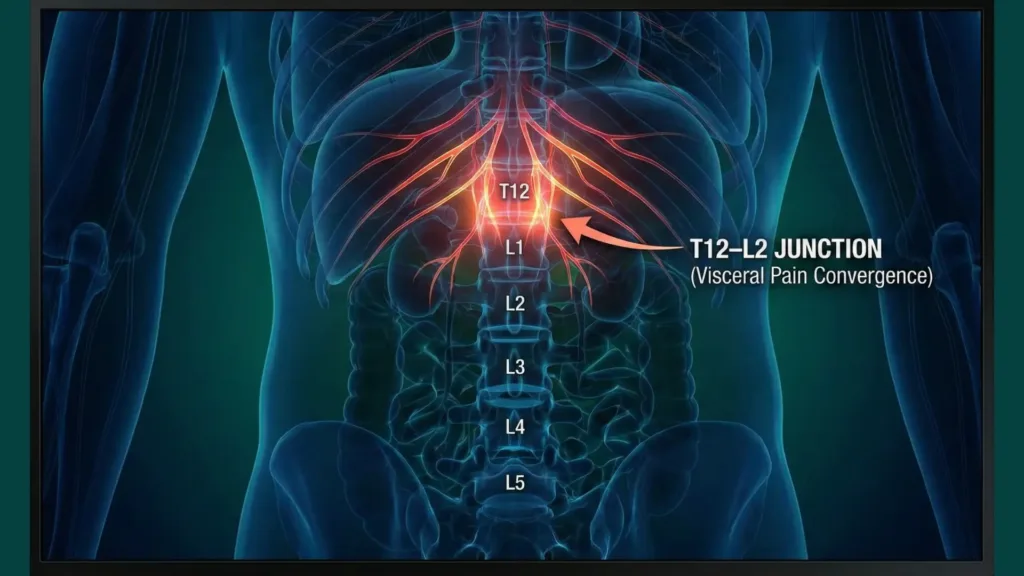
Because the abdomen, pelvis and lumbar spine share nerve supply and connective tissue. Internal organs send pain signals into the same spinal segments that serve the skin and muscles of the back, and the brain localizes organ pain poorly. Add a continuous fascial sheet wrapping the whole trunk, and irritation in one compartment can genuinely be felt in another.
1) Referred pain: one problem, two locations
Organs in your abdomen and pelvis send pain signals to the spinal cord. Those signals enter at specific spinal levels (segments). Your brain is much better at locating pain from skin and muscles than pain from internal organs, so it sometimes “maps” internal pain to nearby body regions—commonly the back, flank, groin, or lower abdomen. This is why kidney and bowel problems can feel like back and stomach pain at the same time.
2) Shared muscles and fascia: the “core can transmit pain” effect
The front of the abdomen, the sides of the trunk, and the low back share a continuous fascial system (think: a strong sheet of connective tissue). If you have a strong cough, vomiting, lifting strain, or a sudden twist, you can irritate both abdominal wall tissues and lumbar tissues. The result can be lower back and abdominal pain that feels “linked,” even though no organ disease is present.
3) The “two problems at once” scenario is common
It is surprisingly common to see back and stomach pain together because of two overlapping, treatable issues—such as constipation plus a lumbar strain, or a urinary infection plus back muscle guarding. This is why pattern recognition (what it feels like, what triggers it, and what other symptoms travel with it) matters more than guessing.
For readers whose main driver is bowel-related, this guide on whether constipation can cause lower back pain breaks down the gut-spine mechanism in detail.
When is back and stomach pain a medical emergency?
It is an emergency when the pain is accompanied by signs of blood loss, infection, obstruction or neurological damage. The specific combinations below matter because each one points toward a condition where the time to treatment changes the outcome. Do not stretch, wait, or treat these as muscular. In the US and Canada call 911; in the UK call 999.
Seek urgent care now if you have:
- Sudden severe abdominal pain with fainting, dizziness, clammy skin or collapse. This combination suggests internal bleeding or circulatory failure. Blood loss into the abdomen produces pain before it produces obvious external signs, so the drop in blood pressure is the warning.
- Severe back pain with a tearing or ripping sensation in the abdomen. This is the classic description of an aortic emergency. The aorta runs directly in front of the lumbar spine, so a leak or dissection is felt in the back as much as the belly.
- Fever or chills with flank pain, or feeling systemically unwell. This points toward a kidney infection rather than a simple bladder infection. Infection that has reached the kidney can progress to sepsis within hours and needs antibiotics urgently.
- Persistent vomiting, inability to keep fluids down, or a rigid, board-like abdomen. These suggest obstruction or peritoneal irritation — the abdomen protecting itself against inflammation that has spread beyond the original organ.
- Visible blood in urine, or painful urination alongside fever and back pain. Blood indicates the urinary tract has been injured or obstructed, most often by a stone, and combined with fever it raises the possibility of an infected obstructed kidney.
- Black tarry stools, or vomiting blood. Both indicate bleeding in the upper digestive tract. Black stool means blood has been in the gut long enough to be digested, which points to a bleed above the small bowel.
- Pregnancy, or possible pregnancy, with new abdominal or pelvic pain, shoulder-tip pain, fainting or bleeding. Shoulder-tip pain is referred from blood irritating the diaphragm and is a recognized warning sign of a ruptured ectopic pregnancy.
- New loss of bladder or bowel control, urinary retention, numbness in the saddle area, or progressive leg weakness. This suggests compression of the nerve bundle at the base of the spinal cord. Recovery depends heavily on how quickly pressure is relieved.
- Back pain after a fall or crash, or in someone with osteoporosis or a cancer history. Fracture and spinal involvement by disease are meaningfully more likely in these groups, and imaging is appropriate early rather than after a trial of treatment.
If you are unsure, treat a red flag alongside back and stomach pain as a reason to be assessed the same day. Being wrong about a benign cause costs you an afternoon; being wrong about a dangerous one costs considerably more.
How do I tell muscle pain from organ pain?
Musculoskeletal pain has a mechanical signature: it changes predictably when you move, and you can usually find a position that eases it. Visceral pain — pain from an internal organ — tends to ignore posture, come in waves or build steadily regardless of what you do, and arrive with systemic company such as nausea, fever or urinary changes. The table below sets out the practical differences.
| Feature | Musculoskeletal (spine, muscle, fascia) | Visceral (organ referred) |
|---|---|---|
| Response to movement | Changes clearly — a position, stretch or short walk makes it better or worse | Largely unchanged by posture; you cannot get comfortable in any position |
| Onset | Often traceable to a lift, twist, long drive or unaccustomed activity | Frequently arrives without a mechanical trigger, sometimes overnight |
| Character | Ache, stiffness, sharp catch with specific movements | Colicky waves, deep gnawing, cramping, or boring pain that radiates through |
| Location on examination | Tender to press over muscle or joint; the pain is reproduced by touch | Deep and poorly localized; pressing the back does not reproduce it |
| Company it keeps | Usually none — no fever, appetite normal, bowels and bladder unchanged | Nausea, vomiting, fever, urinary changes, bowel changes, menstrual timing |
| Effect of eating or urinating | No relationship | Often clearly linked — worse after meals, or eased after passing urine or stool |
| Night behavior | Eases when the spine is unloaded lying down | May wake you and persist regardless of position |
What are the 7 causes doctors look for?
Clinicians work through a short mental list when someone reports pain in the back and the abdomen at the same time: kidney stones, urinary or kidney infection, pancreatitis, appendicitis, diverticulitis, gynecologic and pregnancy-related causes, and aortic emergencies. They range from very common to rare-but-lethal. The point of knowing them is not self-diagnosis — it is recognizing which pattern you have and how fast you need to act.
1) Kidney stones (renal/ureteric colic)
Kidney stones are a classic reason people experience back and stomach pain together. The stone irritates the ureter (the tube from kidney to bladder), causing intense “colicky” pain that can shift as the stone moves.
How it typically feels
- Sudden onset flank or back pain that may wrap to the lower abdomen or groin
- Pain often comes in waves; people can’t find a comfortable position
- You may also have back pain and nausea or vomiting
Other clues that support this cause
- Blood in the urine (visible or microscopic)
- Urinary urgency or burning (especially as the stone approaches the bladder)
- Pain that is not clearly linked to movement, bending, or posture changes
What doctors may do
- Urine test (blood, infection markers)
- Imaging depending on risk and setting. NICE guideline NG118 recommends urgent low-dose non-contrast CT within 24 hours of presentation for adults with suspected renal colic, with ultrasound used instead in pregnancy
- Pain control and hydration guidance; sometimes medication to help stone passage
Seek urgent care if
- Fever/chills (stone + infection can be dangerous)
- Intractable vomiting, severe uncontrolled pain, or one kidney/known kidney disease
2) Urinary tract infection (UTI) or kidney infection (pyelonephritis)
A UTI can cause suprapubic discomfort, but when infection ascends to the kidney, it often produces flank/back pain plus abdominal discomfort—making back and stomach pain a common pairing. Kidney infection is more likely to cause fever and systemic illness than a simple bladder infection.
How it typically feels
- Dull ache in the flank or low back, sometimes with lower abdominal pressure
- Burning urination, urgency, frequency
- In kidney infection: fever, chills, nausea, feeling “flu-ish”
Other clues
- Cloudy or foul-smelling urine
- Pain is often not relieved by stretching or changing positions
What doctors may do
- Urinalysis and urine culture
- Assessment for dehydration, sepsis risk, pregnancy status
- Antibiotics when indicated
Seek urgent care if
- High fever, shaking chills, confusion, severe weakness, or pregnancy with urinary symptoms
3) Acute pancreatitis (upper abdominal pain radiating to the back)
Although pancreatitis pain is usually felt in the upper abdomen, it is famously described as abdominal pain that radiates to the back. People may describe it as severe “stomach pain” plus back pain, sometimes felt lower depending on posture and body build.
How it typically feels
- Deep, severe upper abdominal pain that can bore through to the back
- Often associated with nausea/vomiting and worsens after eating
- Many people report that leaning forward or curling up provides partial relief
Other clues
- Recent heavy alcohol intake, gallbladder disease history, very high triglycerides (risk factors)
- Marked tenderness in the upper abdomen
What doctors may do
- Blood tests (lipase/amylase) and metabolic assessment
- Ultrasound/CT if needed to define cause and severity
- IV fluids, pain control, monitoring for complications
Seek urgent care if
- Pain is severe and persistent, vomiting persists, or you feel faint/confused
4) Appendicitis (including “atypical” or retrocecal appendicitis)
Appendicitis is usually right-lower abdominal pain, but the appendix can sit in positions that irritate nearby muscles (like the psoas) and nerves, producing back, flank, or even hip pain—so back and stomach pain can coexist.
How it typically feels
- Pain that starts near the belly button and then localizes to the right lower abdomen (classic pattern)
- Loss of appetite, nausea, low-grade fever
- Sometimes pain with walking, hopping, or extending the right hip (psoas irritation)
Other clues
- Worsening pain over hours
- Tenderness when pressing the right lower abdomen
What doctors may do
- Focused exam, labs (white blood cell count), imaging (ultrasound/CT) as appropriate
- Surgical consult when suspected
Seek urgent care if
- Pain is steadily worsening, fever rises, or there is significant vomiting
5) Diverticulitis or other lower-bowel inflammation
Diverticulitis (inflamed pouches in the colon) is a common cause of lower abdominal pain in adults and can refer discomfort to the low back. People often describe “lower left stomach pain” plus a deep back ache—another scenario where back and stomach pain occur together.
How it typically feels
- Usually left-lower abdominal pain (but location can vary)
- May be accompanied by fever, constipation, or diarrhea
- Low-grade, deep ache that can be felt in the back or pelvis
Other clues
- Pain that worsens over 1–2 days rather than minutes
- Tenderness localized to one side of the lower abdomen
What doctors may do
- Labs and imaging (often CT) depending on severity
- Antibiotics or supportive care depending on the clinical picture
- Advice on diet progression during recovery
Seek urgent care if
- High fever, severe worsening pain, vomiting, or inability to pass stool/gas
6) Gynecologic or pregnancy-related causes (endometriosis, ovarian cyst/torsion, ectopic pregnancy)
In people with ovaries/uterus, pelvic organs can generate pain that feels like back and stomach pain—particularly lower abdominal cramping or pelvic pressure with a back ache. Endometriosis is a common inflammatory condition associated with pelvic pain, and flares may track with the menstrual cycle.
How it typically feels
- Cyclic pelvic pain (worse around periods) with back and stomach pain
- Pain with sex, bowel movements, or urination in some cases (endometriosis patterns)
- Sudden severe one-sided pelvic pain can occur with ovarian torsion or cyst rupture
Other clues
- Late or missed period, positive pregnancy test, or unusual bleeding (consider ectopic pregnancy)
- Shoulder-tip pain, dizziness, or fainting with pregnancy-related pain is an emergency sign
What doctors may do
- Pregnancy test when relevant (this is a standard safety step)
- Pelvic exam and ultrasound
- Referral to gynecology when suspected
Seek urgent care if
- Pregnancy + new pelvic pain, fainting, heavy bleeding
- Sudden severe one-sided pelvic pain with nausea/vomiting (torsion risk)
7) Abdominal aortic aneurysm (AAA) or aortic emergency (rare but dangerous)
An abdominal aortic aneurysm is an abnormal widening of the large artery (aorta) in the abdomen. Most AAAs are silent, but if an aneurysm leaks or ruptures, it can present with severe abdominal pain and back pain. This is one of the key “do not miss” causes when clinicians hear back and stomach pain together—especially in older adults and people with vascular risk factors.
This is the reason clinicians take the pairing seriously in anyone over 60 with vascular risk factors. The NHS lists sudden, severe pain in the tummy or back among the emergency warning signs of a ruptured abdominal aortic aneurysm, alongside pale or grey skin, breathing difficulty and loss of consciousness. Risk is concentrated in men aged 65 and over, smokers, and people with high blood pressure or a family history — which is why routine ultrasound screening is offered to men at 65 in the UK.
How it typically feels
- Sudden, severe abdominal pain with back pain (sometimes described as deep, tearing, or ripping)
- May be accompanied by collapse, dizziness, sweating, or shock
Other clues
- Age over 60, smoking history, known aneurysm, cardiovascular disease
- A pulsating abdominal mass may be present but is not reliable for self-checking
What doctors may do
- Emergency evaluation, rapid imaging (ultrasound/CT)
- Vascular surgery involvement immediately if suspected
Seek urgent care if
- Symptoms are sudden and severe, especially with dizziness/fainting or very low blood pressure
Which symptom cluster points to which cause?
Clinicians rarely rely on pain location alone. They look for the cluster — what stands out most, what travels with it, and how fast it changed. The table below maps the clusters that most often decide the next step. It is not a diagnostic tool, but it does explain why a doctor asks about urination, bowel habits and menstrual timing when you came in about your back.
| What stands out most | Common cluster | Why it matters |
|---|---|---|
| Waves of severe flank pain + can’t get comfortable | Stone pattern | Ureter irritation causes shifting, colicky pain |
| Fever/chills + urinary symptoms + back/flank ache | Infection pattern | Kidney infection can worsen quickly |
| Severe upper abdominal pain + vomiting + pain “through to back” | Pancreas pattern | Needs labs and fluid management |
| Migrating pain to right-lower abdomen + worsening over hours | Appendix pattern | Delay raises complication risk |
| Left-lower abdominal tenderness + fever/constipation/diarrhea | Diverticulitis pattern | Imaging guides management |
| Cyclic pelvic pain + lower back and abdominal pain | Endometriosis pattern | Inflammatory pelvic pain referral |
| Sudden severe abdominal + back pain + fainting/dizziness | Aortic emergency | Time-critical, life-threatening |
Myths vs facts about back and stomach pain
- Myth: “If it hurts in the back and belly, it must be the spine.”
Fact: Many abdominal/pelvic problems refer pain to the back; you need pattern + associated symptoms. - Myth: “Gas pain can’t cause back pain.”
Fact: Bowel distension can cause back discomfort via pressure and shared nerve pathways, but it should improve and should not come with serious red flags. - Myth: “If stretching helps a little, it can’t be serious.”
Fact: Some serious conditions fluctuate. Red flags and systemic symptoms matter more than short-term relief. - Myth: “Pain location alone tells the diagnosis.”
Fact: With back and stomach pain, timing, triggers, urinary/bowel symptoms, fever, and pregnancy status often matter more than the exact spot.
From the Clinic: Dr. Arora’s Expert Insight
In my clinical work, the most common mistake I see with back and stomach pain is that people treat it as “either back or belly,” and they pick one strategy too aggressively. They either keep stretching and twisting because they assume it’s muscular, or they completely stop moving because they assume it’s an internal problem. Both extremes can backfire.
What works better is a two-lane approach: first, screen for danger (fever, urinary changes, worsening pain, pregnancy, fainting), and if none are present, use gentle movement as a diagnostic tool. Mechanical pain usually changes with posture, breathing, or a short walk; visceral pain often doesn’t. This simple “does it change?” test—done carefully—often clarifies the next step faster than an hour of searching.
What should I do in the next few hours?
Work through three steps in order: screen for danger, identify which system your symptoms point to, then use gentle movement as a test rather than a treatment. The sequence matters. Deciding the pain is muscular and stretching into it before you have excluded fever, urinary changes, pregnancy and rapid worsening is the most common way people lose time.
Step 1: Do a 60-second safety screen
Ask yourself:
- Do I have fever, faintness, severe vomiting, blood in urine/stool, or new neurologic symptoms?
- Am I pregnant or could I be?
- Is the pain sudden and severe or rapidly worsening?
If yes to any, treat back and stomach pain as urgent until proven otherwise.
Step 2: Identify your “dominant lane” (urinary, bowel, pelvic, or mechanical)
Urinary lane clues
- Burning urination, urgency, cloudy urine
- Flank pain wrapping forward
- Back and stomach pain with fever/chills → higher concern
Bowel lane clues
- New constipation/diarrhea, bloating, pain around meals
- Localized lower abdominal tenderness (especially one-sided)
- Back pain and stomach cramps that track with bowel changes
Pelvic lane clues
- Cyclic symptoms around periods
- Lower back pain and pelvic pain, pain with sex, or unusual bleeding
- Pregnancy-related symptoms
Mechanical lane clues (still important)
- Pain changes clearly with bending, sitting, getting up, coughing, or lifting
- A specific movement triggers pain
- Gentle walking or position change improves symptoms
Even if mechanical features dominate, don’t ignore red flags—back and stomach pain can overlap.
Step 3: Use “safe tests” that don’t aggravate symptoms
These are not medical tests—just safe observations.
- Position change test (2 minutes): Lie on your back with knees supported (pillow under knees). If back and stomach pain ease notably, it suggests a mechanical component or muscle guarding.
- Short walk test (3 minutes): Walk at an easy pace. If symptoms settle, a purely internal organ cause is less likely (not impossible).
- Hydration check: If you’re dehydrated (dark urine, dry mouth), symptoms from stones, infection, or constipation can worsen.
Stop if anything makes pain worse quickly or causes dizziness.
What can I safely do today while arranging care?
Assuming you have already screened for red flags and found none, the goal for the next 24 to 72 hours is to reduce guarding without masking anything a clinician needs to see. Steady hydration, heat on the low back, short frequent walks and unforced positions are generally safe. Avoid aggressive stretching, deep abdominal massage, and painkillers taken purely to get through activity.
Do
- Hydrate steadily (small sips frequently if nauseated)
- Use heat on the low back for muscle guarding (15–20 minutes)
- Choose easy meals (soups, bland foods) if nausea/bloating is present
- Keep moving lightly (short walks, gentle posture changes) rather than bed rest
Don’t
- Don’t do aggressive twisting stretches or deep forward bends when you have back and stomach pain—especially if nausea, fever, or urinary symptoms are present.
- Don’t ignore worsening pain or new systemic symptoms.
- Don’t self-medicate heavily (especially NSAIDs) if you suspect dehydration, kidney issues, ulcers, or you’re unsure—speak with a clinician.
If serious causes are ruled out: a 10-minute reset for the common “guarding” pattern
After an urgent cause has been excluded, the most common reason low back pain and stomach pain keeps lingering is a protective guarding pattern: the abdominal wall, hip flexors, and low back tighten together.
10-minute reset (once or twice daily for 3–5 days)
1) 90/90 breathing (2 minutes)

- Lie on your back with calves on a chair (hips and knees about 90°).
- Inhale through the nose 4 seconds.
- Exhale slowly 6–8 seconds, letting the ribs soften down.
- Repeat 6–8 breaths.
This reduces bracing and can ease back and stomach pain driven by tension.
2) Gentle pelvic tilts (2 minutes)
- Stay on your back, knees bent.
- Slowly flatten your low back into the floor (20–30% effort), then release.
- 8–10 reps.
3) Supported single-knee to chest (2 minutes)

- Bring one knee toward the chest only as far as comfortable.
- Hold 10 seconds, breathe, switch sides.
- 3–4 rounds each side.
Skip this if it increases abdominal pain.
4) Side-lying “open book” breathing (2 minutes)
- Lie on your side, knees bent, pillow between knees.
- Breathe into the side ribs; avoid deep twisting.
- 6–8 slow breaths.
5) Short walk (2 minutes)
- Easy pace, relaxed arms.
- Stop if pain spikes or you feel unwell.
How do I stop low back pain and stomach pain coming back?
Prevention runs on two tracks, because repeat episodes usually have two drivers. The first is spine and trunk capacity — a back that tolerates load poorly will flare whenever an abdominal problem forces you to guard. The second is the gut and urinary triggers themselves: hydration, fiber, meal timing and bowel regularity. Working on only one track is why episodes keep returning.
Spine capacity (weekly)
- 3–4 days/week: 15–20 minutes of gentle strength (glute bridges, bird-dog, side planks modified)
- Daily: brief mobility (hips, thoracic spine) without forcing range
- Build walking tolerance gradually
Gut/urinary triggers
- Hydration habits (especially during travel, workouts, hot weather)
- Fiber consistency (increase slowly; avoid sudden large jumps)
- Don’t delay urination for long periods
- Review recurrent UTI or stone risk factors with your clinician
The bottom line
Low back pain and stomach pain together is a symptom pattern, not a diagnosis. In most people it reflects something ordinary — a constipated gut, a guarded trunk, a period, a strained abdominal wall. In a minority it is the first sign of a problem that needs treating within hours. The whole skill is telling those two situations apart, and the deciding information is almost never the pain itself. It is what travels with it.
Screen for red flags first. If none are present, give it 48 to 72 hours of hydration, gentle movement and unforced positions, and note whether the pattern changes. If it has not begun to settle, or the picture shifts in any direction you cannot explain, that is the point to be assessed rather than to keep experimenting.
Frequently asked questions
1) Can back and stomach pain be “just gas”?
It can be, especially if you have bloating, relief after passing gas or a bowel movement, and no red flags. However, persistent or severe back and stomach pain—especially with fever, vomiting, or urinary changes—should be evaluated.
2) How do I tell kidney stone pain from a back muscle strain?
Stone pain often comes in waves, makes you restless, and may radiate toward the groin; muscle strain is more position- and movement-dependent. Blood in urine, nausea, and back and stomach pain that doesn’t change with posture increase suspicion of a stone.
3) Can a UTI cause back and stomach pain without burning urination?
Yes. Some people—especially older adults—may not notice classic burning. If you have back and stomach pain with fever, chills, flank tenderness, or feeling very unwell, get assessed for kidney infection.
4) Why does pancreatitis feel like back pain?
The pancreas sits deep in the upper abdomen near the spine. Inflammation can produce abdominal pain that radiates to the back, so people describe back and stomach pain even when the main source is upper abdominal.
5) Can endometriosis cause back and stomach cramps?
Yes. Endometriosis-related inflammation and pelvic floor guarding can produce lower back and abdominal pain, often worse around periods. If back and stomach pain is cyclic and accompanied by heavy periods, pain with sex, or infertility concerns, discuss evaluation options.
6) Is back and stomach pain in early pregnancy normal?
Mild aches can occur, but you should never assume. If you are pregnant (or could be) and have back and stomach pain with bleeding, fainting, shoulder-tip pain, or one-sided pelvic pain, seek urgent care to rule out ectopic pregnancy.
7) When should I get imaging?
Imaging depends on the pattern and risk. Back and stomach pain with fever, blood in urine, suspected appendicitis/diverticulitis, pancreatitis complications, or an aortic emergency often requires prompt imaging. Mechanical back pain without red flags usually does not need immediate imaging.
8) What if the pain is on the right side only?
Right-sided back and stomach pain raises suspicion for appendicitis, right kidney stones, or gallbladder/liver issues depending on the exact location and symptoms. If it is worsening, associated with fever, vomiting, or localized tenderness, seek evaluation.
9) Can constipation cause back and stomach pain?
Yes. Constipation can cause back pressure and abdominal cramping, and it can also trigger muscle guarding in the low back. If symptoms resolve with bowel movement and there are no red flags, conservative care is reasonable. If constipation is new, severe, or accompanied by weight loss, blood in stool, or severe pain, get assessed.
10) What’s the safest first step if I’m unsure?
Start with the red-flag screen, then focus on hydration, gentle movement, and arranging medical advice. If back and stomach pain is severe, sudden, or accompanied by systemic symptoms, treat it as urgent.
References
- National Institute for Health and Care Excellence. Renal and ureteric stones: assessment and management. NICE guideline NG118. 2019. nice.org.uk/guidance/ng118
- NHS. Abdominal aortic aneurysm. National Health Service, UK. nhs.uk/conditions/abdominal-aortic-aneurysm