
Low back pain by the tailbone when sitting is most commonly caused by direct pressure on the coccyx (tailbone), poor sitting posture, or irritation of the sacrococcygeal joint. Prolonged sitting on hard or unsupportive surfaces, a previous tailbone injury, weak glute muscles, or pelvic floor tension are the most frequent triggers. Most cases are mechanical and reversible — meaning posture changes, the right cushion, and targeted exercises can fix it without surgery.
The good news is that most cases of low back pain by tailbone are mechanical and reversible. In simple terms, something about how your bones, joints, muscles, nerves, or posture are working together is irritating the tissues around the coccyx, or tailbone. Once you understand the pattern behind your pain, you can usually make very targeted changes to reduce pressure, calm the irritation, and gradually return to normal sitting.
In this guide, we will break down why you get low back pain by tailbone when sitting, which structures are involved, what symptoms you should never ignore, and practical steps you can start today to feel better. You will also learn when it is time to get professional help and what a typical treatment plan looks like.

What does low back pain by tailbone actually feel like?
Before talking about causes, it helps to clarify what people mean when they say they have low back pain by tailbone. The pain is usually centered at or just above the small triangular bone at the very bottom of the spine, between the buttocks. Some people feel it as a stabbing pain directly on the bone when they sit. Others describe a dull, bruised, or burning pain spreading slightly into the buttocks or lower back.
Common features of low back pain by tailbone include:
- Pain that increases when sitting, especially on hard or narrow surfaces
- Discomfort when leaning back or rolling from side to side while seated
- Relief when standing up or lying on the side or belly
- Tenderness if you gently press over the tailbone region
- Sometimes pain with bowel movements or after long drives
Many people also notice that once low back pain by tailbone has started, even small movements like leaning forward to tie shoes or reaching for something in the car can trigger a sharp reminder that something is not happy in that area.
A quick anatomy tour of the tailbone area
To understand why sitting can trigger low back pain by tailbone, it is useful to know what lives in that region.
- Coccyx (tailbone): The small bone at the very base of the spine, made of three to five tiny fused segments.
- Sacrum: The wedge-shaped bone just above the tailbone that connects the spine to the pelvis.
- Sacroiliac joints: Joints where the sacrum meets the large pelvic bones on each side.
- Pelvic floor muscles: A group of muscles forming a supportive hammock at the bottom of the pelvis.
- Gluteal muscles and deep hip rotators: Muscles in the buttock region that help support the pelvis and control hip movement.
- Discs, ligaments, and small nerves: Soft structures that cushion and stabilize the area and carry signals to and from the brain.
When you sit, your body weight shifts down through the pelvis onto the sitting bones and, in many people, partially onto the coccyx. If this pressure becomes too high or too prolonged, it can inflame the tailbone region and cause low back pain by tailbone, especially if other risk factors are present.
Common causes of low back pain by tailbone when sitting
There is rarely just one single reason for low back pain by tailbone. Often, there is a mix of posture, previous injury, muscle imbalance, and daily habits. Here are some of the most frequent contributors.
1. Direct injury to the tailbone (coccydynia)
A fall on the buttocks, slipping on stairs, missing a chair, or a difficult childbirth can leave the tailbone bruised, sprained, or even slightly dislocated. This condition is often called coccydynia. After such an injury, even routine sitting can trigger low back pain by tailbone because the area is sensitive and overloaded.
Signs this might be you:
- Clear memory of a fall or impact onto the buttocks
- Pain that started soon afterward and has not fully settled
- Very sharp or stabbing pain when first sitting down
- Feeling like you are sitting on a marble or stone
2. Poor sitting posture and slumping

Long hours of slumped sitting, especially on soft sofas or low chairs, can roll the pelvis backward and push more body weight directly over the tailbone instead of the sitting bones. Over time, this compressive load leads to low back pain by tailbone, stiffness, and muscle fatigue.
Postural clues:
- Sitting with a rounded lower back and head forward over screens
- Sliding forward on the chair so you lean on the coccyx
- Feeling temporary relief when you sit up tall on your sitting bones
3. Weak core and glute muscles
Your deep core, hip, and glute muscles act as a supportive corset for the pelvis and lower spine. When these muscles are weak or not coordinating well, more stress is transmitted to passive structures like ligaments, joints, and the coccyx. Tight or overworked glutes are just as problematic as weak ones — and the two conditions are more connected than most people realize. This makes low back pain by tailbone more likely, especially during long sitting or repeated transitions from sit to stand.
You might notice:
- Difficulty maintaining upright posture without slumping
- Early fatigue when standing or walking
- A feeling of heaviness or strain in the low back by the tailbone when you sit for work or driving
4. Pelvic floor tension or dysfunction
The pelvic floor muscles attach near the tailbone and help support the pelvic organs and stabilize the spine. If these muscles are chronically tight, overactive, or not coordinating with the diaphragm and deep core, they can pull on the coccyx and contribute to low back pain by tailbone.
Clues toward pelvic floor involvement:
- Pain during or after bowel movements
- Discomfort with prolonged sitting that improves briefly after standing or walking
- A sense of deep pressure or fullness low in the pelvis, together with low back pain by tailbone
5. Referred pain from lumbar discs or joints
Sometimes the tailbone is not the primary problem, but pain from a lumbar disc, facet joint, or sacroiliac joint is felt near the base of the spine. In these cases, you still experience low back pain by tailbone, but imaging or examination may show that a higher spinal segment or sacroiliac joint is the main source.
You may notice:
- Pain that radiates slightly above the tailbone into the low back
- Stiffness after prolonged sitting that eases with walking
- Occasional pain into the buttock or back of the thigh, without classic sciatica
6. Increased body weight or rapid weight loss
Carrying extra weight can increase the load on the tailbone during sitting, especially if posture and muscle strength are not optimal. On the other hand, very rapid weight loss can reduce the natural padding over the coccyx, so even normal pressure starts to feel like low back pain by tailbone.
When is low back pain by tailbone a red flag?
Most cases of low back pain by tailbone are uncomfortable but not dangerous. However, there are some warning signs that should prompt urgent medical attention. Call a doctor promptly or seek emergency care if your low back pain by tailbone is associated with:
- Recent significant trauma, such as a fall from height or a car accident
- Loss of bladder or bowel control, or difficulty starting urination
- Numbness in the groin or around the anus (saddle numbness)
- Sudden severe weakness in both legs
- Fever, chills, or unexplained weight loss
- History of cancer, inflammatory arthritis, or serious infection
These features may suggest something more serious than simple mechanical low back pain by tailbone and should never be ignored.
Simple self-checks you can try at home
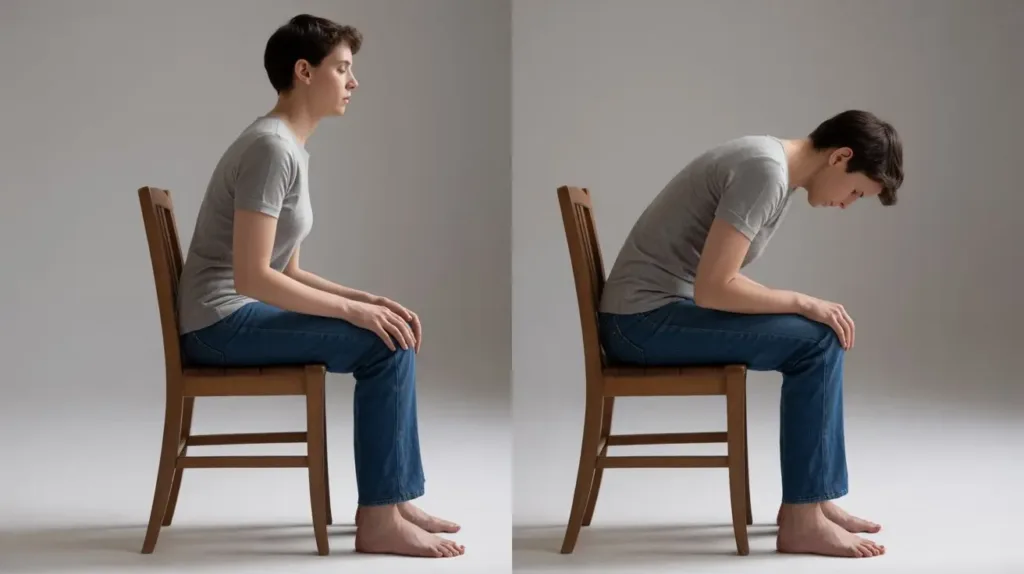
These gentle observations can help you better understand your own pattern of low back pain by tailbone. They are not a substitute for a professional assessment but can guide your self-care.
- Surface test: Compare sitting on a hard wooden chair, a firm cushioned chair, and a soft couch. Does low back pain by tailbone worsen clearly on one type of surface?
- Posture test: Sit tall with your feet flat, knees at hip level, and weight on the sitting bones for two to three minutes. Then slump, rounding your lower back and sliding forward. Notice when low back pain by tailbone increases.
- Movement test: Gently rock your pelvis forward and back while seated. Does pain spike at the far slumped position or when rolling onto one buttock?
- Standing reset: When pain builds during sitting, stand up and walk for two to three minutes. If low back pain by tailbone eases with movement, it usually suggests a mechanical and reversible problem rather than something aggressive or destructive.
Write down what you observe. These notes can be very helpful if you later consult a physiotherapist or doctor about persistent low back pain by tailbone.
Step-by-step home plan to relieve low back pain by tailbone
If there are no red flags, many people can ease low back pain by tailbone with a logical, stepwise plan. The key is to reduce direct pressure on the coccyx, calm irritation, and strengthen the supporting muscles around the pelvis and spine.
Step 1: Adjust your sitting position
- Sit on your sitting bones, not directly on the tailbone. You can feel them as two bony points under your buttocks.
- Keep your knees roughly at the same height as your hips, or slightly lower.
- Aim for a small natural curve in the lower back instead of slumping.
- If low back pain by tailbone flares while sitting, shift your weight slightly forward or to one side for a short time, then return to a neutral position.
Step 2: Use smart cushions and supports
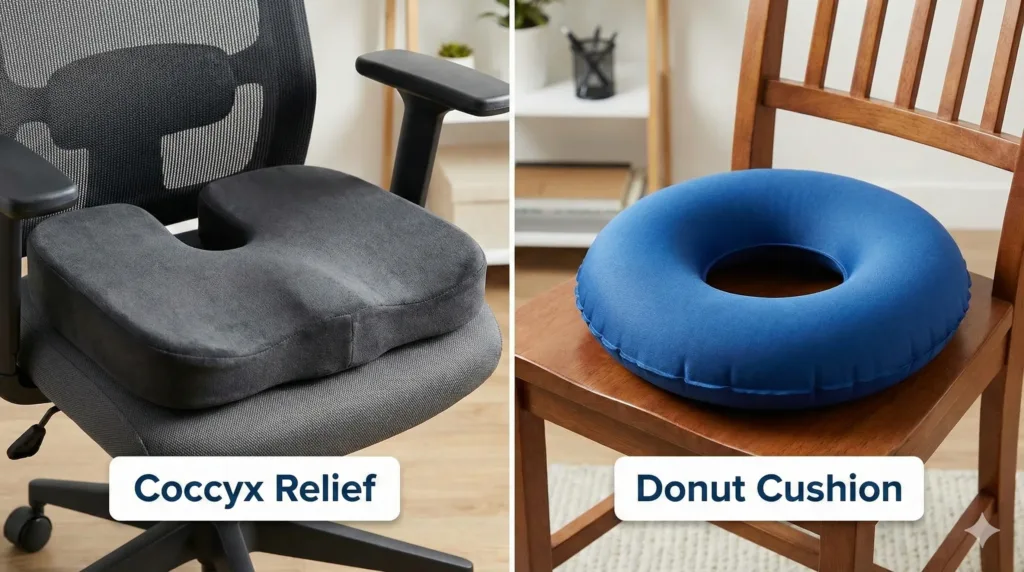
A well-chosen cushion can dramatically reduce low back pain by tailbone during sitting:
- Coccyx cut-out cushion: A U-shaped cushion with a gap at the back so the tailbone floats instead of bearing weight.
- Firm, not mushy, support: Very soft cushions can let you sink down and still overload the coccyx. A moderately firm cushion keeps pressure more evenly distributed.
- Donut cushions: These can help some people, but for others they concentrate pressure around the ring. If you use one and your low back pain by tailbone worsens, switch to a coccyx cut-out design.
Step 3: Take movement breaks
Even perfect posture cannot compensate for eight to ten hours of continuous sitting. To protect against low back pain by tailbone:
- Stand up at least every 30–45 minutes, even for 1–2 minutes.
- Use small triggers, like phone calls or message checks, as reminders to change position.
- Walk to get water, stretch your legs, or do a few gentle pelvic tilts.
Regular movement breaks reduce stiffness, improve blood flow, and give irritated tissues around the tailbone a chance to calm down.
Step 4: Start gentle mobility and activation exercises
If your doctor or physiotherapist has cleared you for exercise, these basic moves are often helpful for low back pain by tailbone. Perform them slowly, within a comfortable range.
- Pelvic tilts in lying: Lie on your back, knees bent, feet flat. Gently rock your pelvis to flatten your low back into the surface, then release to your natural curve. This helps you find neutral spine and reduces guarding around the tailbone.
- Deep belly breathing: Place one hand on your lower ribs and one near your belly button. Inhale through the nose, feeling the lower ribs and belly expand. Exhale gently, letting the belly soften. This can relax the pelvic floor and reduce tension linked to low back pain by tailbone.
- Glute squeezes: In lying or standing, gently tighten the buttock muscles as if lightly pinching a coin between them, hold for five seconds, then relax. This wakes up gluteal support without stressing the coccyx.
If any exercise clearly increases low back pain by tailbone, reduce the intensity, check your position, or stop and seek professional guidance.
👨⚕️ Dr. Arora’s Clinical Note:
A common mistake I see in recovery is trying to “stretch the pain away” aggressively—especially hamstrings, glutes, or deep forward folds—when the real driver is compression + irritation right on the coccyx. If your tailbone pain spikes most when you slump or lean back, your best “physio shortcut” is to unload first, strengthen second.
Try this for 48–72 hours before you add more exercises:
- Create a slight forward tilt: place a small folded towel under the front of your coccyx cut-out cushion (or under the front half of your sitting bones). This tiny “wedge” shifts pressure off the coccyx better than forcing perfect posture.
- Use the “lean-forward rule”: when sitting, hinge forward 10–15% from the hips (not rounding your back). If pain drops noticeably, it strongly suggests pressure sensitivity rather than “weakness that needs more reps today.”
- Avoid repeated hard pelvic tucks (deep posterior pelvic tilt). For many people with tailbone pain, the end-range “tuck” mechanically pushes load back onto the coccyx and flares symptoms even if the movement looks gentle.
Once sitting is calmer, then your breathing + glute activation work becomes far more effective (and less likely to trigger a flare).
Step 5: Build core and hip strength over time
As symptoms start to settle, gradually add more specific strengthening. A stronger core and hip system helps prevent low back pain by tailbone from returning.
Helpful progressions (under guidance if needed):
- Bridges
- Side-lying hip abductions
- Bird-dog variations
- Wall sits or mini squats
Quality matters more than quantity. The goal is to train your body to share load evenly so the tailbone is not repeatedly overloaded.
If you are unsure where to start with exercises, our physiotherapist-approved home program walks you through each movement step by step.
Best sitting setups to reduce low back pain by tailbone
Small ergonomic changes can make a big difference when you are dealing with low back pain by tailbone.
At a desk or computer
- Choose a chair where you can adjust height so your feet are flat and your hips are slightly higher than your knees.
- Sit back so the lumbar support or a small rolled towel supports the natural curve of your lower back.
- Place your screen at eye level to avoid hunching forward.
- Use a coccyx cut-out cushion if direct pressure triggers low back pain by tailbone.
In the car
- Adjust the seat so your knees are not higher than your hips.
- Slightly recline the backrest but avoid slumping.
- Slide your hips all the way back and, if needed, use a small cushion or towel roll at the lower back.
- For longer drives, plan short breaks to stand and walk, which can dramatically reduce low back pain by tailbone after travel.
Myth vs fact about low back pain by tailbone
Understanding common myths can reduce fear and help you make better choices.
| Myth | Fact |
|---|---|
| “If I have low back pain by tailbone, something must be broken.” | Many cases involve irritated soft tissues, posture, or muscle imbalance and do not show serious damage on imaging. |
| “I should avoid all movement until the pain is gone.” | Gentle, well-chosen movement often speeds recovery from low back pain by tailbone by improving circulation and reducing stiffness. |
| “Only surgery can fix tailbone pain.” | Most people with low back pain by tailbone get better without surgery, using a mix of posture correction, supportive cushions, targeted exercises, and hands-on therapy. |
| “Pain near the tailbone always means a spine problem.” | Pain in this area can also relate to pelvic floor tension, sacroiliac joints, or even digestive or gynecological conditions, so a broad view is important. |
For an evidence-based overview of coccydynia (tailbone pain)—including anatomy, common causes, and treatment options—see [Coccydynia: An Overview of the Anatomy, Etiology, and Treatment of Coccyx Pain, 2014].
When to see a professional about tailbone-area back pain
You do not need to live with constant tailbone-area back pain, especially if it is affecting your work, sleep, or mood. Consider seeing a physiotherapist or healthcare provider if:
- Pain has lasted more than a few weeks despite home care
- You cannot sit comfortably for more than 15–20 minutes
- You feel anxious about the cause of your low back pain by tailbone
- Pain is starting to limit walking, exercise, or daily tasks
A professional assessment typically includes:
- A detailed history of how your low back pain by tailbone started and what makes it better or worse
- Posture and movement analysis in standing, sitting, and walking
- Gentle palpation of the tailbone, sacroiliac joints, and surrounding muscles
- Screening of the hips, lumbar spine, and sometimes the pelvic floor
Based on this assessment, your clinician may design a tailored plan that can include manual therapy, exercise, education, and advice about cushions or ergonomic changes.
Long-term prevention habits
Once your symptoms improve, the next step is to prevent low back pain by tailbone from returning.
Helpful long-term strategies include:
- Keeping a regular movement routine that combines mobility, strength, and low-impact cardio
- Maintaining a healthy body weight and avoiding extreme crash diets
- Alternating between sitting, standing, and walking throughout the day
- Using supportive seating for work, study, and travel
- Paying attention to early warning signs of low back pain by tailbone, such as mild soreness at the end of the day, and adjusting your habits before it escalates
Over time, these habits can make your spine and pelvis more resilient and less prone to irritation.
FAQs about low back pain by tailbone
1. Is low back pain by tailbone always caused by the coccyx itself?
No. Although the coccyx is often involved, low back pain by tailbone can also be referred from lumbar discs, facet joints, sacroiliac joints, or even pelvic floor muscles. That is why a careful assessment looks at the entire lower back and pelvis instead of focusing only on the tailbone.
2. How long does low back pain by tailbone usually last?
It varies. Mild irritation after a long trip or a minor bump can settle in a few days with rest and posture changes. More persistent low back pain by tailbone, especially after a fall or childbirth, can take several weeks to months to fully improve. Consistent self-care, cushions, and targeted exercises usually shorten the recovery time.
3. Do I need an X-ray or MRI for low back pain by tailbone?
Not always. Many people with low back pain by tailbone recover without any imaging, especially when there are no red flags like fever, weight loss, bowel or bladder changes, or severe trauma. Imaging may be considered if pain is severe, long-lasting, or not responding to a well-designed treatment plan.
4. Can low back pain by tailbone be related to pregnancy or childbirth?
Yes. Hormonal changes, weight gain, postural shifts, and the strain of labor can all affect the sacrum, coccyx, and pelvic floor. Many people first notice low back pain by tailbone during late pregnancy or after delivery. Gentle exercises, cushions, and guidance from a physiotherapist can be very helpful in these situations.
5. Will sitting on the floor worsen low back pain by tailbone?
It can, depending on how you sit. Cross-legged sitting on a firm surface can sometimes increase direct pressure on the tailbone and aggravate low back pain by tailbone. If you prefer floor sitting, using a small cushion to lift the pelvis, sitting on your sitting bones, and changing position frequently can reduce strain.
6. Are special chairs worth it for low back pain by tailbone?
Some people do feel better with kneeling chairs, saddle seats, or ergonomic office chairs that encourage neutral posture and reduce pressure on the coccyx. However, no chair alone can cure low back pain by tailbone. The best results usually come from combining better seating with movement breaks and strengthening.
7. Is exercise safe when I have low back pain by tailbone?
Gentle, well-chosen exercise is usually not only safe but beneficial. Start with low-impact options such as walking, stationary cycling, or water-based exercise, together with basic core and hip strengthening. Avoid high-impact sports or activities that clearly worsen low back pain by tailbone until you have built a stable foundation.
8. Can stress make low back pain by tailbone worse?
Yes. Stress can increase overall muscle tension, including in the pelvic floor and deep spinal muscles, which may amplify low back pain by tailbone. Stress can also disrupt sleep, and poor sleep lowers your body’s ability to dampen pain signals. Simple stress-management tools like breathing exercises, short walks, and regular routines can support recovery.
9. When is injection or surgery considered for low back pain by tailbone?
Injections or surgery are usually reserved for severe, persistent cases of low back pain by tailbone that have not improved with a thorough course of conservative care. A specialist may consider targeted injections around the coccyx or, rarely, surgical removal of unstable segments. These decisions are individualized and based on imaging, examination, and your response to non-surgical treatment.
10. Can low back pain by tailbone be completely cured?
Many people experience complete or near-complete relief, especially when they address both the immediate irritation and the underlying contributors such as posture, weak muscles, or prolonged sitting. Even if low back pain by tailbone has been present for months, a structured plan that combines education, ergonomic changes, and tailored exercise can make a big difference in comfort and confidence.
For a complete overview of all lower back pain causes and treatments, see our Lower Back Pain Complete Guide.