
“Expert Review: This article includes clinical insights from Dr. Arora, a physiotherapist with 20+ years of experience.”
Bench press day shouldn’t feel like a low-back day. Yet bench press lower back pain is one of the most common “unexpected” problems lifters report—because you’re lying down, not squatting or deadlifting. The confusion usually leads to two bad outcomes: people ignore it until it becomes a real flare-up, or they over-correct (flattening completely, losing stability, and hurting their shoulders instead).
Here’s the practical truth: if you’re dealing with lower back pain while bench pressing, most bench press lower back pain is not “a disc slipped” in that moment. It’s usually a mismatch between (1) how you set your ribs and pelvis, (2) how you use leg drive, and (3) how much lumbar extension your spine tolerates that day. Once you understand the mechanics, you can fix the driver—often in the same session—without giving up the lift long-term.
This guide explains why bench press lower back pain happens anatomically, how to spot the exact trigger, what counts as a red flag, and the form tweaks + rehab steps that reliably get lifters back to pressing comfortably.
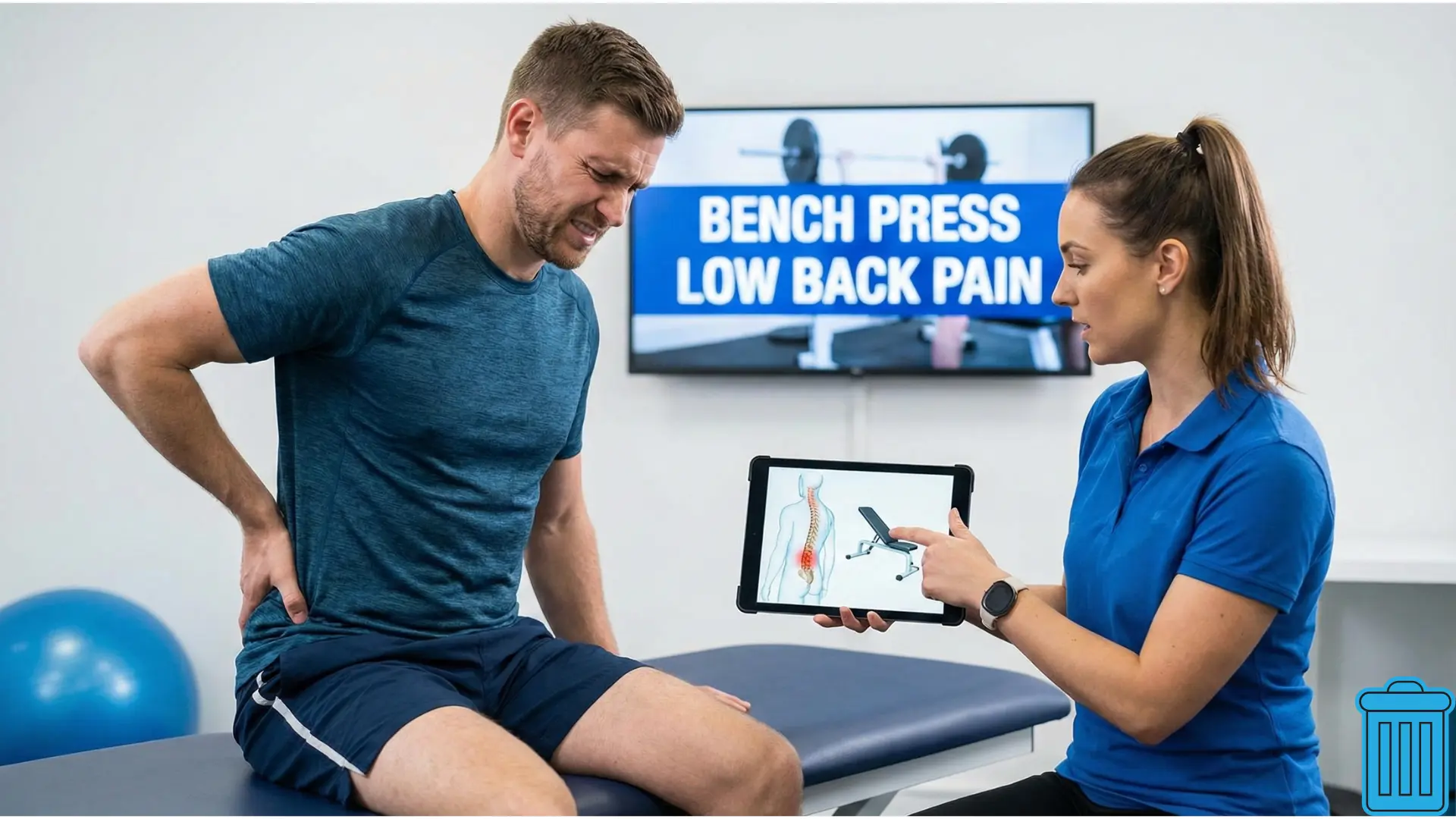
Why bench press lower back pain happens even though you’re lying down
When you bench, your spine is still carrying load—just in a different way. You’re creating a stable “bridge” from your feet to your upper back so force transfers into the bar. That bridge often involves some lumbar arching, and that’s fine for many lifters. Trouble starts when the arch becomes a compensation pattern rather than a controlled position.
The three structures most likely to complain
Most bench press lower back pain comes from one (or a mix) of these:
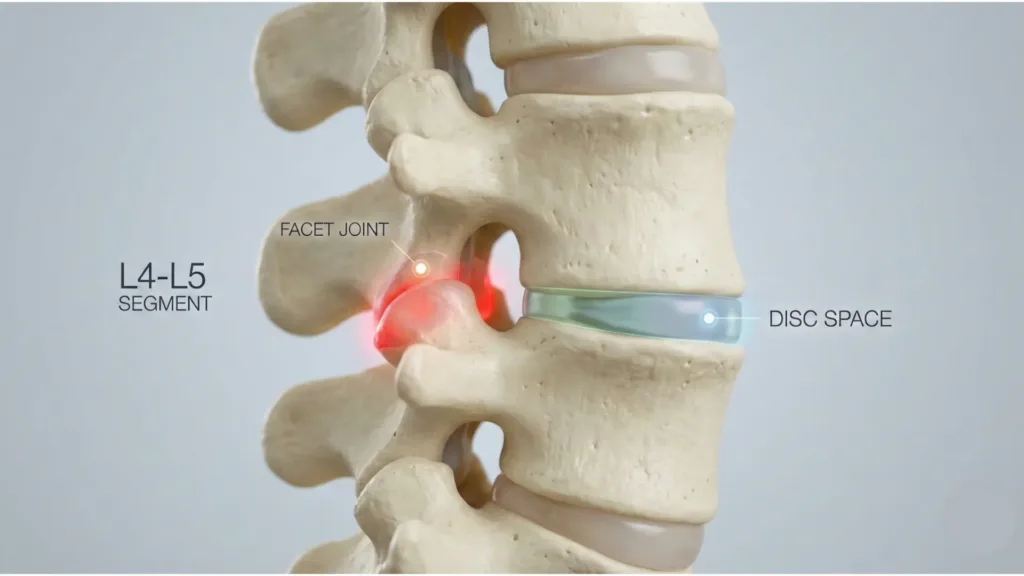
1) Lumbar facet joints (extension intolerance)
Facet joints are the small joints at the back of your spine. They don’t love excessive, repeated end-range extension—especially with compression. If you already tend to stand in a swayback posture or have stiff hips/thoracic spine, your bench arch may dump stress into the facets. Extension-biased pain is typically more one-sided and “pinchy,” worse when you arch harder.
2) Lumbar discs and surrounding tissues (pressure + shear sensitivity)
Discs usually hate heavy bending-and-twisting. Bench press is not a flexion lift, but an aggressive setup can create shear forces if you “slide” your pelvis, flare ribs, and lose abdominal control. If pain feels deep, central, or comes with symptoms into the butt/thigh, the disc region may be irritable.
3) Muscles and fascia (erector spinae, quadratus lumborum, hip flexors)
Your spinal extensors and hip flexors can become the “stiffness providers” when your core brace is weak or your legs drive the pelvis into tilt—this is a common pattern behind a bench press lower back strain. This often feels like a tight band or spasm after the set, not a sharp pinch during the rep.
The “arch” is not the enemy—the uncontrolled arch is
Research comparing flat-back and arched-back benching shows the arched technique changes body position and mechanics, and it’s commonly used for performance and stability. The key is that the arch should come mainly from the thoracic spine (upper back extension) and scapular positioning—not from cranking the lumbar spine into end range. [Flat-Back vs. Arched-Back Bench Press: Examining the…, 2024].
In simple terms: if you suspect your bench press arch causing lower back pain, you want a stable, repeatable shape. If your arch grows rep-to-rep, set-to-set, or only appears when the weight gets heavy, your back is “doing the job” your brace and setup should be doing.
11 root causes of bench press lower back pain
Below are 11 distinct drivers of bench press lower back pain. Many lifters have 2–3 at the same time, which is why “just flatten your back” rarely works.
Cause 1: Rib flare + anterior pelvic tilt (the classic “banana bench”)
This is the classic rib flare pelvic tilt bench press back pain pattern.
Clue: your belly pops up, belt line tips forward, and your low back feels compressed during setup.
Cause 2: Leg drive that pushes the pelvis—not the torso
Leg drive should help you stay tight and drive the upper back into the bench. But if your feet position makes you push your pelvis forward, you increase lumbar extension with every rep.
Clue: pain increases specifically as you “push through the floor.”
Cause 3: Bench too high/low or rack position forces a “reach”
If the rack is too high, you shrug and lose your scapular set; too low, you over-arch to unrack safely. Either way, you may compensate at the lumbar spine.
Clue: discomfort begins during unrack, not during pressing.
Cause 4: Lack of thoracic extension (you borrow extension from the lumbar spine)
If your upper back is stiff, your body will find extension somewhere else—usually your low back.
Clue: you can’t keep your chest “proud” without cranking your low back.
Cause 5: Shoulder positioning issues that destabilize the base
If you lose scapular retraction/depression, your torso wobbles and your spine tries to create rigidity. This can feed bench press lower back pain because you’re chasing stability from the wrong segment.
Clue: shoulder blades slide; you feel “loose” on the bench.
Cause 6: Poor 360° brace (bracing late or only in the front)
A strong brace increases trunk stiffness and reduces unwanted spinal motion. The intra-abdominal pressure mechanism is well described in spine stability research. [Intra-abdominal pressure mechanism for stabilizing the lumbar spine, 1999].
Clue: you can talk easily mid-rep, or you only tense your “six-pack” but not the sides/back.
Cause 7: Excessive bench arching to shorten range (performance technique taken too far)
A competition-style arch can be fine if you own it and your spine tolerates it. But chasing ROM reduction without control is a direct route to bench press lower back pain for extension-intolerant lifters.
Clue: your arch is much bigger on heavy singles than on warm-ups.
Cause 8: Hip flexor stiffness and “locked” hips
Tight hip flexors can pull the pelvis into anterior tilt on the bench, especially with feet tucked far back.
Clue: you feel pulling at the front of the hips plus low-back compression.
Cause 9: Fatigue and volume spikes (your back becomes the “stability muscle”)
In powerlifting and strength sports, training load management and technique optimization matter for injury risk. [Prevalence and Consequences of Injuries in Powerlifting, 2018; Narrative review of injuries in powerlifting…, 2018].
Clue: pain shows up late in the session or the day after high-volume benching.
Cause 10: Extension-sensitive low back conditions (facet irritation, spondylosis patterns)
If your back dislikes extension, bench setup can be the exact provocation—especially if you already feel worse with backbends or prolonged standing.
Clue: relief in slight flexion (knees-to-chest) and pain with arching.
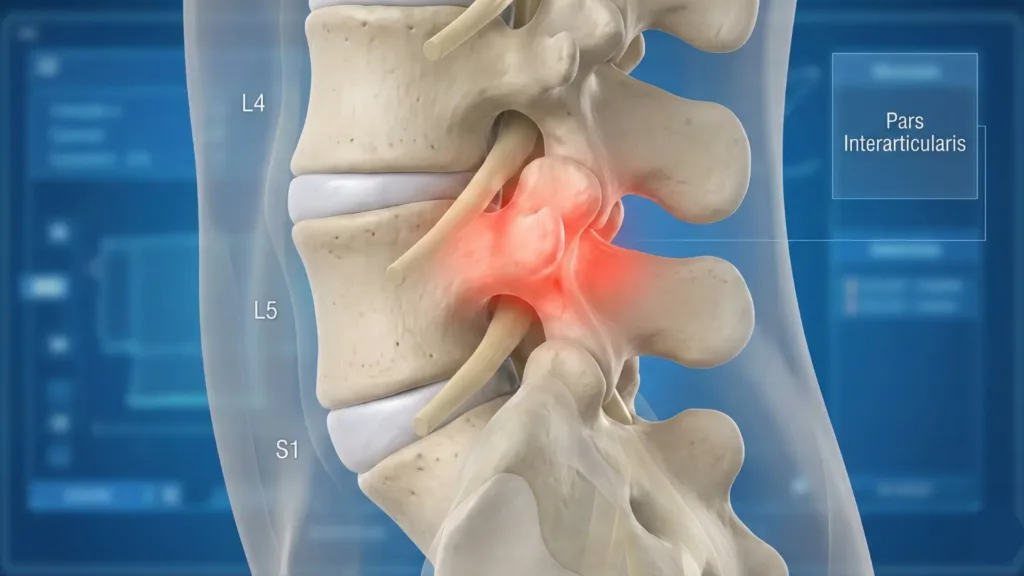
Cause 11: Pars stress reaction / spondylolysis risk (especially in younger lifters)
A pars defect is a stress injury often related to repetitive hyperextension loading (commonly at L5). If you’re a teen/young adult with focal back pain that worsens with extension, take it seriously.
How to tell what type of bench press lower back pain you have (fast triage)
Not all bench press lower back pain is the same. Use this quick pattern check:
A) Pain during setup/unrack
Likely drivers: rack height, reaching, over-arching to unrack, rib flare, lack of thoracic extension.
B) Pain only when you use leg drive
Likely drivers: foot position too far back, pelvis being pushed forward, bracing timing, hip flexor stiffness.
C) Pain that builds across sets and lingers after
Likely drivers: fatigue, volume spikes, erector spinae overwork, extension intolerance.
D) Pain with radiation, numbness, weakness, or cough/sneeze sensitivity
This is not “just technique.” It may involve nerve irritation and needs proper assessment.
Red flags and precautions
Most bench press lower back pain is mechanical and improves with targeted changes, but stop and get evaluated urgently if you have:
- New numbness, tingling, or weakness down the leg
- Loss of bowel/bladder control or saddle numbness
- Severe pain after a fall/accident
- Fever, unexplained weight loss, history of cancer, or night pain that doesn’t change with position
- Progressive worsening despite rest and easier training
Also be cautious with aggressive breath-holds (Valsalva) if you have uncontrolled high blood pressure, certain heart conditions, or are pregnant—get clearance.
From the Clinic: Dr. Arora’s Expert Insight
The most common pattern I see with bench press lower back pain is not “weak abs” in isolation—it’s a timing problem. Lifters set a big arch first, then try to brace on top of it. By then, the ribs are flared and the pelvis is tipped, so the brace can’t wrap 360°. The back becomes the stabilizer, and leg drive turns into a pelvic push.The standard advice “just arch less” often fails because it removes stability without rebuilding the real base: stacked ribs-pelvis, locked-in upper back, and a brace that turns on before you create leg drive. When we fix the sequence—stack, set shoulders, brace, then drive—pain often drops immediately, even without changing the lifter’s overall strength program.
Body (Part 2 — The Solution)
How to fix bench press lower back pain: form tweaks that work
If you want the shortest path to reducing bench press lower back pain, start with setup and sequencing—think of this section as your bench press setup to protect lower back. These tweaks are listed in the order that matters most.
Step 1: Rebuild a “stacked” start position (ribs over pelvis)
Cue set
- Exhale gently to bring ribs down (don’t smash them down—just reduce flare).
- Feel your low ribs connect to your abdomen.
- Keep a small, natural arch—avoid end-range lumbar crank.
Goal: you can keep this shape while you breathe into a brace.
Step 2: Set your upper back first (not your low back)
Scapula position
- Pull shoulder blades down and back (retraction + slight depression).
- Think “make a shelf” for your upper back.
- Keep your chest up by extending through the upper back, not by jamming the low back.
This reduces the need for lumbar extension as a stability strategy and often reduces bench press lower back pain immediately.
Step 3: Fix foot position so leg drive helps your torso, not your pelvis
Practical foot options
- Option A (most lifters): feet slightly behind knees, full foot contact, knees slightly below hip line.
- Option B (if back is sensitive): feet a bit more forward to reduce anterior pelvic tilt.
- Option C (temporary regression): feet on the bench (feet-up bench) for a few weeks to retrain rib–pelvis control—then reintroduce leg drive.
If you’re specifically noticing bench press leg drive lower back pain, move your feet forward 2–4 inches and retest.
Step 4: Learn a true 360° brace (and time it correctly)
Spine stability research supports the role of intra-abdominal pressure in increasing trunk stiffness. [Intra-abdominal pressure mechanism for stabilizing the lumbar spine, 1999].
How to do it (simple)
- Inhale through the nose or mouth into your belly and your sides (like filling a cylinder).
- Expand into your belt (or your hands around the waist).
- Hold that pressure while you lower the bar.
- Exhale only after the hardest part of the rep (or between reps if doing singles).
If you brace late, your lumbar spine often takes the load—classic bench press lower back pain setup.
Step 5: Control your arch with “glute contact” and butt rules
Your butt should stay on the bench. Over-squeezing glutes can posteriorly tilt the pelvis and destabilize some lifters; under-squeezing can let leg drive shove the pelvis forward.
Balanced cue: “Light glute tension, heavy upper-back tension.”
Step 6: Check bar path and touch point
A touch too low can increase spinal extension demand as you “reach” with the torso.
- Aim for a touch point around the lower chest/upper sternum region (varies by anatomy).
- Keep wrists stacked over elbows.
- Don’t chase a super-low touch if it forces your spine to compensate.
Step 7: Adjust equipment and environment
Small changes can eliminate bench press lower back pain triggers:
- Use a bench with good grip (less sliding = less pelvic shear).
- Consider a slightly wider bench if you feel unstable.
- Use a small towel under the upper back (not the low back) if you need thoracic extension support.
- Set rack height so unrack happens with locked shoulders, not a “reach.”
Pain-modifying bench variations (so you don’t stop training)
If bench press lower back pain persists while you’re rebuilding technique, rotate temporarily:
- Floor press: reduces leg drive demands and limits excessive extension.
- Dumbbell bench (neutral grip): often easier to control rib flare.
- Close-grip bench: sometimes reduces arch/flare tendency.
- Tempo bench (3–0–1): forces control without maximal load.
- Feet-up bench: excellent for learning stacked trunk control.
A 3-phase rehab plan for bench press lower back pain
This is a conservative, training-friendly approach. If you have severe symptoms or red flags, get assessed first.
Phase 1 (7–14 days): Calm the irritation and remove the trigger
Goal: reduce bench press lower back pain to ≤2/10 during training.
- Drop load to RPE 6–7.
- Cut total sets by 30–50%.
- Use feet-forward or feet-up bench.
- Add 5–8 minutes of easy walking after training (often reduces stiffness).
Starter exercises (daily, 8–12 minutes)
- Dead bug (brace focus): 2–3 sets × 6–10/side
- Side plank (modified if needed): 2 sets × 20–40 sec/side
- Hip flexor stretch (gentle): 2 × 30–45 sec/side
- Thoracic extension on foam roller: 6–10 slow reps
Phase 2 (2–6 weeks): Build capacity where your bench leaks
Goal: your trunk holds position under leg drive.
- Glute bridge isometric hold: 3 × 20–30 sec
- Bird dog (slow, no lumbar sway): 3 × 6/side
- Pallof press (anti-rotation): 3 × 10–12/side
- Hip hinge patterning (light RDL or dowel hinge): 2–3 × 8–10
During this phase, you reintroduce leg drive gradually while watching bench press lower back pain.
Phase 3 (6–12 weeks): Return to performance-style benching safely
Goal: increase load without increasing extension stress.
- Add weight weekly only if pain stays stable.
- Use a consistent setup checklist (below).
- Keep some trunk work 2–3x/week.
Return-to-load rule
If pain increases the next morning by >2 points (e.g., 2/10 → 5/10), that was too much. Reduce load or volume and rebuild.
The setup checklist (print this in your head)
Use this every session to prevent bench press lower back pain from creeping back:
- Feet placed (not jammed back)
- Upper back set (down + back)
- Ribs stacked (reduce flare)
- Brace 360° (before unrack)
- Unrack without reaching
- Leg drive into torso stability (not pelvic shove)
- Same arch on warm-ups and work sets
Do’s and don’ts (quick rules)
Do
- Do treat bench press lower back pain as a technique + tolerance problem first.
- Do keep a small arch if it’s controlled and pain-free.
- Do manage volume spikes and fatigue.
- Do strengthen trunk endurance and hip control.
Don’t
- Don’t chase the biggest arch if your back is extension-sensitive.
- Don’t drive your hips forward with leg drive.
- Don’t ignore symptoms that radiate or include numbness/weakness.
- Don’t “stretch your low back hard” if extension already hurts.
Myths vs facts
Myth: “If you have bench press lower back pain, your core is weak.”
Fact: Many strong lifters have bench press lower back pain because of timing and stacking errors, not raw strength.
Myth: “Flattening your back fixes everything.”
Fact: Over-flattening can reduce stability and shift stress to shoulders. Better is a controlled arch and 360° brace.
Myth: “Back pain during bench always means a disc problem.”
Fact: It can be discs, facets, or muscles. Pattern and symptoms matter.
Myth: “Belts are bad.”
Fact: A belt can be a useful feedback tool for 360° bracing, but it doesn’t replace technique.
FAQ
1) Should I stop benching if I get bench press lower back pain?
If pain is mild (0–3/10), non-radiating, and improves with setup changes, you can often keep benching with modifications. If symptoms radiate, worsen, or include neurological signs, stop and get assessed.
2) Is an arch always the reason for bench press lower back pain?
Not always. The arch is only a problem if it’s excessive, uncontrolled, or paired with rib flare and pelvic tilt.
3) Why do I feel bench press lower back pain only when I use leg drive?
That pattern usually means your leg drive is pushing your pelvis forward or you’re losing your brace when you drive. Adjust feet forward slightly and retime your brace.
4) Can tight hip flexors cause bench press lower back pain?
Yes. Hip flexor stiffness can pull the pelvis into anterior tilt, increasing lumbar extension and compression.
5) What’s the safest bench variation if bench press lower back pain flares up?
Feet-up bench, floor press, or dumbbell bench (neutral grip) are common “pain-modifying” options while you rebuild stacking and bracing.
6) How do I know if bench press lower back pain is muscular?
Muscular pain often feels like tightness or fatigue after sets, is tender to touch, and improves with heat and gentle movement. Sharp pinching with arching suggests facet irritation.
7) Can bench press lower back pain be a sign of spondylolysis?
In younger athletes, focal back pain that worsens with extension can be a pars stress injury. Don’t ignore persistent extension pain.
8) Is it okay to use a lifting belt for bench press lower back pain?
A belt can help you feel 360° expansion and maintain stiffness. Use it as feedback—not as a crutch.
9) How long does bench press lower back pain take to resolve?
If it’s mechanical and technique-driven, many lifters feel improvement in 1–3 sessions. If it’s an irritated structure, expect 2–6 weeks with smart load management.
10) What if bench press lower back pain returns every time I go heavy?
That suggests a tolerance mismatch: either your arch is too aggressive for your spine, your volume is spiking, or you lose brace under high effort. Build back up with slower progressions.