
Expert Review: This article includes clinical insights from Dr. Vivek Arora, a physiotherapist with 20+ years of experience.
Lower back pain while driving is one of those problems that creeps up on you. The first fifteen minutes feel fine. By the thirty-minute mark, there’s a dull pull. By the time you reach your destination and try to get out of the car, your lower back has locked into something it does not want to leave quietly. You straighten up slowly, take a few shuffling steps, and wonder how a car journey — not a heavy lift, not a workout — did that to you.
Lower back pain while driving is usually caused by three stressors acting at once: a seated position that flattens the natural lumbar curve, a fixed posture held without movement for long stretches, and road vibration transmitted through the seat into the spine. It is nearly always mechanical rather than dangerous, and it usually improves with seat adjustment, regular movement breaks and targeted strengthening.
It is more common than most people expect, and the reason is that no single one of those stressors would cause much trouble on its own. Add shortened hip flexors from the pedal position, and sustain the whole combination over thirty, sixty or ninety minutes, and the total load becomes significant — particularly for anyone whose lumbar spine is already sensitized or mildly degenerated.
This article explains exactly what is happening, why your seat position matters more than most people realize, what driving-related lower back pain usually indicates (and occasionally does not), and how to manage it effectively — from today’s commute through to a structured rehab plan.
Key Takeaways
- Driving places the lumbar spine in a prolonged, low-load flexion position that flattens the natural lordosis and gradually increases tissue stress.
- Road vibration transmitted through the seat is a separate, additional stressor on the intervertebral discs — not just background noise.
- Most driving-related back pain responds well to seat correction, short movement breaks, and a targeted exercise program.
- Pain that is one-sided, worsens on getting out of the car, or radiates into the buttock or leg may suggest involvement of the sacroiliac joint, a disc, or sciatic nerve irritation — each requires a slightly different approach.
- Imaging is rarely needed unless neurological symptoms, red flags, or a failure to respond to six weeks of conservative management are present.

Why does driving make my lower back hurt?
To understand why driving stresses the lumbar spine, it helps to know what the lumbar spine is doing when you sit in a car seat — which is not quite the same as what it does in a kitchen chair or an office chair.
In an upright standing posture, the lumbar spine maintains a gentle inward curve called the lordosis. This arch distributes load evenly across the vertebral bodies, the discs between them, and the small facet joints at the back. The muscles around the spine — the erector spinae, multifidus, and quadratus lumborum — do relatively little work because the skeletal structure is doing most of the load-sharing.
Car seats change this almost immediately. Most vehicle seats, particularly those not properly adjusted, tip the pelvis backward into a slight posterior tilt. This flattens or even reverses the lumbar lordosis, shifting the spine into a low-grade flexion posture. The vertebrae ahead of the disc move slightly apart at the back and closer together at the front. This is not a crisis — it is a normal position for the spine to move through. The problem is staying there, without moving, for the entire duration of a commute or a long drive.
This is what biomechanists call creep loading: when connective tissue — the disc, the posterior ligaments, the joint capsules — is held under sustained low-level stress, it gradually deforms. The longer it stays loaded in that position, the more the tissue stress accumulates, even without any increase in the force applied. This is why the first fifteen minutes of a drive feel fine and the forty-fifth do not.
Add to this the hip flexors. Sitting at approximately 90 degrees of hip flexion keeps the iliopsoas — the primary hip flexor — in a shortened position. Over time, this tightness tilts the pelvis anteriorly during standing, or resists full hip extension when getting out of the car, which transfers mechanical stress directly to the lumbar segments above.
Then there is the vibration environment. A car engine, road surface, and suspension system together expose the seated occupant to low-frequency whole-body vibration. This is transmitted vertically through the seat into the pelvis and lumbar spine. The lumbar discs are particularly sensitive to this frequency range, and sustained occupational exposure has been associated with meaningfully higher rates of both low back pain and sciatica. A systematic review and meta-analysis by Burström and colleagues, covering 28 studies and published in the International Archives of Occupational and Environmental Health, found that workers exposed to whole-body vibration had more than double the prevalence of low back pain compared to those without such exposure — a finding relevant to anyone who spends significant daily time behind the wheel, not just professional drivers.
For a deeper look at how specific muscle groups contribute to lumbar pain, the article on low back pain muscles and hidden causes covers the relevant anatomy in detail.
Common Causes of Lower Back Pain While Driving
Not all driving-related lumbar pain has the same origin, and the cause matters because it shapes the fix.
Lumbar disc irritation is among the most frequent contributors. The intervertebral discs act as load-distributing cushions between the vertebral bodies. In sustained flexion, the soft inner nucleus of the disc is pushed posteriorly. In a spine that already has some disc thinning or a small annular tear, this positional load amplifies pain. The classic pattern: discomfort builds progressively through the drive, stiffness on standing up, and a slow easing of pain after a few minutes of walking.
Sacroiliac joint irritation presents differently. The SIJ sits where the base of the spine meets the pelvis. Driving — particularly on uneven roads or with a seat that tilts the pelvis asymmetrically — can provoke the SIJ in ways that manifest as one-sided lower back or buttock pain. The telltale sign is pain that is worst not during the drive itself but on getting out of the car: that sharp, catching sensation in the lower back or posterior hip as the body transitions from seated to standing.
Hip flexor tightness is underappreciated as a driver of lumbar pain. The iliopsoas and rectus femoris, kept in a shortened state during long drives, can create a pulling force on the lumbar vertebrae that becomes symptomatic hours after the drive rather than during it. People with a desk-based lifestyle often have pre-existing hip flexor tightness that driving simply compounds.
Lumbar facet joint irritation tends to present as a central or slightly lateral lower back ache that is worse on certain seat positions and may be associated with morning stiffness. Unlike disc pain, facet pain often improves — at least initially — with sitting. But when the sitting posture is poor and sustained, even facet-mediated pain deteriorates during a long drive.
Piriformis and sciatic nerve irritation deserve mention here because car seat design is particularly unfriendly to this problem. The piriformis muscle, which sits deep in the buttock alongside the sciatic nerve, can be directly compressed against a firm seat edge. Pain that radiates into the buttock or down the back of the thigh — rather than originating clearly in the spine — may suggest this mechanism rather than a disc.
What does your pain pattern actually suggest?
The timing and character of driving-related back pain narrows the likely source considerably. Pain that builds over half an hour and clears with a walk behaves differently from one-sided pain that catches as you climb out, and both differ again from pain that eases while seated. The table below maps the five patterns seen most often, and each is explained underneath.
| Pain pattern | Typical behaviour | Most likely source | What it means for you |
|---|---|---|---|
| Builds gradually, peaks after 30–60 minutes, eases on walking | Central, deep ache; settles within 10–20 minutes of standing | Disc or ligamentous response to sustained flexion loading | Movement breaks and seat correction usually help most |
| One-sided, sharply worse on getting out of the car | Catching sensation in low back or hip during the transition | Sacroiliac joint or posterior hip structures | Change how you exit the car; target hip and pelvic control |
| Diffuse and bilateral, worst at the end of a long drive | Tired, aching quality that lingers afterwards | Muscular fatigue in erector spinae and quadratus lumborum | Better seat support plus endurance work, not stretching alone |
| Better sitting, worse standing or walking | Driving is one of the more comfortable activities | Possible lumbar spinal stenosis | Warrants formal clinical assessment rather than self-management |
| Back pain plus leg pain, numbness or tingling | Symptoms travel into buttock, thigh, calf or foot | Nerve-root irritation, often sciatic distribution | Arrange a structured evaluation; do not rely on seat fixes alone |
Pain that builds gradually and peaks after 30–60 minutes of driving, then eases with a short walk, is strongly suggestive of a disc-related or ligamentous response to sustained flexion loading. The spine has been held in one position long enough for tissue stress to accumulate. Movement allows fluid dynamics within the disc to redistribute, and pain typically subsides within 10–20 minutes of getting up.
One-sided pain that is specifically worse on exiting the car — particularly a sharp, catching sensation in the lower back or hip — points more toward the sacroiliac joint or the posterior hip structures. The transition from seated to standing creates a brief, high-demand shear force through the SIJ, which is a known provocation for SIJ-mediated pain.
Diffuse bilateral achiness that worsens toward the end of the drive and persists afterward suggests muscular fatigue rather than a structural problem. The erector spinae and quadratus lumborum work harder than usual in a poorly supported seat to maintain what lordosis remains. Over a long journey, they simply tire.
Pain that actually improves when sitting and worsens with walking or standing is a meaningful distinction. Lumbar spinal stenosis — a narrowing of the spinal canal — typically behaves this way. Sitting and mild forward flexion open the canal space slightly, so many people with stenosis find that driving is one of their more comfortable activities. If your back pain gets consistently worse with standing or walking but better with driving, a formal clinical assessment is important.
Leg pain, numbness, or tingling that accompanies lumbar pain during a drive warrants closer attention. Sustained seated flexion with vibration can provoke a sensitized disc to irritate a spinal nerve root, generating symptoms down the leg — most commonly the sciatic nerve distribution (back of the thigh, calf, foot). This does not automatically mean something serious is wrong, but it does mean a structured clinical evaluation should be arranged rather than relying on self-management alone.
Pain that sits near the tailbone or coccyx rather than the central lower back has its own distinct pattern. The article on low back pain by the tailbone when sitting addresses this presentation specifically.
Red Flags: When to Seek Urgent Assessment
The vast majority of people who experience lower back pain while driving have a mechanical problem that responds well to conservative management. However, some symptoms indicate that a timely medical review is essential:
- Loss of bladder or bowel control, or difficulty initiating urination: This may indicate cauda equina syndrome — compression of the nerve bundle at the base of the spine. This is a medical emergency requiring same-day assessment.
- Saddle area numbness — numbness or altered sensation in the groin, inner thighs, or genitals — is another cauda equina warning sign and should be treated with the same urgency.
- Progressive leg weakness — particularly foot drop (difficulty lifting the front of the foot) or repeated tripping — suggests significant nerve root compromise that needs prompt evaluation.
- Back pain accompanied by unexplained weight loss, persistent night pain that wakes you from sleep, or fever: These suggest non-mechanical causes — including rare but important ones such as infection or neoplasia — that require investigation regardless of driving habits.
- Back pain following significant trauma (a collision, a fall), particularly in older adults with known or suspected osteoporosis, should be assessed promptly to rule out fracture.
Do You Actually Need a Scan?
For most people experiencing lumbar pain while driving — even quite significant pain — imaging in the first four to six weeks adds very little. MRI and X-ray findings of disc bulges, mild degeneration, and facet changes are extremely common in pain-free adults over the age of 40. Seeing these findings on a scan without the right clinical context can generate unnecessary alarm and sometimes leads to over-treatment.
Imaging becomes genuinely useful when the clinical picture suggests something that would change management: progressive neurological symptoms (worsening leg weakness, numbness), symptoms lasting beyond six to eight weeks despite appropriate conservative management, a suspicion of infection or fracture based on the red flags above, or when a surgical referral is being considered and the surgeon needs structural information to plan.
The practical guide: if your driving-related back pain is your primary symptom, you have no leg neurological symptoms, and you have had the pain for less than six weeks, imaging is unlikely to tell you anything that changes the plan.
Three Things Most People Get Wrong About Driving and Back Pain
“It’s just muscle tightness — a massage will sort it.” Soft tissue work can certainly reduce muscle guarding, and it is not unhelpful. But driving-related lumbar pain usually involves loaded disc and joint tissues, not just muscle. Treating only the surface while the underlying positional mechanics remain unchanged means the pain typically returns after the next long drive. The seat position and movement pattern need to change, not just the muscle tone.
“Pushing the seat further back gives my back more room.” This is one of the most consistent errors I see. Increasing the distance to the pedals forces the driver to reach forward, which further flattens the lumbar lordosis and rounds the upper back. Closer is usually better — close enough that the knees are slightly bent, the foot is not fully extended on the pedal, and the lumbar support actually makes contact with the low back.
“A hard, flat seat is better for your back than a soft one.” A seat surface that is too firm without contouring creates localized pressure points on the ischial tuberosities (sitting bones) and posterior thighs and actually destabilizes the seated pelvis. The ideal is a seat that provides moderate contouring without excessive sinking — one that keeps the pelvis in a stable, near-neutral position rather than allowing it to roll backward into posterior tilt.
From the Clinic: Dr. Arora’s Expert Insight
I ask every patient with driving-related back pain the same first question: how do you get out of the car? Not because it tells me something I couldn’t get from their history — but because it tells me exactly how the spine has been loaded for the entire journey. If they describe grabbing the door frame, rolling sideways, and pushing themselves up while holding their breath, I know the lumbar spine has been in a compromised position for the whole trip. The exit maneuver just makes the load explicit.
What I find consistently in clinic is that people manage their pain with the wrong half of the problem. They focus on the discomfort that peaks at the end of the drive or after getting out, and they try to treat that — heat, rest, painkillers. All reasonable, but incomplete. The real work happens before the drive: seat setup, hip flexor preparation, and knowing that the spine needs a positional change somewhere around the 40-minute mark. If you don’t interrupt the static load, you’re just managing the consequence of a mechanical situation you haven’t addressed.
The second consistent finding is that people with driving-related lumbar pain almost universally have weak lumbar multifidus and poor endurance in their deep spinal stabilizers. This matters because the multifidus — the small, deep, segment-by-segment muscle of the lumbar spine — is the primary active stabilizer of each individual lumbar level. When it fatigues or is inhibited by pain, the larger surface muscles (erector spinae, quadratus lumborum) take over with less efficiency. This is why exercises for driving-related back pain are not about “doing some core work” — they specifically need to target the deep stabilizers at the lumbar level, with an emphasis on endurance rather than raw strength. Generic planks and crunches miss this entirely.
How should you set up your car seat?
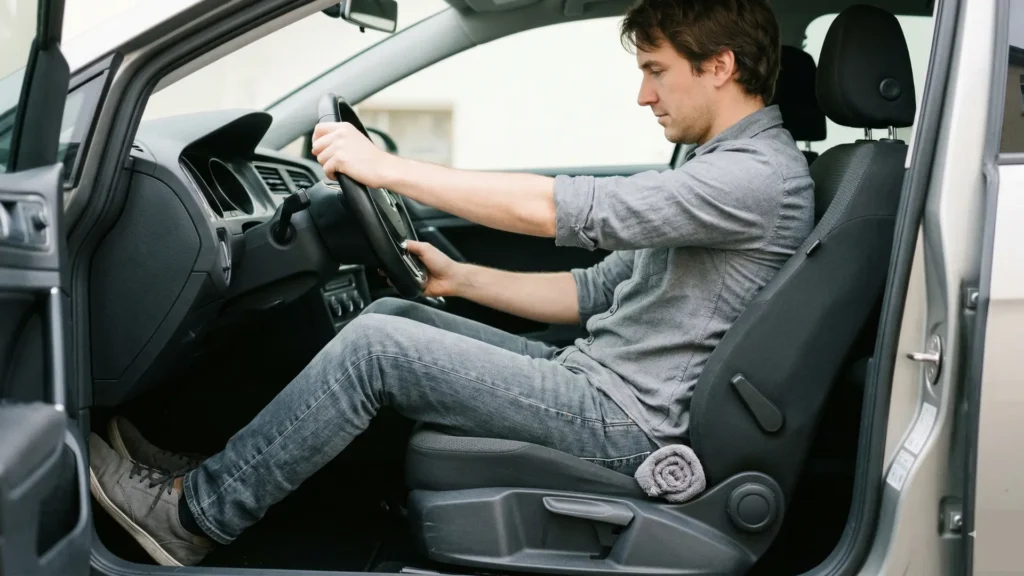
Seat position is the most immediately modifiable factor in driving-related lumbar pain, and most people set it up sub-optimally. Here is the specific adjustment sequence:
Seat distance to pedals: Move the seat forward enough that when the clutch or brake is fully depressed, the knee remains slightly bent — roughly 20–30 degrees of knee flexion. A fully extended leg means the pelvis is being pulled toward the pedal, which flattens the lumbar curve.
Seat back angle: Between 100 and 110 degrees is the target. Fully upright (90 degrees) creates excessive posterior pelvic tilt in most seat designs. Reclined beyond 110 degrees pushes the head forward and increases neck and upper thoracic tension. Somewhere in the 100–110 degree range, with the lumbar support making actual contact with the curve of your lower back, is the goal.
Lumbar support: Adjust the lumbar support height until it sits at the waistline — approximately at the level of the L3/L4 disc space, roughly the same height as the top of the posterior iliac crest. A lumbar support positioned too high becomes a thoracic support and forces the lumbar spine forward aggressively. Too low, and it loses contact with the curve it’s meant to support.
Seat height: Where adjustable, the hip should be level with or slightly higher than the knee. A low seat position drops the knees above the hips, which tilts the pelvis backward and removes the lordosis. Higher is usually better for lumbar alignment.
Steering wheel position: The arms should reach the wheel with a slight elbow bend — not a full stretch. Reaching forward to the wheel pulls the shoulders and upper back forward, which reverses any lumbar positioning you’ve carefully set.
If your vehicle’s lumbar support does not make adequate contact with your curve, a small rolled towel or a purpose-designed lumbar roll placed just above the seat base can restore the lordosis effectively. It need not be firm — even a moderate roll that fills the gap between your lower back and the seat back is sufficient.
Managing the Pain: From Today Through Full Recovery
First 24–48 Hours
If the pain is acute following a long drive, the immediate priority is to reduce the static load the spine has been carrying and encourage gentle movement. Prolonged rest is not helpful — the spine needs circulation, fluid exchange in the disc, and muscle activation.
- Take a 10–15 minute gentle walk as soon as you can after a flare-inducing drive. Walking encourages lumbar extension and disc fluid exchange.
- Apply a heat pack or warm shower to the lumbar region for 15–20 minutes. Heat reduces muscle guarding and improves local circulation.
- Avoid prolonged sitting in low, soft furniture immediately after a long drive. If you must sit, sit in a firm chair with a lumbar roll and maintain the curve you just lost in the car.
- Over-the-counter anti-inflammatories (NSAIDs such as ibuprofen) can help manage acute pain if appropriate for you and not contraindicated by other health conditions.
Phase 1: Reducing Load and Restoring Movement (Days 3–14)
The goal in this phase is to reduce the sensitized tissue’s exposure to provocative load while keeping the spine mobile. Complete avoidance of driving is rarely necessary, but driving sessions should be kept short — under 30 minutes — with a break to walk and stand before continuing.
Exercises in this phase focus on gentle lumbar mobility and initial activation of the deep stabilizers:
- Knee-to-chest stretch (lying): Draw one knee gently toward the chest and hold for 20–30 seconds. Alternate sides. This decompress the posterior lumbar structures and counters the flexion load that driving imposes — the goal here is restoration of full range, not aggressive stretching.
- Hip flexor stretch (low lunge position): The shortened iliopsoas from sustained hip flexion during driving needs lengthening. A supported low lunge with a gentle posterior pelvic tilt maintained — not an exaggerated arch — held for 30–40 seconds per side is a practical starting point. Do this immediately after every significant driving session.
- Supine pelvic tilt and segmental activation: Lying on your back with knees bent, gently flatten your lower back to the floor and hold for 5 seconds. This activates the deep abdominals and begins multifidus engagement without any compressive lumbar load.
Phase 2: Building Endurance and Load Tolerance (Weeks 2–6)
Once the acute sensitivity settles — typically when you can complete a 30-minute drive without significant pain escalation — the exercise focus shifts to building the endurance that prevents recurrence. This is where most people stop too early, which is why driving pain tends to return.
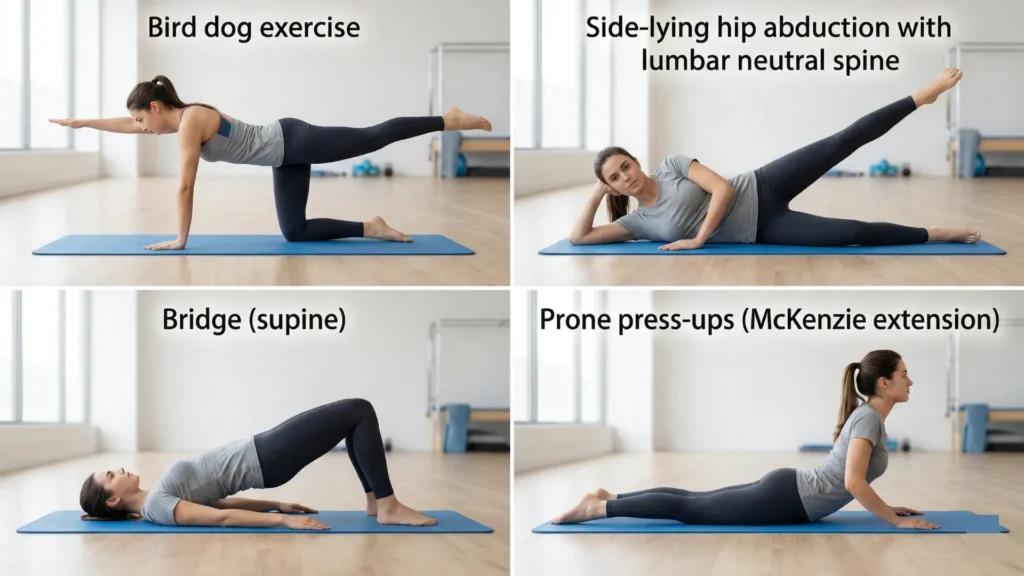
- Bird-dog: On all fours, extend the opposite arm and leg simultaneously while maintaining a neutral lumbar curve. The emphasis is on not allowing the low back to rotate or sag. Hold 8–10 seconds, 8–10 repetitions per side. Progress by adding a light ankle weight or a resistance band at the wrist when the form is consistent.
- Side-lying hip abduction with lumbar neutral: This targets the gluteus medius — a muscle that, when weak, allows the pelvis to drop and increases lateral lumbar loading during single-limb activities (walking, getting into a car). Slow, controlled repetitions with emphasis on not rotating the pelvis.
- Bridge (supine): Glute bridges directly address the posterior chain weakness that contributes to poor pelvic positioning in the car seat. Progress from a simple bridge to a single-leg bridge as strength improves.
- Prone press-ups (McKenzie extension): If your pain is disc-related and centralized (i.e., it stays in the lower back rather than running into the leg), prone press-ups — lying face down and pushing the upper body up while keeping the pelvis in contact with the floor — are often therapeutic. They counteract the flexion bias of driving posture directly. Start with 10 repetitions, 2–3 times daily.
For a structured home exercise program covering these movement phases in detail, the low back pain physical therapy home program provides a step-by-step approach.
Taking Movement Breaks on Long Drives
Beyond exercise, the single most effective behavioral intervention for driving-related lumbar pain is breaking up the static load. For most people, a stop every 45–60 minutes (approximately every 45–50 miles / 70–80 km on a highway journey at normal speed) with a 5–10 minute walk is sufficient to prevent significant pain escalation. During the walk, add 5 backward steps or a gentle standing lumbar extension (hands on the back of the hips, gently arch backward) to actively counteract the flexion position.
Do’s and Don’ts for Driving With Lower Back Pain
Do:
- Set your seat so there is always a slight lordosis in your lumbar spine — use a lumbar roll if the built-in support is inadequate.
- Stop and walk every 45–60 minutes on longer journeys. Set a phone reminder if needed.
- Do a brief hip flexor stretch immediately after every drive longer than 30 minutes.
- Maintain a consistent lower back exercise program — particularly deep stabilizer work — even when the pain settles.
- Get out of the car carefully: rotate your whole body to face the door, use your arms to assist, and push up from both legs together rather than twisting out of the seat.
Don’t:
- Push the seat too far back to “give your back room” — this forces you to reach the pedals with a straightened knee and removes the lordosis completely.
- Brace or tense the back muscles throughout the drive in an attempt to “sit up straight.” Sustained muscular co-contraction fatigues faster than a well-supported passive posture.
- Rely on a lumbar massage cushion with vibrating elements as a pain management strategy — adding vibration to a spine already experiencing road-transmitted whole-body vibration is not helpful.
- Avoid movement after a painful drive. Lying down immediately after a flare-inducing journey prolongs stiffness; a short walk is better.
- Drive through significant pain without reassessing seat position. Pain that consistently peaks before the 30-minute mark suggests the seat setup needs addressing before the cause, not just after the consequence.
Return to Normal Driving
The progression back to unrestricted driving depends on the underlying cause and severity. As a general guide:
For simple mechanical pain with no neurological involvement, most people can comfortably complete a 60-minute drive without significant pain within 3–6 weeks of implementing seat corrections and beginning a targeted exercise program. A realistic functional milestone — rather than a specific time — is completing two consecutive 30-minute drives on the same day without residual pain or stiffness that persists beyond 20 minutes of getting out.
For disc-related pain with leg symptoms, the timeline extends. Symptom centralization (pain moving from the leg back toward the lower back as the disc settles) is the key marker of progress. Return to unrestricted long-distance driving is reasonable once the leg symptoms have resolved and a 45-minute drive is well-tolerated.
When Conservative Management Is Not Enough
Conservative management — seat correction, exercise, manual therapy, load modification — resolves most driving-related lumbar pain. When it does not, the question is whether the diagnosis is correct and whether anything has been missed, before considering more invasive options.
A structured physiotherapy (physical therapy) assessment is warranted if pain has not meaningfully improved after four to six weeks of consistent, well-implemented conservative management. A PT can identify movement faults, assess whether the SIJ, a specific lumbar level, or the hip is the primary driver, and direct treatment accordingly.
Imaging becomes appropriate at this stage — specifically to look for structural findings (significant disc herniation, nerve compression, facet degeneration) that would change the treatment direction. A lumbar MRI provides this information without radiation exposure and is generally preferred over plain X-ray for soft tissue assessment.
Interventional options — such as targeted nerve root injections or facet joint blocks — are sometimes recommended for persistent pain with a clear structural correlate, when conservative care has been genuinely optimized. These can provide a pain window that allows rehabilitation to progress.
Spinal surgery for driving-related lower back pain is uncommon and is generally considered only when there is a specific structural finding (such as significant disc herniation with progressive neurological deficit), when conservative management has been exhausted, and when the imaging findings correspond clearly to the clinical symptoms. Pain alone — without neurological compromise and without a clear surgical target — is not a strong indication for lumbar surgery, and the outcomes data supports conservative and injection-based management first in most cases.
Conclusion
Lower back pain while driving is not an inevitable consequence of time behind the wheel — it is usually a correctable mechanical problem with a clear clinical explanation. The lumbar spine responds poorly to sustained static flexion, hip flexor shortening, and whole-body vibration when given no opportunity to reset. Address those three inputs — through proper seat position, regular movement breaks, and a targeted exercise program that builds real deep stabilizer endurance — and most people see meaningful improvement within a few weeks.
If the pain is one-sided, travels into the leg, came on after a specific incident, or has not responded to six weeks of genuinely implemented conservative management, a formal physiotherapy assessment will identify what is driving it and what needs to change. Imaging and further investigation are available when needed, but they are rarely the first step. The seat is.
Frequently Asked Questions
1. How long should I drive before taking a break to protect my lower back?
For most people with lumbar pain, a break every 40–50 minutes is the practical target. At that point, get out, walk for 5–10 minutes, and do a brief standing lumbar extension before continuing. On pain-free days, 60 minutes between breaks is usually manageable — but if you notice discomfort beginning to build before 45 minutes, that’s the cue to stop sooner, not push through to the planned stop time.
2. Can my car seat cause permanent damage to my spine?
Routine driving — even daily commuting — does not typically cause permanent spinal damage in otherwise healthy adults. The concern is cumulative load over years, not individual journeys. Consistently poor seat position, combined with no corrective exercise and high daily driving volume, can accelerate disc changes over time. However, these are the same degenerative changes seen in sedentary workers across many occupations — they are manageable, rarely lead to permanent structural damage in the absence of significant trauma, and respond well to posture correction and movement.
3. My pain is worse getting out of the car than during the drive itself. What does that mean?
Pain that peaks specifically on the exit transition — standing up from the seated position — suggests one of two things: sacroiliac joint provocation (as the pelvis shifts from seated to weight-bearing), or a lumbar spine that has stiffened under sustained static load and objects to the sudden change in position. Try exiting more slowly, rotating your whole body toward the door before standing rather than twisting out of the seat, and pausing for a moment with both feet on the ground before fully straightening. If it persists, an SIJ assessment by a physical therapist is worthwhile.
4. Does it help to use a back support cushion in the car?
A well-designed lumbar roll or lumbar cushion — one that fills the gap between your lower back and the seat back and maintains the lordotic curve — can meaningfully reduce driving-related lumbar pain. The key word is well-designed: a cushion that is too thick forces excessive extension; one that is too soft provides no useful support. A rolled towel of about 4–6 inches (10–15 cm) in diameter, placed at waist height, is a reasonable starting point if you want to test the effect before investing in a commercial product.
5. Should I avoid driving completely while my lower back is painful?
Complete avoidance is rarely necessary or helpful. Short, well-positioned drives — under 30 minutes — are generally tolerable even during a back pain flare, and complete rest tends to prolong recovery rather than accelerate it. The practical goal is to keep driving sessions short enough that pain does not escalate significantly during the journey. As symptoms improve and the exercise program takes effect, distance tolerance typically increases steadily.
6. Can sciatica be triggered or worsened by driving?
Yes, and it is a recognized pattern. Sustained lumbar flexion during driving increases posterior disc pressure, which can provoke an already irritated disc to press further against an adjacent nerve root. Additionally, the sciatic nerve can be mechanically compressed against a firm seat edge during long drives — particularly in bucket seats with a raised lateral bolster. If your driving is triggering leg pain, numbness, or tingling that runs below the knee, this warrants clinical assessment rather than self-management alone, since the nerve needs to be offloaded and the disc allowed to settle.
7. What exercises specifically help lumbar pain from driving?
The most useful exercises target what driving specifically depletes: hip flexor length, lumbar stabilizer endurance, and posterior chain strength. Hip flexor stretches immediately after drives, bird-dog for deep stabilizer endurance, prone press-ups (McKenzie extensions) for disc-related pain, and glute bridges for posterior chain activation are the core priorities. One thing worth knowing: the first thing many people reach for after a long drive is a deep forward bend or a knee-to-chest pull. The spine has spent the last hour in a flexion-biased position — piling more flexion onto that immediately is not the reset it feels like.
8. I have a long road trip coming up. How do I prepare and manage my back during it?
Start with seat setup before you leave: lumbar support in contact with your low back, seat close enough that the knee is slightly bent at full pedal depression, and backrest at 100–110 degrees. Pack a lumbar roll if your car’s support is inadequate. Plan a stop every 45–50 miles (70–80 km) and walk for 5–10 minutes each time. Do a hip flexor stretch at every stop. On the day before a long drive, a gentle exercise session — particularly hip flexor work and prone extensions — prepares the spine for sustained seated load. Avoid the temptation to “push through” to the destination when pain begins building; a 10-minute stop saves you three days of recovery.
Medical Disclaimer
This article is written for informational and educational purposes and is not a substitute for professional medical advice, diagnosis, or treatment. The content reflects general clinical principles in physiotherapy and musculoskeletal medicine and is not tailored to any individual’s specific circumstances. If you are experiencing severe, worsening, or unexplained pain, neurological symptoms (leg weakness, numbness, bladder or bowel changes), or any of the red flags described in this article, seek prompt medical evaluation. Always consult a qualified healthcare professional before beginning any new exercise program, particularly if you have an existing spine condition or recent injury.
References
- Burström L, Nilsson T, Wahlström J. Whole-body vibration and the risk of low back pain and sciatica: a systematic review and meta-analysis. International Archives of Occupational and Environmental Health. 2015;88(4):403–418. doi:10.1007/s00420-014-0971-4.