
Seek urgent medical assessment for sudden, severe back or neck pain after a fall or impact, including a minor one, if you have ankylosing spondylitis. Get emergency care for new neurological warning signs. Get emergency care now for new difficulty passing or controlling urine, new loss of bowel control or sensation, numbness around the genitals or anus, or new sciatic pain down both legs. Severe or worsening weakness or numbness in both legs also needs emergency care. Pillow and position changes can help comfort while you follow your treatment plan.
“Expert Review: This article includes clinical insights from Dr. Vivek Arora, a physical therapist (physiotherapist) with 20+ years of experience.”
With ankylosing spondylitis, sleep may be disturbed by inflammation, pain, stiffness, mood, other sleep conditions or an uncomfortable position. Bedding can affect comfort, but a broken night is not proof of poor posture or uncontrolled inflammation.
This guide offers positions and pillow options to discuss, without treating one setup as a cure or a way to reverse fusion. Persistent sleep disruption deserves review of both disease management and other possible contributors.
Key Takeaways
- Inflammatory back pain can worsen after rest and improve with movement, but the pattern overlaps with other conditions and cannot diagnose AS by itself.
- Choose a supported position you can enter, leave and breathe in comfortably. Back-lying is one option, not a proven best position for everyone.
- Pillow height should match your existing shape and sleeping position. Do not force a stiff or fused neck flat.
- Waking in the second half of the night with stiffness that improves once you get up and move is a classic pattern, not a sign you chose the “wrong” position.
- A sudden, new, severe spinal pain after even a minor knock deserves urgent assessment — a long-standing fused spine can fracture more easily than people expect.
- Comfortable bedding can support sleep. Regular individualized exercise and appropriate rheumatology treatment remain important parts of care.
Why does ankylosing spondylitis make sleep so difficult?
Ankylosing spondylitis is a chronic inflammatory arthritis that mainly targets the spine and the sacroiliac joints, where the base of the spine meets the pelvis. Because the inflammation is driven by an active immune process rather than by a one-off mechanical injury, the pain follows a rhythm: it tends to quiet down when you are active during the day and flare when you hold still for a long stretch — which is exactly what sleep asks you to do. This is why so many people describe their worst hours as the early morning.
Inflammatory pain, reduced mobility and changes in spinal shape can make lying down uncomfortable. A simple explanation based on fluid pooling or “gelling” does not establish the biological cause of overnight symptoms, and not everyone develops fusion or a forward curve.
Rib and spinal stiffness may affect comfort, but new or significant breathing difficulty should not be attributed to AS or a sleep position without assessment. Choose support that allows comfortable breathing and safe movement.
What is the best sleeping position for ankylosing spondylitis?
No sleeping position is proven best for every person with AS. Back-lying or side-lying may be comfortable if supported to your existing spinal shape. Do not force a fused spine straight or persist in a position that causes pain or breathing difficulty.
Here is the reasoning behind each option, because the “why” is what lets you adapt it to your own body.
Back-lying: Try it if comfortable. Support the head and any gaps without forcing the neck backward or creating an arch; someone with a fixed forward curve may require more head support, not less.
Side-lying: Use comfortable head support and an optional pillow between the knees. A modest bend may be comfortable; do not assume an ordinary sleep posture causes disease progression.
Front-lying: This may be uncomfortable or impractical with neck stiffness or breathing problems. It is not a required extension treatment. Discuss mobility exercises with a clinician rather than forcing the spine or neck.
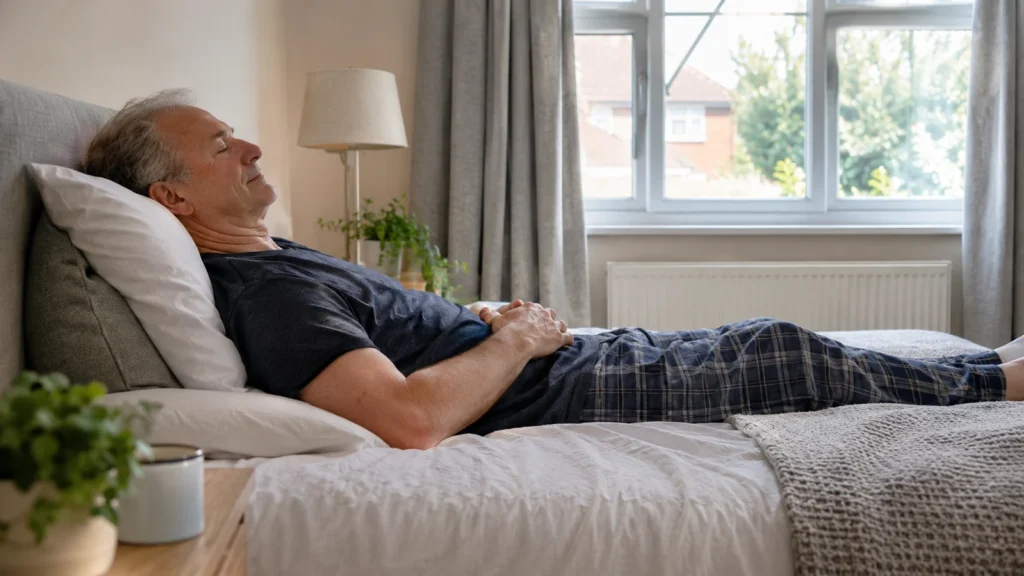
| Position | Possible comfort option | Precaution |
|---|---|---|
| Back-lying | Support the head and body to the existing shape | Do not force a fused or curved spine flat |
| Side-lying | Comfortable head support; optional knee pillow | Avoid unsupported twisting or forced correction |
| Front-lying | Only if comfortable and appropriate for you | Neck stiffness or breathing difficulty may make it unsuitable |
| Supported reclining | May be an alternative for comfort | Discuss persistent difficulty lying normally; no automatic prohibition |
How should you set up pillows for ankylosing spondylitis?
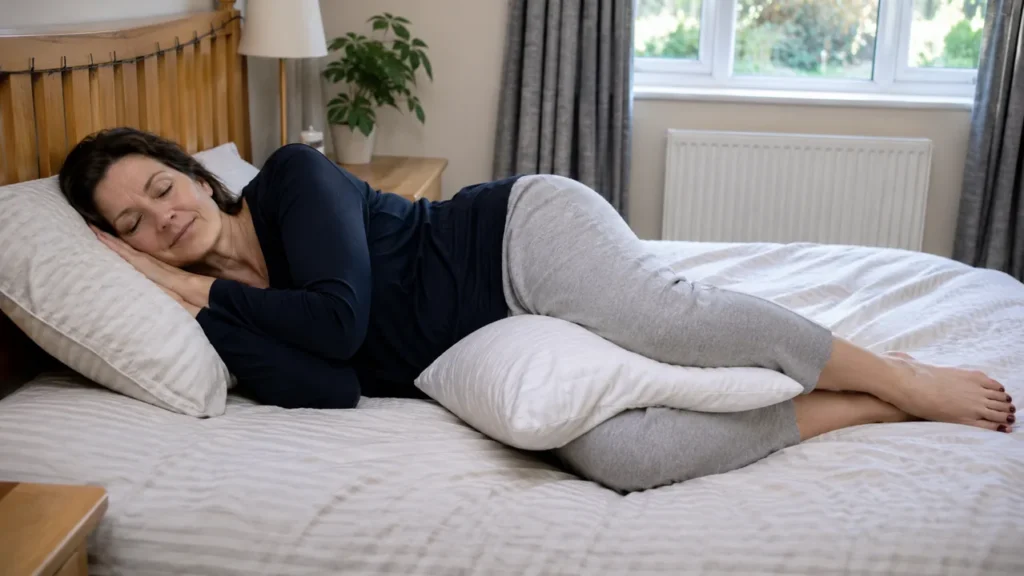
Pillows should support your existing shape comfortably. Their role is support, not forced correction of a rigid deformity. The height needed can differ substantially between back-lying and side-lying.
Walk it through, top to bottom:
- Head and neck: Use enough support to avoid an uncomfortable unsupported position. If you have a fixed curve or fused neck, ask your physiotherapist about positioning; do not remove necessary pillows to meet a flat-neck target.
- Lower back: A small support is optional if it improves comfort. Do not force an arch into a stiff or fused area.
- Knees: An optional pillow between the knees or a small support under them may improve comfort. Reassess the whole position with your clinician if it is difficult to lie down or get up.

A warm shower or protected heat pack may provide comfort, but it does not control the underlying disease. Avoid burns and sleeping with a pack; the heat and ice guide discusses general safety.
How is this different from ordinary mechanical back pain?
Inflammatory pain may involve night waking and prolonged morning stiffness that improves with movement. Mechanical and other conditions can share these features, so timing alone cannot distinguish them or measure AS activity.
| Feature | Inflammatory pain can include | Limitation |
|---|---|---|
| Night symptoms | Waking, sometimes in the second half of the night | Other causes can also disturb sleep |
| Morning stiffness | Prolonged stiffness | Duration alone does not diagnose AS |
| Rest and movement | Worse after rest, easier with activity | Responses overlap with other back conditions |
| Age at onset | Often starts before 45 | Age is not a stand-alone diagnostic test |
| Change in pattern | Different or severe new pain | Consider fracture or another cause, not just a flare |
These patterns help a clinician interpret the history; they are not a home diagnostic rule or a reason to dismiss a change in symptoms as routine stiffness.
From the Clinic: Dr. Arora’s Expert Insight
Comfortable support is a reasonable goal. A person who cannot sleep flat has not failed at posture, and a search for a suitable pillow should not replace review of persistent pain or other sleep problems.
If you wake stiff, a brief comfortable position change or gentle movement may help. You do not have to get up or extend the spine at a fixed time, and movements should respect your established limitations.
Regular exercise is recommended, but it does not guarantee better sleep and should not require pushing a rigid spine into discomfort. Agree a suitable programme with your clinician and review persistent night symptoms.
When should night pain make you worried?
Seek immediate assessment for new severe spinal pain after a fall or knock, even if it seemed minor. Get emergency care now for new difficulty passing or controlling urine, loss of bowel control or sensation, or numbness around the genitals or anus. New sciatic pain down both legs or severe or worsening weakness or numbness in both legs also needs emergency care. Seek urgent advice for new weakness or numbness or fever with worsening pain.
A stiff or ankylosed spine can fracture after relatively minor trauma. New severe back or neck pain needs immediate assessment rather than stretching or manipulation. A painful red eye, light sensitivity or blurred vision may indicate uveitis and needs same-day ophthalmological assessment.
Use the specific urgency below:
- Immediate assessment for sudden severe new spinal pain, especially after a fall or knock; avoid forcing or manipulating the spine.
- Urgent medical assessment for new limb weakness or numbness; severe or worsening bilateral leg findings need emergency care.
- Emergency care now for new difficulty passing or controlling urine, loss of bowel control or sensation, or new saddle numbness.
- Same-day eye assessment for a painful red eye, light sensitivity or blurred vision.
- Fever, night sweats, or unexplained weight loss alongside the pain
These signs should not be managed by adjusting pillows. Do not drive yourself if emergency care is needed.
When is imaging actually needed?
Changing a pillow does not normally require a scan. Imaging may be used to support diagnosis or investigate a meaningful change in symptoms; persistent night stiffness alone does not automatically require repeat imaging.
X-rays and MRI have different roles in assessing structural change and inflammation. A suspected fracture in an ankylosed spine needs urgent evaluation and may require CT and/or MRI; do not assume a normal plain X-ray excludes it.
Practical management: building a night that works
What to do in the next few nights
You do not have to overhaul everything at once. Layer these in over a few evenings and notice what your body says.
- Try warmth if helpful: A warm shower or a protected heat pack may ease discomfort. Stop if the skin changes or sensation is reduced; do not sleep with a pack.
- Use familiar, comfortable movement: Follow your existing physiotherapy plan and avoid forceful extension or rotation, especially in a fused spine.
- Match support to your shape: Change pillow height gradually for comfort rather than automatically lowering it.
- Try a supported position: Back-lying or side-lying may suit you; there is no compulsory default.
- Respond to waking: Change position or move gently if that helps. Repeated disrupted sleep deserves assessment rather than automatic attribution to AS.
How to think about progression
Sleep quality can vary with pain, disease activity, bedding, stress, medication and other sleep conditions. Use changes as information to discuss, not as a direct test of inflammation.
| Situation | Possible focus | Review |
|---|---|---|
| Troublesome nights | Comfortable support, familiar activity and symptom management | Disease activity and other sleep contributors |
| Improving sleep | Continue the strategies that suit you | Adjust for changing comfort or mobility |
| New or severe symptoms | Use the warning-sign guidance | Do not rely on bedding changes alone |
The thread running through every phase is movement. Major international rheumatology guidance places non-pharmacological care — patient education and regular exercise — as a cornerstone of managing axial spondyloarthritis, sitting alongside medication rather than behind it, as set out in the 2022 ASAS-EULAR recommendations. Your bedroom setup supports that work; it does not replace it.
Do’s and don’ts specific to AS
Do:
- Keep an individualized exercise routine and adjust it during a flare with clinical advice.
- Use warmth for comfort if helpful and safe.
- Review pillow support when your comfort or mobility changes.
Don’t:
- Do not force a flat position when a supported or reclined position is more comfortable; seek advice if ordinary lying is becoming difficult.
- Do not remove head support needed for a fixed spinal curve or use pillows to force correction.
- Don’t equate a sleepless night with a personal failure; treat it as information about disease activity.
When the basics aren’t enough
Persistent poor sleep warrants a broader review. Disease activity may contribute, but pain from other causes, sleep apnea, mood or medication may also matter. Discuss symptoms with your rheumatology or primary-care team. The guide to back pain while driving offers general position-change ideas without identifying the cause of night pain.
Conclusion
How to sleep with ankylosing spondylitis depends on your comfort, existing spinal shape, mobility and disease management. Support rather than force the spine, choose positions that allow comfortable breathing and transfers, and keep an individualized activity plan. Review persistent sleep problems and act on new severe pain or eye and neurological warning signs.
Frequently Asked Questions
1. What is the single best sleeping position for ankylosing spondylitis?
There is no proven single best position. Supported back-lying or side-lying may suit you, but a fixed curve or fused neck can change the support required. Do not force yourself flat or remove pillows you need.
2. Why does my back hurt more at night than during the day?
Inflammatory pain can worsen after rest, but other pain and sleep problems can also disturb the night. Fluid pooling is not an established explanation for your symptoms; seek review if they change or remain troublesome.
3. Should I sleep on a firm board or a very hard mattress?
Choose a surface that supports you comfortably and lets you turn and rise safely. No mattress firmness has been established as best for every person with AS; a very hard surface may be uncomfortable.
4. Is it bad that I wake up and have to walk around at night?
Gentle movement may ease stiffness, but you do not have to follow a fixed night routine. Keep transfers safe and discuss frequent waking or a new symptom pattern with your clinician.
5. Can the right pillow stop my neck from stiffening?
A pillow cannot prevent inflammation or fusion. Use the height that supports your existing neck and upper-back shape comfortably; too little support can also be uncomfortable, especially with a fixed forward curve.
6. Will fixing my sleep position cure my ankylosing spondylitis pain?
No. Positioning may improve comfort but does not cure AS or replace treatment. Regular individualized exercise and appropriate rheumatology care matter; persistent sleep disruption should also be assessed for other causes.
7. When should night pain send me to a doctor urgently?
Seek immediate assessment for new severe back or neck pain, especially after minor trauma. Get emergency care now for new difficulty passing or controlling urine, loss of bowel control or sensation, numbness around the genitals or anus, or new sciatic pain down both legs. Severe or worsening weakness or numbness in both legs also needs emergency care. Get urgent medical assessment for new or worsening weakness in one leg. A painful red eye, light sensitivity or blurred vision needs same-day eye assessment.
Medical Disclaimer
This article is for general education and is not a substitute for individual medical advice, diagnosis, or treatment. Ankylosing spondylitis varies considerably from person to person, and sleep strategies that suit one individual may not suit another. Always consult a qualified rheumatologist, physician, or physical therapist about your own symptoms and before making changes to your management — particularly if you have new, severe, or rapidly changing symptoms.
References
- Ramiro S, Nikiphorou E, Sepriano A, et al. ASAS-EULAR recommendations for the management of axial spondyloarthritis: 2022 update. Annals of the Rheumatic Diseases. 2023;82(1):19–34. doi:10.1136/ard-2022-223296. Available at: https://ard.bmj.com/content/82/1/19
- National Institute for Health and Care Excellence. Spondyloarthritis in over 16s (NG65). Individualized exercise, uveitis and fracture assessment.
- National Institute of Arthritis and Musculoskeletal and Skin Diseases. Ankylosing spondylitis: diagnosis, treatment and steps to take.