
Check for emergency symptoms first. Get emergency care now for new difficulty passing or controlling urine, new loss of bowel control or sensation, numbness around the genitals or anus, or new sciatic pain down both legs. Severe or worsening weakness or numbness in both legs also needs emergency care.
Expert Review: This article includes clinical insights from Dr. Vivek Arora, a physical therapist (physiotherapist) with 20+ years of experience.
Leg pain has a way of hijacking your attention. One moment you are reaching for a dropped set of keys, the next a hot line of pain is running from your buttock down the back of your thigh, and your first thought is rarely calm. So let’s answer the question directly. What does sciatica feel like? At its core it is nerve pain that travels — a shooting, burning, or electric sensation that follows a defined path down one leg, often mixed with tingling, numbness, or a leg that feels oddly weak. It is not the same as an ordinary sore lower back, and knowing the difference changes what you do next.
This guide describes seven symptoms that can occur with sciatica, how they overlap with other conditions, and which changes need urgent or emergency assessment. The list is not a diagnostic test.
Key takeaways
- Sciatica is a symptom, not a diagnosis — it describes irritation of a lumbar nerve root or the sciatic nerve, most often from a bulging or herniated disc.
- The hallmark is pain that radiates down one leg, frequently below the knee, rather than staying parked in the lower back.
- Tingling, numbness, and a burning or electric quality are common; genuine leg weakness deserves closer attention.
- Sciatica often improves over a few weeks to a few months, but it can last longer and can recur.
- A few symptoms — loss of bladder or bowel control, numbness around the groin — are emergencies and override everything else here.
What does sciatica actually feel like?
Sciatica typically feels like a sharp, shooting, or burning pain that starts in the lower back or buttock and travels down the back or side of one leg, often past the knee toward the calf or foot. Many people also notice tingling, patches of numbness, or a sense that the leg is heavy or unreliable. The pain tends to be one-sided and is frequently worse when sitting, bending forward, or straining.
The word itself simply means pain in the distribution of the sciatic nerve — the largest nerve in the body, formed from lower lumbar and upper sacral nerve roots. When one of those roots is irritated where it exits the spine, the brain interprets the signal as coming from wherever that nerve travels. That is why a problem in your back announces itself in your shin or your foot. The leg is the messenger, not the culprit.
What symptoms can occur with sciatica?
Several of these symptoms may occur together, but their number or combination does not confirm sciatica. Clinical assessment considers other nerve, joint, vascular and medical causes.
- Radiating leg pain: Pain can spread from the buttock toward the thigh, calf or foot. It is useful to describe the distribution without treating the knee as a diagnostic boundary.
- Electric, shooting or burning pain: These qualities can occur with nerve pain, but sciatica may also ache and other conditions can feel sharp or burning.
- Pins and needles. A tingling, buzzing, or “fizzing” strip along the leg or into specific toes, tracking the nerve rather than spreading evenly.
- Numbness or reduced feeling. A patch of skin on the calf, the outer shin, the sole, or the toes that feels muffled, like a partial dental freezing.
- Heaviness or weakness: A feeling of heaviness is not the same as measured weakness. New or worsening loss of strength, such as a dragging foot, needs urgent assessment.
- Pain with coughing or sneezing: Straining may aggravate back or leg symptoms, but this does not by itself identify a disc or nerve-root diagnosis. See pain when sneezing.
- A one-sided pattern: Sciatica commonly affects one side. New sciatic pain down both legs requires emergency care rather than simply a routine check.
Why does sciatica feel the way it does?
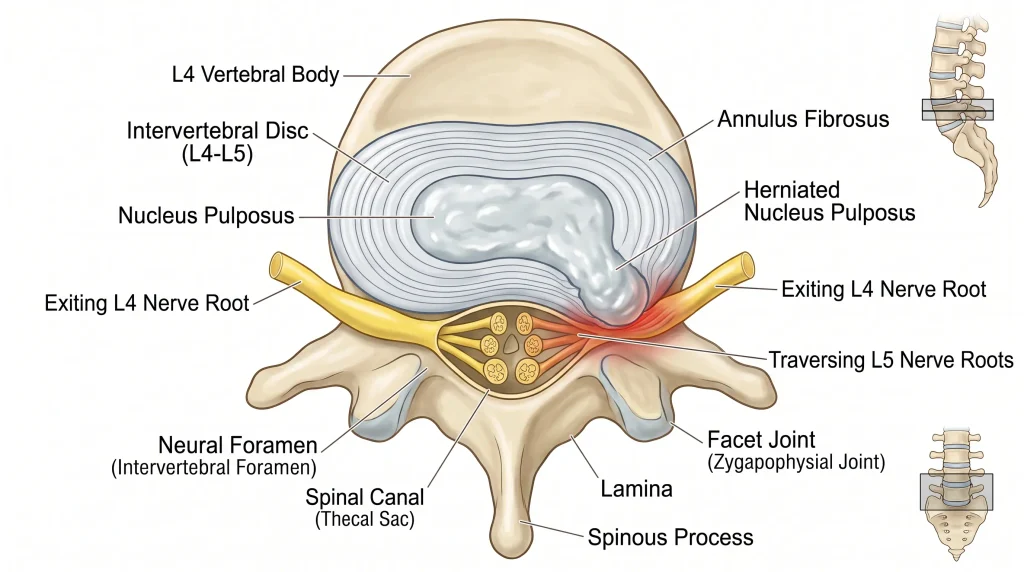
Sciatic pain may involve mechanical and inflammatory irritation of a spinal nerve root, often associated with a herniated disc. The pain can be felt in the leg without much back pain; examination is needed to distinguish this from other causes.
Normal bending and sitting do not demonstrate that a disc is weakening or moving into a nerve. Positions can change symptoms for several reasons. Relief with walking or arching cannot establish the cause or rule out a serious condition.
How is sciatica different from ordinary back or hip pain?
Radiating pain with tingling, numbness or weakness can prompt a nerve assessment, but the symptoms overlap. Hip disease can refer below the knee, and spinal referred pain may remain in the buttock or thigh.
| Observation | Possible relevance | Limit |
|---|---|---|
| Pain into the leg | May occur with a nerve-root condition or referred pain | Distance alone does not establish the source |
| Electric, burning or aching quality | Can occur with nerve or other pain | Pain words are not a diagnostic test |
| Tingling or numbness | May involve a nerve or another condition | Requires interpretation with the examination |
| New or worsening weakness | Potential neurological or other problem | Needs urgent assessment rather than symptom scoring |
| Hip, back or buttock pain | Several structures can produce overlapping symptoms | Hip disease can also refer below the knee |
A sensation of gluteal tightness does not establish a muscle diagnosis, and the end point of leg pain does not reliably separate hip from spine. See gluteal tightness and back pain and the back-versus-hip assessment guide.
When is sciatica a red flag?
Use the specific urgency below. These findings do not all have the same cause and should not be treated as proof of cauda equina syndrome.
- Emergency now: New difficulty passing or controlling urine, or new loss of bowel control or sensation.
- Emergency now: New numbness around the genitals, anus or inner thighs.
- Neurological changes: New bilateral sciatic pain, or severe or worsening weakness or numbness in both legs, needs emergency care. New or worsening weakness in one leg needs urgent assessment.
- Medical assessment: Fever with worsening back or leg pain needs urgent advice. Persistent night pain, unexplained weight loss or a cancer history also warrants review.
- Emergency assessment: Severe back pain after a major accident. Other injuries may need prompt assessment depending on the symptoms and fracture risk.
Do not wait for a full set of symptoms or continue an exercise test when emergency signs appear. Do not drive yourself to emergency care.
When do you actually need an MRI?
Most people with sciatica do not need a scan, at least not at first. Imaging rarely changes early management, and MRIs of pain-free adults routinely show disc bulges that cause no symptoms — so a scan can easily reveal a “finding” that has nothing to do with your pain and simply frightens you. Guidance from bodies such as the UK’s National Institute for Health and Care Excellence discourages routine imaging for low back pain and sciatica unless the result would change treatment.
MRI may be useful for suspected serious disease, significant neurological findings or a specialist treatment decision. It does not automatically explain symptoms, and an improving uncomplicated episode may not need imaging.
Myths worth putting down
Some common claims overstate what symptoms or scans can tell you:

- “The pain means my disc is crumbling.” A scan finding does not determine the severity of symptoms. Some herniations shrink over time, but improvement does not require proof that the scan has normalized.
- “I should stay in bed until it stops.” Avoid prolonged bed rest when possible and continue manageable activity. Trials do not establish that a particular walking or stretching dose accelerates sciatica recovery.
- “Severe pain proves severe damage.” Intensity alone cannot measure damage, but severe or worsening pain still deserves assessment in context.
- “A scan will finally explain everything.” As above, images often show changes that are common in comfortable backs too. The story your symptoms tell usually matters more than the picture.
From the Clinic: Dr. Arora’s Expert Insight
The place you feel pain is not always its source. An assessment considers the back and the leg, as well as other possible causes; it should not assume that every calf or foot symptom originates in the spine.
Comfortable activity and position changes can be useful without treating stillness as a cause of “sticky” nerves. Brief rest is reasonable, and ongoing or worsening symptoms should prompt review rather than blame about inactivity.
What can you do in the first 72 hours?
If there are no warning signs, use manageable daily activity, comfortable rest and temporary modification of clearly aggravating tasks. Severe symptoms, worsening function or neurological changes can justify assessment immediately rather than waiting through the first 72 hours.
What to do today
- Try a brief comfortable activity such as walking, without a required hourly dose or a claim that it beats every other option.
- Change position if sitting aggravates you. Standing or gentle movement may help, but backward arching is not a universal prescription.
- Choose a resting position that is comfortable. Do not force prone lying or an arch, and do not use relief to infer a diagnosis.
- Ask a pharmacist or prescriber about pain relief that suits your history and medicines. Benefits for sciatica can be limited, and medication is not simply a prerequisite for exercise.
- Protect your sleep. A pillow between or under the knees often takes the edge off overnight.
What does a sensible rehab progression look like?

Track pain, activity, sleep, strength and sensation together. Centralization — pain retreating toward the back during some movements — may help guide an examination, but it is not required for recovery or a stand-alone sign that it is safe to progress.
| Goal | Possible approach | Review |
|---|---|---|
| Manage symptoms | Comfortable support and manageable activity | Warning signs and ability to do daily tasks |
| Improve movement | Exercises selected for the examination findings | Immediate and later symptom response |
| Build capacity | Gradual strength and functional activity | Strength, sensation, balance and recovery between sessions |
| Return toward demands | Individual work or sport progression | Goals and any clinical restrictions |
The physical therapy exercise guide offers options to discuss, rather than a programme that everyone must complete.
Do’s and don’ts specific to sciatica
- Try a movement only if it is comfortable and appropriate for you; extension is one option rather than a default for disc-related symptoms.
- Use manageable walking or another activity that suits your response and balance.
- Reduce a stretch that worsens leg symptoms; forward bending is not permanently prohibited.
- Do not repeatedly push through steadily worsening symptoms or a loss of function.
- Avoid making prolonged bed rest the whole plan, while allowing brief comfortable rest.
When does conservative care fail, and is surgery ever needed?
Many people improve without a procedure. New or worsening weakness needs urgent assessment, and emergency signs should not wait for conservative care. Persistent disabling leg pain may justify a specialist discussion of options when findings support them. Surgery is not indicated simply because six or twelve weeks have passed.
Seek care promptly if…
- New or worsening weakness or a foot that drags needs urgent medical assessment.
- Seek review sooner for severe or worsening pain or inability to manage ordinary activities; otherwise arrange assessment if symptoms are not improving after a few weeks.
- New sciatic pain down both legs needs emergency care now.
- New bladder or bowel changes or numbness around the genitals or anus need emergency care now.
What is the realistic outlook?
Sciatica often improves over a few weeks to a few months, but some people have symptoms for longer or experience recurrence. Appropriate activity can support function without guaranteeing recovery or preventing another episode. Review persistent limitations rather than assuming a missed deadline means permanent damage.
Frequently asked questions
What does sciatica feel like when it first starts?
It may start suddenly or gradually with aching, sharp, burning or tingling leg symptoms. The back may or may not hurt. The pattern can suggest a nerve problem but does not confirm the diagnosis.
How do I know if it is sciatica or just a pulled muscle?
Radiating pain with tingling, numbness or weakness may prompt a nerve assessment. Muscle and hip symptoms can overlap, and coughing, pain quality or crossing the knee cannot establish the cause alone.
Can sciatica cause numbness and tingling without much pain?
Altered sensation can occur with little pain, but that is not automatically sciatica. Persistent or spreading sensory changes merit assessment, and new or worsening weakness needs urgent advice.
Is it safe to walk and exercise with sciatica?
Manageable activity is often reasonable when no warning signs are present. Adjust it for symptoms, balance and function; unchanged pain or centralization is not automatic clearance, and exercise should not continue through new weakness.
How long does sciatica usually last?
It often improves within a few weeks to a few months, but it can last longer or recur. Get assessed if it is worsening, limiting normal activity or not improving after a few weeks; neurological warning signs change the urgency.
Will I need surgery for sciatica?
Many people improve without surgery, but an individual outcome cannot be promised. Emergencies and significant neurological loss require timely assessment; persistent disabling symptoms may justify a specialist discussion of treatment options.
Why is my sciatica worse when I sit?
Sitting can aggravate symptoms, but this does not prove a disc is being pushed backward. Try comfortable support and position changes, without automatically prescribing extension or assuming that relief locates the cause.
Conclusion
Sciatica can involve radiating leg pain, tingling, numbness or weakness, but the seven symptoms are clues rather than a diagnosis. Maintain manageable activity when appropriate, seek review for persistent or worsening symptoms and act immediately on emergency warning signs.
Medical disclaimer
This article provides general information. It cannot assess your symptoms or give you an individual treatment plan. Get emergency care now for new difficulty passing or controlling urine, loss of bowel control or sensation, or numbness around the genitals or anus. New sciatic pain down both legs or severe or worsening weakness or numbness in both legs also needs emergency care. Get urgent medical assessment for new or worsening weakness in one leg.
References
- Davis D, Taqi M, Vasudevan A. Sciatica. StatPearls [Internet]. Treasure Island (FL): StatPearls Publishing; updated 2024. Available at: https://www.ncbi.nlm.nih.gov/books/NBK507908/
- National Institute for Health and Care Excellence (NICE). Low back pain and sciatica in over 16s: assessment and management (NG59). Available at: https://www.nice.org.uk/guidance/ng59
- NHS. Sciatica. Symptoms, activity advice and emergency warning signs.
- Khan AM, et al. Hip osteoarthritis: where is the pain? Ann R Coll Surg Engl. 2004;86(2):119–121.