Expert Review: This article includes clinical insights from Dr. Vivek Arora, a physiotherapist with 20+ years of experience.
Elliptical machine lower back pain usually happens when the lumbar spine takes over as a stabilizer because the hips and glutes have stopped doing their share. The common drivers are leaning on the handles, a stride set too long for your hip extension, too much incline and resistance at once, and glute fatigue late in a session. The machine is low-impact, but it still demands continuous trunk control.
If your cardio keeps ending in a sore back, the answer is rarely to abandon it. It is to identify which of those drivers applies to you, change it, and rebuild capacity until the hips and trunk share the work again.
Key takeaways
- Timing tells you the cause. Discomfort in the first two minutes is a setup problem. At eight to fifteen minutes it is an endurance problem. The next morning it is a progression problem.
- The handles are the most common single culprit. Loading bodyweight through the arms flares the ribcage and drives lumbar extension for the entire session.
- A long stride is not a better stride. If your hips cannot supply that much extension, the low back supplies it instead, thousands of times per workout.
- Bracing harder makes it worse, not safer. Maximal bracing across twenty minutes increases compression and fatigue. Aim for roughly 30–40% effort and keep breathing.
- Build minutes before intensity. Change one variable every three sessions and use next-morning symptoms as your feedback.
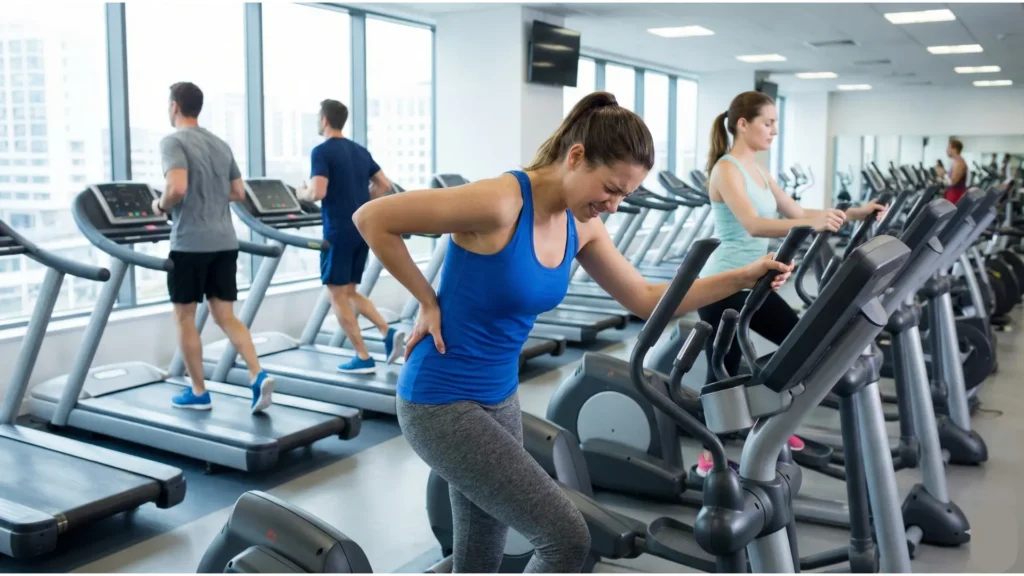
Why does the elliptical bother my back when walking doesn’t?
Because your feet never leave the pedals. That single difference changes how force travels through the legs and how much rotational control the pelvis has to supply. Muscle demands shift too — a comparison of elliptical training and walking found increased gluteus maximus and vastus lateralis activation on the elliptical, with reduced activity in several calf and shin muscles. Different demands, different tolerance.
Small setup choices change spinal mechanics
Hand position, cadence and stride length all influence how the trunk moves and which muscles work. Clinically this is why leaning on the handles or reaching too far forward converts an easy session into a back-aggravating one within minutes, without you changing the speed or the resistance at all.
Low impact still means high endurance demand
Reduced impact does not mean reduced postural work. High resistance, steep incline or a slow grinding cadence all ask for sustained trunk control. Once the glutes fatigue and breathing turns shallow, the spine stiffens to compensate — and across ten to thirty minutes that is a very reliable route to an aching back. If tight, underworking glutes are already an issue before you step on, the machine will expose it faster than most other cardio.
Which pattern is your back? Extension-sensitive or flexion-sensitive
Not every back behaves the same, and the elliptical can push you either way depending on posture and fatigue. Extension-sensitive backs dislike arching and incline; flexion-sensitive backs dislike slumping and sustained rounding. Working out which one you are makes prevention considerably faster, because the two need opposite adjustments.
| Extension-sensitive | Flexion-sensitive | |
|---|---|---|
| Typical feel | Localized ache or pinch near the belt line | Ache that can spread into the buttock or thigh |
| Worse with | Incline, leaning back, rib flare, standing tall with an arch | Slumping, rounded posture, long sitting, poor hip hinge |
| Better with | Slight flexion — sitting or knees to chest | Standing up, walking, gentle extension |
| Likely driver | Excess lumbar extension and facet compression under repetitive load | Sustained flexion load and low segmental tolerance |
| First change on the machine | Drop incline, soften the ribs down, shorten the stride | Stay taller, raise the hands, avoid reaching forward |
Nine common triggers and the exact fix for each
Almost all of these come down to two themes: losing a stable ribs-over-pelvis stack, and borrowing motion from the lumbar spine when the hips should be supplying it. Use the list as a checklist — most people have two or three running at once.
1) Hanging on the handles
Feels like: belt-line ache or pinching that builds quickly, especially on incline. Why: leaning forward or loading bodyweight through the arms flares the ribcage and increases lumbar extension. Fix: light fingertip contact rather than a weight-bearing grip; exhale gently to bring the ribs down without slumping; drop the incline before you touch anything else.
2) Stride too long for your hips
Feels like: a pinch at the back of the stroke, often one-sided. Why: a long stride demands more hip extension. If the hip cannot give it, the low back substitutes with extension and rotation. Fix: stand more centered and shorten the stroke; keep a soft knee at end range rather than locking out; favor a smooth cadence over slow grinding.
3) Too much incline and resistance together
Feels like: deep fatigue and an ache that ramps up steadily. Why: heavy settings raise the sustained trunk stiffness demand well beyond what most people can hold for twenty minutes. Fix: reduce one variable at a time — flatten the incline or drop the resistance, not both — and keep a cadence you can breathe through.
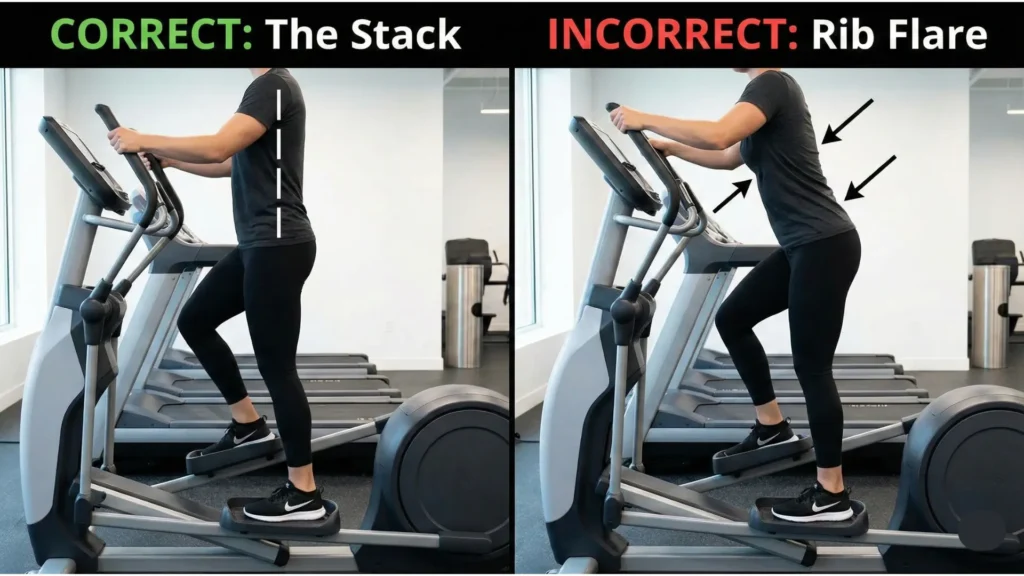
4) Rib flare and over-arching
Feels like: pressure that eases the moment you step off and flex slightly. Why: rib flare increases lumbar lordosis and facet compression, and it is remarkably common in people conscientiously trying to stand tall. Fix: think of gently zipping the ribs down; keep the pelvis neutral with no hard tuck or hard arch; use short intervals until control holds.
5) Hip flexors dominating the stroke
Feels like: a pull at the front of the hip alongside a low-back ache. Why: the hip flexors overwork, the glutes under-contribute, and the pelvis drifts forward. Fix: cue pushing the pedal back with the glute rather than pulling up with the front of the hip, and add glute-biased intervals. Stretching alone rarely resolves this, because the problem is which muscle is driving, not how long it is.
6) Glute fatigue leading to pelvic wobble
Feels like: comfortable for five to ten minutes, then symptoms arrive as form falls apart. Why: pelvic drop and rotation increase as the glutes tire, and the spine stiffens to compensate. Fix: switch to intervals of two minutes easy and one minute moderate; keep the pelvis visibly quiet; build side-hip endurance off the machine.
7) Over-bracing and shallow breathing
Feels like: a tight back, shallow breathing, occasionally spasm. Why: maximal bracing for long durations increases compression and accelerates fatigue — armor is not a strategy you can hold for half an hour. Fix: brace at around 30–40% effort, and breathe low and wide rather than into the upper chest.
8) Asymmetrical foot pressure
Feels like: a one-sided ache, sometimes near the sacroiliac region. Why: uneven pressure drives a small pelvic rotation that repeats thousands of times in a single session. Fix: match foot angle on both pedals, use a tripod foot cue — heel, big toe, little toe — and keep the knees tracking over the second toe.
9) Too much, too soon
Feels like: fine during the session, worse later that day or the next morning. Why: the workout exceeded your current recovery capacity, which is a dosing error rather than a technique one. Fix: build minutes before intensity, increase only one variable every three sessions, and step back if next-day symptoms spike.
A two-minute self-check before your next session
Three questions narrow it down fast. When does discomfort start, where do you feel it, and what changes it within sixty seconds? Answering those in order usually identifies a driver you can actually control, rather than leaving you guessing between six possible fixes at once.
Step 1: When does it start?
- 0–2 minutes: a setup or posture driver
- 8–15 minutes: an endurance or capacity driver
- Later that day or next morning: a progression and recovery driver
Step 2: Where do you feel it?
- Central, across the belt line: often a compression and stiffness pattern
- One-sided, near the dimple: often facet or sacroiliac irritation
- Below the knee: possible nerve sensitivity — be conservative and stop progressing
Step 3: What changes it immediately?
Try one change for sixty seconds: lighter hand contact and no leaning; incline down two or three levels; or a slightly higher cadence with less resistance. If symptoms drop meaningfully, you have found a mechanical driver within your control — and you now know what to set differently tomorrow.
When should I stop and get assessed?
Stop training and arrange urgent assessment if any of the following appear. Each one suggests something other than an overloaded muscle or joint, and each one changes what needs to happen next.
- New bladder or bowel changes, or numbness around the groin and inner thighs. This pattern may indicate cauda equina compression and needs same-day emergency assessment, not a rest week.
- Leg weakness that is getting worse. Progressive motor loss points to sustained pressure on a nerve root, and it is one of the few back symptoms where waiting genuinely costs you.
- Fever, unexplained weight loss, or a history of cancer with new severe back pain. These shift the probability away from a training problem toward infection or systemic disease.
- Significant trauma — a fall or a crash. Fracture should be excluded before you load the spine repetitively.
- Severe night pain that does not change with position. Mechanical pain almost always eases in some posture; pain that ignores position needs explaining.
- Symptoms escalating week to week, or consistently radiating into the leg. Not an emergency, but a clear signal that adjusting the machine settings is no longer the right level of intervention.
From the Clinic: Dr. Arora’s Expert Insight
The pattern I see most is not a weak core — it is a fear-driven strategy. People brace hard, stop breathing, and then lean onto the handles to feel more stable. That pushes the ribcage forward and the pelvis into an exaggerated arch, and turns the lumbar spine into a load-bearing column for the whole session. The irony is that everything they are doing to protect the back is what is loading it.
The cue that works best is simple: stack, breathe, then drive with the hips. When someone can keep the ribs over the pelvis and breathe under effort, the glutes start contributing again and symptoms usually settle within a session or two. And if you can only hold that form for six to eight minutes right now, that is not a failure — it is your current capacity, and it is the number we build from instead of forcing twenty-five minutes and paying for it tomorrow.
Prevention: a setup and technique system you can repeat
Step 1: set the machine for control
- Incline: start flatter, around 0–4, until symptoms are stable
- Resistance: low enough that you can hold a conversation
- Cadence: smooth and moderate, never grinding
- Hands: light contact at first; add moving handles once form holds
Step 2: use the stack cue
Exhale gently and let the lower ribs soften down, keep the pelvis neutral without a hard tuck or arch, and stay tall through the crown of the head. If you can only manage two of the three, prioritize the ribs.
Step 3: make the hips do the work
Push the pedal back with the glute rather than pulling it through with the front of the hip. Keep the pelvis quiet with no side-to-side sway, and keep foot pressure even across the tripod of heel, big toe and little toe.
A two-week return-to-elliptical plan
| Week | Total time | Structure | Settings | Ready to progress when |
|---|---|---|---|---|
| Week 1 — restore tolerance | 12–18 minutes | 2 min easy / 1 min moderate × 6 | Low resistance, low incline, light hand contact | You finish with the same symptoms you started with, three sessions running |
| Week 2 — build capacity | 18–25 minutes | 3 min easy / 1 min moderate × 6 | Change only one variable every three sessions | Next-morning symptoms stay flat after each increase |
Off-machine work that makes the elliptical feel easy
Pick one from each category, three or four days a week. These target the specific leaks that show up on the machine — extension control, hip range, and lateral pelvic endurance — rather than general fitness.
A) Trunk control
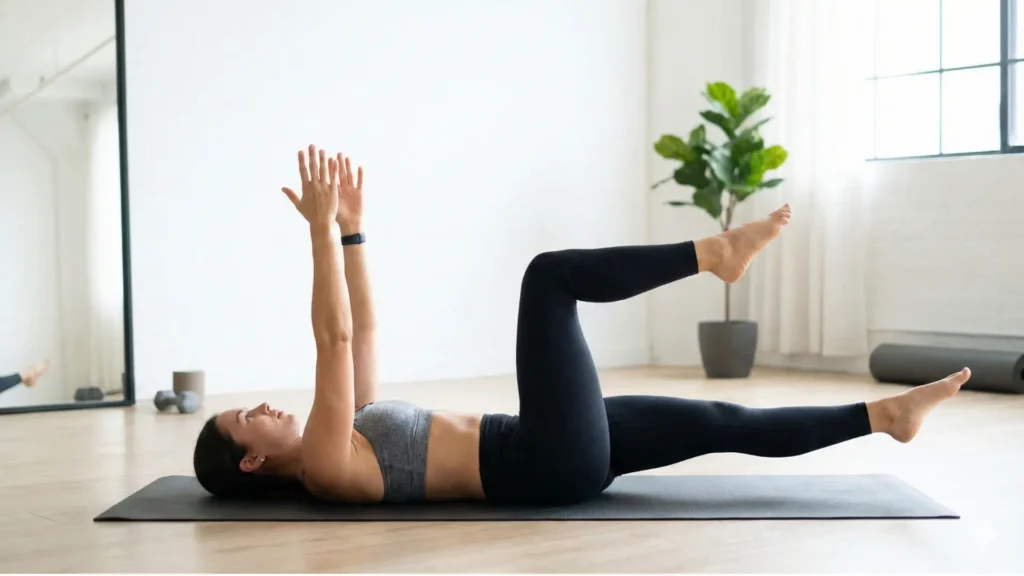
- Dead bug with breathing: 6–8 slow reps per side. Exhale as the leg reaches and keep the ribs down without forcing the back flat — it trains the exact anti-extension skill that fails at minute twelve.
- Side plank: 20–30 seconds × 3. You should feel the side hip and obliques, not a pinch in the low back. This is the lateral endurance that stops the pelvic wobble.
B) Hip mobility and hinge pattern
- Half-kneeling hip flexor stretch: 30–45 seconds × 2 per side. Squeeze the back-leg glute and avoid arching — the glute contraction is what makes the stretch useful.
- Hip hinge drill: 8–10 reps × 2. Ribs stacked, hips back, stopping before the spine rounds or arches. This teaches the hips to supply the motion the low back has been borrowing.
C) Glute endurance
- Glute bridge with 3-second holds: 10 reps × 2. Stop if the hamstrings cramp; you want to feel the glutes, not the backs of the thighs.
- Band lateral walks: 8–12 steps each way × 2. Level pelvis, small steps, knees tracking over the toes.
Do’s and don’ts
| Do | Don’t |
|---|---|
| Start flatter and lighter than you think you need | Use the handles as a support rail |
| Use intervals while rebuilding tolerance | Combine high incline and high resistance while symptomatic |
| Keep a tall stack and breathe during effort | Grind slow, heavy strokes with the breath held |
| Stop the set when the pelvis starts to sway | Force a long stride when the hips feel tight |
| Progress one variable at a time | Train through progressive numbness or weakness |
Myths vs facts
Myth: “If the elliptical bothers my back, it is a bad machine.”
Fact: It is almost always a mismatch between setup, technique and current capacity. When the mechanics improve and endurance builds, most people return to it comfortably.
Myth: “I just need to stretch my hip flexors.”
Fact: Mobility helps, but endurance, breathing and pelvic control are usually bigger levers. Stretching a muscle that is overworking rarely changes which muscle drives the movement.
Myth: “Bracing harder always protects the spine.”
Fact: Sustained maximal bracing increases compression and brings fatigue forward. Moderate, controlled bracing with normal breathing is far more sustainable across a cardio session.
Elliptical, treadmill or bike — which is safer for a sore back?
There is no universal winner. The best option is whichever you can perform with stable mechanics and predictable next-day recovery, and that varies by which direction your back dislikes. Elliptical training and walking produce broadly similar hip and knee motion but noticeably different muscle demands, which is exactly why one can feel fine while the other does not.
- Elliptical: lowest impact, but the most technique-sensitive, and it biases extension if you lean
- Treadmill walking: highly adjustable and usually the easiest place to keep a natural hip strategy
- Upright bike: often suits extension-sensitive backs, and often irritates flexion-sensitive backs if you slump
The bottom line
Elliptical machine lower back pain is a solvable mechanical problem in the large majority of cases, and stopping cardio is almost never the answer. Correct the driver — leaning, rib flare, stride length or intensity — rebuild tolerance with intervals, and add the trunk and glute endurance work so the spine is not carrying the session. Use the timing of your symptoms to identify the culprit, change one variable at a time, and judge each change by how you feel the following morning. If symptoms radiate below the knee, involve numbness or weakness, or keep escalating despite correct progression, get assessed rather than adjusting settings again.
For the wider picture, our complete guide to lower back pain causes and treatment covers how this fits alongside the other common drivers.
FAQ
Medical disclaimer
This article is for general education and is not medical advice. Exercise guidance that suits one person may be inappropriate for another, and you should consult a qualified clinician before starting a new exercise or rehabilitation program, particularly if your symptoms are severe, persistent or neurological.
References
- Burnfield JM, Shu Y, Buster T, Taylor A. Similarity of Joint Kinematics and Muscle Demands Between Elliptical Training and Walking: Implications for Practice. Physical Therapy. 2010;90(2):289–305.