
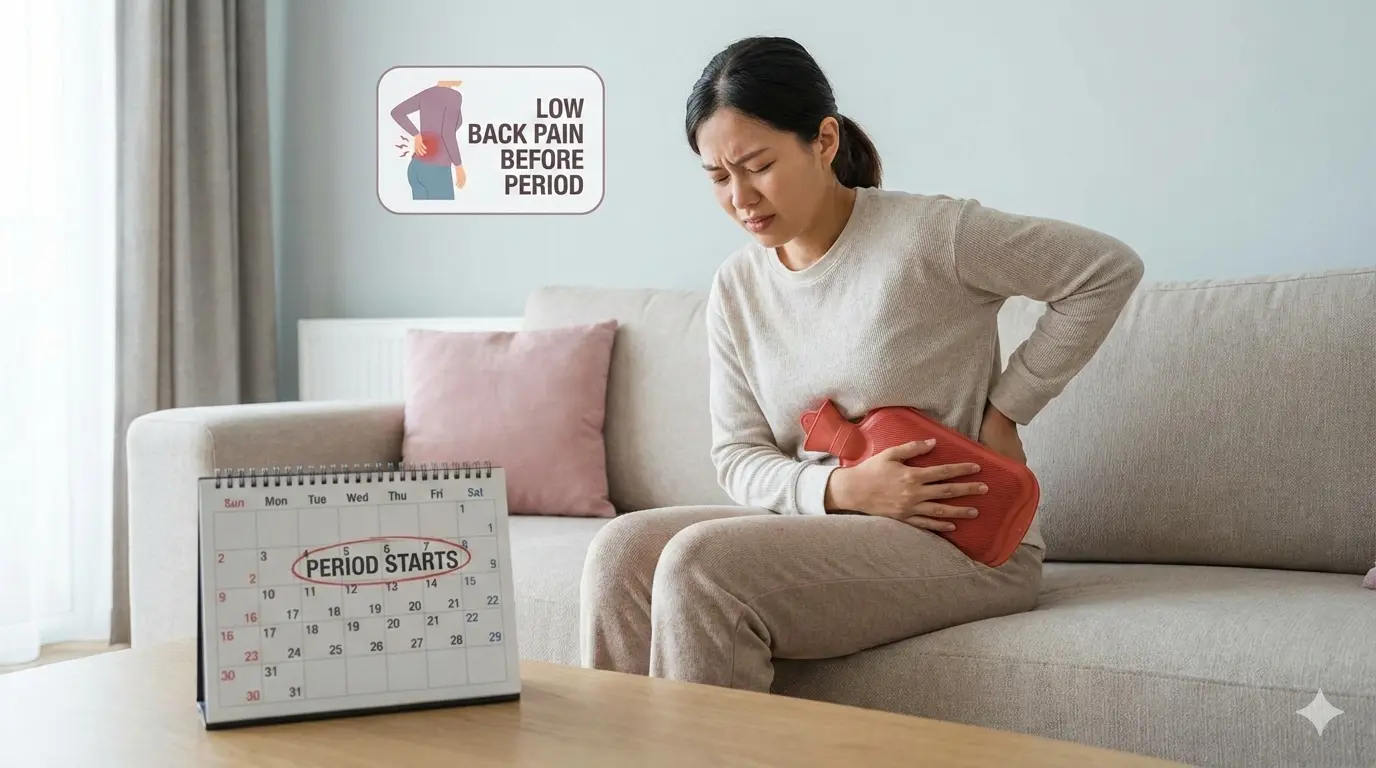
If low back pain before period arrives almost like clockwork, one to three days before any bleeding starts, you are not imagining the pattern. It is one of the most predictable complaints in the premenstrual week, and for most people it has more to do with where they are in the hormonal cycle than with anything structurally wrong in the spine.
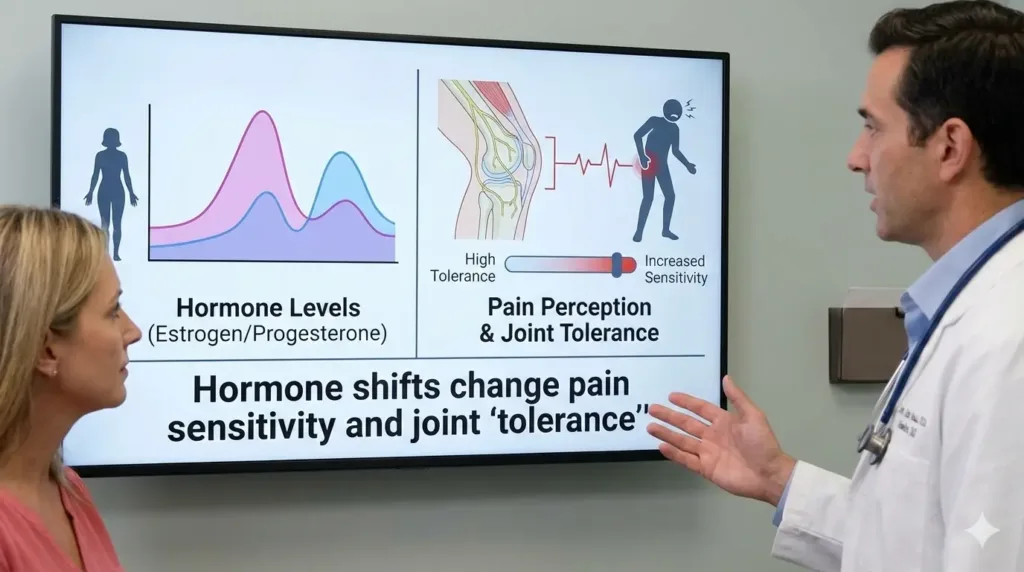
Pain that shows up before bleeding is driven mainly by the late luteal hormone shift, not by the prostaglandin peak that causes period cramps. Falling progesterone and estrogen alter pain sensitivity, fluid balance and tissue tolerance, so ordinary daily loads start to register as ache. It typically eases within the first day or two of flow, once the hormonal picture resets.
Key takeaways
- Before bleeding is a different problem from during bleeding. Premenstrual ache is largely a sensitivity and fluid-balance issue. Pain that peaks once flow starts is more about uterine contraction.
- The tell is the resolution. If the ache reliably fades within the first day or two of bleeding, it is behaving like a cycle-driven pattern rather than a mechanical injury.
- Stretching hard is the wrong lever. Nothing has shortened. Changing pressure, position and load usually outperforms chasing range of motion.
- Treat the week as predictable. Because you can forecast it, you can lower training load and raise support before symptoms arrive rather than reacting at the peak.
- Pain that ignores the cycle is not premenstrual pain. Constant or progressive back pain, or pain with neurological symptoms, needs assessing on its own terms.
What does premenstrual back pain feel like?
Most people describe a dull, heavy ache across the beltline that builds over a day or two rather than arriving suddenly. It often comes with a sense of internal pressure rather than surface muscle soreness, and it tends to be worse on standing up after sitting. Unlike a strain, there is no single movement you can blame for starting it.
- A dull ache across the low back, sometimes spreading into the buttocks
- Deep pressure that feels inside the pelvis rather than in the surface muscles
- Stiffness on standing up from a chair or getting out of a car
- An old back problem — disc, facet or sacroiliac — flaring louder than usual for no obvious reason
Two people with identical cycle timing can experience completely different sensations, and the difference usually comes down to four things: where the pain is actually generated, how sensitized the nervous system is that particular week, how much bloating is present, and what the baseline movement habits look like. Someone with a desk-heavy week and broken sleep will feel far more than the same person after a light, well-rested week.
What causes low back pain before period?
The premenstrual week produces a specific combination: falling progesterone and estrogen change how readily the nervous system reports discomfort, fluid retention alters abdominal pressure and posture, early prostaglandin activity begins before bleeding does, and disrupted sleep lowers the threshold further. None of these damages tissue. Together they make ordinary loads feel considerably more expensive.
1. The late luteal hormone shift
The late luteal phase is the stretch of days between ovulation and bleeding, when progesterone and then estrogen fall away. This is the mechanism that most clearly separates premenstrual back pain from period pain: the ache begins while hormone levels are dropping, days before uterine contractions are doing much of anything.
That shift does three practical things. It changes how the nervous system processes normal input, so a load you tolerated last week now registers as pain. It increases perceived stiffness, particularly first thing in the morning. And it subtly alters ligament and joint give, which matters most for people who already have a sacroiliac or lumbar area that is easily provoked. This is not a dangerous laxity — it simply means the system wants more support and less strain during a window you can predict.
2. Early prostaglandin activity
Prostaglandins are hormone-like chemicals released by the uterine lining that make the uterus contract. Their peak belongs to the bleeding days, but release begins before flow starts, which is why a crampy, wave-like quality can appear in the run-up. Because the uterus and the low back feed into overlapping spinal segments, some of that signal is felt across the sacrum rather than in the abdomen.
Clues that this component is significant for you: the ache comes in waves rather than sitting steady, it travels with nausea or loose stools, and it is hard to localize with one finger. If that pattern intensifies sharply once bleeding starts, the drivers behind low back pain during your period are probably doing more of the work than the premenstrual hormone shift is.
3. Fluid retention changes pressure and posture
Premenstrual fluid retention is extremely common, and bloating is not just a comfort issue. A distended abdomen changes intra-abdominal pressure and alters how you breathe, which changes how the trunk muscles support the spine. Most people respond by arching the low back slightly more or bracing in an awkward pattern, and both add compressive load to a region that is already reporting more loudly than usual.
4. Sleep, stress and the volume knob
Premenstrual insomnia, anxiety and irritability all make pain feel sharper, and stress adds protective muscle guarding on top — the muscles tighten to shield an area that does not actually need shielding, and the back feels locked as a result. If the premenstrual week routinely collides with a heavy work week, the flare is often the final straw rather than the sole cause.
What else contributes beyond cramps?
Plenty. Constipation and gas raise pelvic pressure, the fatigue week means more sitting and less movement, hip flexors shorten, glutes disengage, and ordinary domestic and gym loads land on a system with less margin than usual. More than one of these is usually true at the same time, which is why a single fix rarely resolves the whole picture.
Common and usually benign contributors
- Primary dysmenorrhea, meaning period pain with no underlying disease
- Premenstrual bloating, fluid retention, constipation or gas pressure
- Reduced activity and increased sitting through the fatigue week
- Hip flexor tightness and glute fatigue changing how the pelvis is controlled
- Sacroiliac irritation, especially with asymmetrical loads such as one-shoulder bags or carrying a child on one hip
- Lumbar facet irritation from arch-heavy standing postures
- An older back episode becoming sensitized again
- Sleep deprivation and stress-related muscle guarding
Less common, but important if symptoms are severe or changing
- Endometriosis, where pain often starts before bleeding and continues through it, frequently with pain during sex or bowel movements
- Adenomyosis, typically with heavy bleeding and a deep, boring pelvic ache
- Fibroids, producing pressure, heavy periods and urinary frequency
- Pelvic infection, where pain arrives with fever or abnormal discharge
- Ovarian cyst irritation or torsion, which presents as sudden, severe, one-sided pain
- Urinary tract infection or kidney stone, with burning urination, flank pain, or sharp waves and blood in the urine
- Early pregnancy complications, wherever pregnancy is possible
- Mechanical spinal conditions unrelated to the cycle, such as disc, stenosis or spondylolisthesis
| Pattern | More likely | What usually helps first |
|---|---|---|
| Crampy waves, deep pelvic ache in the days before bleeding | Prostaglandin activity and dysmenorrhea | Heat, gentle movement, appropriately timed anti-inflammatory strategies |
| Stiff after sitting, better after walking | Muscle guarding and joint irritation | Walking breaks, hip mobility, supported positions |
| One-sided sharp pain of sudden onset | Cyst irritation, kidney or urinary causes | Medical assessment, no self-treating |
| Pain with fever, unusual discharge or burning urination | Infection | Prompt medical assessment |
| Pain tied to a bending or lifting pattern, not to cycle timing | Mechanical spinal source | Technique changes and graded strengthening |
Is your pain actually cycle-related?
Four questions settle it for most people. If the answers cluster toward yes, it is reasonable to manage the pattern at home first and to plan around it next cycle. If they cluster toward no, the cycle is probably coincidental and the back deserves assessment in its own right.
- Does the pain start within about seven days before bleeding and ease within the first one to three days of flow?
- Does it travel with other premenstrual signs such as bloating, breast tenderness or mood change?
- Does heat help more than stretching does?
- Does gentle walking feel better than complete rest?
Keeping a simple symptom diary across two cycles is the single most useful diagnostic step here, and it is the same approach the NHS recommends for identifying a premenstrual symptom pattern before deciding what to do about it. Two tracked cycles convert a vague impression into a forecast you can act on.
What actually helps in the days before bleeding?
Three things, in order: reduce the threat signal with heat and unloaded positions, restore circulation with short bouts of easy movement, then add light stabilizing work so the spine and pelvis have more support. The aim is not to eliminate symptoms in an afternoon. It is to stop the flare from compounding across the week.
Step 1: De-threaten the area (first 10 to 20 minutes)
Heat first. A heating pad or hot water bottle over the lower abdomen or across the low back for 15 to 20 minutes reduces cramp intensity and relaxes guarding muscles, which is why it tends to work faster than anything else available at home. Keep it warm rather than scalding, keep a layer of clothing between the source and your skin, do not fall asleep on it, and do not use heat over any area with numbness or altered sensation.
Then unload the spine and pelvis. Pick one of these and hold it for three to five minutes with slow breathing. These are not exercises; they are deliberate downshifts that make the rest of the week easier to manage.
90/90 supported rest
- Lie on your back beside a sofa or bed
- Rest your lower legs on the seat so hips and knees are both around 90 degrees
- Let the low back soften rather than forcing it flat to the floor
- Breathe in through the nose for 4 seconds, out for 6, for six to ten breaths
Side-lying with pillow support

- Lie on your side with a pillow between the knees
- Add a small rolled towel under the waist if you feel the spine sagging into a gap
- Keep shoulders relaxed and jaw unclenched, with slow breathing
Step 2: Movement snacks, two to four times a day
Total rest reliably increases stiffness. Small, unthreatening doses of movement do the opposite.
A five-minute walk. Comfortable pace, repeated later if it helped. In the premenstrual window this is one of the highest-return interventions available, because it improves circulation and reduces guarding without demanding anything of a system that is already tired.
Pelvic tilts in pain-free range. Lie on your back with knees bent and feet flat. Imagine the pelvis as a bowl of water, then tip it gently toward your face and away again. Eight to twelve slow repetitions, no breath-holding, small and smooth. Do not push into sharp pain and do not turn it into a hard abdominal workout.
Step 3: Targeted mobility (choose two, six to eight minutes)
These specifically address the premenstrual contributors above — hip flexors shortened by a sitting-heavy fatigue week, stiff glutes, and a sensitized lumbar area — without aggressive stretching that the tissue does not need.
- Gentle kneeling hip flexor stretch. Kneel with one knee on a cushion, other foot forward in a lunge stance. Tuck the tail slightly to avoid over-arching, then shift forward until you feel a mild stretch at the front of the hip. Hold 20 to 30 seconds, twice each side. Stop if you feel pinching at the front of the hip.
- Supported figure-4 glute stretch. On your back with knees bent, cross one ankle over the opposite knee, hold behind the thigh of the bottom leg and draw it gently toward you. Hold 20 to 30 seconds, twice each side.
- Child’s pose with a side reach. Kneel and sit the hips back toward the heels, reach the arms forward, then walk the hands slightly to one side to open the opposite flank. Three or four slow breaths, then switch. Skip it entirely if it irritates your knees or hips.
Step 4: Stabilize without strain
Strength work here is not about abdominal definition. It is about giving the spine and pelvis steadier support during a week when tolerance is lower, so a normal day does not spiral into a flare.
- Glute bridge, easy version. On your back, knees bent, feet hip-width. Exhale, squeeze the glutes and lift the hips a few inches (roughly 5 to 10 cm). Pause two seconds, lower slowly. Eight to ten reps, one or two sets. Keep the ribs down rather than arching. If the hamstrings cramp, walk the feet slightly closer to your hips or reduce the lift.
- Side plank on knees. On your side with knees bent and elbow under the shoulder, lift the hips so the body forms a straight line from shoulders to knees. Hold 10 to 20 seconds, two or three times each side. Stop for shoulder pain, sharp side pain, or if back pain increases during the hold.
- Dead bug march, tiny range. On your back, knees bent, brace lightly as if preparing to cough, then slowly lower one heel to tap the floor and return. Six to ten taps each side. This is a control exercise, not a speed drill.
Step 5: Daily habits that carry real weight
Regular meals and hydration. Skipping meals adds fatigue and irritability, and both raise pain sensitivity. Steady intake through the premenstrual week is unglamorous and genuinely effective.
Supplements, with caution. Some people try magnesium for cramping. If you use supplements, check with a clinician first, particularly with kidney problems or regular medication. Natural is not a synonym for risk-free.
Anti-inflammatory medicines, used properly. A Cochrane systematic review found nonsteroidal anti-inflammatory drugs clearly more effective than placebo for period pain, alongside a substantial rate of adverse effects. They are not appropriate for everyone — stomach ulcers, kidney disease, blood thinners, certain asthma and pregnancy all matter here — so a pharmacist or clinician is the right first stop if you are unsure.
👨⚕️ Dr. Arora’s Clinical Note
The mistake I see most often is treating premenstrual back pain as a tight-back problem, then stretching hard or bending forward repeatedly to chase relief. When the timing is clockwork — one to three days before bleeding — the back is usually reacting to pelvic pressure, bloating-driven posture change and a more sensitive nervous system. Nothing has actually shortened, so there is nothing for the stretching to fix.
Change pressure and position before you chase flexibility. During a flare, try this three-minute reset:
- 90/90 breathing for six slow breaths, in for 4 seconds and out for 6 to 8, letting the ribs settle down rather than flaring.
- On the last exhale, add five gentle pelvic tilts in a tiny range.
- Stand and take a two-minute easy walk.
If your pattern is predictable, the counter-intuitive part is timing: starting your best strategy before symptoms peak consistently outperforms waiting until it is unbearable. And if a stretch produces a sharp pinch at the front of the hip or drives your back into more arch, make it milder or drop it for that day.
A seven-day reset plan for a recurring pattern
If this happens most cycles, stop treating the premenstrual week as a surprise and start treating it as a scheduled training block with a known load reduction. The plan below works backwards from the day bleeding usually starts.
| Window | Goal | What to do | Ready to progress when |
|---|---|---|---|
| Days -7 to -4 | Build a buffer | Walk 15 to 25 minutes most days; the three strength moves on two non-consecutive days; one mobility option after sitting-heavy days | You can complete the strength moves without next-day soreness in the low back |
| Days -3 to -1 | Lower load, raise support | Cut maximal lifts, deep backbends and long runs if they reliably trigger a flare; heat once daily; keep movement snacks going; protect sleep timing | Morning stiffness is easing rather than building day on day |
| Day 0 to Day 2 | Comfort first | Use the two interventions that reliably work for you, usually heat plus walking; supported rest positions at symptom peaks; keep mobility gentle | Pain is settling with flow and you can sit or stand for normal periods again |
| Day 3 onward | Rebuild capacity | Return to full strength work; progress side plank from knees toward full; add hip hinge and squat patterns in pain-free range | You are back to your usual training loads without a symptom rebound |
When is premenstrual back pain a sign of something more?
Most premenstrual back pain is manageable at home. The exceptions announce themselves by breaking the pattern: pain that is sudden rather than gradual, one-sided rather than central, accompanied by fever or fainting, or entirely disconnected from the cycle. Each of those points somewhere different, and none of them should be managed with a heat pack and patience.
Seek medical care promptly if you have:
- Sudden severe pain, particularly one-sided and new. Premenstrual ache builds gradually and sits across the midline. A sudden one-sided onset raises the possibility of ovarian cyst rupture or torsion, both of which are time-sensitive.
- Fever, chills, or feeling acutely unwell. Hormonal shifts do not cause fever. This combination points toward pelvic or urinary infection, which needs treatment rather than observation.
- Fainting, dizziness or marked weakness. These suggest significant blood loss or another acute process and warrant same-day assessment.
- Heavy bleeding, or bleeding between periods. Soaking through protection quickly points toward fibroids, adenomyosis or a clotting problem, and intermenstrual bleeding needs evaluating independently of the back pain.
- New pain with sex, bowel movements or urination. This suggests involvement of pelvic structures beyond the uterine cavity, and it is one of the more reliable pointers toward endometriosis.
- A missed period or possible pregnancy alongside the pain. Ectopic pregnancy can present as one-sided pelvic and back pain, and it must be excluded rather than assumed unlikely.
- Numbness in the groin or saddle area, or any loss of bowel or bladder control. This combination may indicate cauda equina syndrome, a spinal emergency requiring immediate hospital assessment rather than a routine appointment.
- Back pain that is constant, progressive, or unrelated to your cycle. If the timing link breaks, the premenstrual explanation no longer applies and the back needs assessing on its own merits.
If the pattern is recurrent and comes with deep pelvic pain, pain during sex, or bowel and bladder symptoms, ask specifically about endometriosis and adenomyosis. Getting the right label matters because it changes the entire next step, and both conditions are commonly missed for years when the pain is filed under normal period pain.
How do clinicians evaluate a recurring premenstrual pattern?
Mostly by history rather than by scanning. A clinician wants the symptom timeline, the bleeding pattern, associated bowel, urinary or sexual symptoms, and which movements provoke the pain. A pelvic examination is often appropriate, and ultrasound or blood tests are added only when the history points toward something specific.
Spinal imaging is usually unnecessary here. If the pattern is tightly cycle-linked and there are no neurological symptoms, an MRI of the lumbar spine will most likely show age-typical changes that were present last year and the year before, and finding them does not change what you do next. Imaging earns its place when the pain is clearly mechanical, persists beyond the cycle, or comes with neurological signs — in other words, when the result would actually alter the plan.
Reducing it over the coming months
Prevention here is a stack rather than a single fix: more hip and trunk capacity so ordinary loads cost less, better management of long sitting, less asymmetrical loading in the premenstrual window, and attention to the pelvic floor where the symptoms suggest it.
1. Build hip and trunk capacity

Two or three days a week, keep the routine simple and repeatable: a glute bridge or hip hinge pattern, side plank progressing from knees to full, dead bug variations, and a squat to chair within pain-free range. More capacity means the same daily loads sit further below your threshold, which is what actually shrinks the premenstrual flare.
2. Manage sitting deliberately
- Stand up every 30 to 45 minutes for 60 to 90 seconds
- Six pelvic tilts or a short walk on each break
- Avoid perching on the front edge of the chair with an exaggerated arch
3. Reduce asymmetrical loading in the premenstrual window
- Switch shoulders when carrying a bag, and switch hips when carrying a child
- Avoid standing on one hip for long stretches
- Use a low step stool for sink tasks, with one foot up to reduce lumbar strain
4. Consider the pelvic floor
The pelvic floor is a sling of muscles across the base of the pelvis that helps manage internal pressure. Some people develop over-tension in it during stress-heavy weeks; others have weakness and poor coordination, and the two need opposite treatment. Clues that it is involved include pelvic heaviness, urinary urgency, pain with penetration, or an ache that feels distinctly deep rather than muscular. Where those exist, a clinician trained in pelvic health can determine whether down-training or strengthening is the right direction — guessing wrong here reliably makes symptoms worse.
Myth versus fact
| Myth | Fact |
|---|---|
| “Back pain before my period means something is wrong with my spine.” | More often it reflects premenstrual hormone shifts and pelvic activity temporarily raising sensitivity in an otherwise unchanged back. |
| “If stretching does not help, nothing will.” | Heat, walking, supported rest and gentle stabilizing work frequently succeed where stretching fails, because shortness was never the problem. |
| “I should rest completely until it passes.” | Prolonged stillness increases stiffness and guarding. Short, easy bouts of movement usually reduce the ache faster than lying down for a day. |
| “Pain is normal, so I should ignore it.” | Mild discomfort is common. Severe, changing or disabling pain is a reason for assessment, not endurance. |
Frequently asked questions
How many days before bleeding can low back pain before period start?
Anywhere from a few hours to about a week, though most people notice it most strongly one to three days beforehand. The more useful marker is the ending rather than the beginning: a consistent pattern that eases once bleeding is established points toward hormone shifts and prostaglandin activity rather than a mechanical back problem.
How is this different from back pain during my period?
Timing and mechanism. Premenstrual pain sits in the late luteal phase and is driven mainly by falling progesterone and estrogen changing pain sensitivity and fluid balance. Pain during bleeding is driven more by the prostaglandin peak and uterine contractions. Many people get both, in which case the ache builds beforehand and then changes character once flow starts.
Can back pain be my only premenstrual symptom?
Yes. Some people have minimal mood change or bloating and still get a reliable premenstrual backache. That is not unusual on its own. It becomes worth investigating if the pain is new, severe, or getting progressively worse from cycle to cycle rather than staying stable.
Why is it worse when I sit?
Sitting loads the lumbar discs and shortens the hip flexors, and in the premenstrual window the tissues report that load more readily. The same chair that felt fine last week now does not. Brief standing breaks, a short walk, or the 90/90 supported rest position usually change it within minutes.
Is constipation making it worse?
It can be. Constipation and trapped gas raise pelvic pressure, which amplifies cramping and can present as backache. Hydration, gentle walking and fiber-rich meals usually help within a day or two. Constipation that persists beyond the premenstrual week should be discussed with a clinician rather than managed indefinitely at home.
Could this be endometriosis?
Possibly, particularly if the pain starts before bleeding and continues right through the period, or if you also have pain with sex, pain with bowel movements, or significant fatigue. Premenstrual back pain on its own does not confirm anything, but a recurring deep pelvic ache that outlasts the bleed is a reason to be assessed.
Can this happen with a normal ultrasound?
Yes, routinely. Prostaglandin-driven pain and hormone-related sensitivity produce no ultrasound findings at all. A normal scan means there is no structural pelvic mass, which is genuinely useful information, but it is not evidence that the pain is imagined or that nothing can be done about it.
What is the fastest thing that works at home?
Heat for 15 to 20 minutes followed by a short walk. If that is not enough, add a supported rest position and gentle pelvic tilts. Speed matters less than repeatability here, so the best option is the one you can realistically do two or three times in a day.
References
- National Health Service. Premenstrual syndrome (PMS). NHS, UK. https://www.nhs.uk/conditions/pre-menstrual-syndrome/
- Marjoribanks J, Ayeleke RO, Farquhar C, Proctor M. Nonsteroidal anti-inflammatory drugs for dysmenorrhoea. Cochrane Database of Systematic Reviews. 2015. doi:10.1002/14651858.CD001751.pub3. https://pubmed.ncbi.nlm.nih.gov/26224322/
This article is for general education and does not replace individual medical assessment. If your symptoms are severe, changing, or accompanied by any of the warning signs above, arrange a proper evaluation.