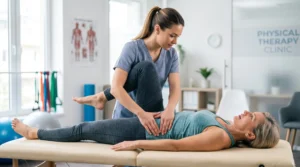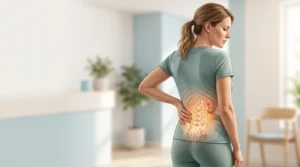
If you’re dealing with low back pain in women and wondering, “Why is this happening to me?” you’re not alone—and you’re not imagining it. Back pain can show up after a long day of sitting or standing, after lifting kids or groceries, after a new workout, or during stressful weeks when sleep is poor. It can also be influenced by body-specific factors like menstrual cycles, pregnancy, postpartum recovery, pelvic floor changes, and menopause.
Low back pain in women usually comes from more than one source at the same time: mechanical overload of muscles, discs and joints from sitting, lifting or deconditioning, layered onto factors specific to female physiology such as menstrual cycle sensitivity, pregnancy load, postpartum recovery, pelvic floor changes and menopause-related bone loss. Most cases are mechanical and improve with graded movement, but cyclical and gynecological patterns need separate assessment.
Key takeaways
- Two or three causes usually stack. Undertrained glutes plus long sitting plus a cycle-related dip in pain threshold is far more typical than one clean diagnosis.
- Timing is the biggest diagnostic clue. Pain that tracks your cycle, or that is worse in the days before a period, points somewhere different than pain that tracks bending, lifting or sitting duration.
- The pelvic floor is part of the trunk. Tension or weakness there changes how the low back is loaded, which is why some back pain does not respond to back exercises alone.
- Most people do not need an early scan. Imaging is for red flags and for cases where the result would change treatment, not for confirming that a sore back is sore.
- Movement beats rest, but graded movement beats both. A short daily reset plus a four-week strength progression outperforms bed rest and outperforms pushing through.
The key point: low back pain in women is usually multifactorial. More than one “cause” can be true at the same time—and that’s exactly why a practical plan works better than chasing one perfect diagnosis.
This guide is built to do two things:
- Help you sort the most likely drivers behind low back pain in women (without scary language).
- Give you a step-by-step plan that helps most people feel better—starting today.
The causes below are specific to female physiology where that matters, but the movement principles are useful for anyone in a back flare.
You’ll see 21 common causes, the clues that point to each one, what to try first at home, and when it’s time to seek medical care. If the pain is new, the goal is not to “fix everything” in a day — it is to calm the flare and rebuild steadily.
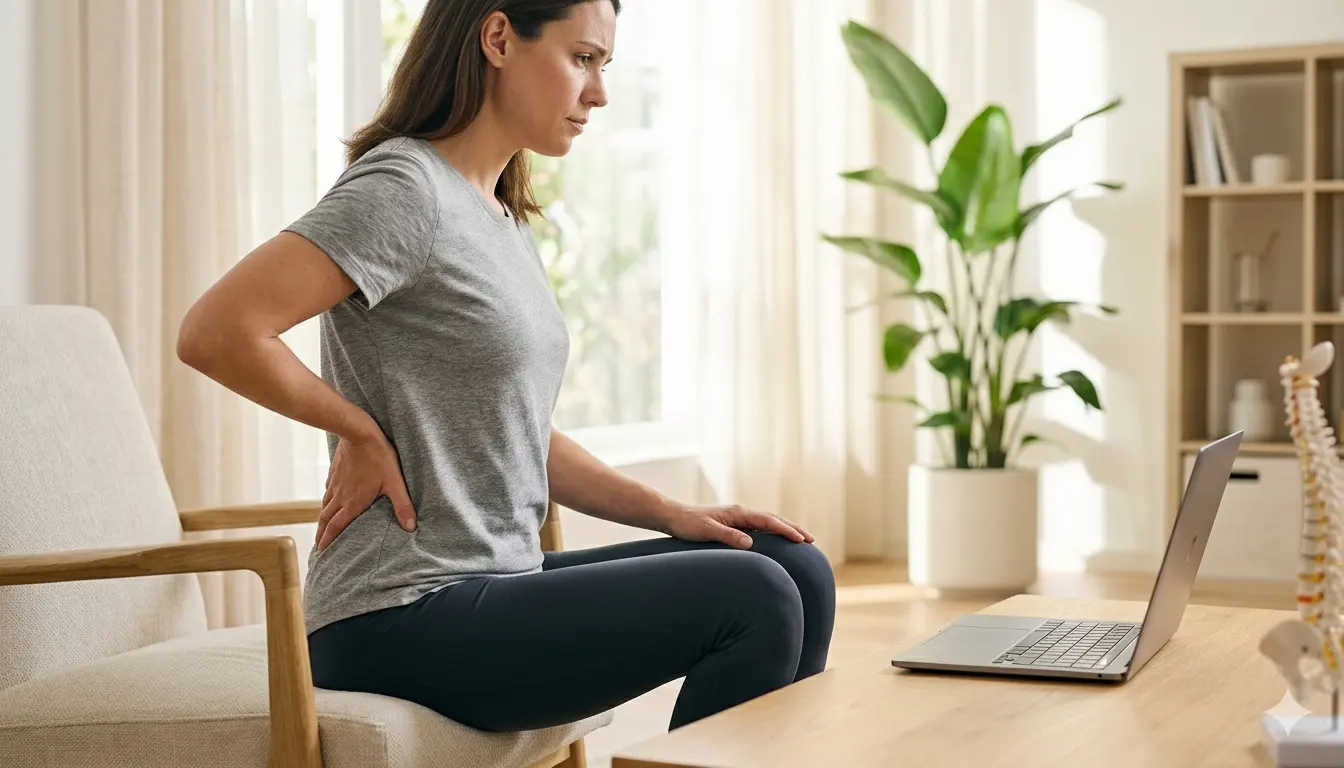
What counts as the low back, and why does that area hurt so often?
The low back is the region between the bottom of the ribs and the top of the pelvis. It hurts easily because it sits at the junction where the upper body’s weight transfers into the hips and legs, and because it is the segment most people ask to compensate when hips are stiff, glutes are undertrained, or the same position is held for hours.
Pain in that region usually comes from one or more of these structures:
- Bones (lumbar vertebrae) that stack like blocks
- Discs (soft cushions) between the bones
- Facet joints (small joints at the back of the spine)
- Ligaments (tough bands that hold things together)
- Muscles (your “guy wires” that stabilize and move you)
- Nerves that travel to the hips and legs
- Nearby structures: hips, sacroiliac joints, and the pelvic floor
Pain is not a perfect “damage meter.” Often the pain is a signal that tissues are irritated, overloaded, stiff, or guarded—not necessarily injured in a dangerous way. That’s why the most effective approach usually combines smart movement, load management, and calming an overprotective nervous system.
Low back pain in women: the 21 most common causes
Below is a practical list. You do not need to match every detail. Instead, look for the “most you” pattern—then follow the plan.
1) Muscle strain or “overwork” (the most common)
Common clues
- Symptoms started after lifting, cleaning, travel, a new workout, or “doing too much”
- Sore or tight feeling, worse with bending or twisting
- Improves with gentle movement, worse with long rest
What helps
- Relative rest (avoid the one movement that spikes pain, not all movement)
- Heat for 10–15 minutes, then a short walk
- Gradually reloading with simple core and hip exercises (see plan below)
👨⚕️ Dr. Arora’s Clinical Note:
A common mistake I see in recovery is treating “rest” as the main treatment. For most uncomplicated flares, the winning combo is: calm the tissues, then micro-dose movement.
Physio secret: instead of one long workout or a full day off, do 4–6 mini “resets” (2–5 minutes each) across the day. This is often faster at switching off guarding than a single 30-minute session.
Try this for 48 hours:
- Heat 10 minutes → walk 3–5 minutes immediately. Heat alone relaxes; the short walk “locks in” the improvement by restoring normal motion.
- If bending is the trigger, practice a pain-free hip hinge for 4–6 slow reps after the walk (spine long, ribs stacked, hips back).
- Keep the rule: sharp/catching pain = stop; mild discomfort ≤3/10 = acceptable.
If your pain is clearly worsening day-by-day, or you develop leg weakness/numbness, switch from self-care to evaluation.
2) Protective muscle guarding (your body bracing)
Sometimes pain continues because muscles tighten to protect you—even after the original trigger has settled.
Clues
- Feels like a “locked” back
- Stiff after sitting, better after walking for a few minutes
- Tender, “grippy” muscles on one or both sides
What helps
- Gentle mobility (cat-camel, pelvic tilts) and slow breathing
- Short, frequent walks
- Avoid forcing a deep stretch into sharp pain
3) Poor load tolerance from deconditioning
Your back may be healthy—but not currently trained for your daily loads. Pain often shows up when life demands jump faster than your strength and recovery can keep up.
Clues
- Pain builds through the day
- Worse after long standing, chores, or carrying
- Better after rest but returns when activity resumes
What helps
- A progressive strengthening plan (hips + core + glutes)
- “Micro-breaks” every 30–45 minutes of sitting/standing
4) Disc irritation (often felt with bending)
Discs are strong, but they can get irritated—especially with repeated rounding plus load. This pattern commonly shows up during busy seasons with lots of sitting and rushed lifting.
Clues
- Worse with sitting, bending, or picking things from the floor
- Better with standing or gentle back-bending
- Sometimes pain refers to the buttock or back of the thigh (not always sciatica)
What helps
- Reduce repeated deep bending for a week
- Use a hip-hinge to lift (hips back, neutral spine)
- Consider gentle “press-up” movements if they reduce symptoms
5) Facet joint irritation (often felt with arching)
Facet joints can feel sore when compressed, often with repeated arching.
Clues
- Worse with prolonged standing, walking downhill, or arching
- Feels one-sided near the spine
- Turning or leaning back can reproduce pain
What helps
- Slightly reduce repeated arching for a few days
- Hip flexor mobility + glute strengthening
- Change standing posture (soft knees, ribs stacked over pelvis)
6) Sacroiliac (SI) joint irritation
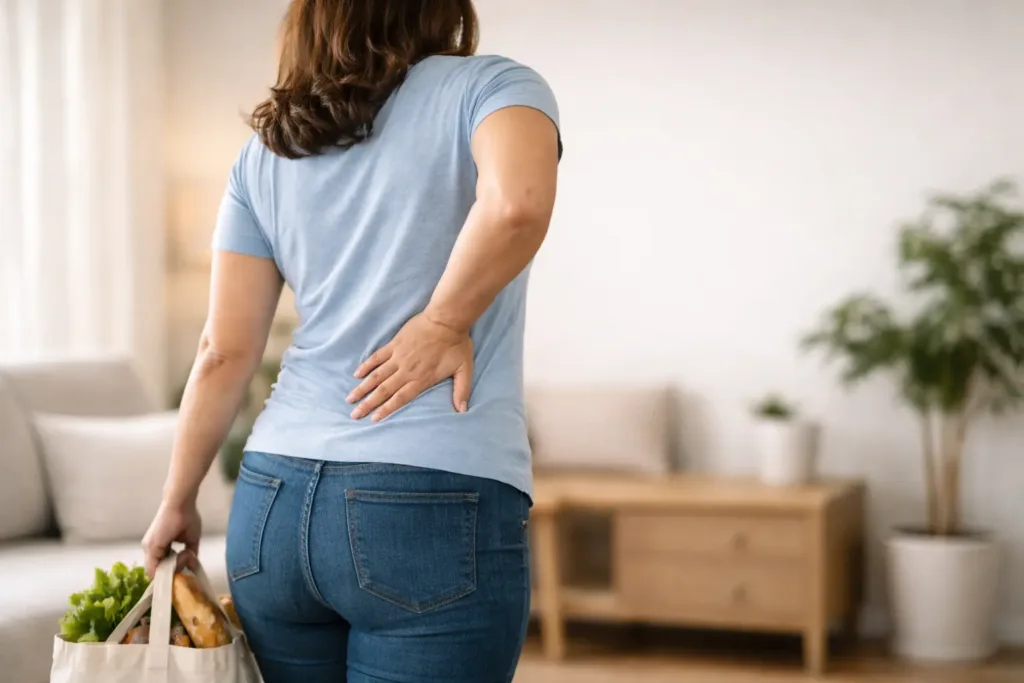
The SI joints connect your spine to your pelvis. They can get cranky with asymmetrical loads.
Clues
- Pain near the “dimple” area, one side more than the other
- Worse with single-leg tasks: stairs, getting out of a car, rolling in bed
- Feels deep, aching, sometimes into buttock or groin
What helps
- Avoid long single-leg positions briefly (standing on one leg while dressing)
- Glute med strengthening (side-lying clams, side steps)
- A supportive belt for short periods can help some people
7) Hip joint or hip muscle referral
Hip problems can feel like back pain, and back problems can feel like hip pain.
Clues
- Pain with deep squats, getting up from low chairs, or rotation
- Pinchy groin discomfort or side-hip pain
- Back feels “secondary” to hip symptoms
What helps
- Hip mobility within comfort
- Glute strengthening
- Adjust squat depth and stance temporarily
8) Glute weakness + tight hip flexors (the “arching” pattern)
This is one of the most common movement patterns behind persistent back ache, especially with long sitting.
Clues
- Feels compressed; belly and ribs flare upward when standing
- Sitting all day makes you stiff; standing feels “jammed”
- Glutes fatigue quickly with bridges or stairs
What helps
- Hip flexor stretch (gentle, not aggressive)
- Glute bridges, step-ups, and hip-hinge practice
9) Core control issues (bracing that’s either too little or too much)
Your deep core stabilizes without holding your breath all day.
Clues
- Pain spikes with rolling in bed, transitions, lifting, or coughing
- Feels unstable or “catchy”
- You either collapse posture or brace hard and fatigue fast
What helps
- “Exhale and brace” drills (gentle abdominal tension without breath-holding)
- Carrying and anti-rotation exercises later in the program
10) Pelvic floor tension or weakness
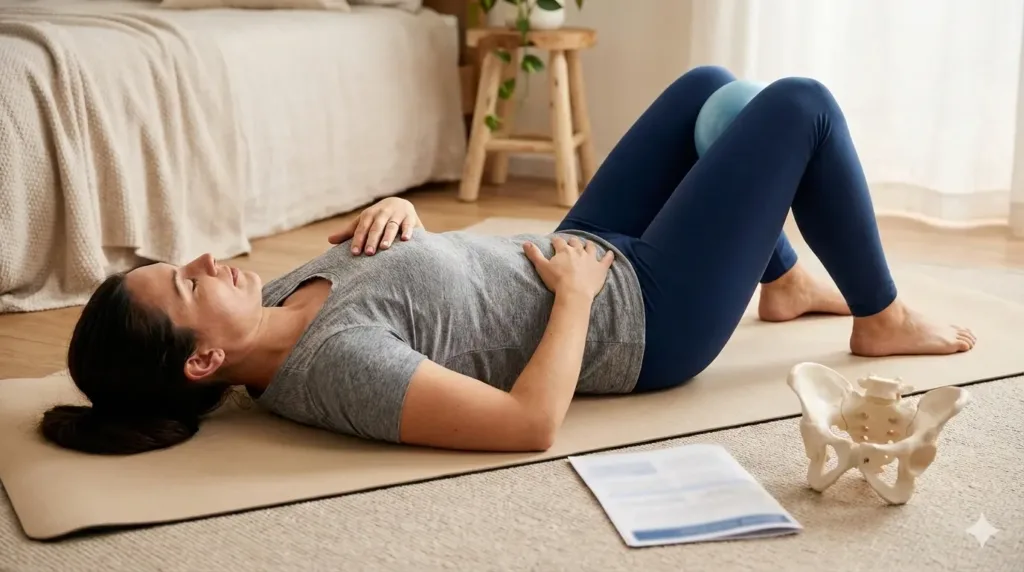
The pelvic floor is a sling of muscles inside the pelvis that supports organs and helps manage pressure. Tension or weakness there can be a contributor to back pain—especially when bladder, bowel, or heaviness symptoms are present.
Clues
- Worse with prolonged sitting
- Leakage, urgency, or heaviness/pressure symptoms
- Pain with intercourse or tampon use (not always present)
What helps
- If symptoms are present, consider pelvic floor–focused evaluation
- Down-training (relaxation) matters as much as strengthening for many people
- Avoid excessive “squeezing” cues if you already feel tight
11) Menstrual cycle-related sensitivity
Hormones and natural inflammatory chemicals can change pain sensitivity and muscle tone.
Clues
- Pain predictably worsens in the days before or during bleeding
- Crampy pelvic symptoms accompany back ache
- Often improves as the cycle progresses
What helps
- Heat, gentle walking, and positions of comfort
- Sleep, hydration, light movement
- If pain is severe, progressive, or different from your usual pattern, seek medical evaluation
12) Endometriosis (a common “not just cramps” cause)
Endometriosis can cause pelvic pain that refers to the low back.
Clues
- Painful periods that disrupt life
- Pain with intercourse or bowel movements
- Back pain that continues beyond the bleeding days
What helps
- Medical evaluation is important; self-care alone is often not enough
- Track symptoms across cycles to support diagnosis discussions
13) Fibroids or adenomyosis (uterus-related causes)
These can produce pelvic heaviness and a deep ache that may be felt in the back.
Clues
- Back ache plus heavy bleeding, clots, pelvic pressure
- Back ache with bloating or urinary frequency
- Symptoms gradually worsen over months
What helps
- Medical evaluation; treatment varies widely
- Meanwhile, gentle mobility and pacing can reduce secondary muscle guarding
14) Ovarian cysts or ovulation pain
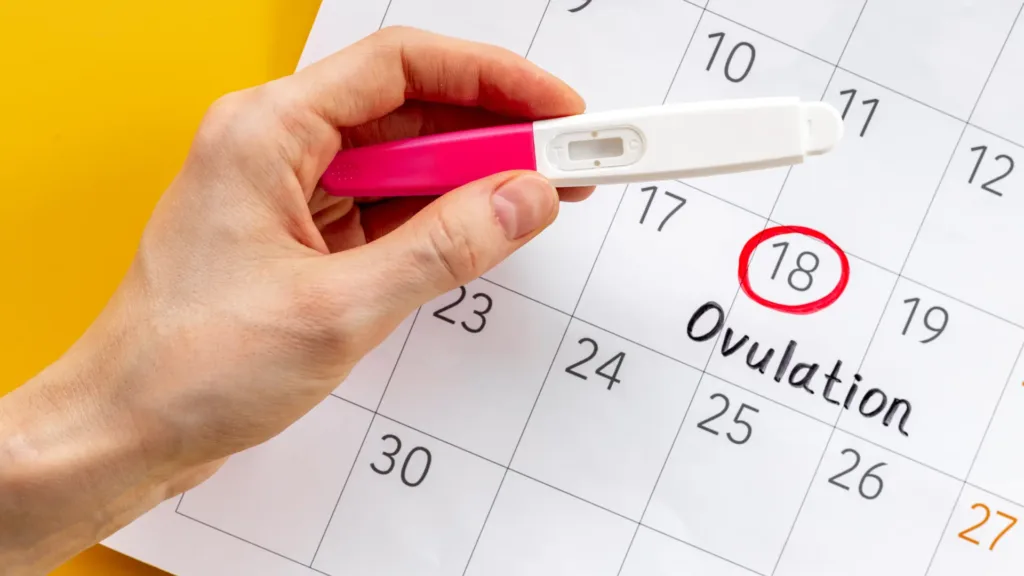
Some people feel a one-sided pelvic ache that can radiate to the back.
Clues
- One-sided pain mid-cycle or sudden pelvic pain
- Pain may come with nausea or a “pinch” sensation
- Back ache can be referred
What helps
- Monitor patterns; seek urgent care for severe sudden pain, fever, fainting, or worsening symptoms
15) Pregnancy-related mechanical load
As pregnancy progresses, posture and load distribution change. Ligaments also soften and stretch in preparation for labor, which the NHS notes puts extra strain on the joints of the lower back and pelvis.
Clues
- Pain increases with standing, walking, and turning over in bed
- Pelvic girdle pain (front of pelvis or SI area) is common
- Symptoms often fluctuate day to day
What helps
- Gentle strength (glutes, deep core), frequent breaks, supportive pillows
- Modify tasks: split loads, avoid heavy asymmetric carrying
16) Postpartum recovery (and “new load” back pain)
Feeding, carrying, sleep disruption, and returning to activity can overload tissues.
Clues
- Pain flares with prolonged leaning (feeding, diaper changes)
- Back ache plus abdominal weakness or heaviness
- Symptoms worsen when sleep is poor
What helps
- Return-to-load plan: short walks, gentle core reactivation, progressive strength
- Set up feeding stations with back support and a footstool
17) Osteoporosis-related vertebral compression fracture (less common, but important)
This is more likely with low bone density, especially after menopause, but it can occur in other settings too.
Clues
- Sudden severe pain after a minor fall—or even a simple movement
- Pain is sharp, constant, worse with standing/walking
- Height loss or a new curve in the upper back can accompany it
What helps
- Medical assessment promptly; imaging may be needed
18) Inflammatory arthritis (immune-driven back pain)
This is not the “I lifted wrong” type of pain.
Clues
- Significant morning stiffness (often >30 minutes)
- Improves with movement, worse with prolonged rest
- May have alternating buttock pain or other joint symptoms
What helps
- Medical evaluation; targeted treatment can be very effective
- Keep moving gently while awaiting care, if tolerable
19) Nerve irritation or sciatica (true radiating nerve pain)
Sciatica is a pattern, not a diagnosis. It refers to nerve-related symptoms down the leg.
Clues
- Burning, electric, shooting pain into the buttock/leg
- Numbness/tingling, or weakness
- Coughing/sneezing may worsen it
What helps
- Avoid stretching aggressively into nerve pain
- Use nerve-friendly positions and graded activity
- Seek evaluation if weakness, significant numbness, or progressive symptoms occur
20) Spinal stenosis
Stenosis is narrowing around nerves, often causing “walking intolerance.”
Clues
- Leg symptoms worsen with standing/walking, improve with sitting or leaning forward
- Legs feel heavy, crampy, or numb after a certain distance
- Back arching can aggravate
What helps
- Forward-leaning breaks, cycling, and specific strength/mobility strategies
- Evaluation if symptoms limit walking or worsen
21) Stress, poor sleep, and pain amplification
This is not “it’s all in your head.” It’s biology: sleep loss and chronic stress sensitize the nervous system.
Clues
- Pain flares during stressful stretches and eases on calmer weeks
- Pain shifts location or feels more intense than expected
- You feel “wired and tired”
What helps
- A “calm and move” plan: sleep routine, short walks, breathing, and gradual strength
- Lower the threat: consistent, safe movement beats searching for the perfect posture
A simple self-check table: clues and first steps
| Pattern you notice | Most likely contributors | First-step actions (next 7 days) |
|---|---|---|
| Worse with sitting and bending | Disc irritation, guarding, deconditioning | Break up sitting; hinge to lift; short walks |
| Worse with standing and arching | Facet irritation, hip flexor tightness | Soft-knee stance; glute work; avoid prolonged arching |
| One-sided near “dimple” area | SI joint/hip loading | Reduce single-leg time; glute med strength; avoid big twists |
| Period-linked flares | Cycle sensitivity, pelvic contributors | Heat + gentle movement; track cycles; evaluate if severe |
| Radiating leg symptoms | Nerve irritation | Avoid aggressive stretches; graded walking; evaluate if weakness |
What actually helps most women with low back pain?
Four things together do most of the work: calming the current flare without shutting your life down, keeping the back gently moving rather than resting it, rebuilding hip and trunk strength so the back stops taking more than its share, and adjusting the daily habits that keep re-triggering it. No single one of the four is enough on its own.
In practice that means combining these four pieces:
- Calm the flare (reduce what spikes pain without freezing your life)
- Keep the back moving (gentle motion often helps more than bed rest)
- Build capacity (hips + core + glutes)
- Fix the repeat offender (the daily habit that keeps re-irritating it)
The 10-minute reset plan (do this daily for 7 days)
This routine fits most uncomplicated patterns. Keep everything in a comfortable range, and treat it as a baseline you can return to whenever things flare.
Step 1: Breathing + gentle brace (2 minutes)
Lie on your back with knees bent, feet on the floor.
- Inhale through your nose.
- Long exhale through your mouth as if fogging a mirror.
- As you exhale, gently tighten your lower belly like you’re zipping snug pants—no breath-holding.
Do 6–8 slow breaths.
Step 2: Pelvic tilts (1 minute)
Same position:
- Tilt your pelvis to gently flatten your low back into the floor.
- Then tilt the other way to allow a small natural arch.
Do 8–10 slow reps.
Step 3: Cat-camel (2 minutes)
On hands and knees:
- Round your mid-back gently, then return to neutral.
- Then gently let your belly drop a little without forcing a deep arch.
Do 8–10 slow reps. No sharp pain.
Step 4: Hip hinge practice (2 minutes)
Stand with feet hip-width.
- Place hands on hips.
- Push hips back as if closing a car door with your hips.
- Keep ribs stacked over pelvis; spine stays long.
Do 6–8 reps. This protects you during daily lifting — one of the biggest triggers of all.
Form cues (keep it simple)
- Hips move back before your chest drops.
- Weight stays mid-foot to heel (not all in the toes).
- Your spine stays long; imagine a string pulling the crown of your head forward.
Step 5: Glute bridge (3 minutes)
Lie on your back, knees bent.
- Exhale gently, brace.
- Push through heels, lift hips until your body forms a straight line from knees to shoulders.
- Pause 2 seconds, lower slowly.
Do 2 sets of 8 reps.
Strength that sticks: a 4-week progression
If symptoms are improving and red flags are absent, add strength gradually. The goal is confidence and capacity.
Week 1: Stabilize and walk

- 10-minute reset plan daily
- Walk 10–20 minutes most days (split if needed)
- Avoid the one movement that spikes pain >3/10
Week 2: Add side support
Add:
- Side-lying clamshells: 2×10 each side
- Side plank on knees (modified): 2×15–25 seconds each side
Week 3: Add anti-rotation and carries
Add:
- Dead bug (slow): 2×6 each side
- Suitcase carry (one hand): 2×30–45 seconds each side (light weight, tall posture)
Week 4: Add functional lifting strength
Add:
- Sit-to-stand from chair: 3×8
- Step-ups: 2×8 each side
- Hip hinge with light weight: 2×8
If pain increases and stays elevated for more than 24–48 hours, scale back one step and rebuild.
Progress rule you can trust
- During exercise: discomfort is acceptable, sharp pain is not.
- After exercise: you should feel the same or slightly better within 24 hours.
- If symptoms flare: cut the volume in half for 3–4 days, then rebuild.
Common “do and don’t” rules that prevent setbacks
| Do | Don’t |
|---|---|
| Keep moving gently every day | Stay in bed for long periods unless advised |
| Use pain as a guide (aim ≤3/10 during exercise) | Push into sharp, catching, or escalating pain |
| Break up sitting with short walks | “Save it up” and do one huge workout on weekends |
| Strengthen hips and core progressively | Only stretch the back aggressively |
| Practice hip hinge for lifting | Round and twist while lifting heavy objects |
When should back pain be treated as urgent?
Seek same-day care for loss of bladder or bowel control, numbness around the groin or inner thighs, leg weakness that is getting worse, or back pain with fever, unexplained weight loss or a cancer history. Sudden severe back pain after a minor fall in a postmenopausal woman also needs prompt review, because it may indicate a vertebral compression fracture.
Special note for pregnancy and postpartum
If you are pregnant or recently postpartum and pain is severe, sudden, or paired with concerning pelvic symptoms, treat it as time-sensitive and get evaluated promptly.
Seek urgent evaluation if any of these are present:
- New bowel or bladder control problems
- Numbness in the groin/saddle area
- Progressive leg weakness or foot drop
- Fever, unexplained weight loss, history of cancer, or severe night pain
- Major trauma (fall/accident) or suspected fracture
- Severe, sudden pelvic pain with fainting, fever, or pregnancy-related concerns
When should you book an evaluation even if it isn’t urgent?
Book an assessment if the pain has not clearly improved after two to four weeks of consistent self-care, if it keeps returning every few months, if it follows your menstrual cycle, or if leg symptoms are present. Persistent pain that has not responded to sensible loading usually means something in the pattern has been missed, not that you need to try harder.
Consider evaluation if:
- Pain persists beyond 2–4 weeks despite good self-care
- Pain keeps recurring (same pattern every month or every few weeks)
- You have significant leg symptoms (numbness/tingling/weakness)
- Period pain is severe, worsening, or associated with heavy bleeding or pelvic symptoms
- You’re postpartum and feel heaviness, leaking, or discomfort that limits daily function
Practical ergonomics for real life (not perfect posture)
If your day includes lots of sitting and symptoms keep returning:
- Put a small cushion or rolled towel behind your low back.
- Feet flat, knees roughly hip level.
- Every 30–45 minutes: stand up, take 20–30 steps, do one gentle hinge rep.
If your day includes lots of standing:
- Soft knees, ribs stacked over pelvis (avoid “rib flare”).
- Shift weight gently side to side instead of locking into one position.
- Use a small step or stool to alternate one foot up for 30–60 seconds.
A reality check on causes and scans
Two points worth holding on to. First, a scan is rarely the starting move: UK national guidance advises clinicians not to routinely offer imaging for low back pain in non-specialist settings, because in the absence of red flags the result seldom changes what treatment is actually recommended. Second, if your back pain is genuinely cyclical, that is worth flagging to a doctor rather than treating as a purely mechanical problem — NICE advises suspecting endometriosis in women with chronic pelvic pain, period-related pain that interferes with daily activities, or cyclical bowel or urinary symptoms.
So which causes dominate in everyday life?
In practice, the most common contributors are usually a mix of:
- Too much sitting + tight hip flexors + undertrained glutes
- A flare after lifting/twisting + protective guarding
- Deconditioning (your back is doing more than its share)
- Cycle-linked sensitivity that lowers your pain threshold, making a small issue feel big
That’s good news, because these patterns respond well to consistent habits.
Myth vs fact
| Myth | Fact |
|---|---|
| “If it hurts, I should stop moving.” | Gentle movement is often the fastest way to settle many back flares. |
| “My back is weak, so I need constant bracing.” | Healthy stability is adaptable, not rigid. Strength builds confidence. |
| “Imaging will always show the cause.” | Many people have normal scans and real pain, or “abnormal” scans and no pain. |
| “I must find the one perfect posture.” | Variety beats perfection. Frequent position changes protect you. |
FAQs about low back pain in women
1) Is low back pain in women always related to the menstrual cycle?
No. While cycle-linked flares are common, back pain is more often driven by daily loads, posture habits, muscle conditioning, or joint/disc irritation. The cycle can amplify symptoms, but it is not always the root cause.
2) Can low back pain in women be caused by the pelvic floor?
Yes. Pelvic floor tension, weakness, or coordination issues can contribute to back pain, especially if you also notice leakage, urgency, heaviness, or pain with intercourse or tampons.
3) What’s the difference between “muscle strain” and “disc pain”?
Muscle strain usually feels sore and improves with gentle movement over days. Disc irritation is typically worse with sitting and bending and may feel better with standing. Both can overlap, and both commonly improve with load management and progressive strengthening.
4) Should I stretch my back when it hurts?
Sometimes gentle mobility helps, but aggressive stretching into sharp pain can prolong a flare—especially if nerves are irritated.
5) When is low back pain in women a red flag?
Red flags include new bladder/bowel control problems, groin numbness, progressive leg weakness, fever, unexplained weight loss, major trauma, or severe constant pain that does not ease.
6) Why does my back hurt more at night?
Night pain can be linked to stiffness from long stillness, an uncomfortable sleep setup, stress, or inflammation. If pain wakes you regularly, the most useful first move is usually to adjust sleep positions and build a gentle morning routine. Try side-lying with a pillow between knees or on your back with a pillow under knees.
7) Can endometriosis cause back pain even if my back feels “muscular”?
Yes. Pelvic pain can refer into the back and also trigger secondary muscle guarding.
8) Is walking good or bad for low back pain in women?
For most uncomplicated patterns, walking is one of the best first steps. Start with short, frequent walks and build gradually.
9) Do I need an MRI right away?
Not usually. Most back pain improves with conservative care in the first few weeks. Imaging is typically reserved for red flags, significant nerve deficits, or persistent symptoms that do not improve with a structured plan.
10) What’s the fastest way to calm a flare today?
For many people: heat for 10–15 minutes, a short walk, then the 10-minute reset plan. Avoid the single movement that spikes pain sharply for a few days, but keep gentle movement going.
The bottom line
Low back pain in women rarely has one tidy explanation, and that is usually good news rather than bad. When two or three ordinary contributors stack up — long sitting, undertrained hips, a stressful month, a cycle-related dip in pain tolerance — they also unstack when you address them together. Start with the 10-minute daily reset, hold it for a week, then begin the four-week strength progression. Track whether pain follows movement or follows your cycle, because that single observation tells a clinician more than most scans will. If nothing has shifted after four weeks, or if any red flag appears, get assessed rather than repeating the same plan louder.
References
- National Institute for Health and Care Excellence (NICE). Low back pain and sciatica in over 16s: assessment and management. NICE guideline NG59. Published 30 November 2016; last updated 11 December 2020. https://www.nice.org.uk/guidance/ng59
- National Institute for Health and Care Excellence (NICE). Endometriosis: diagnosis and management. NICE guideline NG73. Published 6 September 2017; last updated 11 November 2024. https://www.nice.org.uk/guidance/ng73
- NHS. Back pain in pregnancy. Last reviewed 10 January 2024. https://www.nhs.uk/pregnancy/related-conditions/common-symptoms/back-pain/