
If you live with persistent low back pain, you may have noticed brightly colored strips of tape on athletes, weekend runners, or even people in your workplace. That tape is usually kinesiology tape (KT tape), and when used correctly, low back pain KT tape can provide gentle support, reduce the feeling of strain, and help you move more confidently.
What often gets missed in online tutorials is a crucial point: in real-world practice, low back pain KT tape is usually assessed, recommended, and applied by physiotherapists or other trained professionals—not as a casual do-it-yourself fix at home. The tape pattern, amount of stretch, and even whether taping is appropriate at all depend on a proper assessment of your spine, muscles, nerves, and daily activities.
This article will walk you through:
- What low back pain KT tape can and cannot do.
- Why professional assessment matters before taping.
- A step-by-step view of how a physiotherapist typically uses KT tape for lower back problems.
- How taping fits into a broader plan of exercise, movement, and lifestyle changes.
- Practical FAQs about low back pain KT tape so you can ask better questions at your next appointment.
Throughout, remember this key idea: low back pain KT tape is a supportive tool, not a standalone cure, and it works best in skilled hands as part of a structured recovery plan.

What low back pain KT tape actually does (and does not do)
Kinesiology tape is a stretchy, breathable tape with an acrylic adhesive designed to move with your skin, not lock your joints in place. When a physiotherapist applies low back pain KT tape correctly, it can:
- Provide a light, reassuring sense of support around painful or fatigued areas.
- Gently lift the superficial skin layers, which may influence local pressure and fluid movement.
- Enhance your awareness of posture and movement (proprioception), helping you avoid overloaded positions.
- Support muscles that are tired or recovering from a mild strain without acting like a rigid brace.
However, even the best low back pain KT tape application cannot:
- “Put a slipped disc back in place.”
- Reverse arthritis or structural changes in spine joints.
- Replace the need for strengthening, stretching, and activity modification.
- Override major red-flag symptoms that need urgent medical attention.
Think of low back pain KT tape as an assistant to your nervous system and muscles—offering comfort and feedback—rather than as a mechanical fix that realigns bones or discs.
Why low back pain KT tape should be guided by a physiotherapist
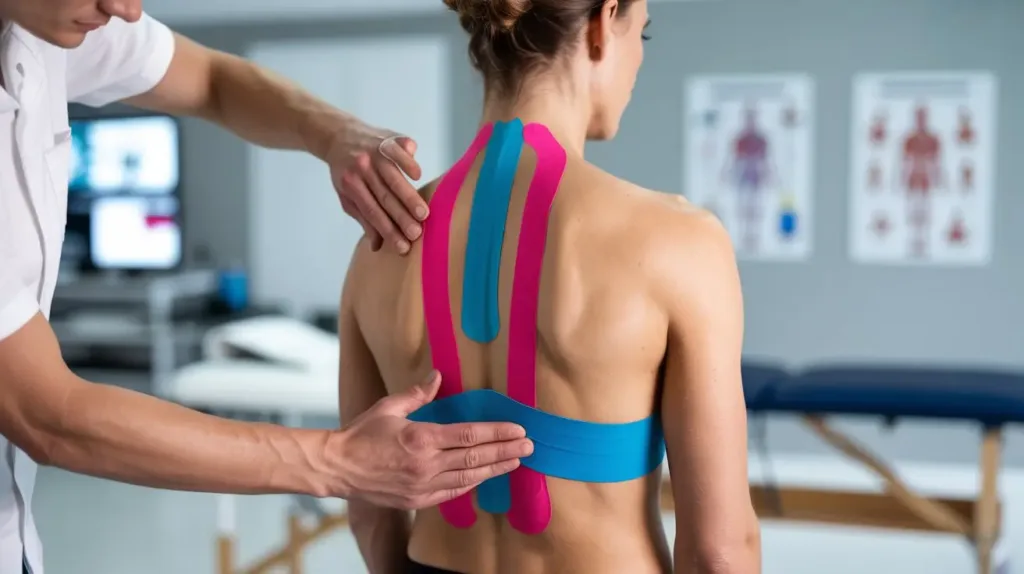
It is very easy to find online videos showing do-it-yourself patterns. Yet in sports fields, rehabilitation centers, and outpatient clinics, low back pain KT tape is most often applied by physiotherapists or trained sports medicine staff. There are several reasons for this.
Your back pain pattern needs a diagnosis, not just tape
Two people can have pain in the same region of the lower back for completely different reasons:
- One may have a simple muscle strain from lifting.
- Another may have nerve-related pain from a disc issue.
- A third may have spinal stenosis or arthritis-related pain.
Each of these conditions behaves differently and may respond to low back pain KT tape in distinct ways—or not at all. A physiotherapist is trained to:
- Take a detailed history of how your pain started and behaves.
- Examine your posture, movement, strength, and nerve function.
- Identify red flags that mean taping alone would be unsafe or misleading.
Only then will they decide whether low back pain KT tape is appropriate, and if so, what pattern and tension to use.
Tape pattern and tension are not “one size fits all”
The same strip of low back pain KT tape can be used in very different ways. Variables include:
- Direction: along the muscle, across it, or in a fan pattern.
- Purpose: decompression (less pressure), support, or sensory feedback.
- Tension: from no stretch to moderate stretch, depending on the goal.
A physiotherapist will experiment with these variables based on how you move, where you feel pain, and how your tissues respond during the session. Copying a random internet pattern does not account for your specific anatomy, pain triggers, or activity demands.
Professional application reduces skin and comfort issues
Trained clinicians know how to:
- Prepare the skin, position the body, and avoid wrinkles that cause irritation.
- Test a small piece of low back pain KT tape first if you have sensitive skin.
- Monitor your response over several visits and adjust the approach accordingly.
In short, professional guidance makes low back pain KT tape safer, more comfortable, and more likely to add real value to your recovery plan.
When low back pain KT tape may be useful in clinic
Even within a clinic setting, low back pain KT tape is not used for everyone. It tends to be most helpful when pain is mechanical and activity-related.
Muscle-dominant and mechanical low back pain
If your pain:
- Worsens with certain movements or positions (for example, bending or prolonged sitting).
- Improves with gentle movement, short walks, or changing posture.
- Feels like tightness, fatigue, or “overworked” muscles in the lower back.
Then low back pain KT tape may provide gentle support around the lumbar muscles and glutes. Your physiotherapist might use taping to help you:
- Tolerate daily tasks such as work or childcare with less discomfort.
- Practice better hip hinge and lifting technique with sensory feedback.
- Transition back to usual activities while a strengthening plan is underway.
Disc-related pain and sciatica
If pain travels into the buttock or leg, especially below the knee, a disc and nerve root may be involved. In these cases:
- Low back pain KT tape does not fix the disc itself.
- It is used to calm protective muscle spasm and reduce fear of movement.
- It may be applied in patterns that encourage positions your spine tolerates better (for example, flexion- or extension-biased patterns, depending on your response).
Your physiotherapist will often combine taping with specific directional exercises, nerve-friendly movements, and clear guidelines on which positions to limit temporarily.
Age-related changes, arthritis, and spinal stenosis
In people with arthritis or spinal stenosis:
- Back pain often coexists with stiffness and reduced walking tolerance.
- Low back pain KT tape may provide a subtle “hug” sensation and improve confidence while walking or standing.
- The physiotherapist will typically pair taping with hip mobility work, flexion-biased exercises (if appropriate), and pacing strategies.
In all of these scenarios, low back pain KT tape is chosen based on a clinical reasoning process, not simply on where the pain is felt.
Safety checks before your physiotherapist uses low back pain KT tape
Before applying low back pain KT tape, a responsible clinician will consider several safety factors.
They will check for:
- Skin integrity: no open wounds, rashes, infections, or fragile skin in the taping area.
- Allergy or sensitivity: past reactions to plasters or tapes; if uncertain, they may test a small patch first.
- Medical conditions: such as uncontrolled diabetes, circulatory problems, active infections, or certain autoimmune conditions that may affect skin healing.
- Medications: including corticosteroids or blood thinners, which may change how tissues respond.
- Pregnancy: taping is commonly used but patterns may be adapted to avoid excessive pressure on the abdomen or sensitive areas.
If anything raises concern, your physiotherapist may avoid low back pain KT tape altogether or modify the plan significantly.
Step-by-step: how physiotherapists typically use low back pain KT tape
This section is not a do-it-yourself guide. Instead, it shows the typical sequence a physiotherapist follows so you know what to expect during your session.
Step 1: Assessment and goal setting
Your appointment will usually begin with:
- A discussion about your pain: when it started, what makes it better or worse, and how it affects your life.
- A physical examination: posture, range of motion, muscle strength, nerve tests, and functional tasks such as sitting, standing, or lifting.
- Identification of priorities: for example, “I need to sit for my job,” “I want to return to my sport,” or “I struggle to sleep due to pain.”
Only when the physiotherapist understands your pattern will low back pain KT tape enter the conversation. They will explain:
- Why they are considering taping.
- What the tape is expected to do for you (support, feedback, comfort).
- How long they expect the tape to stay on.
Step 2: Skin preparation and positioning
If taping is appropriate, your physiotherapist will:
- Clean the area and, if necessary, trim (not shave) excessive hair to improve adhesion.
- Check for moles, scars, or sensitive spots to avoid.
- Position you in a posture that matches the goal—for example, slightly flexed or extended spine, or neutral aligned posture.
The position you are in when the tape is applied influences how low back pain KT tape behaves once you move around.
Step 3: Choosing a low back pain KT tape pattern

Depending on your presentation, your physiotherapist may choose:
- Two vertical strips on either side of the spine for general support and awareness.
- A horizontal “decompression” strip over a particularly tender area.
- Fan-shaped or angled strips to address specific muscle groups or directions of movement.
They will also decide:
- How much stretch to use (often light to moderate, with ends applied without tension).
- How many layers are necessary—usually fewer than many people expect.
During this stage, communication is key. You can expect them to describe what they are doing and how low back pain KT tape should feel on your skin.
Step 4: Application, movement testing, and adjustment
After low back pain KT tape is applied, your physiotherapist will ask you to:
- Gently bend, extend, and side-bend your spine.
- Perform functional tasks such as sitting, standing, or a small squat.
They will look for:
- Reduced sense of strain or “guarding.”
- Improved confidence in moving.
- Any signs of restriction, pinching, or discomfort caused by the tape.
If something does not feel right, the tape can be removed and reapplied with different tension or placement. Your feedback is essential in fine-tuning how low back pain KT tape is used.
Step 5: Instructions for living with the tape
Before you leave, you should receive clear guidance on:
- How long to keep the tape on (commonly 2–5 days for an initial trial).
- What activities are allowed or encouraged while it is on.
- How to remove low back pain KT tape gently to protect your skin.
- What reactions are normal (mild imprint lines) and what reactions require removal (itching, burning, rash).
This turns the taping from a one-time procedure into a monitored part of your rehabilitation.
Why do-it-yourself low back pain KT tape is usually not advised
While it is physically possible to tape your own lower back, it is rarely the best starting point. Common problems with self-applied low back pain KT tape include:
- Applying tape where it “looks right” rather than where assessment suggests it should go.
- Using excessive stretch, which can irritate the skin and worsen symptoms.
- Covering too large an area, making removal uncomfortable and reducing skin breathing.
- Over-relying on tape instead of addressing weak, stiff, or poorly coordinated movement patterns.
A simple way to compare approaches:
| Aspect | Physio-Guided Low Back Pain KT Tape | DIY Low Back Pain KT Tape |
|---|---|---|
| Based on assessment | Yes | Usually no |
| Pattern & tension choice | Tailored to your condition | Copied from internet |
| Red-flag screening | Yes | Often missed |
| Skin care & safety | Prioritized | Variable |
| Role in rehab plan | Integrated with exercise and pacing | Often used in isolation |
If you strongly prefer to apply low back pain KT tape yourself, the safest route is to first learn your pattern directly from a physiotherapist, then follow their instructions at home while checking in periodically.
Living with professionally applied low back pain KT tape
Once your tape is on, most of your day will happen away from the clinic. Knowing how to care for it helps you get the maximum benefit.
How long should you wear low back pain KT tape?
Your physiotherapist will give you a specific time frame, but general guidelines are:
- Initial trial: often 1–3 days to see how your skin and symptoms respond.
- Ongoing use: up to 3–5 days at a time, with a break of about 24 hours between applications.
Wearing low back pain KT tape continuously for weeks without breaks is not recommended, as your skin needs recovery time and your long-term plan should emphasize exercise and self-management.
Showering, sleeping, and clothing
With low back pain KT tape in place:
- Showers are usually fine; pat dry rather than rubbing vigorously.
- Very hot water directly on the tape can soften the adhesive and cause edges to peel.
- Loose, breathable clothing reduces friction over the taped area.
At night, you should be able to sleep in your usual positions. If the tape wakes you or feels too restrictive, inform your physiotherapist so they can adjust the pattern or tension next time.
Safe removal of low back pain KT tape
Your clinician will typically advise you to:
- Loosen the tape in a warm shower or by applying a bit of oil.
- Hold the skin with one hand and gently roll the tape back on itself with the other, keeping it low and slow.
- Avoid ripping it off quickly like a traditional plaster.
If you notice significant redness, blisters, or a rash after removal, show this to your physiotherapist before your next taping session.
How low back pain KT tape fits into your rehabilitation plan
Even when low back pain KT tape is perfectly applied, it is still just one element of a broader strategy.
Movement and mobility
Your physiotherapist may use low back pain KT tape to:
- Make it easier for you to perform gentle mobility exercises such as cat–camel, pelvic tilts, or hip hinge practice.
- Support you during short, frequent walks that keep your joints and muscles moving.
- Reduce fear of bending or twisting so that you can reintroduce normal movement patterns.
The goal is not to avoid movement but to move with more confidence and less guarding while wearing low back pain KT tape.
Strength and endurance
Long-term improvement in mechanical low back pain usually requires:
- Strengthening gluteal muscles, abdominal muscles, and hip stabilizers.
- Progressively loading the spine with safe, well-controlled exercises.
- Building endurance for daily tasks such as sitting, standing, lifting, and walking.
Low back pain KT tape can make this process more comfortable and less threatening, but it cannot replace the hard work of gradually strengthening your body.
👨⚕️ Dr. Arora’s Clinical Note:
Many patients ask me if KT tape is “supporting the spine” the way a belt or brace does. In most cases, the real benefit is not mechanical support—it’s a nervous-system “movement cue.”
Here’s the shortcut that separates effective taping from wasted taping: the immediate re-test rule. After taping, you should re-check the one movement that reliably triggers your symptoms (e.g., sit-to-stand, forward bend, getting out of the car). If there’s no clear reduction in strain or guarding within minutes, the pattern/tension is probably not right for your presentation that day—and repeatedly re-taping at home won’t fix that.
A second clinical insight: more stretch is not better. Excess tension often creates constant skin pull, which can increase protective muscle tone and make you feel “restricted.” Skilled taping usually uses light tension and strategic placement to guide you toward a calmer movement pattern—then you “earn your way off the tape” by building endurance and control.
When low back pain KT tape is not enough: red flags and medical review
Certain symptoms require prompt medical evaluation, regardless of whether you are using low back pain KT tape.
Seek urgent medical help if you experience:
- Sudden, severe back pain after a fall, accident, or major trauma.
- Difficulty controlling bladder or bowel function or numbness around the groin area.
- Progressive weakness or numbness in one or both legs.
- Unexplained weight loss, fever, or a history of cancer along with new back pain.
- Pain that is constant, severe, and unrelenting at night, not eased by rest.
In these situations, KT tape is not an appropriate main strategy. A full medical workup is more important than any taping approach. Trusted health sites such as MedlinePlus also outline warning signs and typical back pain patterns in straightforward language, which can help you understand why urgent evaluation is sometimes necessary.
Practical tips to get the best from low back pain KT tape
To summarize how to use low back pain KT tape wisely:
- See a physiotherapist or other qualified professional first, especially if this is your first episode or your pain pattern is complex.
- Treat low back pain KT tape as a short-term support and feedback tool, not a lifelong crutch.
- Use the time while taped to practice better posture, lifting technique, and daily movement habits.
- Keep a simple record of when you were taped, what activities you did, and how your pain responded; this helps fine-tune the plan.
- Be honest with your clinician: if low back pain KT tape does not feel helpful or causes irritation, say so. There are always alternatives.
Used in this thoughtful, collaborative way, low back pain KT tape can make your rehabilitation journey safer, more comfortable, and more confident—always guided by professional expertise rather than guesswork.
For an evidence-based overview of interventions that tend to help (and what usually doesn’t) in acute versus chronic low back pain—written for rehabilitation clinicians—see the clinical practice guideline: [Interventions for the Management of Acute and Chronic Low Back Pain: Revision 2021, 2021].
FAQs about low back pain KT tape
1. Can low back pain KT tape replace a back brace?
In many cases of mild to moderate mechanical pain, physiotherapists prefer low back pain KT tape over a rigid brace because it allows more natural movement while still providing support and feedback. A brace may still be indicated after certain surgeries or in specific instability conditions, but that decision should be made by your healthcare team.
2. How soon should I feel a difference after being taped?
Some people feel immediate changes with low back pain KT tape, such as a lighter, more supported feeling or reduced fear of bending. Others notice smaller benefits, like being able to sit or walk a little longer. If repeated trials of professionally applied tape make no difference, your physiotherapist may choose different strategies instead.
3. Is low back pain KT tape safe during pregnancy?
Yes, low back pain KT tape is commonly used during pregnancy, but patterns and tension need careful adjustment to respect changing posture, ligament laxity, and sensitive areas. It is especially important in pregnancy to have taping guided and applied by a physiotherapist who understands prenatal care.
4. Can I go to the gym with low back pain KT tape on?
Most people can safely exercise while wearing low back pain KT tape, and many feel more confident doing so. Your physiotherapist will usually recommend starting with lighter loads and gradually progressing. The tape is there to support good technique and comfort, not to encourage you to ignore pain signals.
5. Does low back pain KT tape work for sciatica?
Low back pain KT tape does not directly treat the nerve, but it can reduce protective muscle tension and make it easier to adopt nerve-friendly positions and exercises. For sciatica, taping is usually combined with targeted movement strategies and medical guidance rather than used alone.
6. How do I choose a brand of low back pain KT tape?
Your physiotherapist may recommend specific brands that are hypoallergenic, latex-free, and clinically tested. In general, look for tapes marketed for medical or sports use rather than purely cosmetic color options. How your own skin responds is the ultimate test, so follow your clinician’s advice and report any irritation.
7. How often can I have low back pain KT tape applied?
Frequency depends on your skin tolerance and overall rehabilitation plan. A common pattern is to be taped for a few days, take at least a day off, and reassess. Continuous taping for weeks without breaks is rarely necessary and may indicate that your plan needs more focus on exercise and self-management.
8. What if low back pain KT tape makes my pain worse?
If your pain increases significantly once low back pain KT tape is applied, tell your physiotherapist as soon as possible. The pattern or tension may not suit your spine, or the tape may be highlighting a movement that irritates your symptoms. The tape should support, not aggravate, your condition.
9. Can I learn to apply low back pain KT tape myself later?
Yes, some people gradually learn to apply low back pain KT tape themselves, especially athletes or those with recurrent episodes. The safest route is to let your physiotherapist teach you step-by-step, with clear instructions on pattern, tension, and safety checks. Self-taping should build on professional guidance, not replace it.
10. Is low back pain KT tape enough if I have chronic back pain?
Chronic low back pain is rarely resolved by any single treatment. Low back pain KT tape can be a valuable tool to improve comfort and confidence while you work on exercise, sleep, stress management, and lifestyle factors. The most effective plans are multidisciplinary and may involve physiotherapy, medical input, education, and behavioral strategies—not tape alone.