
This page catalogs the ICD-10-CM codes used for low back pain in US healthcare billing, with documentation requirements, common pitfalls, and related code families. It reflects the ICD-10-CM FY2026 code set per CMS, effective October 1, 2025 through September 30, 2026. It is written for medical coders, billers, claims processors, clinic administrative staff, and clinicians verifying code selection before claim submission.
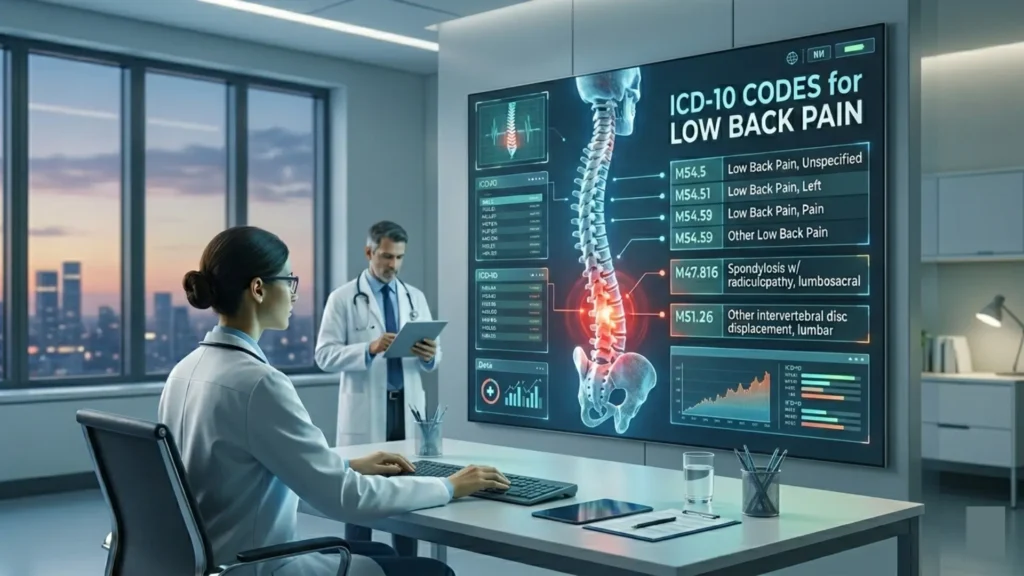
Short answer for coders: There is no single low back pain ICD-10 code. M54.5 has been a non-billable parent since October 1, 2021, and claims carrying it are rejected. Select one of three billable children instead: M54.50 when no cause is documented, M54.51 when the record supports an imaging-confirmed vertebrogenic (endplate) source, and M54.59 when a specific non-vertebrogenic source is documented. These three are mutually exclusive on a single encounter.
The three children carry different documentation requirements, and the wrong selection is one of the most common sources of payer pushback on lumbar pain claims.
Key takeaways
- M54.5 is dead on arrival. Non-billable since October 1, 2021. Any encounter template, problem list, or charge ticket still carrying it will generate denials.
- M54.51 is the audit-prone one. It requires an explicit provider statement naming vertebrogenic low back pain plus imaging evidence of endplate pathology. Imaging findings alone, without the assessment-line diagnosis, do not support it.
- Do not stack M54.5x on a structural code. If disc displacement, radiculopathy, sciatica, or stenosis is documented as the source, that code stands alone. Excludes1 relationships block the combination.
- Chronicity is a secondary code, not a different M54.5x. There is no acute-versus-chronic split inside M54.5x; add G89.29 when chronicity is documented, and sequence it first only for pain-management encounters.
- Check the fiscal year before you submit. The FY2026 set governs encounters through September 30, 2026; the October 1, 2026 update takes effect the next day.
Last updated: July 29, 2026. Code set validity: ICD-10-CM FY2026, including the April 1, 2026 update, applies to encounters through September 30, 2026. Re-verify against the October 1, 2026 (FY2027) addenda for later dates of service.
Patients looking to understand what their diagnosis code means in plain language should see the patient guide to M54.50, M54.51, and M54.59.
Which code set is currently in effect?
The ICD-10-CM FY2026 code set governs encounters and discharges through September 30, 2026. CMS also posted an April 1, 2026 update that applies to encounters from April 1, 2026 onward, so a code list downloaded in late 2025 is no longer the authoritative version. The October 1, 2026 files are already published and take effect for encounters on and after that date.
| Release | Applies to encounters and discharges | Practical note for coders |
|---|---|---|
| FY2026 — October 1, 2025 release | October 1, 2025 – March 31, 2026 | Superseded mid-year; do not use for current dates of service |
| FY2026 — April 1, 2026 update | April 1, 2026 – September 30, 2026 | The version governing encounters today; replaces the October 2025 release |
| October 1, 2026 update (FY2027) | October 1, 2026 onward | Files already posted by CMS; re-verify the M54.5x family and any related codes against the FY2027 addenda before the changeover |
Because the changeover falls at the start of the federal fiscal year rather than the calendar year, claims for services in September and October of the same calendar year can fall under different code sets. Date of service, not date of submission, determines which set applies. Effective dates for each release are published on the CMS ICD-10 page, and the accompanying FY2026 ICD-10-CM Official Guidelines for Coding and Reporting — approved by CMS, NCHS, the AHA, and AHIMA — remain the governing convention document through September 30, 2026.
Which ICD-10 code should I use for low back pain?
Match the code to the level of specificity the record actually supports. Use M54.50 when lumbar pain is documented without a defined cause or radicular involvement, M54.51 only when the assessment names vertebrogenic low back pain and imaging shows endplate pathology, and M54.59 when a specific source such as mechanical or myofascial pain is documented but is not vertebrogenic.
| ICD-10 Code | Description | Billable? | Primary Use |
|---|---|---|---|
| M54.5 | Low back pain (parent code) | No — non-billable since Oct 2021 | Superseded by M54.50–M54.59 |
| M54.50 | Low back pain, unspecified | Yes | Default when site/cause not specified |
| M54.51 | Vertebrogenic low back pain | Yes | Imaging-confirmed vertebral endplate source (Modic changes) |
| M54.59 | Other low back pain | Yes | Documented cause not fitting M54.50 or M54.51 |
M54.50 — Low back pain, unspecified
Code details
M54.50 is a billable ICD-10-CM code in the Dorsalgia (M54) category. It became effective October 1, 2021, when the former M54.5 was converted to a non-billable parent. The current FY2026 definition took effect October 1, 2025 and remains active through September 30, 2026.
Hierarchy: Chapter 13 (Diseases of the musculoskeletal system) → M50–M54 (Other dorsopathies) → M54 (Dorsalgia) → M54.5 (parent, non-billable) → M54.50.
When to use
Assign M54.50 when the documentation describes lumbar pain without a defined cause, without radicular or neurological involvement, and without findings that support a more specific M54.5x code. It is appropriate early in an episode of care when the clinical picture has not yet been resolved, or when diagnostic workup has not identified a source.
This code covers lumbago not otherwise specified (NOS) and loin pain.
Documentation requirements
The encounter note should establish that the pain is located in the lumbar or lumbosacral region and that no more specific pathology has been documented. Supporting elements include onset (acute, subacute, or chronic), aggravating and relieving factors, prior episodes, and a statement that radiculopathy, sciatica, disc pathology, stenosis, strain, and vertebrogenic features have not been identified.
Chronic presentations can be supported with a secondary code from the G89 category — most commonly G89.29 (Other chronic pain) — when the documentation establishes chronicity and the site-specific M54.5x code remains the reason for the encounter.
Common coding pitfalls
- Continuing to use M54.50 after imaging or exam findings support a more specific code such as M54.51 or M54.59.
- Pairing M54.50 with a structural diagnosis (disc disorder, radiculopathy, sciatica) that already explains the pain. Excludes1 and Excludes2 relationships block this combination.
- Repeating M54.50 across multiple visits without updating the code as the workup matures. Frequent use of unspecified codes raises payer scrutiny.
- Using M54.50 for thoracic or cervical pain. It is specific to the lumbar region.
Related codes to check
Before defaulting to M54.50, rule out M54.51 (vertebrogenic), M54.59 (other low back pain), M54.16 (lumbar radiculopathy), M54.30–M54.32 (sciatica), M54.40–M54.42 (lumbago with sciatica), M51.26 (lumbar disc displacement), M51.36 (lumbar disc degeneration), M48.061/M48.062 (lumbar stenosis), and S39.012 (low back strain).
Excludes1 notes on M54.50 specifically block: low back strain (S39.012), lumbago due to intervertebral disc displacement (M51.2-), lumbago with sciatica (M54.4-), and intervertebral disc degeneration of the lumbar or lumbosacral region with discogenic back pain only (M51.360, M51.370).
M54.51 — Vertebrogenic low back pain
Code details
M54.51 is a billable ICD-10-CM code, effective October 1, 2021. The FY2026 definition took effect October 1, 2025. It was created — along with M54.50 and M54.59 — when CMS and the NCHS split the former M54.5 to capture clinical differences that the catch-all code obscured.
Vertebrogenic low back pain describes pain originating from the vertebral endplates themselves, not from the disc, facet joint, nerve root, or paraspinal soft tissue. The code is tied to an underlying pathology (endplate damage with associated Modic changes in the adjacent bone marrow) rather than a symptom pattern.
When to use
Assign M54.51 only when the record supports a vertebrogenic source. The typical clinical pattern is deep, midline, axial lumbar pain aggravated by prolonged sitting, standing, or loaded forward flexion. Imaging is expected to show Modic Type 1 or Type 2 endplate changes on MRI, or equivalent evidence of vertebral endplate pathology.
This code is commonly seen in workflows involving basivertebral nerve ablation and other endplate-targeted interventions.
Documentation requirements
M54.51 carries the strictest documentation standards of the M54.5x group. The provider note should contain all of the following:
- An explicit diagnostic statement naming the condition as vertebrogenic low back pain. Assessments that say only “low back pain” default to M54.50 regardless of imaging.
- MRI findings identifying Modic Type 1 or Type 2 endplate changes, or documented vertebral endplate damage. The specific level or levels should be recorded.
- A pain description consistent with vertebrogenic origin — midline, axial, and commonly worsened by sustained postures.
- Clinical correlation between the imaging findings and the symptom pattern.
- If the payer’s local coverage determination (LCD) requires it, evidence of conservative care trial and failure.
The 2021 split of M54.5 tightened coding granularity precisely so vertebrogenic presentations could be tracked as distinct from mechanical or nonspecific lumbar pain. Use of M54.51 without imaging support is the single most audit-prone error with this code.
Common coding pitfalls
- Assigning M54.51 based on symptom pattern alone, without MRI or CT evidence of endplate pathology.
- Interpreting M54.51 as a code for left-sided low back pain. It is not laterality-specific; the “.51” suffix refers to the vertebrogenic subtype.
- Applying M54.51 to pain whose source is a disc, facet joint, or nerve root. Those presentations map to M51.xx, M47.8xx, or M54.1x codes.
- Missing the diagnostic statement in the assessment line while including MRI findings elsewhere. Coders cannot assign M54.51 from imaging reports alone if the provider’s assessment does not name the vertebrogenic origin.
Related codes to check
Consider M51.36 (lumbar disc degeneration) when the endplate findings sit alongside disc-level degeneration that better explains the pain, M48.06x (lumbar stenosis) when stenosis coexists, and M47.816 (spondylosis without myelopathy or radiculopathy, lumbar region) when degenerative facet arthrosis is the documented driver.
M54.59 — Other low back pain
Code details
M54.59 is a billable ICD-10-CM code, effective October 1, 2021. The FY2026 definition took effect October 1, 2025. It captures documented lumbar pain that does not fit the unspecified or vertebrogenic buckets.
When to use
Assign M54.59 when the record clearly identifies a source or mechanism for the low back pain, but that source is neither vertebrogenic (M54.51) nor undefined (M54.50). Typical fits include mechanical low back pain, muscular or myofascial pain patterns, facet-mediated pain without a more specific M47 code, and sacroiliac-region pain that does not meet the criteria for a sacroiliitis or SI joint disorder code.
M54.59 is often the right code in physical therapy, rehabilitation, and primary care encounters where the clinical picture is described with detail but does not cross into vertebrogenic or radicular territory.
Documentation requirements
The note should describe the pain pattern with enough specificity to justify a named source or mechanism (for example, mechanical aggravation with extension-based movement, reproducible paraspinal muscular pain, or a defined postural trigger) while explicitly not meeting criteria for M54.50 or M54.51. Laterality, chronicity, and aggravating factors help anchor the selection.
Common coding pitfalls
- Using M54.59 as a near-synonym for M54.50. If no defining characteristic is documented, M54.50 is correct.
- Pairing M54.59 with a structural code that independently explains the pain (disc displacement, radiculopathy, stenosis). The structural code takes precedence; M54.59 should not be layered on top.
- Applying M54.59 when the documented source is vertebrogenic with imaging confirmation. That scenario is M54.51.
Related codes to check
Review M54.50 first if documentation detail is thin, M54.51 if endplate pathology is present, S39.012 for documented acute lumbar strain, and the M51.xx series when the pain is clearly disc-mediated.
Why was M54.5 retired, and what replaced it?
M54.5 was converted to a non-billable parent on October 1, 2021 and replaced by three billable children — M54.50, M54.51, and M54.59. The driver was clinical granularity: a single catch-all code treated every lumbar pain presentation as interchangeable, which limited outcome tracking and payer analytics. Claims still carrying M54.5 are rejected as non-specific.
The split was made by CMS together with the NCHS, and it changed what the record has to prove. Under the old parent code, “low back pain” in an assessment line was sufficient. Under the current structure, that same phrase resolves only to M54.50 — the unspecified child — so a provider who documents a genuinely specific presentation but writes it generically will still be coded as unspecified.
For coders, the practical implications are straightforward. Claims submitted with M54.5 as a diagnosis code are rejected as non-specific. Encounter templates, EHR problem lists, and charge tickets still carrying M54.5 need to be updated. When reviewing legacy records, M54.5 should be mapped forward to the most appropriate M54.5x child based on the documentation available at the time of service, not retroactively assumed to be M54.50.
Documentation Checklist for Low Back Pain Claims
A supportable M54.5x claim typically contains the following elements in the clinician’s note:
- Anatomic site specified — lumbar or lumbosacral, not generic “back.”
- Duration and onset characterized as acute, subacute, or chronic, with a date or time frame where possible.
- Aggravating and relieving factors documented (sitting, standing, flexion, extension, rest).
- Neurological status recorded, including presence or absence of radicular symptoms, sensory changes, and motor deficits.
- Imaging findings, when obtained, explicitly tied to the assessment — especially for M54.51, which requires Modic change documentation.
- An explicit diagnosis statement in the assessment line using the exact terminology that supports the selected code (“vertebrogenic low back pain,” “mechanical low back pain,” “low back pain, unspecified”).
- Chronic pain documentation, where applicable, to support a secondary G89 code.
- Conservative care history and response, which can support medical necessity for higher-level workup or intervention.
What are the most common M54.5x coding mistakes?
The recurring denials cluster around four errors: submitting the retired M54.5, assigning M54.51 without imaging support, stacking an M54.5x code on top of a structural diagnosis that already explains the pain, and defaulting to M54.50 long after the workup has produced something more specific. The list below expands each.
- Continuing to bill M54.5. The parent code has been non-billable for over four years; submission triggers automatic denial.
- Confusing M54.51 (vertebrogenic) with M54.16 (lumbar radiculopathy). The two describe different pain sources and are not interchangeable. Radiculopathy is nerve root-mediated; vertebrogenic pain arises from the endplate.
- Coding an M54.5x code when sciatica is documented. Sciatica maps to M54.30–M54.32, or to M54.40–M54.42 when coexistent lumbago is documented. The Excludes1 relationship between M54.5x and M54.4x blocks concurrent use.
- Defaulting to M54.50 when the documentation supports a more specific code. Repeat use of unspecified codes is a leading audit trigger.
- Assigning M54.51 without MRI evidence of Modic changes or endplate pathology. Symptoms alone do not justify the code.
- Pairing an M54.5x code with a structural diagnosis (disc displacement M51.2-, disc degeneration with discogenic pain M51.36-/M51.37-) that already explains the pain. The structural code takes the primary position; the M54.5x code should be dropped, not stacked.
- Omitting laterality on associated sciatica or radiculopathy codes when the record specifies side. M54.5x itself does not require laterality, but the codes it sits beside often do.
Related ICD-10 Codes for Low Back Conditions
| Code | Description | When to use instead of M54.5x |
|---|---|---|
| M51.36 | Other intervertebral disc degeneration, lumbar region | Disc degeneration documented as pain source |
| M51.26 | Other intervertebral disc displacement, lumbar region | Disc herniation without myelopathy or radiculopathy |
| M54.16 | Radiculopathy, lumbar region | Nerve root involvement documented |
| M54.17 | Radiculopathy, lumbosacral region | Involves L5–S1 distribution |
| M54.30 / .31 / .32 | Sciatica (unspecified / right / left) | Sciatic nerve symptoms without lumbago |
| M54.40 / .41 / .42 | Lumbago with sciatica (unspecified / right / left) | Low back pain with radiating leg symptoms |
| M48.061 / M48.062 | Lumbar spinal stenosis (without / with neurogenic claudication) | Stenosis documented; parent M48.06 is non-billable |
| M47.816 | Spondylosis without myelopathy or radiculopathy, lumbar region | Degenerative spondylosis of the lumbar spine |
| S39.012 | Strain of muscle, fascia, and tendon of lower back | Acute lumbar strain with mechanism of injury |
| G89.29 | Other chronic pain | Secondary code supporting chronicity alongside M54.5x |
How do I choose between M54.50, M54.51, and M54.59?
Work down from most specific to least. Rule out injury mechanism, radiculopathy, disc pathology, stenosis, and spondylosis first, because each of those has its own code and displaces M54.5x entirely. Only once those are excluded do you choose within the M54.5x family, and there the deciding question is what the documentation names as the source.
A sequencing decision tree for lumbar pain encounters:
- Is there a mechanism of acute injury with muscular or tendon strain? → S39.012.
- Is radiculopathy or sciatica documented? → M54.16/M54.17 for radiculopathy, M54.30–M54.32 for sciatica, or M54.40–M54.42 for lumbago with sciatica. Do not add M54.5x on top.
- Is disc pathology documented as the source? → M51.26 for displacement, M51.36/M51.37 for disc degeneration with discogenic pain.
- Is stenosis documented? → M48.061 or M48.062 depending on neurogenic claudication status.
- Is spondylosis the documented driver? → M47.816 for the lumbar region.
- Is the pain vertebrogenic with imaging-confirmed Modic changes or endplate damage? → M54.51.
- Is the pain described with a specific non-vertebrogenic pattern (mechanical, muscular, facet-referred without a more specific code)? → M54.59.
- Is the documentation thin on defining characteristics? → M54.50.
- Is chronicity documented and clinically relevant? → Add G89.29 as a secondary code. Sequence G89 first if the encounter is primarily for pain management (for example, an injection visit).
Frequently Asked Questions
Is M54.5 still valid in 2026?
No. M54.5 became a non-billable parent code on October 1, 2021, and remains non-billable in FY2026. Use M54.50, M54.51, or M54.59 based on the documentation.
What’s the difference between M54.50 and M54.59?
M54.50 is for lumbar pain without a documented cause or defining characteristic. M54.59 is for lumbar pain with a clearly documented source or mechanism — typically mechanical, muscular, or facet-referred — that does not meet the criteria for vertebrogenic pain under M54.51.
Can I use M54.51 without imaging?
No. M54.51 requires documentation of vertebral endplate pathology, typically MRI-confirmed Modic Type 1 or Type 2 changes. Symptom pattern alone does not support the code, and payers treat unsupported M54.51 claims as high-risk for audit.
What code do I use for chronic low back pain?
Assign the site-specific M54.5x code that best matches the documentation (M54.50, M54.51, or M54.59) as the primary diagnosis, and add G89.29 (Other chronic pain) as a secondary code when chronicity is documented. If the encounter is primarily for chronic pain management rather than evaluation, sequence G89.29 first.
What’s the code for acute low back pain?
ICD-10-CM does not have a separate acute vs chronic code within the M54.5x group. Use the M54.5x code that matches the source or specificity level of the documentation, and let the clinical note establish acuity. If the acute presentation involves a documented strain mechanism, S39.012 may be more appropriate.
Does M54.50 require laterality?
No. M54.50 is not laterality-specific. Laterality requirements apply to certain related codes — for example, M54.31/M54.32 for right or left sciatica, and M54.41/M54.42 for right or left lumbago with sciatica — but not to the M54.5x group.
When should I use G89 codes alongside M54.5x?
Use a G89 code — most commonly G89.29 (Other chronic pain) — as a secondary diagnosis when chronicity is documented and the visit is for evaluation or treatment of the back condition. Sequence the G89 code first only when the encounter is specifically for pain management, such as an epidural injection or nerve block visit.
Can I bill M54.50 and M54.51 on the same claim?
No. The M54.5x codes are mutually exclusive — each describes a different specificity level for the same underlying lumbar pain. Select the single code best supported by the documentation for that encounter.
Sources and Further Reference
- CMS — ICD-10-CM FY2026 code set
- AAPC — M54.50 code lookup
- CMS / NCHS — ICD-10-CM Official Guidelines for Coding and Reporting, FY2026 (October 1, 2025 – September 30, 2026)
- CDC / NCHS — ICD-10-CM official guidelines and files
Medical and Coding Disclaimer
This page is a general reference compiled from publicly available ICD-10-CM materials. It does not constitute coding advice for any individual claim, payer contract, or clinical scenario. Final code selection is the responsibility of the submitting provider or coding professional based on the complete medical record, applicable payer policy, and current CMS and NCHS guidance. Verify all codes against the current ICD-10-CM code set before submission.
Reviewed by Dr. Vivek Arora (BPT, MPT, FRCPT, MIAP), physiotherapist with 20+ years of clinical experience in spine and joint care. Coding information verified against the CMS ICD-10-CM FY2026 Official Guidelines for Coding and Reporting (effective October 1, 2025 – September 30, 2026) and the CMS ICD-10 release schedule, including the April 1, 2026 update and the October 1, 2026 changeover.