“Expert Review: This article includes clinical insights from Dr. Arora, a physiotherapist with 20+ years of experience.”
Tight glutes and lower back pain usually travel together because the hip is not taking its share of the load. When the glutes cannot extend or stabilize the hip well, the lumbar spine absorbs the difference. The tightness you feel is frequently a lengthened, under-strengthened muscle holding protective tension — not a genuinely short one, which is why stretching it keeps failing.
Key takeaways
- Tight does not mean short. A muscle can feel tight because it is guarding, because it is fatigued, or because it is sitting long and working near the end of its range. Only one of those responds to stretching.
- The load has to go somewhere. If the hip cannot produce extension or control the pelvis on one leg, the lumbar spine takes the shortfall — every step, every stair, every time you stand up.
- Stretching that only works for an hour is a clue, not a failure. Rebound tightness points to a nervous system protecting something, not to a muscle that needs more length.
- Capacity beats flexibility here. Glute endurance, hip extension and pelvic control change the pattern far more reliably than deeper stretching.
- One-sided symptoms usually mean a control problem. Walking and stairs are single-leg tasks, so a side-to-side difference in hip control shows up as a side-to-side difference in tightness.
Here’s the key: this is often not a simple “my glutes are short, so I must stretch” problem. In many people, the glutes feel tight because they are protecting something (a sensitive joint, an irritated disc, a reactive nerve, or a hip that isn’t sharing load well). In other cases, they feel tight because they are overworking—trying to stabilize the pelvis when other systems (hips, trunk control, breathing mechanics, or foot/ankle control) are not doing their job.
This guide breaks down the real mechanics behind this pattern, the patterns I see most often, and the fix most people miss: restoring hip-driven movement and glute capacity without provoking your back.
Important: This is educational information, not a diagnosis. If you have red flags (listed below), seek urgent medical care.
Before we start: quick safety check (red flags)
Most cases are mechanical and settle with sensible loading. A small group are not, and those need assessment before any exercise plan begins. Each of the following points to a problem that tight glutes cannot explain.
- New difficulty controlling bladder or bowel, or numbness in the saddle area. This combination can signal compression of the nerve bundle at the base of the spine, known as cauda equina syndrome. It is treated as an emergency because delay risks lasting bladder, bowel and sexual dysfunction.
- Progressive leg weakness, foot drop, or numbness that is spreading. Weakness that is getting worse suggests a nerve is losing function rather than simply being irritated. That needs reviewing on a timescale of days, not weeks.
- Fever, chills, unexplained weight loss, a history of cancer, or a suppressed immune system with new back pain. These raise the possibility of infection or malignancy involving the spine. Neither behaves like a muscular problem, and neither responds to stretching or strengthening.
- Recent significant trauma, or severe pain at rest that nothing relieves. Fracture is the concern after a fall or a crash, particularly in anyone with osteoporosis or on long-term corticosteroids. Mechanical pain almost always has some position that eases it; pain with no such position is a different signal.
- Escalating night pain that does not change with position. Guarding and muscular tightness usually settle once you find a comfortable position. Pain that builds overnight regardless of how you lie deserves investigation rather than a new stretching routine.
If you are unsure, get assessed—especially if the symptoms are new, severe, or changing quickly.
Why do tight glutes and lower back pain happen together?
Because the hip and the lumbar spine share the same job. Every time you stand, walk or lift, something has to extend the hip and keep the pelvis level. If the glutes cannot do that job well, the low back does it instead — and a spine repeatedly asked to work as a hip gets stiff and sore. The glute tension you notice is often the consequence, not the cause.
Your pelvis is the bridge between your spine and your legs. The glutes (gluteus maximus, medius, and minimus) help control this bridge in three big ways:
- Extension power: pushing you up from a chair, climbing stairs, deadlifting, sprinting (mostly glute max).
- Pelvic stability: keeping the pelvis level when you stand on one leg, walk, or run (mostly glute med/min).
- Rotation control: stopping the pelvis from twisting excessively when you turn or step (glutes + deep rotators).
When the hip cannot produce or control force efficiently, the lumbar spine often “pays the bill.” That’s why the two so often show up together.
A plain-English note on “tightness”
“Tight” can mean different things:
- Short/tissue tightness: the muscle is actually shortened (less common than people think).
- Protective tone (guarding): the nervous system increases tension to protect a sensitive area.
- Trigger points: small hypersensitive spots that can refer pain into the butt, hip, or low back.
- Overuse fatigue: the muscle is working too hard, too often, because something else is not contributing.
| What you feel | What is actually happening | How to tell it apart | What helps |
|---|---|---|---|
| Genuinely short tissue | The muscle has adapted to a shortened position, often after long-term habit or a period of immobilization | Range is limited the same way every day and does not change much after a warm-up | Consistent, unhurried mobility work — this is the one case where stretching is the right tool |
| Protective guarding | The nervous system is raising tension to defend a sensitive joint, disc or nerve | Stretching feels good for an hour, then rebounds; gentle movement helps more than deep stretching | Lower the threat first: breathing, gentle isometrics, then graded loading |
| Long but under-strengthened | The glute sits in a lengthened position and is working near the end of its range, which reads as tension | Feels tight yet tests weak — single-leg stance is shaky and bridges fatigue quickly | Strength through the full range, not more length |
| Overworked and fatigued | The glutes are covering for something else — limited hip motion, poor trunk control, or a load spike | Tightness builds through the day and after activity, and eases with rest | Fix the missing link: hip extension, pelvic control, and sensible load progression |
So when you feel tightness and ache together, the right question is not “what stretch?” It’s “why is my system choosing tension?”
What actually causes tight glutes and lower back pain? 9 real drivers
1) Hip extension loss (your hip can’t go back, so your back goes back)
One of the most common drivers of this pattern is limited hip extension—your thigh cannot move behind you smoothly. When you walk, climb, or stand up, the body still needs extension somewhere. If the hip is “blocked,” the lumbar spine extends instead.
Common clues
- Low back feels compressed during walking uphill or after standing.
- Glutes feel tight after sitting, then worsen when you stand.
- You arch your back to “get the leg behind you.”
Quick self-check
- Do a gentle split-stance lunge and squeeze the back-side glute. If your low back arches to find the stretch, the hip is not extending cleanly.
What helps
- Hip flexor mobility with a glute squeeze (not aggressive lumbar arching).
- Re-learning a hip hinge so extension comes from the hip, not the spine.
This is a classic “after sitting” pattern of this pattern: sitting biases hips into flexion and the system loses extension capacity. It’s also why people describe it as tight glutes causing lower back pain—because the real issue is often the hip not sharing extension load.
2) Weak or delayed glute medius (pelvic drop = back tension)
When the gluteus medius is weak, delayed, or easily fatigued, the pelvis can drop or rotate during single-leg tasks like walking, stairs, and standing on one leg. Your lumbar muscles often tighten to “hold the pelvis,” and you feel tightness and ache together—commonly worse on one side.
Reduced hip abductor strength and endurance is one of the more consistent findings on examination in people with persistent non-specific low back pain. The direction of that relationship is worth holding loosely — weakness may contribute to the pain, or develop as a result of it, and in practice it is often both at once. Either way, the practical target is the same: restore the capacity rather than argue about which came first.
Common clues
- Pain or tightness is worse on one side.
- Standing on one leg feels shaky.
- You get outside-hip ache plus low back tightness.
Quick self-check
- Single-leg stance for 20–30 seconds. If your pelvis drops or you lean your trunk to stay balanced, glute med control may be the limiter.
What helps
- Side-lying hip abduction progressions, step-down control, and lateral walking—done with form, not speed.
3) The “stretch-only trap” (tightness from guarding, not shortness)
Many people stretch their glutes daily and still have tightness and ache together. That usually means the glutes are guarding. In response to irritation within a joint, disc, or nerve, the nervous system often induces rigidity in the pelvic and hip regions as a defensive measure. Stretching can feel temporarily relieving but quickly rebounds—or even irritates symptoms.
Common clues
- Stretching feels good in the moment but symptoms return within hours.
- Your back feels “unstable” or “fragile.”
- You feel better with gentle movement than deep stretching.
What helps
- Lower the threat first: breathing, gentle isometrics, and graded loading.
- Treat the tightness as a capacity problem, not a flexibility problem.
4) SI joint irritation (the pelvis joint that makes glutes clamp down)
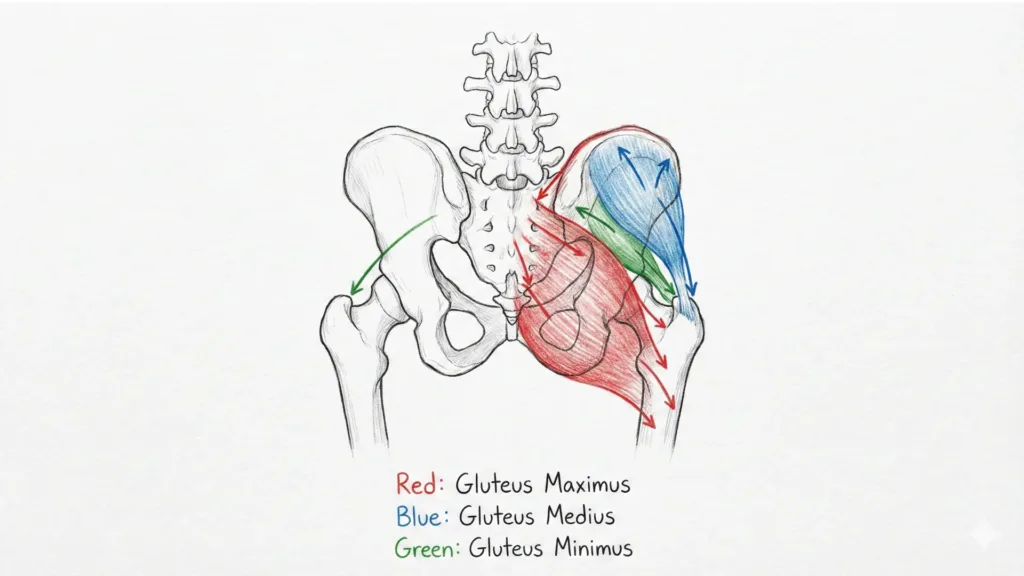
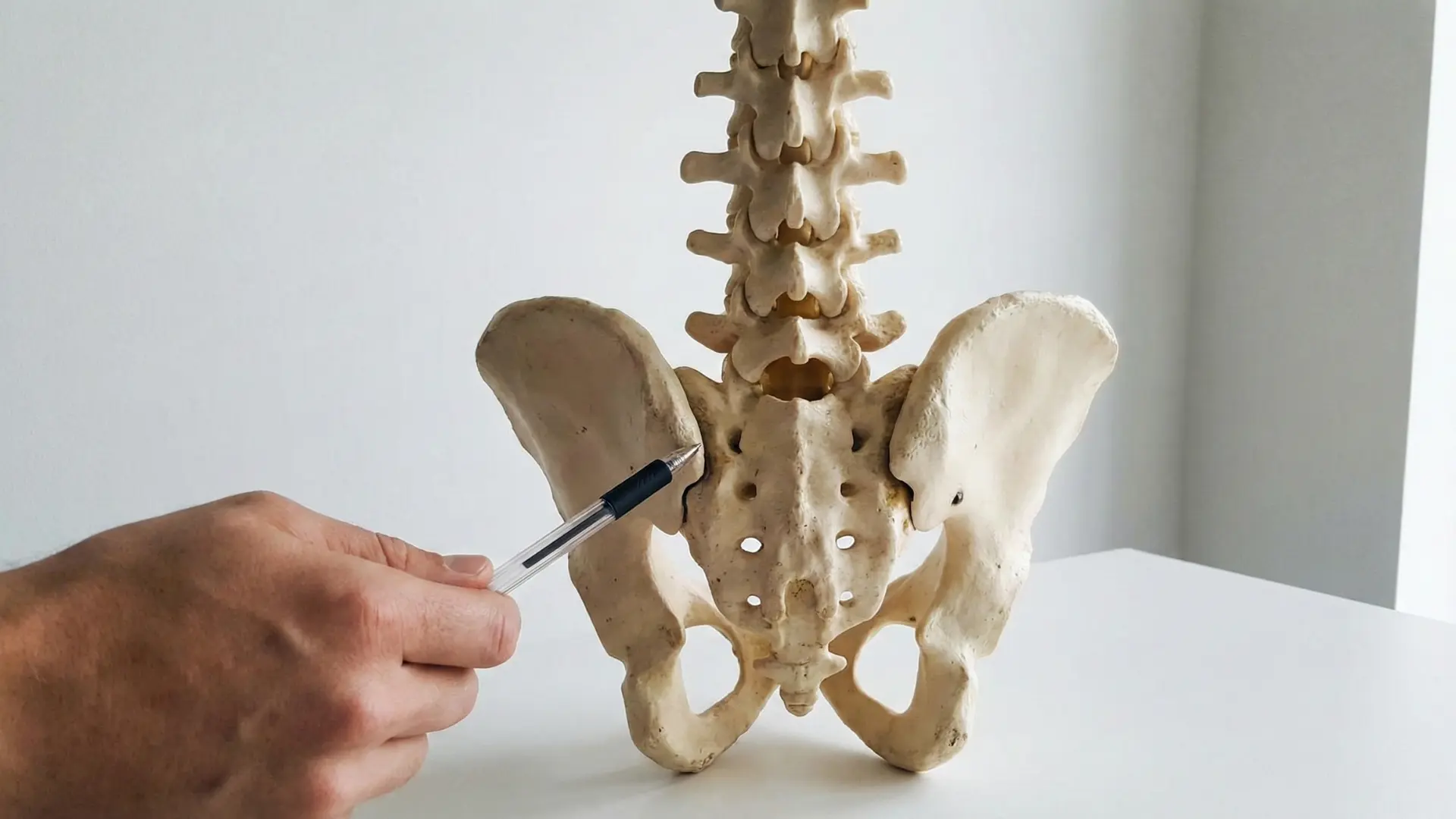
The sacroiliac (SI) joints connect the sacrum to the pelvis. They are designed for small movements and load transfer. When the SI area is irritated (often after a sudden twist, pregnancy/postpartum changes, or a load spike), the glutes can “splint” the area. That produces tightness and ache together that is often one-sided and close to the dimples above the butt.
Common clues
- Pain is near one SI joint, sometimes radiating into the butt.
- Rolling in bed, standing from sitting, or single-leg loading aggravates it. Pain near the base of the spine when sitting is also closely linked to tailbone and coccyx irritation.
- You feel “stuck” rather than “pulled.”
What helps
- Temporary reduction of aggravating asymmetrical loads.
- Glute med endurance and trunk control to improve load transfer.
- If severe or persistent, a clinician can help differentiate SI pain from lumbar and hip sources.
5) Disc sensitivity + bending intolerance (glutes tighten to stop motion)
Some low back pain is driven by disc sensitivity. When discs or related structures are irritated, your body can reduce motion by increasing muscle tension around the pelvis and hips. You experience tightness and ache together, but the glute tightness is secondary.
Common clues
- Pain increases with bending/lifting or prolonged sitting.
- Symptoms can radiate into the butt or thigh.
- You feel stiff after sitting, then “unlock” after walking.
What helps
- Reduce repeated bending under load temporarily.
- Use hip hinge strategies, shorter lever lifting, and gradual exposure.
- If leg symptoms are increasing, get assessed.
6) Deep gluteal pain (piriformis and friends) that mimics sciatica
Deep butt pain can irritate nearby tissues and sometimes mimic sciatica-like symptoms. People commonly label this as piriformis tightness and lower back pain, but the label is less important than identifying whether symptoms are muscular referral, nerve irritation, or lumbar referral. A critical point: butt pain radiating down the leg is not automatically a “piriformis problem.” Differential diagnosis matters, and piriformis syndrome remains a debated/variable diagnosis.
Common clues
- Deep butt pain, worse with prolonged sitting.
- Pain can refer down the back of the thigh.
- Tenderness deep in the butt; stretching sometimes worsens symptoms.
What helps
- Avoid aggressive deep stretching if it reproduces tingling, numbness, or burning.
- Improve hip rotation control and glute med endurance.
- If symptoms travel below the knee or weakness appears, seek evaluation.
7) Hip joint mechanics (limited rotation, stiff capsule, or impingement pattern)
If the hip joint is limited (for example, reduced internal rotation, a stiff capsule, or an impingement pattern), you may compensate through the lumbar spine and pelvis. Over time, that can create tightness and ache together, especially during squats, deep sitting, or twisting.
Common clues
- Pinch in the front of the hip with deep flexion.
- You can’t rotate the hip well.
- Back tightness increases after squats or long sitting.
What helps
- Hip-friendly squat depth, stance adjustments, and hip mobility drills that do not jam the hip.
- Strengthening in the range you own, then expanding range gradually.
8) Poor hip hinge and bracing strategy (your back muscles do the job of your hips)
A very common movement error: bending by rounding or arching the low back instead of hinging at the hips. Another: “over-bracing” the trunk so hard that the glutes never load properly. Both can drive symptoms because you never distribute load through the hips.
Common clues
- Back tightness after lifting, gardening, or picking up kids.
- Glutes feel “offline” during bridges or squats.
- Hamstrings feel tight after light tasks.
What helps
- Rebuild hinge mechanics with simple feedback drills.
- Learn to brace “just enough,” then push through the hips.
9) Load spikes + deconditioning (capacity mismatch)
Sometimes the cause of this pattern is simply a mismatch between what you did and what your tissues were prepared for: a sudden increase in steps, a new workout, a long drive, or a weekend of lifting and twisting. The glutes clamp as they fatigue; the back tightens to stabilize.
Common clues
- Symptoms flare after a new activity or longer-than-usual day.
- Pain improves with consistent, graded activity.
- Tightness becomes predictable when you track load.
What helps
- Gradual progression: increase volume 10–20% weekly rather than doubling.
- Prioritize sleep, walking, and basic strength before advanced drills.
How do I know if my back pain is coming from my hips?
Look at when the symptoms appear rather than where they hurt. Hip-driven back pain typically builds during single-leg loading — walking, stairs, standing on one leg — and eases when you sit or offload the hip. Pain that is worst with bending, coughing or prolonged sitting points more toward the spine itself. The pattern below tells you more than the location does.
The combination commonly shows up in one of these patterns:
- After sitting: butt feels tight when you stand; back feels stiff for the first few minutes.
- During walking: back tightness builds as stride length increases (often hip extension loss).
- One-sided: one butt feels tighter with one-sided low back ache (often pelvic control issue).
- With “sciatica-like” symptoms: butt pain with leg referral (needs differential assessment).
- After lifting: back tightness dominates; glutes feel “not firing” (hinge and loading issue).
Myths vs facts
- Myth: tightness and ache means you must stretch more.
Fact: Often you need better hip extension, hip control, and glute capacity—not deeper passive stretching. In other words, glute tightness and low back pain are frequently about control and tolerance, not “short” muscles. - Myth: Butt tightness is always piriformis syndrome.
Fact: Many structures can refer pain into the butt; true nerve irritation needs careful evaluation. - Myth: If imaging is “normal,” the pain must be “just muscles.”
Fact: Pain can be significant even with minimal imaging findings, and many imaging findings are age-related. Your plan should be guided by symptoms and function, not fear.
From the Clinic: Dr. Arora’s Expert Insight
The people who struggle most with this are, more often than not, the most disciplined stretchers in my caseload. They can do a perfect figure-4 stretch and hold it for two minutes—yet they still feel “tight” by lunchtime. What I typically find on examination is not a shortage of flexibility but a shortage of hip contribution: the hip doesn’t extend well when they walk, and the pelvis isn’t stable on one leg. So their nervous system chooses tension as a backup plan.
The standard advice “stretch your glutes and strengthen your core” often fails because it misses the order of operations. If you strengthen without restoring hip options, the low back keeps substituting. If you stretch a guarding system aggressively, you can irritate it further. The turning point is usually when we (1) calm the protective tone, (2) restore hip extension without lumbar compensation, and (3) build glute endurance so the pelvis stops needing a constant “clamp.” When those three pieces are in place, the tightness starts fading instead of bouncing back.
What actually fixes tight glutes and lower back pain?
Build capacity in the hip instead of chasing length in the glute. That means calming protective tension first, restoring hip extension so the back stops substituting, then loading the glutes for endurance until the pelvis no longer needs to brace. Stretching can stay in the plan, but it becomes a warm-up for loading rather than the treatment itself.
The fix most people miss for this pattern is this: stop treating tightness as the main problem and start treating hip capacity and pelvic control as the main goal. Stretching can still help, but stretching is the garnish—not the meal.
Below is a structured plan you can follow. If anything increases sharp pain, tingling, or worsening leg symptoms, stop and get assessed.
Step 1: Calm the system (2–5 minutes, 1–3 times/day)
When the tightness is driven by guarding, the first step is reducing threat and compression.
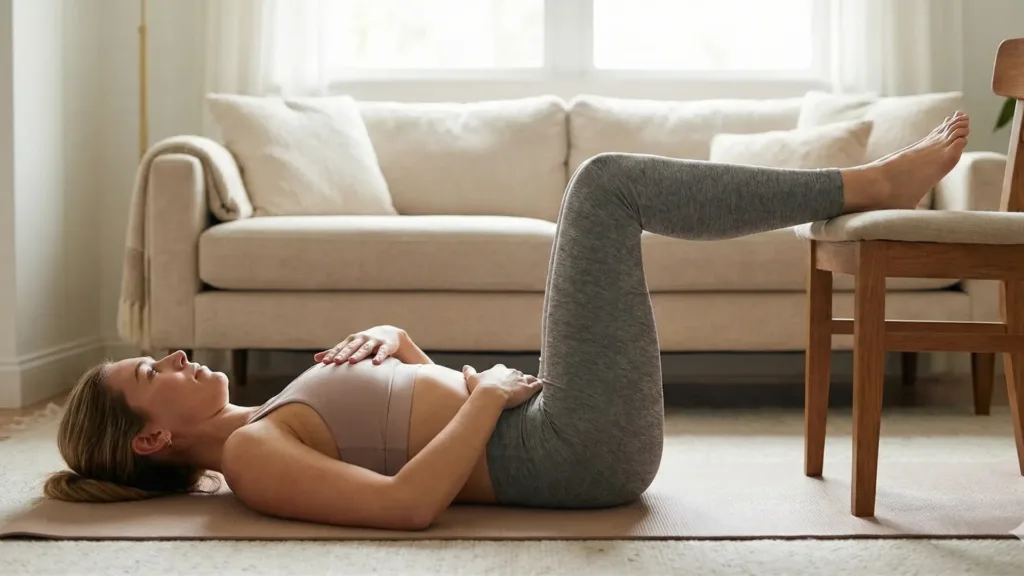
1A) 90/90 breathing reset (back-friendly)
How to do it
- Lie on your back with calves on a chair (hips and knees about 90 degrees).
- Place one hand on your lower ribs, one on your lower abdomen.
- Inhale through the nose for ~4 seconds, letting ribs expand gently sideways.
- Exhale slowly for ~6–8 seconds as if fogging a mirror, letting the ribs drop.
- Do 5–8 slow breaths.
Why it helps
This can reduce excessive extension tone and give the hips a chance to “let go.”
1B) Glute isometric “set” (no movement, just activation)
How to do it
- Stay on your back, knees bent, feet on the floor.
- Gently squeeze both glutes at 30–40% effort (not a max squeeze).
- Hold 10 seconds while breathing normally, then relax.
- Repeat 6–8 times.
Isometrics are often tolerated even when stretching flares symptoms.
Step 2: Restore hip motion without feeding the back (daily)
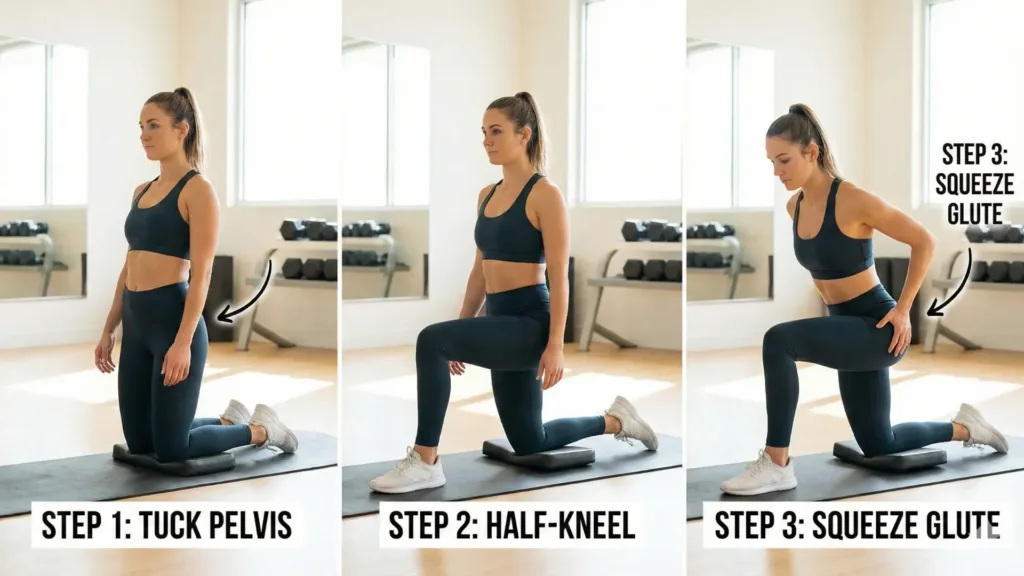
2A) Hip flexor stretch with posterior tilt (the safe version)
How to do it
- Before moving forward, gently tuck the pelvis (think “belt buckle up”).
- Half-kneel (one knee down, one foot forward).
- Squeeze the down-knee side glute.
- Shift forward slightly until you feel a stretch in the front of the hip—not in the low back.
- Hold 20–30 seconds, repeat 2–3 times per side.
This matters most for this pattern after sitting, because hip flexors are often “on” all day. If you’ve noticed tight hip flexors and tight glutes lower back pain together, think “hip extension is missing,” not “I just need to stretch harder.”
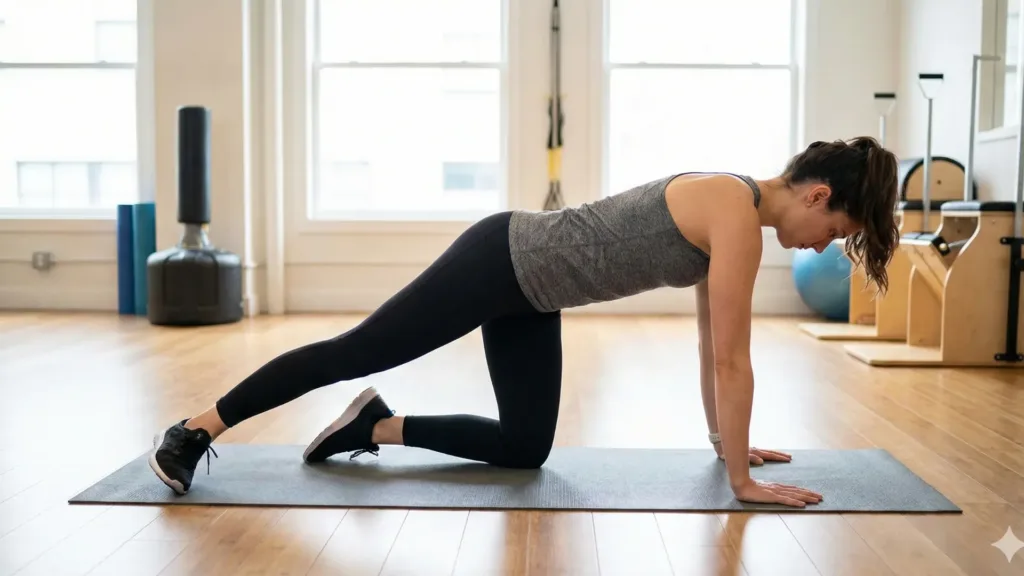
2B) Adductor rock-back (hips, not spine)
How to do it
- On hands and knees, extend one leg out to the side (knee straight or slightly bent).
- Keep spine neutral and ribs down.
- Rock hips back toward heels until you feel a stretch in inner thigh/groin.
- Rock forward again. Do 8–10 reps per side.
This improves hip options so the back doesn’t substitute, which reduces symptoms during daily movement.
Step 3: Build glute capacity (3 days/week, 15–25 minutes)
This is the part that actually changes the pattern, and it is also the part most people skip. Exercise is the intervention with the strongest guideline support for persistent low back pain: the UK’s National Institute for Health and Care Excellence recommends a structured exercise programme as a core treatment for low back pain with or without sciatica, and leaves passive treatments in a much more limited role. What follows is a glute-focused version of that principle.
The goal is to make the glutes strong and enduring enough that they stop “panic-gripping,” which reduces symptoms over time.
3A) Bridge progression (glute max)
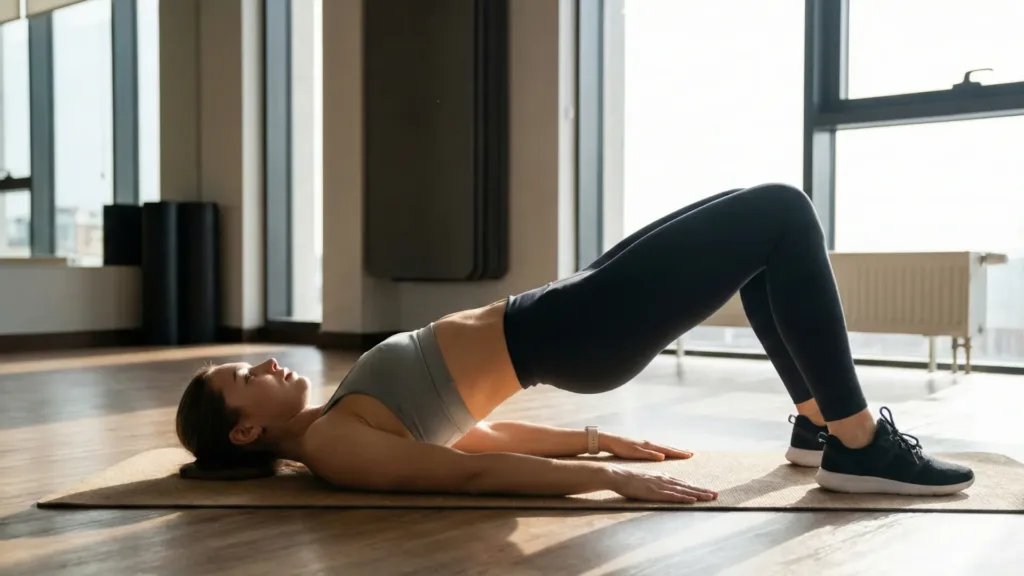
Level 1: Basic bridge
- Lie on your back, knees bent, feet hip-width.
- Lightly brace abdomen (as if tightening a belt one notch).
- Push through heels and lift hips until shoulders–hips–knees form a line.
- Hold 2 seconds, lower slowly (3 seconds down).
- Do 2–3 sets of 8–12 reps.
Form cues
- You should feel glutes more than low back.
- If hamstrings cramp, bring heels slightly closer and reduce height.
- If your back pinches, reduce range and focus on ribs down.
Level 2: Long-lever bridge (more glute)
- Move feet slightly farther away; keep ribs down; stop before back takes over.
3B) Side-lying hip abduction (glute med)
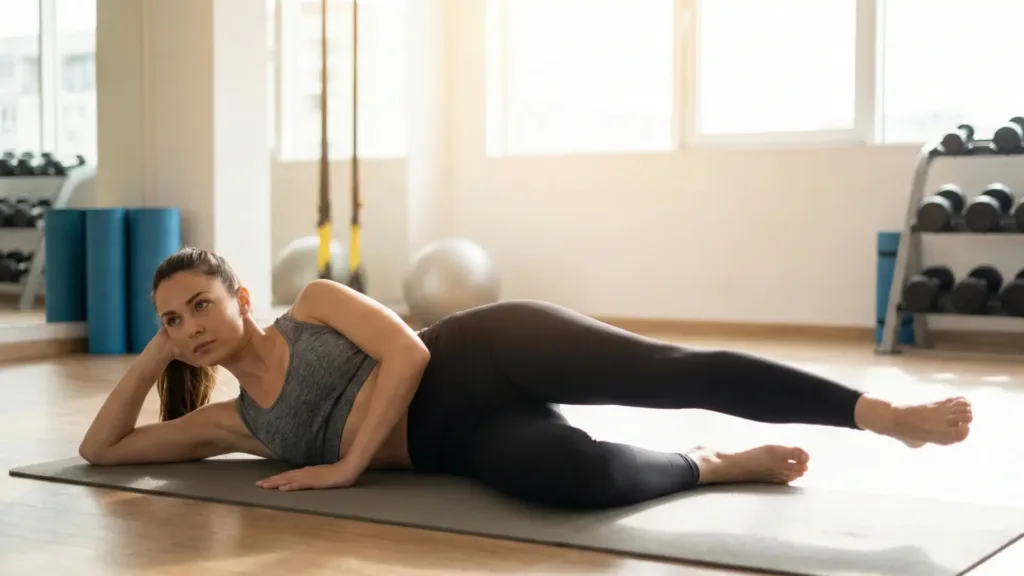
How to do it
- Lie on your side, bottom knee bent, top leg straight.
- Rotate top toes slightly down (targets glute med better).
- Lift the top leg 20–30 cm, pause 1 second, lower slowly.
- Do 2–3 sets of 10–15 reps.
If you get lateral hip pain, reduce range and slow down. Better control often equals less tightness and ache.
3C) Step-down control (pelvic stability)
How to do it
- Stand on a step with one foot; the other foot hovers off the edge.
- Slowly bend the standing knee and tap the hovering heel to the floor.
- Keep pelvis level; knee tracks over mid-foot.
- Do 2 sets of 6–10 reps per side.
This is high-value for this pattern on one side, because it trains single-leg control.
Step 4: Rebuild the hinge (the movement that protects your back)
4A) Dowel hip hinge drill (5 minutes)
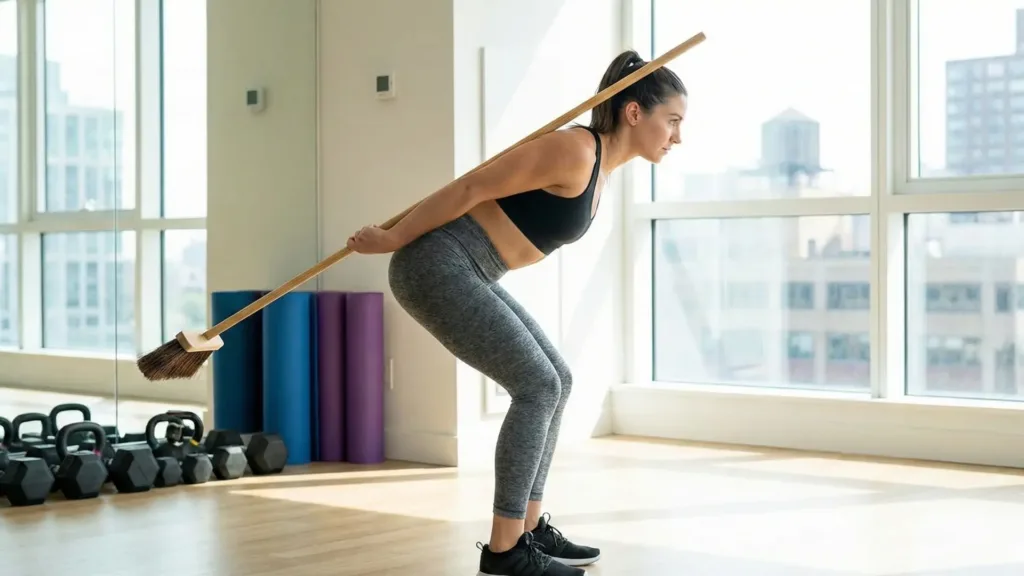
How to do it
- Hold a broomstick along your spine: head, mid-back, and tailbone all touching.
- Soften knees.
- Push hips back as if closing a car door with your butt.
- Keep the three contact points. Stop before you lose tailbone contact.
- Do 8–10 slow reps.
When hinge improves, back tightness during lifting often decreases because the hips share load again.
4B) “Reach to wall” hinge (easier to feel)
Stand ~20–30 cm in front of a wall. Hinge back until your butt touches the wall, then return. Do 2 sets of 6–8 reps. This teaches “hips back” without overthinking.
Step 5: Return to life (habits that stop relapse)
Walking strategy
- Start with a comfortable stride length. If longer steps increase symptoms, shorten stride and increase cadence slightly.
- Add hills last.
- If one side always tightens first, spend 2–3 minutes on the weaker-side glute med drill before walking.
- If you use an elliptical as your cardio of choice, check that your machine setup is not the hidden cause of your back pain.
Sitting strategy
- Stand up every 30–45 minutes for 1–2 minutes.
- Avoid “hanging” on one hip.
- Use a small lumbar roll only if it reduces symptoms; if it increases arching, skip it.
Sleep strategy
- Side sleeping: pillow between knees.
- Back sleeping: pillow under knees.
Avoid stomach sleeping if it increases extension-driven back tightness.
Do’s and don’ts (the practical guardrails)
Do
- Use small, frequent movement breaks if back tightness is worse after sitting.
- Train glute endurance (moderate reps, clean form) rather than chasing max strength early.
- Keep exercises below the “nerve irritation line” (no increased tingling, burning, or spreading symptoms).
- Track your triggers for 7 days: sitting time, steps, lifting, sleep, stress.
Don’t
- Don’t force long, painful glute stretches if they rebound symptoms.
- Don’t foam roll aggressively over deep butt pain that reproduces nerve symptoms.
- Don’t jump from zero to high-volume walking/running—capacity mismatches create flare-ups.
- Don’t assume “tight” equals “weak” or “short.” It often equals “protective.”
A simple 2-week plan
Daily (5–10 minutes)
- 90/90 breathing: 5–8 breaths
- Glute isometric set: 6–8 holds
- Hip flexor stretch: 2–3 x 20–30 sec/side
3 days/week (15–25 minutes)
- Bridges: 2–3 x 8–12
- Side-lying abduction: 2–3 x 10–15
- Step-downs: 2 x 6–10/side
- Dowel hinge: 8–10 reps
Track symptoms: tightness and ache should become less frequent, less intense, and less “sticky” after sitting or walking.
When should I get this assessed?
If two to three weeks of consistent hip loading has not changed anything, the problem is usually a wrong target rather than insufficient effort. Assessment matters most when symptoms are spreading, when nerve signs appear, or when one hip behaves clearly differently from the other. A clinician can separate lumbar, sacroiliac, hip joint and neural contributions, which self-testing cannot reliably do.
Get assessed if:
- Symptoms are worsening over 2–3 weeks despite consistency.
- You have persistent leg numbness/tingling or weakness.
- Night pain dominates, or you cannot find any comfortable position.
- Your hip has catching, locking, or significant groin pain.
A clinician can differentiate lumbar, SI, hip, and neural contributions and tailor loading and progression.
FAQ
Why do I get tight glutes and lower back pain after sitting?
Sitting puts hips in flexion and often reduces hip extension capacity temporarily. When you stand and walk, your body may borrow extension from the lumbar spine and clamp the glutes for stability, creating tightness and ache together after sitting.
Is glute tightness with back pain a sign of sciatica?
It can be, but not always. Butt tightness can occur with disc sensitivity, deep gluteal irritation, SI joint pain, or simple overload. If symptoms travel below the knee, or you have numbness/weakness, get evaluated.
Should I stretch if I have tightness and ache together?
Gentle stretching can help if it does not reproduce nerve symptoms. But if stretching gives only short relief or flares pain, prioritize isometrics and strengthening first—guarding often drives symptoms.
Can weak glutes cause low back pain?
Hip abductor weakness is common in chronic non-specific low back pain populations and improving hip and trunk capacity can improve function and disability.
Why is it so often on one side only?
Walking and stairs are single-leg tasks. If one side has poorer pelvic control or hip mobility, the lumbar spine compensates. That produces tightness and ache together on one side, often with trunk lean or pelvic drop.
Is it piriformis syndrome if my butt hurts?
Not automatically. Piriformis syndrome is often over-assumed, and butt pain can come from lumbar referral, SI irritation, hamstring tendon issues, or deep gluteal myofascial pain.
What is the “fix most people miss” for this pattern?
Most people chase deeper stretching. The missed fix is improving hip extension, pelvic control, and glute endurance so the nervous system stops choosing tension.
How long does it take for this pattern to improve?
Many people notice early changes in 1–2 weeks with consistent daily resets and 2–3 strength sessions weekly. Durable change usually takes 6–12 weeks of progressive loading.
Can running cause tight glutes and lower back pain?
Yes—especially if stride length increases before hip extension capacity and pelvic control are ready. Build glute endurance and adjust cadence/stride to reduce symptoms in runners.
When is this serious?
Red flags include bowel/bladder changes, saddle numbness, progressive weakness, fever, unexplained weight loss, or severe trauma. If these exist, seek urgent evaluation.
For a complete overview of all lower back pain causes and treatments, see our Lower Back Pain Complete Guide.
A realistic outlook
Most episodes settle. The NHS notes that back pain often improves within a few weeks and advises staying active rather than resting in bed — advice that lands squarely here, because the glutes only stop guarding once they are given work they can handle. Expect the first noticeable change within one to two weeks of consistent daily resets and two or three loading sessions. Durable change usually takes six to twelve weeks, because endurance in a muscle group this large is built slowly. If nothing has shifted after three weeks of genuine consistency, the target is probably wrong rather than the effort.
References
- National Institute for Health and Care Excellence. Low back pain and sciatica in over 16s: assessment and management (NG59). Published 2016, last updated December 2020. Recommendations
- NHS. Back pain. National Health Service, United Kingdom. nhs.uk