Low back pain during period can feel like a pincer movement: cramping at the front and a heavy, dragging ache across the back. For some people it is background noise. For others it turns two or three days of every month into a write-off — sitting through a meeting, driving, or sleeping on either side all become negotiations.
Back pain that arrives with your bleed is usually referred pain from the uterus, not a spine problem. As the lining sheds, prostaglandins drive uterine contractions. The uterus and the lower back feed into overlapping spinal segments, so the brain reads some of that signal as backache. It typically peaks in the first 24 to 48 hours of flow and settles as bleeding lightens.
Key takeaways
- Timing is the biggest clue. Pain that builds as bleeding starts, peaks on day one or two, and fades with lighter flow behaves like referred menstrual pain rather than a mechanical back injury.
- Referred pain is real pain. The uterus and lower back share spinal segments, which is why some people feel almost nothing in the abdomen and almost everything across the sacrum.
- Heat and gentle movement usually beat stretching hard. The ache is driven by contraction and guarding, not by tissue shortness, so unloading and circulation help more than aggressive range work.
- Disproportionate pain is a signal, not a personality trait. Pain that is worsening year on year, outlasts the bleed, or ignores usual measures warrants gynecological assessment for endometriosis or adenomyosis.
- Different timing, different problem. Pain that arrives one to three days before bleeding is a separate premenstrual pattern with its own drivers.

Is low back pain during period normal?
Yes — a mild to moderate backache that tracks your bleeding is common and usually reflects primary dysmenorrhea, meaning period pain without an underlying disease. It typically starts as flow begins or shortly before, peaks in the first day or two, eases as bleeding lightens, and responds to heat and movement. What is not normal is pain that disables you every single cycle.
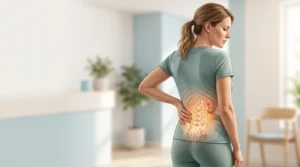
Menstrual cramps do not stay politely in the pelvis. Pain signals from the uterus travel into the same spinal segments that serve the low back, buttocks and upper thighs, so the brain can misattribute the source — a phenomenon called referred pain. That is why a uterine problem can feel like it is sitting directly on your sacrum.
If the pattern is predictable, improves with simple measures, and does not dictate your month, it is usually behaving the way ordinary period pain behaves. If it is new, escalating, or unrecognizable compared with your usual cycles, it deserves a closer look.
How does it actually feel?
People describe it in fairly consistent ways:
- A dull, dragging ache across the beltline
- Pain spreading into the hips or the backs of the thighs
- A heavy, pulled-down sensation through the pelvis and sacrum
- Sharp, spasmodic waves that rise and fall with cramps
It may be constant or arrive in rhythm with uterine contractions, and it often travels with bloating, nausea, loose stools, headache, fatigue or mood change. One detail is worth noticing: some people feel almost nothing in the abdomen and almost everything in the back. That does not mean the uterus is uninvolved — it means the referred component dominates in that individual, which is common and not a sign of a spinal injury.
If the pain has you curling forward, cancelling plans, or reaching for painkillers every cycle just to function, it is worth a conversation with a clinician. Common does not mean you have to absorb it silently.
What causes low back pain during period?
Four mechanisms account for most of it: prostaglandin-driven uterine contractions, referred pain through shared spinal segments, postural guarding from days spent curled up, and in a minority of people an underlying gynecological condition such as endometriosis or adenomyosis. More than one can be running at the same time, which is why single-strategy fixes often disappoint.
1. Prostaglandins and uterine contractions
To shed its lining, the uterus contracts. It does this under the influence of prostaglandins — hormone-like chemicals released by the endometrium as the cycle turns over. When prostaglandin levels run high, contractions become stronger and more frequent, blood flow through the uterine wall is briefly squeezed down, and the volume of pain signalling rises with it.
This is the main reason the ache is usually worst in the first one or two days, when prostaglandin release peaks, and why it tends to unwind as flow lightens. It also explains why anti-inflammatory medicines, which reduce prostaglandin production, tend to work better when started early rather than once pain is already at full volume.
Why do some people feel it almost entirely in the back?
Because the uterus has no dedicated pain map in the brain. Sensory fibres from the uterus and cervix enter the spinal cord around the lower thoracic, upper lumbar and sacral segments — the same neighborhood that receives input from the low back, sacroiliac region and buttocks. The brain resolves that ambiguity by projecting pain onto the body wall it knows better.
How much lands in the back rather than the abdomen varies with individual anatomy and with how sensitized the surrounding tissues already are. Someone whose back is already grumpy from long commutes, desk work or a previous episode will usually feel more of the referral there. Practically, this has one useful consequence: treatments aimed only at the back will underperform if the uterine driver is left untouched, and vice versa.
2. Posture, guarding and muscle overload
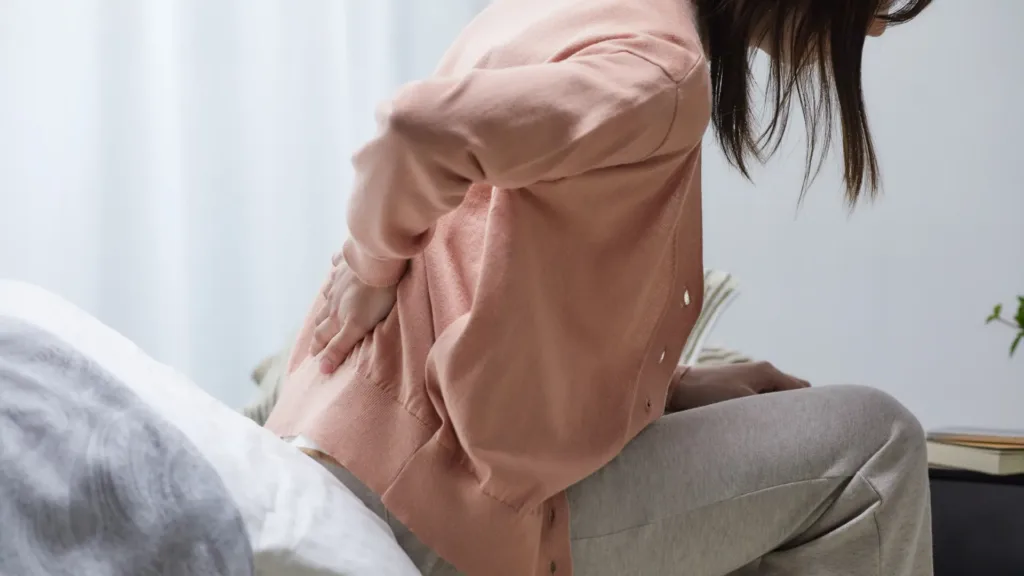
When cramps hit, most people curl forward, lie still, or sink into a sofa for hours. Hold those positions across two or three days and the muscles and ligaments supporting the spine start protesting on their own account. What began as referred pain acquires a genuine mechanical layer on top.
Things that reliably make this worse:
- Long uninterrupted sitting at a desk or in a car
- Sustained forward lean over a laptop or phone
- Carrying a heavy bag consistently on one shoulder
- Low baseline strength through the hips and trunk, so the spine takes more of the load
If your back already aches at other points in the month, that background sensitivity acts as an amplifier. Building steady hip and trunk capacity between cycles is one of the few interventions that changes the following month rather than just the current one, and a broader structured approach to lower back pain is worth reading alongside this.
3. Endometriosis, adenomyosis and other gynecological causes
Sometimes the back pain is not ordinary period pain at all. It is the most visible symptom of something structural, and this is where a lot of people lose years.
- Endometriosis — tissue resembling the uterine lining grows outside the uterus, on the ovaries, pelvic ligaments, bowel or pelvic side wall, driving inflammation, adhesions and pain. Back and sacral pain can be prominent, may begin before bleeding, and often does not stop when the period does.
- Adenomyosis — endometrial-type tissue grows into the muscular wall of the uterus. The uterus becomes uniformly enlarged and tender, periods become heavy, and cramping tends to be deep and boring rather than sharp.
- Fibroids — benign growths in the uterine wall that can increase bleeding, cramping and pelvic pressure. Back pain is commonly reported when fibroids are large or posteriorly placed, though it is rarely the only symptom.
- Pelvic inflammatory disease — infection of the reproductive organs, which can produce pelvic and low back pain that flares with menstruation, usually alongside fever, abnormal discharge or pain with intercourse.
- Ovarian cysts and other pelvic masses — these can stretch or displace tissue and produce pain that tracks hormonal change.
The pattern that should prompt gynecological assessment rather than another heat pack is this: pain that is disproportionate to what your cycle used to produce, that is worsening year on year, or that is unresponsive to usual measures such as heat, movement and appropriately timed anti-inflammatories. UK guidance on endometriosis is explicit that period pain severe enough to interfere with daily activities and quality of life is itself a reason to suspect the condition and investigate, as set out in the NICE guideline on endometriosis diagnosis and management.
Additional features that raise suspicion: pain with intercourse, pain with bowel movements or urination that clusters around your period, cyclical bowel or bladder symptoms, and difficulty conceiving. A normal pelvic ultrasound does not exclude endometriosis — it rules out a mass, which is useful but not the same thing.
4. What turns the volume up
Several factors do not cause the pain but reliably make it hurt more:
- Broken sleep and sustained stress, both of which lower pain thresholds
- Very low activity levels through the month
- Heavy menstrual bleeding
- Coexisting conditions such as irritable bowel syndrome, bladder pain syndrome or widespread chronic pain
These are worth attacking because they are the parts of the picture you can influence between cycles, not just during them.
When is period back pain a red flag?
The concerning signals are changes in pattern rather than intensity alone: pain that is suddenly far worse than your baseline, appears after years of easy periods, outlasts the bleed by days, or brings company such as fever, abnormal bleeding or neurological symptoms. Each of these points at a different problem, which is why the pattern matters more than the number on a pain scale.
Arrange assessment if you notice any of the following:
- Pain that is suddenly much worse than your usual cycle. A clear step-change in severity suggests something new has been added — a cyst, an infection, or a structural change — rather than your usual prostaglandin response.
- Pain that starts after years of relatively painless periods. Late-onset dysmenorrhea is more likely to be secondary, meaning driven by an underlying condition such as adenomyosis or fibroids, than primary.
- Pain that continues for days after bleeding stops. Prostaglandin-driven pain unwinds with flow. Pain that does not is behaving like inflammation or adhesion-related pain, which is a common pattern in endometriosis.
- Pain that wakes you from sleep or is present most of the month. Pain unlinked from position and cycle is one of the features clinicians use to separate mechanical back pain from inflammatory, infective or, rarely, more serious causes.
- Pain with intercourse, urination or bowel movements. This suggests the problem involves pelvic structures beyond the uterine cavity itself — deep endometriosis and pelvic infection both produce this.
- Very heavy bleeding, needing protection changed every one to two hours, or passing large clots. Heavy loss points toward fibroids, adenomyosis or a bleeding disorder, and carries its own risk of iron deficiency.
- Irregular cycles, bleeding between periods, or bleeding after sex. These need evaluation of the cervix and endometrium in their own right, independent of the back pain.
- Fever, foul-smelling discharge, or burning on urination. This combination suggests infection, which needs prompt treatment to protect fertility and prevent spread.
- Unexplained weight loss, or numbness, tingling or weakness in the legs. These take the problem outside gynecology entirely and require assessment without delay.
Seek urgent care the same day if the pain is sudden, severe and one-sided; if you feel faint, dizzy or short of breath; or if you are soaking through pads or tampons in under an hour. Sudden severe one-sided pain in particular can indicate ovarian torsion or a ruptured cyst, and in anyone who could be pregnant it must be assessed immediately.
What actually relieves the pain at home?
Heat and gentle rhythmic movement do most of the work, ideally started at the first sign of cramping rather than once pain has peaked. Supported positions that unload the lumbar spine help through the worst hours, and light hip and trunk work between cycles reduces how much the following month costs you. Aggressive stretching, by contrast, tends to disappoint.
1. Use heat, and use it early
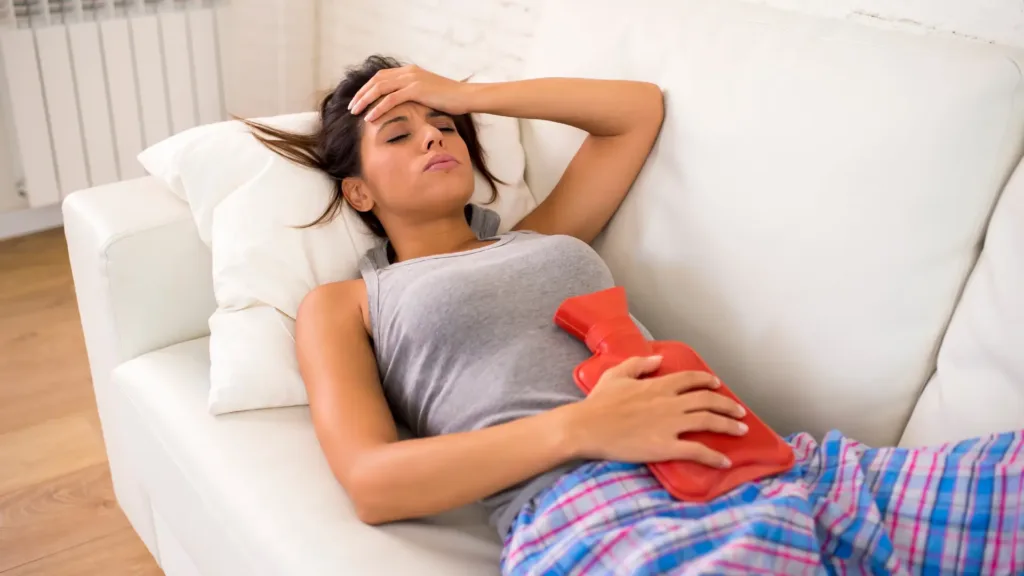
Local heat is the highest-value, lowest-risk option available and it costs almost nothing. It reduces cramp intensity, relaxes the protective muscle guarding that builds up around the lumbar spine, and improves local circulation.
- A hot water bottle or heating pad over the lower abdomen or across the sacrum
- A warm shower aimed at the low back
- A warm bath for 15 to 20 minutes
Keep a layer of cloth between the heat source and your skin, and never fall asleep on an electric pad. If you have reduced sensation, diabetes or circulatory problems, check with a clinician before using heat routinely.
2. Move gently rather than resting completely
Lying still is the instinct and it works against you after the first hour or two. Stiffness builds, guarding increases, and the back becomes more sensitive rather than less. Rhythmic movement restores circulation, unwinds spasm, and shifts the nervous system out of protective mode.
- A short walk indoors every 30 to 60 minutes
- Easy stationary cycling if you have access to a bike
- Pain-free mobility work through the hips and mid-back
The target is not a workout. It is preventing your body from locking up while you are already tired and losing blood.
👨⚕️ Dr. Arora’s Clinical Note
A common mistake I see with period-related back pain is treating it as a tightness problem that needs more mobility. In practice most flares are driven by protective muscle guarding and heightened pain sensitivity, so the useful levers are when and how much you move, not how far you stretch.
Use the relief window.
Pick the 20 to 40 minutes after heat, or after an appropriately timed pain reliever, when symptoms naturally dip. In that window, do a four to six minute movement snack:
- 60 to 90 seconds of easy walking indoors
- Six hip hinges with hands sliding down the thighs, tiny range, pain-free
- Six standing pelvic tilts, slow and controlled
- A 20 to 30 second wall lean with normal breathing
Rule: stop at the first hint of sharpening pain. You are teaching the nervous system that movement is safe and restoring circulation — not training. Repeating this two or three times a day tends to reduce the dragging ache more reliably than one longer session.
3. Positions that unload the low back
Through the worst hours, position beats exercise. Each of these takes pressure off the lumbar spine and lets the abdominal and pelvic muscles let go:
- Supported child’s pose — from all fours, sit back toward your heels with your chest resting on a pillow and arms forward.
- Knees to chest — on your back, draw one or both knees gently toward the chest, holding behind the thighs rather than over the kneecaps.
- Side-lying with support — a pillow between the knees and a small rolled towel under the waist keeps the spine roughly neutral.
If standing is the worst position for you, short spells in any of these will usually take the edge off within a few minutes.
4. Light strength work, not deep stretching
Very light activation gives the spine and pelvis more support without adding strain at a point in the month when tissues are already sensitive:
- Hip flexor length work — these shorten with long sitting and can pull the pelvis into more arch, which the sacrum feels.
- Glute activation — squeezes, short bridges or brief isometric holds give the pelvis a steadier base.
- Breath-led trunk work — slow nasal breathing with a gentle draw of the lower abdomen on the exhale recruits the deep trunk muscles without bracing hard.
Keep intensity low. If a movement clearly sharpens the pain, drop it that day and pick a gentler option — there is no version of this where pushing through helps.
5. What you do between cycles
Because prostaglandins and inflammation sit at the centre of this, habits maintained across the whole month change what the next period costs:
- Regular moderate activity most days
- Consistent sleep timing, which matters more than total hours for pain threshold
- An eating pattern built around vegetables, fruit, whole grains, lean protein and healthy fats
- Reducing smoking and limiting alcohol
- Practical stress management — relaxation work, structured downtime, or counselling where appropriate
No single food or supplement is a cure. The cumulative effect of these habits, however, shows up as a lower ceiling on how bad each cycle gets.
Which medical treatments help?
Anti-inflammatory medicines are usually the first-line option because they reduce prostaglandin production directly. Hormonal treatments that thin the uterine lining help when periods are heavy or painful. Where an underlying condition such as endometriosis, adenomyosis or infection is driving the pain, treatment is directed at that condition rather than at the symptom.
1. Anti-inflammatory pain relief
Nonsteroidal anti-inflammatory drugs, or NSAIDs, target the mechanism rather than just masking the symptom, and a Cochrane systematic review found them clearly more effective than placebo for period pain, while noting a substantial rate of adverse effects. That trade-off is the whole conversation.
- They work best started at the first sign of cramping or bleeding, then taken as directed for one to two days rather than reactively at the peak.
- They are not appropriate for everyone — kidney disease, certain heart or stomach conditions, bleeding disorders, some asthma and specific allergies all rule them out or require caution.
- The lowest effective dose for the shortest necessary time is the operating principle, and monthly reliance is a reason to review the plan rather than to increase the dose.
Acetaminophen, known as paracetamol in the UK, is an alternative where NSAIDs are unsuitable, though it does not act on prostaglandin production in the same way and tends to be less effective for this specific pain.
2. Hormonal treatments
Where periods are heavy or severely painful, or where endometriosis or adenomyosis is suspected, hormonal options may be recommended. These include combined oral contraceptives, progestin-only pills, injections or implants, and hormonal intrauterine devices.
They work by thinning the uterine lining, reducing prostaglandin production, decreasing flow, and in some cases suppressing periods altogether for a time. When flow and cramping fall, the referred backache usually follows. Each option carries its own benefit and risk profile that needs discussion with a clinician who knows your history.
3. Treating the underlying condition
Where a structural or infective cause is identified, the target changes. Depending on the diagnosis this may involve antibiotics for pelvic infection, more targeted hormonal suppression, diagnostic or therapeutic laparoscopy, or surgery to remove fibroids or endometriotic deposits in selected cases. These decisions follow proper assessment and imaging, and they are shared decisions rather than automatic ones.
4. Physical therapy
Structured physical therapy earns its place when the menstrual pain is landing on top of an existing back problem — longstanding postural loading, a previous injury, or low hip and trunk capacity. Assessment identifies which of those is contributing, and a targeted program builds support around the spine and pelvis so the same monthly stimulus produces less pain.
Pelvic health physical therapy is a distinct and useful branch here, particularly where there is pelvic heaviness, urinary urgency, or pain with penetration alongside the backache. When the spine and pelvis are better supported, most people find the monthly episode becomes shorter and less intense even though the cramps themselves continue.
Everyday habits that protect your back across the cycle
Because menstruation recurs, the useful question is not what to do on day one but what to build across the month. Three areas do most of the work.
Keep a movement baseline
Aim for moderate activity most days — brisk walking, cycling, swimming, or whatever you will actually keep doing. As your period approaches, drop the intensity slightly if fatigue is building, keep moving on heavy days where it is comfortable, and swap high-impact work for lower-impact options while symptoms peak. Over months this improves circulation, hormone regulation and pain tolerance together.
Fix the obvious ergonomic load
- Screens at eye level, hips slightly above knee height
- Lumbar support from a cushion or rolled towel to preserve the natural curve
- Standing or walking for a few minutes every 40 to 60 minutes
- Alternating sitting and standing where your setup allows
These matter all month, and they matter most in the days when your back is already carrying a referred load.
Protect sleep and manage stress
Poor sleep and sustained stress raise how loudly the brain reports pain. Consistent sleep and wake times, a wind-down routine that does not end with a screen six inches from your face, and some deliberate stress management will not remove prostaglandins or stop contractions — but they turn down the gain on the whole system, which is often the difference between an uncomfortable day and an unusable one.
Myths and facts
| Myth | Fact |
|---|---|
| “Severe period back pain is normal — you just have to tolerate it.” | Disabling pain is not something you are obliged to absorb. It is one of the recognized signals for investigating endometriosis, adenomyosis or fibroids. |
| “Exercise should be avoided completely during your period.” | Gentle movement usually reduces cramping and backache. Only genuinely aggravating or maximal-effort activity needs limiting. |
| “If scans look normal, the pain is in your head.” | A normal ultrasound rules out a structural mass. It does not rule out prostaglandin sensitivity or early endometriosis, neither of which reliably shows on routine imaging. |
| “Painkillers are the only option.” | Medication helps, but combining it with heat, movement, load management and treatment of any underlying condition produces far better long-term results. |
A cycle-by-cycle self-care plan
Treat the predictable part as predictable. This framework repeats each month:
- Track the pattern. Note when the backache starts relative to bleeding, how long it lasts, and its intensity on a 0 to 10 scale. Record what helped and what did not. Two or three tracked cycles tell you more than a year of guessing.
- Prepare a few days ahead. Have heat sources, comfortable clothing and any agreed medication ready. Ease back demanding workouts and keep steady, gentle movement going.
- Act at the first cramp or spotting. Start heat over the abdomen or sacrum. Begin any agreed anti-inflammatory at that point rather than later. Break up sitting before stiffness sets in.
- Through the peak days. Rotate heat, supported positions and short movement snacks. Keep hydration and meals steady — skipping either adds fatigue and headache to a bad day. Use slow breathing to bring pain sensitivity down.
- Afterwards. Note which strategies actually worked, return gradually to your usual training with attention to hip and trunk strength, and if this cycle was worse than the last, book a review rather than waiting to see whether the next one is worse again.
If your pain reliably arrives one to three days before bleeding rather than with it, the drivers are somewhat different and so is the plan — that premenstrual pattern is covered separately in our guide to low back pain before your period.
Frequently asked questions
Is period-related back pain always caused by cramps?
No. Cramping from uterine contractions is the usual driver, but the same symptom can come from endometriosis, adenomyosis, fibroids, pelvic infection or an existing back problem flaring. If the pain is severe, new for you, or unlike your usual pattern, that difference is the reason to get assessed rather than to wait another cycle.
Why does my back hurt more than my abdomen during my period?
Because uterine pain is referred pain, and how much of it lands in the back rather than the belly varies between people. Sensory fibres from the uterus enter the spinal cord at the same segments that serve the low back and sacrum, so the brain can project most of the signal there. It is common and it does not indicate a spinal injury.
Can back pain be the only sign of endometriosis?
It can be the most noticeable one. Endometriosis pain often feels deep and stubborn, may begin before bleeding, and frequently outlasts the period. Most people also have pelvic pain, pain with intercourse or fertility difficulties, but not everyone fits the textbook picture, which is why persistent severe pain deserves evaluation even when an ultrasound reads as normal.
How long should low back pain during period last?
Typically it builds around the start of bleeding, peaks within the first 24 to 48 hours, and settles as flow lightens, so roughly two to three days. Pain that carries on for days after bleeding stops, or that is present through most of the month, is behaving differently and should be assessed.
Does exercise help or make it worse?
Gentle exercise generally helps. Walking, easy cycling and light mobility work improve circulation, reduce muscle guarding and raise pain tolerance over time. Maximal lifts, deep backbends and long high-impact sessions are the ones worth deferring on peak days. Anything that sharpens the pain during the session should be stopped rather than pushed through.
Which sleeping position is best?
Side-lying with a pillow between the knees suits most people, since it keeps the pelvis level and the lumbar spine roughly neutral. Lying on your back with a pillow under the knees is the next best option. If your mattress is very soft, a small folded towel under the waist stops the low back from sagging into extension overnight.
Is it safe to take painkillers every month?
Occasional use at the correct dose is reasonable for many people. The signal to review is escalation: needing higher doses, longer courses, or combinations every cycle just to function. Long-term heavy use carries stomach, kidney and cardiovascular considerations, so persistent monthly reliance is a reason to build a broader plan with a clinician.
Will it improve after pregnancy or with age?
Sometimes, but it is not something to count on. Some people find period pain eases after pregnancy or as hormone patterns shift. Others develop adenomyosis or fibroids later, which can make it worse. Waiting for time to solve it is a poor strategy when assessment and a structured plan are available now.
References
- National Institute for Health and Care Excellence. Endometriosis: diagnosis and management. NICE guideline NG73. Published 2017, last updated 2024. https://www.nice.org.uk/guidance/ng73
- Marjoribanks J, Ayeleke RO, Farquhar C, Proctor M. Nonsteroidal anti-inflammatory drugs for dysmenorrhoea. Cochrane Database of Systematic Reviews. 2015. doi:10.1002/14651858.CD001751.pub3. https://pubmed.ncbi.nlm.nih.gov/26224322/
This article is for general education and does not replace individual medical assessment. If your symptoms are severe, changing, or accompanied by any of the warning signs above, arrange a proper evaluation.