Expert Review: This article includes clinical insights from Dr. Vivek Arora, a physiotherapist with 20+ years of experience.
If you still have lower back pain 1 year after a C-section, it is understandable to wonder whether the surgery caused permanent damage, whether the epidural is to blame, or whether this is just something motherhood leaves behind. In most cases, the explanation is less dramatic and more frustrating: the incision may be healed, but the system around it often is not. Pregnancy changes how the abdominal wall, pelvis, breathing mechanics, and hips share load. A C-section adds abdominal surgery to that picture. Then real life starts immediately: lifting, carrying, feeding, sleep deprivation, awkward twisting, and less time to rebuild strength. A subgroup of women do continue to have persistent postpartum low back pain or pelvic girdle pain, especially if they had pregnancy-related back pain before delivery, higher physical loading, or other risk factors.
That is the part many people are never told. By one year postpartum, the question is usually not, “Is the scar closed?” It usually is. The better question is, “Is my trunk, pelvis, and hip system actually handling load well again?” That is where the answer usually sits.
Key Takeaways
- Lower back pain 1 year after a C-section is not unusual, but it should not be dismissed as something you simply have to live with.
- The pain is often mechanical and multifactorial, not evidence of one single damaged structure.
- Common contributors include unresolved pregnancy-related low back pain, pelvic girdle pain, abdominal wall weakness or poor coordination, scar-related guarding, hip weakness, pelvic floor dysfunction, and repetitive childcare loading.
- Long-term back pain is usually not explained by “the epidural damaged my back.”
- Imaging is not needed for every case. It matters more when symptoms are severe, progressive, neurological, systemic, or otherwise atypical.
- The most useful treatment is usually targeted physical therapy, load management, and progressive rebuilding of strength and confidence.
Is lower back pain 1 year after a C-section normal?
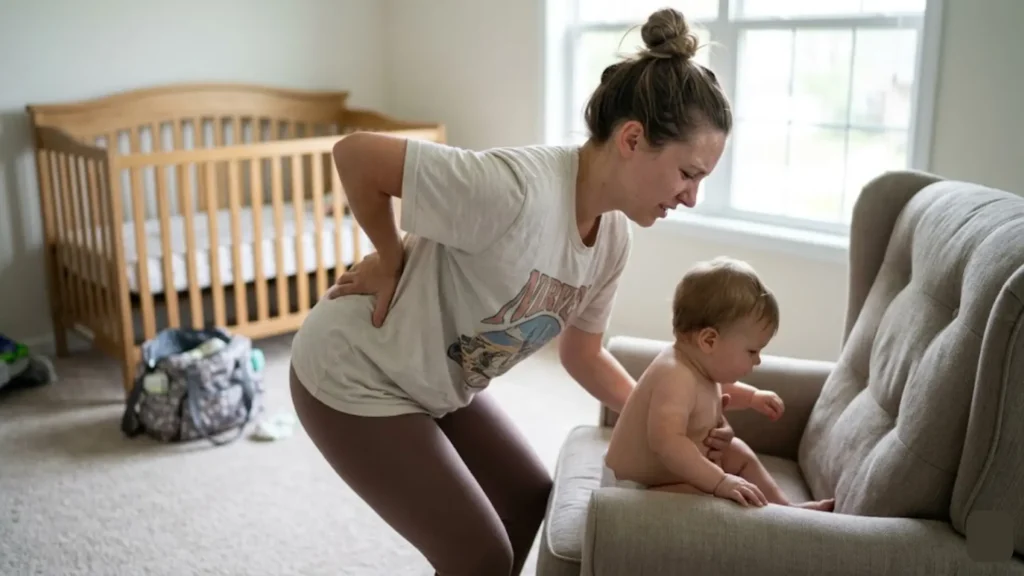
Lower back pain 1 year after a C-section can happen, but it should not be brushed off as “just part of having a baby.” Persistent pain at that stage deserves a proper musculoskeletal assessment because it is often treatable, even when it has been present for months.
That distinction matters. Something can be common without being something you should ignore. Too many women are told some version of, “Well, of course your back hurts. You had a baby.” That may be socially familiar, but it is not clinically useful.
For women dealing with persistent back pain outside the postpartum context as well, a broader breakdown of back pain causes specific to women helps clarify how overlapping factors — from pelvic mechanics to daily loading patterns — keep the problem alive.
What the problem usually is
By one year, the issue is usually not ongoing wound healing in the basic surgical sense. It is usually a load-transfer problem.
Your lower back is part of a wider system that includes the abdominal wall, diaphragm, pelvic floor, pelvis, hips, and glutes. During pregnancy, the body adapts to a growing baby, a shifting center of mass, and changing tissue tension. After a C-section, the abdominal wall has also gone through surgery. If the trunk and hips do not regain good coordination afterward, the low back often becomes the place that absorbs the extra stress.
That is why so many women say things like:
- “My scar looks fine, but my back still hurts.”
- “I feel okay until I carry my child for a while.”
- “Standing in the kitchen bothers me more than walking.”
- “The pain is worse when I get up from sitting.”
- “It flares when I bend, lift, or twist quickly.”
That pattern usually points toward a mechanical lumbopelvic problem, not a mysterious surgical failure.
The anatomy and biomechanics no one explains properly
People are often told they have “core weakness,” which sounds clear but usually explains very little. In postpartum back pain, the issue is rarely simple weakness in isolation.
What matters more is how well the following structures work together:
- the abdominal wall
- the C-section scar and surrounding fascia
- the diaphragm
- the pelvic floor
- the lumbar spine
- the pelvic ring and sacroiliac region
- the hips and glutes
If those parts are not coordinating well, ordinary daily tasks become surprisingly expensive. Rolling in bed, lifting a child from the crib, carrying a toddler on one hip, getting up from the floor, climbing stairs, pushing a stroller, or standing for a long time can all overload the low back.
This is also why the pain often feels inconsistent. A person may tolerate a workout but flare during an hour of childcare, or feel stiff after sitting but better once walking. That does not mean the pain is imaginary or random. It usually means the body’s tolerance to different types of load is uneven.
Common causes of lower back pain 1 year after a C-section
Unresolved pregnancy-related low back pain or pelvic girdle pain
Sometimes the pain did not begin because of the C-section at all. Pregnancy may have started the problem, and postpartum recovery never fully settled it. Prior low back pain and pelvic girdle pain during pregnancy are among the more established risk factors for persistent postpartum symptoms.
Women face a distinct set of anatomical and hormonal vulnerabilities that can make back pain both more likely to develop and harder to resolve — if you want a fuller picture, this guide on what causes lower back pain in females covers those contributing factors in depth.
Abdominal wall weakness or poor force transfer
This is less about doing hard ab exercises and more about pressure control, timing, and force transfer. Many women can tense their stomach hard but still do not manage load well during real tasks like lifting and carrying.
Scar-related guarding
A scar can be healed and still matter. It may alter sensation, local mobility, abdominal confidence, and how a person rotates or braces. Some women develop a subtle habit of protecting the lower abdomen, which shifts extra work into the back.
Pelvic floor dysfunction
The pelvic floor is part of the same pressure system as the diaphragm and abdominal wall. If it is weak, overactive, painful, or poorly coordinated, back pain can linger. This is especially relevant if there is leakage, heaviness, pelvic pain, or discomfort with intercourse.
Hip weakness and glute underuse
If the hips do not contribute well, the low back often tries to create movement and absorb force that should be shared elsewhere. This commonly shows up during stairs, lunges, getting out of the car, or carrying a child while walking.
Repetitive childcare loading
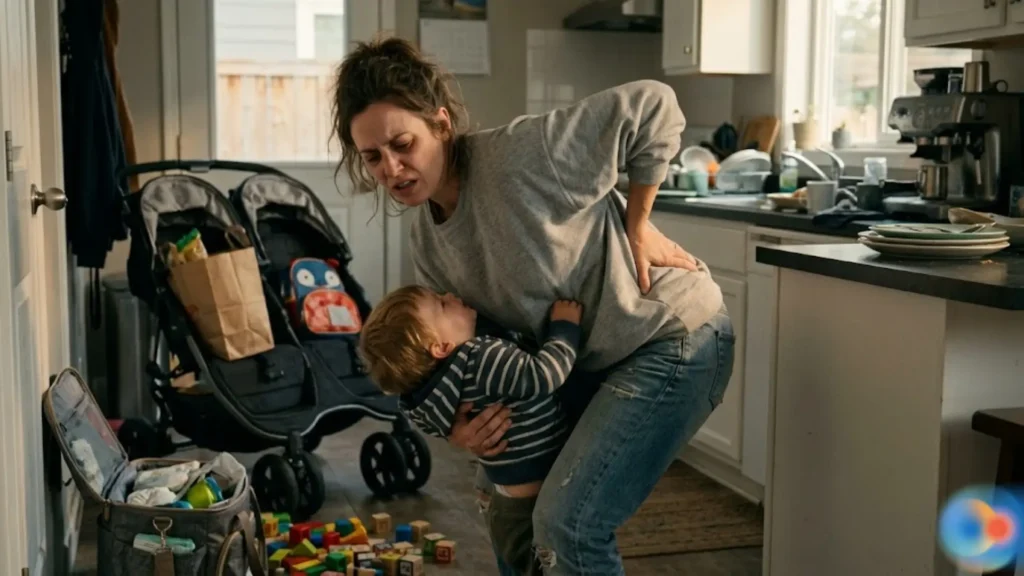
This one is underestimated constantly. A toddler is not light. Repeated bending to floor level, one-sided carrying, lifting from awkward angles, pushing strollers one-handed, and functioning while tired can keep an irritated back irritated.
Deconditioning and movement fear
If pain has been present for months, many women become more cautious, which is understandable. But when the body loses strength and the nervous system loses confidence at the same time, load tolerance drops further. Then normal activity starts to feel threatening.
A different diagnosis altogether
Not every postpartum back pain case is “weak core.” A disc problem, facet irritation, sacroiliac pain, inflammatory condition, kidney-related pain, stress injury, abdominal wall issue, or hernia can also be part of the story. That is why pattern recognition matters.
Symptom patterns that help sort it out
Pain behavior usually tells you more than the phrase “my back hurts.”
Mechanical low back pain
This often behaves like pain that is worse with bending, lifting, prolonged standing, carrying, or rising after sitting. It tends to change with position and load.
Pelvic girdle–dominant pain
This is often felt lower than the waistline, around one or both sacroiliac regions, and may be worse with rolling in bed, stairs, single-leg standing, or getting in and out of the car.
Abdominal wall or scar-related pain
This may feel like pulling, sensitivity, pressure discomfort, or pain with coughing, laughing, sudden trunk movement, or harder abdominal effort.
Nerve-related pain
This becomes more concerning when there is clear leg pain below the knee, numbness, tingling, weakness, or pain strongly aggravated by coughing or sneezing.
Red flags: when not to just stretch and hope
Most lower back pain 1 year after a C-section is mechanical, but some patterns should be assessed promptly.
Seek medical evaluation sooner if you have:
- fever, chills, or feeling systemically unwell
- unexplained weight loss
- severe night pain that is not eased by changing position
- significant trauma
- progressive leg weakness
- numbness in the saddle area
- loss of bladder or bowel control
- major abdominal swelling or a visible bulge
- severe pain that is rapidly worsening rather than fluctuating
That is not the territory for random YouTube exercises and optimism.
When imaging is and is not needed
Imaging is not automatically required just because the pain has lasted a long time. If the pattern is clearly mechanical and there are no red flags, a focused physical examination and a well-structured rehab plan are usually more useful than early MRI.
Imaging becomes more relevant when:
- symptoms are severe or progressively worsening
- there are neurological signs
- the pain pattern is atypical
- there is suspicion of hernia, stress injury, inflammatory disease, or another non-mechanical cause
- a good course of conservative care fails and the diagnosis is still unclear
That balance matters. Some people panic and want imaging for every ache. Others ignore significant pain for a year because they were told postpartum pain is “normal.” Both extremes miss the point.
Myths that keep women stuck
“It must be the epidural.”
Usually, no. Short-term soreness around an injection site can happen, but persistent back pain a year later is much more often related to pregnancy-related back pain, body-weight and load factors, trunk deconditioning, or persistent lumbopelvic dysfunction than to neuraxial anesthesia itself.
“My scar is healed, so it cannot be connected.”
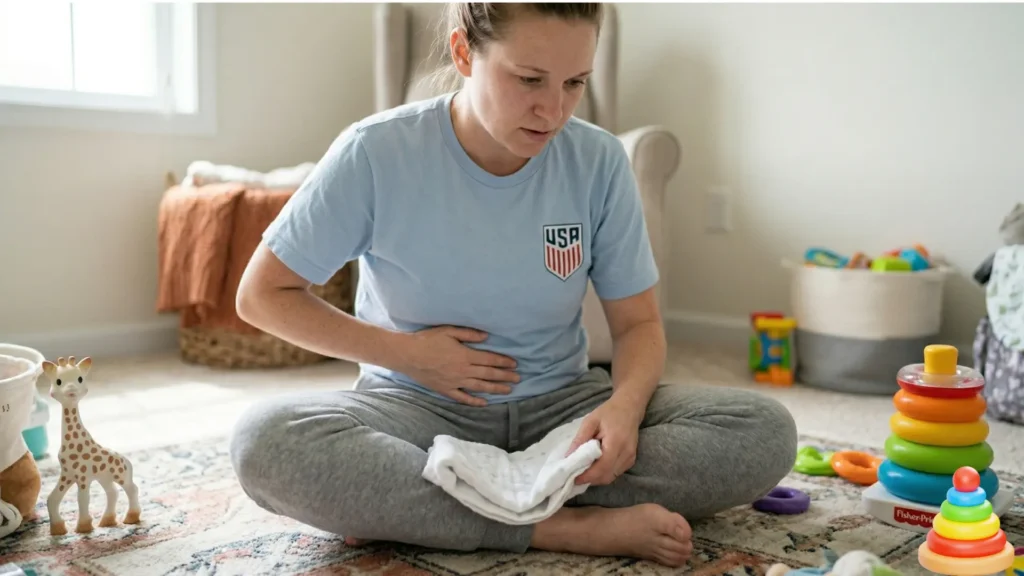
A healed scar can still influence mobility, guarding, abdominal confidence, and force transfer.
“I just need stronger abs.”
Not exactly. Many women do harder ab work and simply become better at over-bracing. The goal is not to become rigid. The goal is to restore breathing, pressure management, trunk control, hip contribution, and progressive tolerance to real-life tasks.
“Rest will fix it.”
Rest can calm a flare. It usually does not rebuild capacity. Persistent postpartum back pain typically improves more with the right progression than with prolonged avoidance.
From the Clinic: Dr. Arora’s Expert Insight
I want you to understand something before we talk about treatment. The spot where you feel the pain is not always where the problem actually lives. Your body has been compensating for a while now, and the back is just where it finally ran out of options.
What I see in most new mothers is this: you’re carrying your baby on the same side every day, your pelvis is drifting forward, your ribs are lifting slightly, and your hips have quietly stopped doing their share of the work. Your lower back has been picking up that slack. And many of you are also guarding your abdomen — holding it, protecting it — which is completely natural after pregnancy, but over time it switches off the very muscles that are supposed to be supporting you.
When you’ve been told to “strengthen your core,” that is not bad advice. But it is incomplete advice, and incomplete advice doesn’t get you better.
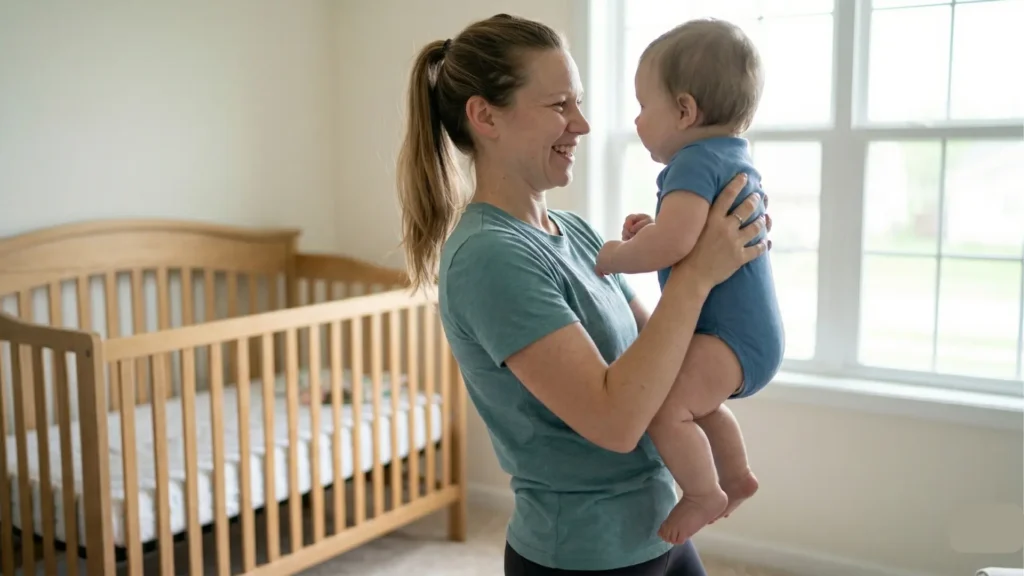
What I want for you is very practical. I want you to be able to roll over at night without dreading it. I want you to lift your baby out of the cot without bracing yourself. I want you to carry on either side, stand at the kitchen counter, get through a full day — and not pay for it the next morning.
So here is how we are going to approach this together. First, we settle down the irritated pattern your body is stuck in. Then we work on getting your breathing and your deep abdominal muscles coordinating properly again. After that, we bring your hips and glutes back into the picture. And then — step by step — we retrain the exact movements your day demands.
No guessing. No generic programs. Just a clear plan built around your life.
What to do in the next 24 to 72 hours if it is flared right now
If your back is currently flared, the aim is not heroic stretching or proving you are tough. The aim is to reduce irritation.
Useful first steps include:
- Reduce repeated painful bending for a couple of days.
- Avoid long static standing when possible.
- Bring the child close to your body before lifting.
- Switch sides when carrying instead of defaulting to one hip.
- Use a stool or one foot on a low support if kitchen standing is a trigger.
- Take short easy walks instead of one long exhausting walk.
- Use heat if it relaxes the area and feels good.
That is early management, not the whole treatment plan.
A phase-based rehab plan that usually works better
Phase 1: calm the irritation and restore control
The first phase is about making movement feel cleaner, not harder. This often includes:
- breathing work that restores rib cage and abdominal coordination
- gentle trunk activation without aggressive bracing
- pelvic floor coordination when relevant
- pain-reduced ways to roll, sit up, bend, and lift
Phase 2: rebuild strength where it matters
This usually means:
- glute strength
- hip control
- anti-rotation trunk work
- single-leg stability
- endurance for daily life, not just isolated reps
The common mistake here is choosing dramatic-looking exercises that do not transfer to life.
Phase 3: retrain real tasks
This is where rehab becomes genuinely useful:
- lifting from floor level
- lifting from crib height
- carrying on both sides
- stairs
- pushing and pulling
- getting up from the floor
- returning to gym movements gradually
Phase 4: return to exercise with progression, not impatience
Postpartum exercise is generally encouraged, but the important question is not whether you can do a workout once. It is whether you can recover from it without a flare lasting two days. A gradual return to aerobic activity and strengthening is supported in postpartum guidance, with modifications as needed.
Exercise selection logic
A good exercise plan usually follows a simple principle: choose movements that improve confidence and capacity without spiking symptoms.
That often means starting with exercises that are:
- low threat
- easy to perform with good form
- relevant to daily function
- progressive over time
It usually does not mean jumping straight into sit-ups, heavy deadlifts, or high-impact classes because the internet told you to “get your core back.”
Do’s and don’ts
Do
- treat the problem as fixable
- get assessed if the pain has clearly lingered
- retrain how you bend, lift, carry, and transition positions
- build glute, hip, and trunk endurance progressively
- screen pelvic floor symptoms if they are present
Don’t
- keep stretching aggressively just because the area feels tight
- do random postpartum workouts with no progression logic
- assume the epidural is the whole explanation
- ignore persistent pain because other people say it is normal
- compare your recovery timeline with someone else’s
Return to activity guidance
A good return to activity plan is based on symptom response, not ego.
You are probably progressing in the right direction if:
- your pain settles faster after activity
- you can do more childcare tasks before symptoms rise
- bending and lifting feel less guarded
- standing tolerance is improving
- flare-ups are becoming less intense and less frequent
You are probably progressing too fast if each upgrade in activity leaves you significantly worse for the next 24 to 48 hours.
When conservative care is not enough
Sometimes the problem is not that you need more exercise. Sometimes you need a more accurate diagnosis.
Further workup or referral becomes more reasonable when:
- pain keeps returning despite a good rehab program
- there are meaningful pelvic floor symptoms
- scar sensitivity or abdominal wall issues seem important
- symptoms look disc-related, inflammatory, or neurological
- function is still clearly limited months into structured care
When surgery may be considered
Surgery is rarely the answer for typical postpartum mechanical back pain. It becomes part of the conversation only if there is a clearly defined structural issue, significant neurological compromise, or another diagnosis that genuinely warrants it. In most cases like this, conservative care is still the main lane.
Realistic outlook
The good news is that persistent lower back pain 1 year after a C-section often improves when the actual driver is identified and treated properly. The frustrating news is that it usually does not improve with vague advice.
If your back still hurts a year after surgery, that does not mean your body is ruined or that you missed your chance to recover. It more often means that some part of the system still needs rebuilding: abdominal control, pelvic coordination, hip contribution, load tolerance, or confidence with movement. When those are addressed properly, the outlook is often much better than people fear.
FAQs
1. Can a C-section cause lower back pain a year later?
Yes, indirectly it can. The surgery can contribute through abdominal wall disruption, scar-related guarding, and altered trunk mechanics, but persistent pain is usually multifactorial rather than caused by the incision alone.
2. Is lower back pain 1 year after a C-section usually from the epidural?
No, not usually. Long-term postpartum back pain is more often linked to pregnancy-related back pain, heavier body-weight or loading factors, and persistent lumbopelvic dysfunction than to the injection itself.
3. Can diastasis recti contribute to lower back pain after a C-section?
Yes, it can contribute, but it is rarely the whole explanation. The more useful question is how well your abdominal wall manages load and pressure during daily tasks.
4. Why does my pain get worse when I carry my child on one hip?
Because that position increases asymmetrical load through the pelvis, trunk, and lower back. If your hips and trunk are not sharing load well, one-sided carrying becomes a common trigger.
5. Should I get an MRI for postpartum back pain?
Not automatically. If the pattern is mechanical and there are no red flags, a skilled examination and structured physical therapy are usually more useful first. Imaging matters more when symptoms are neurological, severe, atypical, or not improving.
6. Can pelvic floor problems cause lower back pain after a C-section?
Yes. The pelvic floor works with the abdominal wall and diaphragm, so poor coordination, weakness, overactivity, or associated pelvic symptoms can contribute to persistent back pain.
7. Will this go away on its own?
Sometimes milder cases improve, but persistent pain at one year is worth assessing properly. A targeted rehab plan is usually more effective than waiting and hoping.
Medical Disclaimer
This article is for educational purposes only and does not replace medical advice, diagnosis, or treatment. If you have severe pain, fever, trauma, progressive weakness, numbness, bladder or bowel changes, or other red-flag symptoms, seek medical care promptly.
References
- Wiezer M, Hage-Fransen MAH, Otto A, et al. Risk factors for pelvic girdle pain postpartum and pregnancy related low back pain postpartum: a systematic review and meta-analysis. Musculoskelet Sci Pract. 2020;48:102154. DOI: 10.1016/j.msksp.2020.102154. PubMed:
- Komatsu R, Carvalho B, Flood P. Factors associated with persistent pain after childbirth: a narrative review. Br J Anaesth. 2020;124(3):e117-e130. PubMed: